

Netball
Quick Hands Passing Circuit: Building Speed, Accuracy and Court Vision
A high-intensity passing circuit that sharpens ball speed, hand–eye coordination and decision-making across all court thirds — ready to run in your next session.

What you need
netballs (2-4), cones or markers (12-16), bibs in two contrasting colours, whistle, stopwatch or interval timer
Overview
The Quick Hands Passing Circuit is a structured, multi-station drill designed to develop rapid ball movement, clean catching technique, and the kind of instinctive decision-making that separates composed teams from hesitant ones. At its core, the drill forces players to receive and release the ball under time pressure, replicating the tempo demands of elite-level netball where the ball must travel the full 30.5 m court in four passes or fewer.
Use this drill as a warm-up activator in the first 10–15 minutes of a session, or as a skill-focus block mid-session when your team is struggling to move the ball quickly through congested channels. It is equally effective as a fitness-with-ball conditioning tool in pre-season, where you can extend work periods and shorten rest intervals to build aerobic capacity alongside technical skill.
The circuit is built around the principle that quality repetitions at pace produce faster neural adaptation than slow, careful practice. Players should feel slightly uncomfortable with the speed of the drill — that discomfort is where the growth happens.
Setup
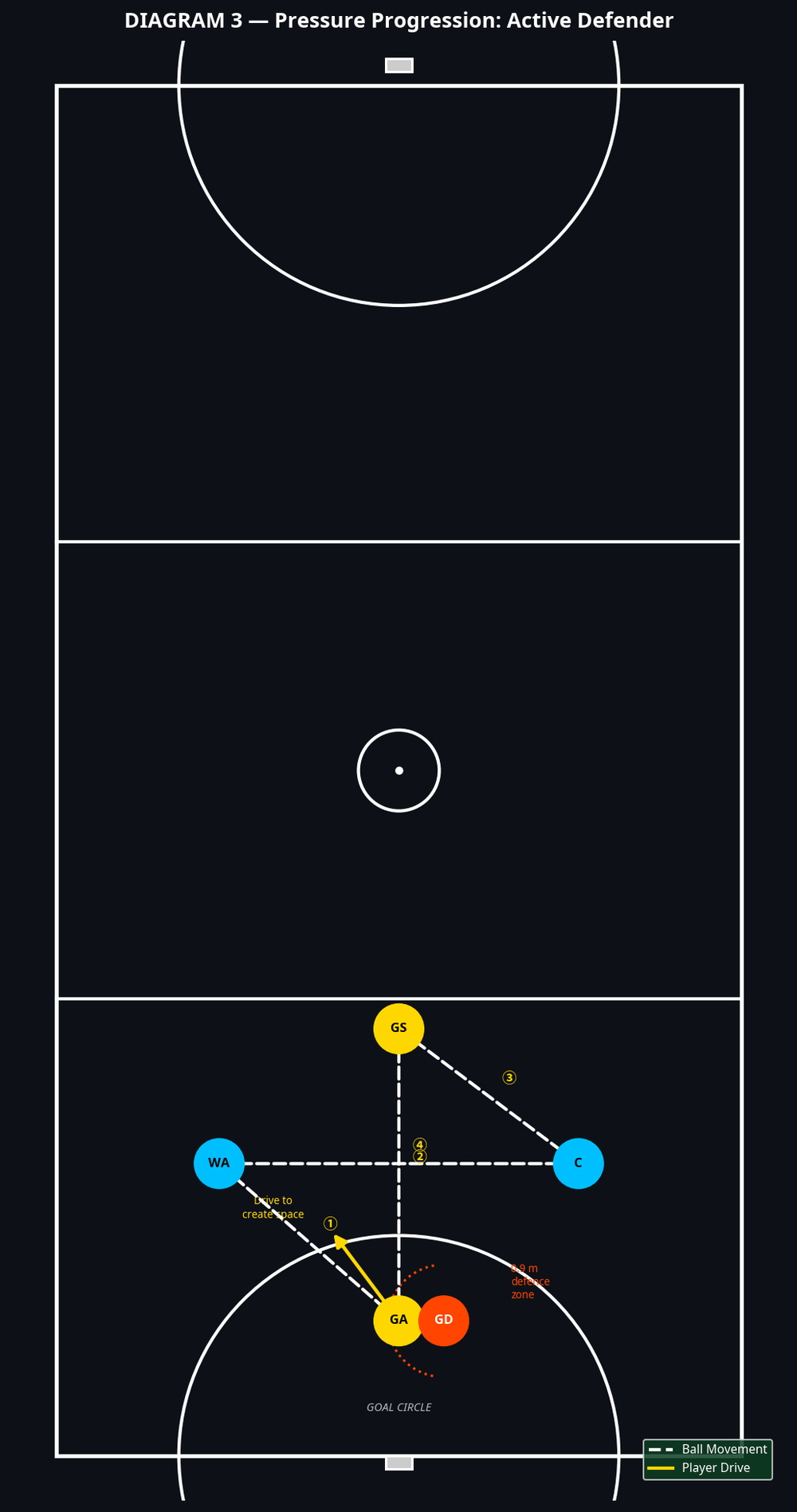
Court area: Use one full third (10.17 m × 15.25 m) per station, or run two simultaneous stations in the attacking and defending thirds while the centre third remains clear. For larger squads, a full-court version using all three thirds is described in the progressions.
Players required: 8–12 players (minimum 4 per station). Ideal squad size is 10, giving 5 players per station.
Equipment needed:
- 2–4 netballs (one per station, plus spares)
- Cones or markers (12–16 total) to define station boundaries and player start positions
- Bibs in two contrasting colours to differentiate attack and defence groups
- Whistle for timing intervals
- Optional: stopwatch or interval timer app for precise work/rest periods
Player positions used: Goal Shooter (GS), Goal Attack (GA), Wing Attack (WA), Centre (C), Wing Defence (WD), Goal Defence (GD), Goal Keeper (GK)
Station layout (as shown in Diagram 1):
Set up two identical diamond-shaped stations — one in the attacking third and one in the defending third. Within each diamond, place five cones at the following positions relative to the centre of the third:
| Cone | Position | Distance from centre cone |
|---|---|---|
| P1 (Feeder) | Baseline / goal-line end | 8.5 m |
| P2 (Left Wing) | Left sideline, mid-third | 5.5 m diagonal |
| P3 (Right Wing) | Right sideline, mid-third | 5.5 m diagonal |
| P4 (Centre Link) | Middle of third | 3.5 m from third line |
| P5 (Outlet) | Third-line edge | 1.0 m inside third line |
Players stand at their cone. The ball starts with P1 (the Feeder).
Step-by-Step Instructions

Assign players to stations. Split your squad evenly between Station A (attacking third) and Station B (defending third). Number players P1 through P5 at each station. If you have a 10-player squad, all positions are filled simultaneously.
Establish the passing sequence. The ball travels in a fixed diamond pattern: P1 → P2 → P4 → P3 → P5, then P5 sprints back to the P1 position to restart. This creates a continuous circuit. Communicate this sequence clearly before the drill begins — walk through it once at half-speed.
Set the tempo. On your whistle, P1 delivers a sharp two-handed chest pass to P2. The rule is non-negotiable: the ball must leave the hands within 1 second of being caught. Use a verbal cue such as "catch–pass" to reinforce the rhythm.
Enforce footwork rules. Players must land on one foot and pivot correctly before releasing. No player may hold the ball and run. Call any footwork infringement immediately and restart the sequence from the previous pass — this keeps the drill honest and game-realistic.
Run the circuit for 90 seconds, then rotate. After 90 seconds, blow the whistle. Each player rotates one position clockwise (P1 → P2 → P3 → P4 → P5 → P1). This ensures every player experiences every role — the feeder, the wing receiver, the link player, and the outlet.
Complete five rotations so every player has occupied every position. Total active time per station: approximately 7.5 minutes. Rest between rotations is the time taken to rotate (approximately 15–20 seconds).
Debrief between rotations. Use the rotation pause to deliver one specific coaching point. Keep it to a single sentence — for example, "I want to see your hands up and ready before the ball arrives." Avoid overloading players with information mid-drill.
W-Pattern Progression
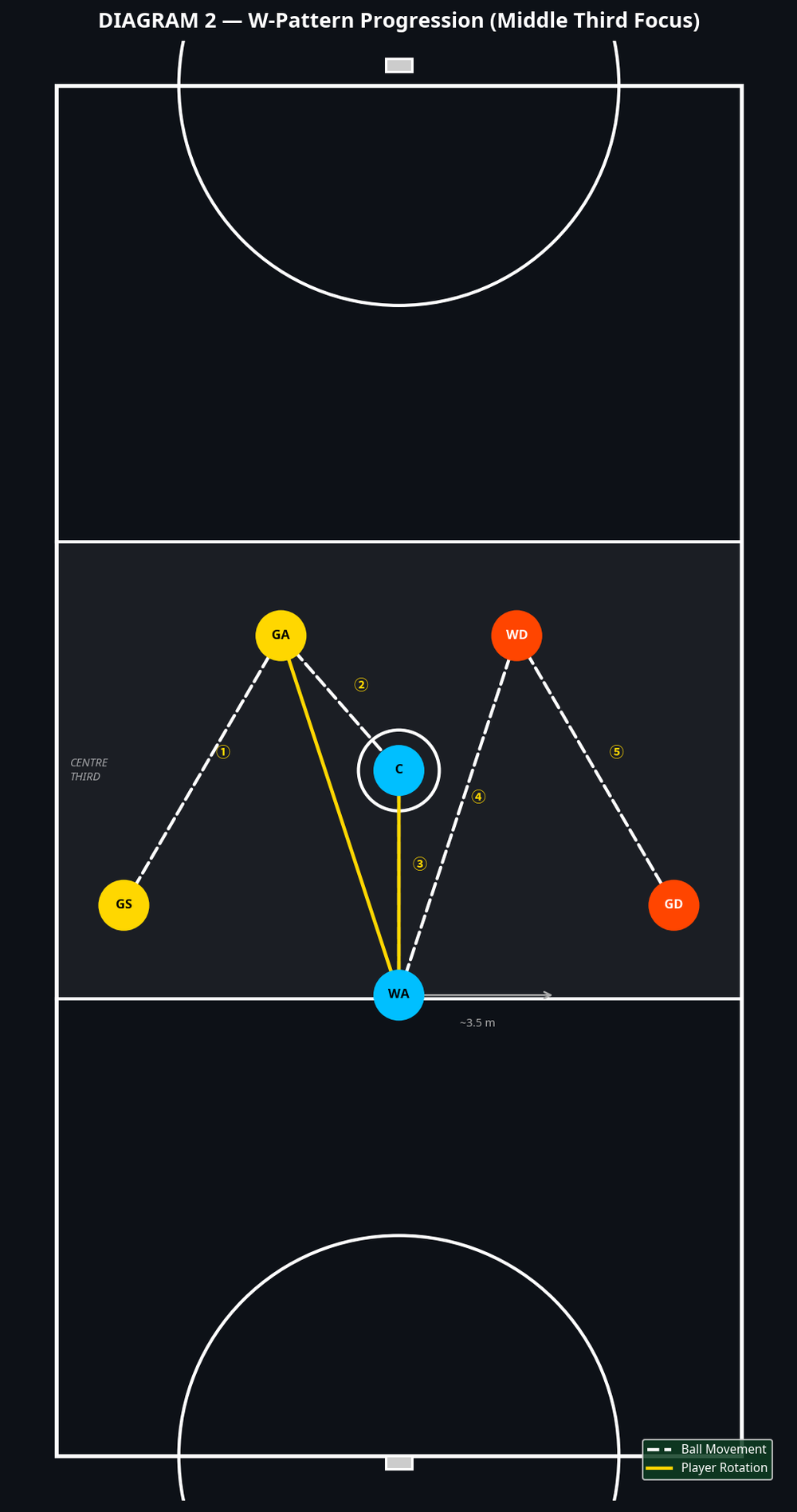

Once players are comfortable with the basic diamond circuit, introduce the W-Pattern Progression shown in Diagram 2. This variant uses all six standard court positions (GS, GA, C, WA, WD, GD) spread across the full width of the centre third. The ball travels in a W-shaped path — low left, high left-centre, low centre, high right-centre, low right — mimicking the lateral ball movement used to shift a defensive line during a real game.
The key coaching emphasis in this progression is width. Players must hold their wide positions and resist the natural tendency to drift inward. The numbered pass sequence (① through ⑤) is shown in the diagram. After the fifth pass, the player at GD position returns the ball to GS and the sequence restarts.
Pressure Progression: Active Defender
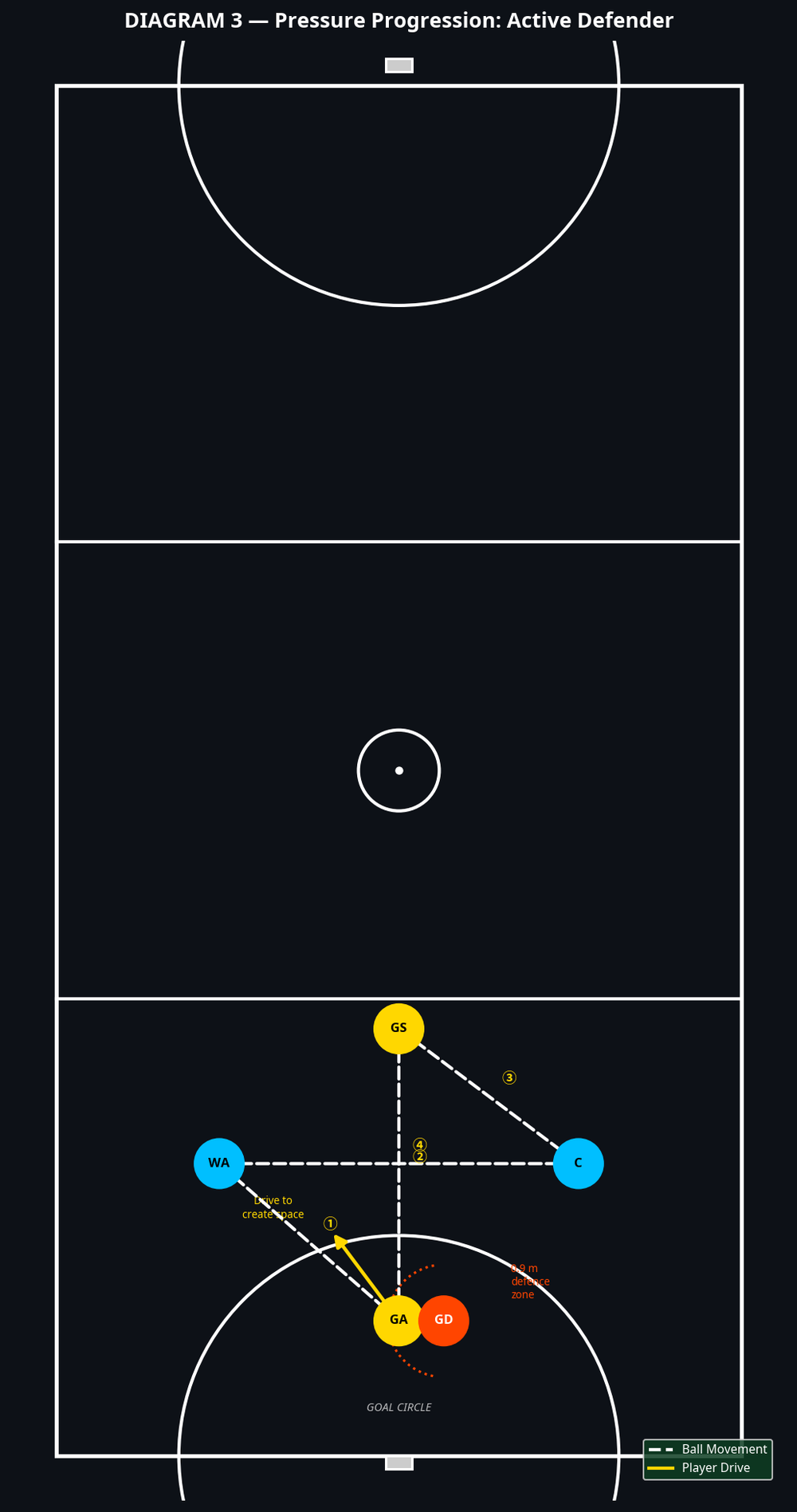
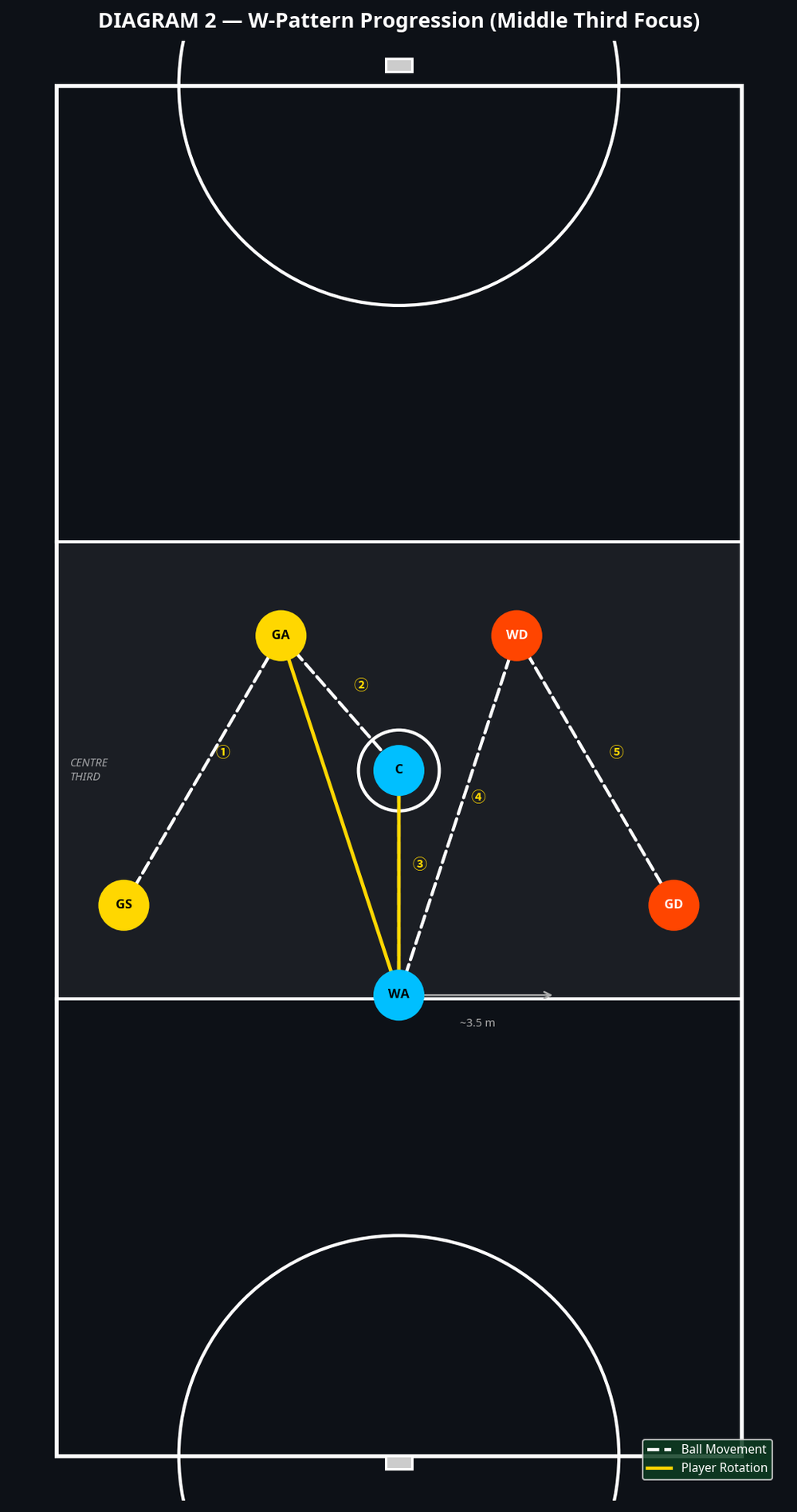
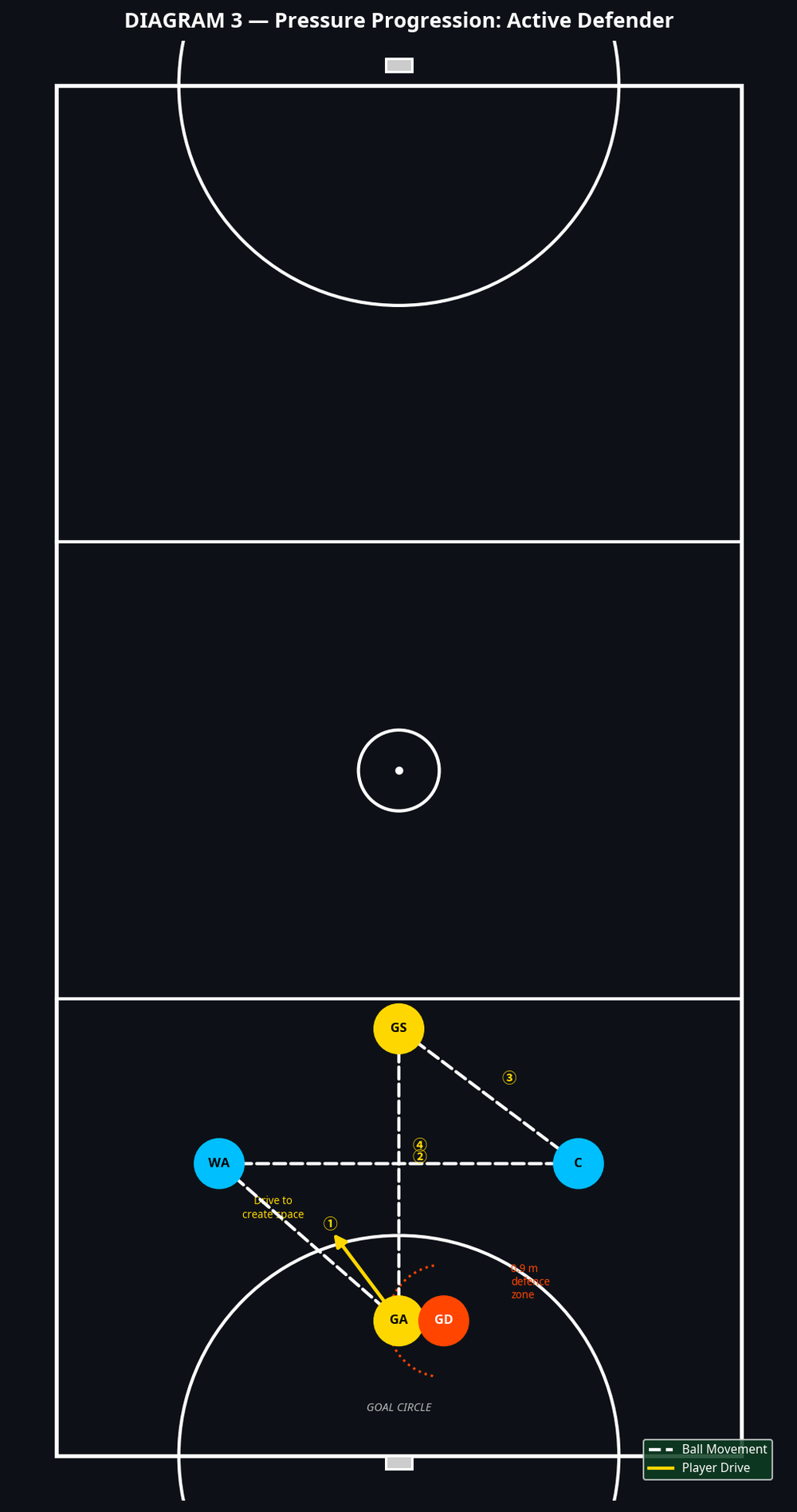
Diagram 3 illustrates the most advanced version of this circuit. A single active defender (GD) is introduced into the attacking third station, marking the GA player. The attacking group (GA, GS, WA, C) must now move the ball around the defender, with GA required to drive away from the defender before presenting for the ball — exactly as they would in a live game situation.
The 0.9 m defensive distance rule is strictly enforced. This progression bridges the gap between closed-skill practice and game-realistic decision-making.
Key Coaching Points

The following four coaching points should be introduced progressively across the circuit rotations. Introduce one per rotation rather than all at once.
1. Hands up early, eyes on the ball. The single most common cause of a dropped ball is late hand preparation. Receivers must present both hands — fingers spread, thumbs pointing toward each other — before the pass is released. Cue: "Show me your hands before the ball leaves their hands."
2. Pass to space, not to the player. Encourage passers to deliver the ball slightly ahead of a moving receiver, or to the side away from an imaginary defender. A flat, direct pass to the chest is a starting point, but players should quickly progress to leading passes that reward movement.
3. Land, pivot, release — in that order. Footwork discipline under time pressure is where most players break down. Insist on a clean landing before any pivot, and a deliberate pivot before the pass. Rushing the footwork creates turnovers; disciplined footwork creates composure.
4. Call for the ball. Communication is a skill, not a personality trait. Every player who wants the ball must call loudly and clearly. Introduce a rule: if you don't call, you don't receive. This immediately lifts the noise level and replicates the communication demands of a real game.
5. Follow your pass. After releasing the ball, the passer should immediately move to a new position — either to support the next pass or to clear space. Static passers create congestion. Dynamic passers create options.
6. Reset your body between passes. Between receiving and passing, players should take a half-second to reset their balance and scan the court. This "micro-reset" prevents rushed, off-balance passes and builds the habit of composure under pressure.
Common Mistakes

Every coach running this drill for the first time will encounter the same cluster of errors. Recognising them early allows you to intervene before they become ingrained habits.
Mistake 1 — Catching with the body, not the hands. Players who are anxious about dropping the ball will pull it into their chest rather than catching it cleanly with extended hands. This slows the release significantly. Correction: have the player stand 2 m from a wall and practise catching and releasing against the wall for 30 seconds before rejoining the circuit.
Mistake 2 — Holding the ball too long. Players who are uncertain about where to pass next will hold the ball while they think. This stalls the entire circuit. Correction: introduce a 1-second rule with a loud verbal count from the coach. The time pressure forces players to pre-scan before they receive.
Mistake 3 — Passing across the body. Players under pressure often release the ball across their own body, creating a weak, inaccurate pass that drifts wide. Correction: cue players to "pass through the target" — their hands should finish pointing directly at the receiver's chest, not across their own midline.
Mistake 4 — Flat-footed receiving. Stationary receivers are easy to intercept in a game. In the circuit, flat-footed receiving signals a player who is not mentally engaged. Correction: require every receiver to take one small lead step toward the ball before catching. This builds the habit of active receiving.
Mistake 5 — Ignoring the rotation. Players who enjoy a particular position (usually the feeder role) will subtly resist rotating. Enforce the rotation strictly. Every player must experience every role — the discipline of rotation is itself a coaching lesson about team adaptability.
Variations and Progressions
Variation 1 — Bounce Pass Only. Restrict all passes in the circuit to bounce passes. This slows the drill slightly but demands far greater accuracy of release angle and force. It is particularly effective for developing the bounce pass through a defensive channel — a critical skill for feeding the goal circle.
Variation 2 — One-Handed Receive and Release. For advanced players, require them to catch with two hands but release with one (dominant hand only). This builds wrist and forearm strength and develops the quick single-handed release used when space is limited.
Progression 1 — Full-Court Circuit. Connect Station A and Station B by adding a centre-third relay: P5 from Station A passes to P1 of Station B, and vice versa. This creates a continuous full-court circuit (30.5 m) that replicates the length of a real attacking passage of play. Aim for the ball to travel the full court in under 8 seconds.
Progression 2 — Timed Competition. Count the number of complete circuits (P1 → P5 and back) each station achieves in 2 minutes. Record the score and challenge players to beat it in the next rotation. Introducing competition elevates intensity and mirrors the pressure of a close game.
Age Adaptations

| Age Group | Key Modifications |
|---|---|
| Under 8 / Under 10 | Reduce the diamond to 3 players (P1, P2, P3 only). Use a softer, lighter ball. Allow 3 seconds to pass. Focus solely on two-handed chest pass and correct catching technique. No rotation pressure — let players find their rhythm first. |
| Under 12 | Use the full 5-player diamond but reduce the third-line distance to 7 m (rather than the full 10.17 m). Introduce the 1-second pass rule only in the final rotation. Emphasise footwork and hand preparation over speed. |
| Under 14 / Under 16 | Run the drill as written. Introduce the W-Pattern Progression in the second half of the session. Add the bounce-pass variation for one rotation. Begin to introduce verbal communication requirements. |
| Open / Senior | Run the full-court circuit with the active defender progression. Introduce the timed competition format. Reduce rest intervals to 10 seconds between rotations. Expect and demand game-speed execution from the first whistle. |
This drill is immediately usable in your next training session. Print this resource, mark your cones the night before, and brief your players on the passing sequence before you step onto the court. The first time you run it, walk through the sequence at half-speed. By the third rotation, your players will be moving the ball with a sharpness that carries directly into your next game.
