

Netball
The Pressure Cooker: 1v1 to 2v2 Defensive Marking Drill
A high-intensity, three-phase defensive drill that builds relentless 1v1 shadow marking skills and escalates into a 2v2 overload scenario, teaching defenders to dictate space, communicate under pressure, and deny clean ball delivery into the attacking circle.
What you need
1 Netball, 4-6 marker cones, Bibs in 2 contrasting colours
Overview
The 'Pressure Cooker' is a foundational defensive drill designed to teach players how to apply relentless, continuous marking pressure. In modern Netball, passive defending is easily exposed. This drill focuses on the core mechanics of 1v1 shadow marking, forcing the attacker into less desirable court spaces, and ultimately progressing into a 2v2 overload scenario where defenders must communicate and make split-second decisions.
Use this drill when your team is struggling to maintain close proximity to their direct opponents, or when attackers are too easily finding space in the centre channel. It is particularly effective for Goal Defences (GD), Wing Defences (WD), and Goal Keepers (GK), but all players benefit from mastering these fundamental 1v1 skills.
Setup
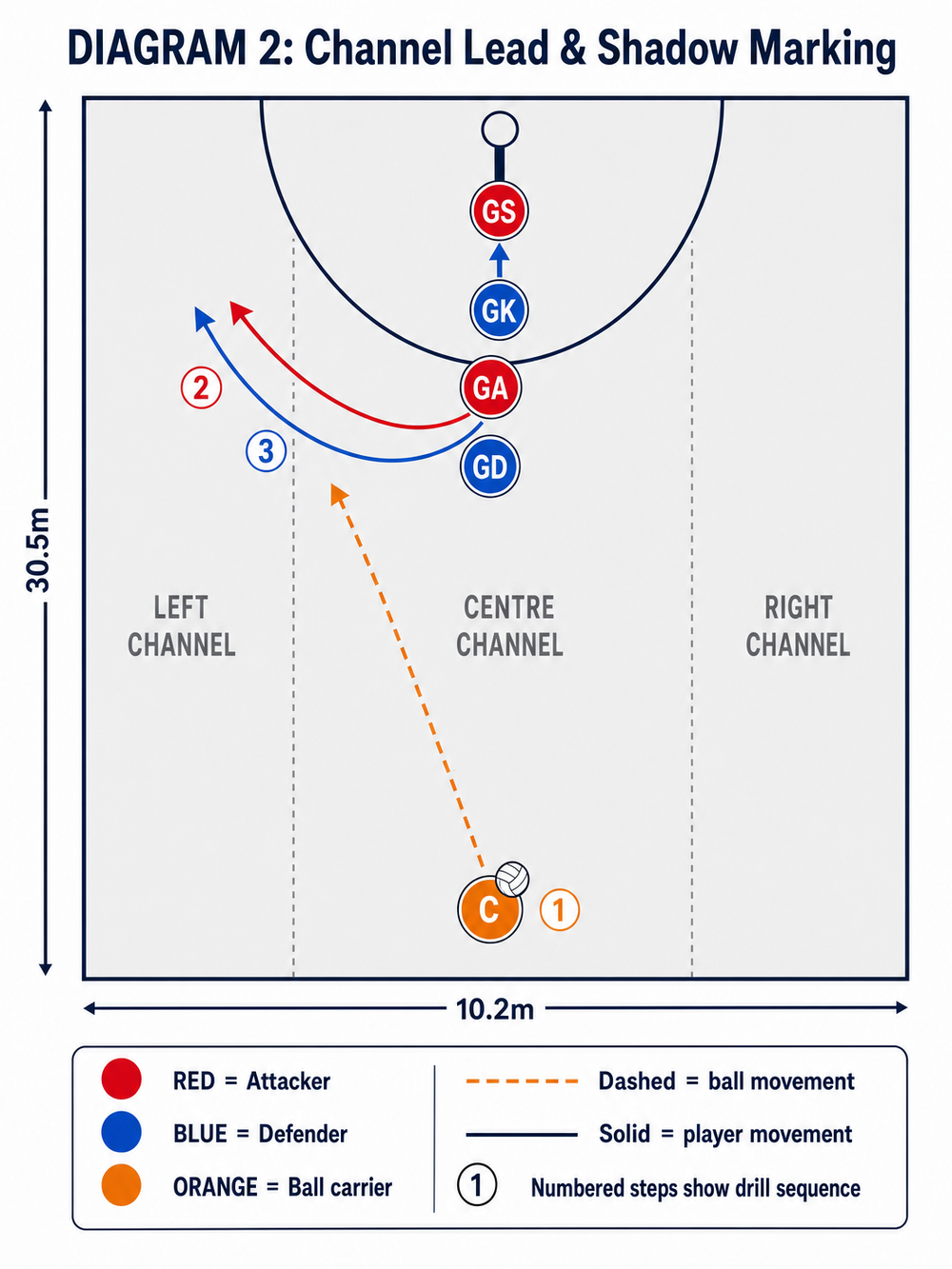
Court Area: Attacking third (30.5m x 10.2m) down to the goal circle.
Players: Minimum of 4 (1 Ball Carrier, 1 Attacker, 1 Defender, 1 additional player for progressions). Optimal group size is 6–8 to allow for quick rotations.
Equipment: 1 Netball, 4–6 marker cones, bibs in two contrasting colours.
Initial Positioning:
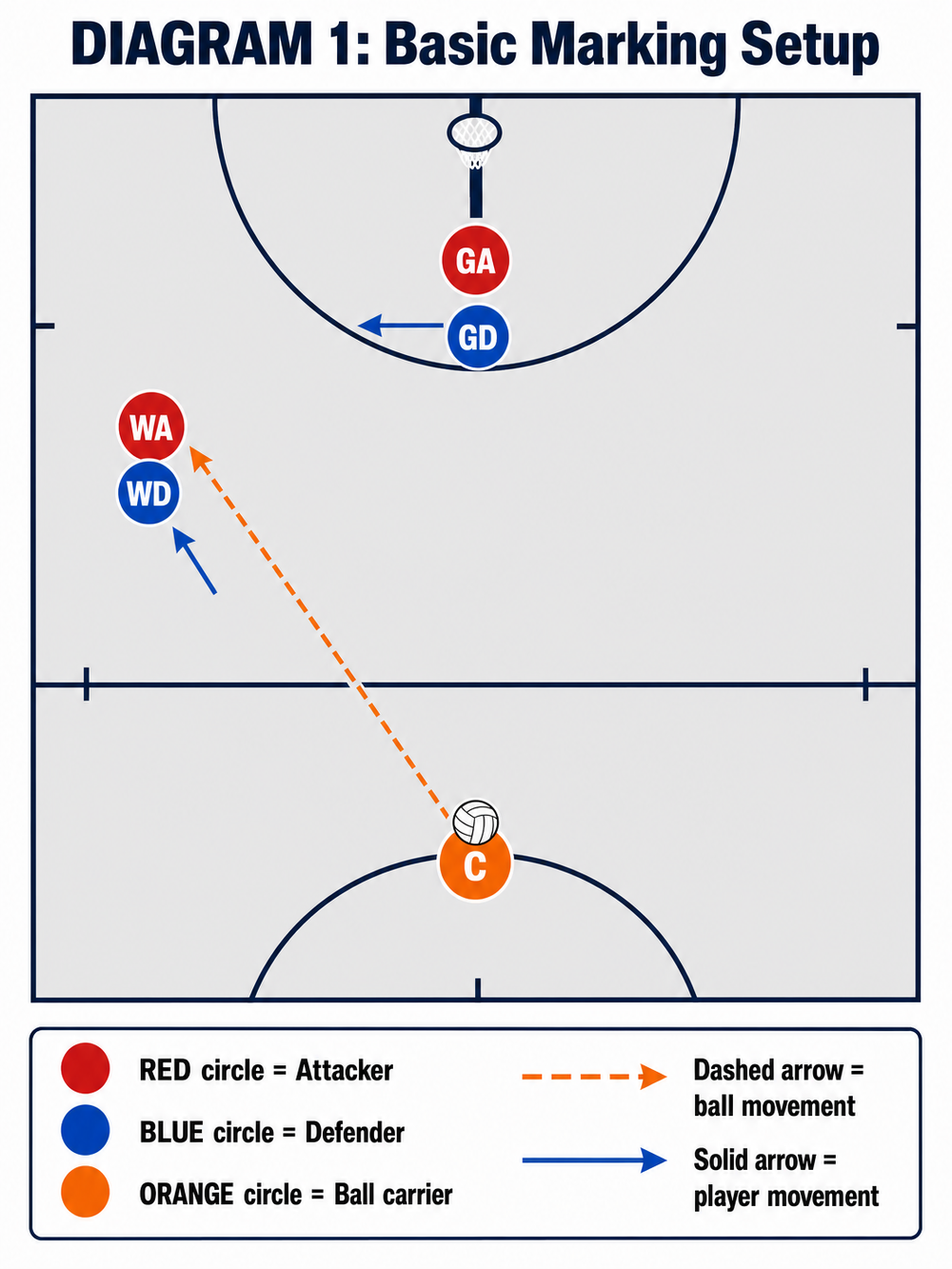
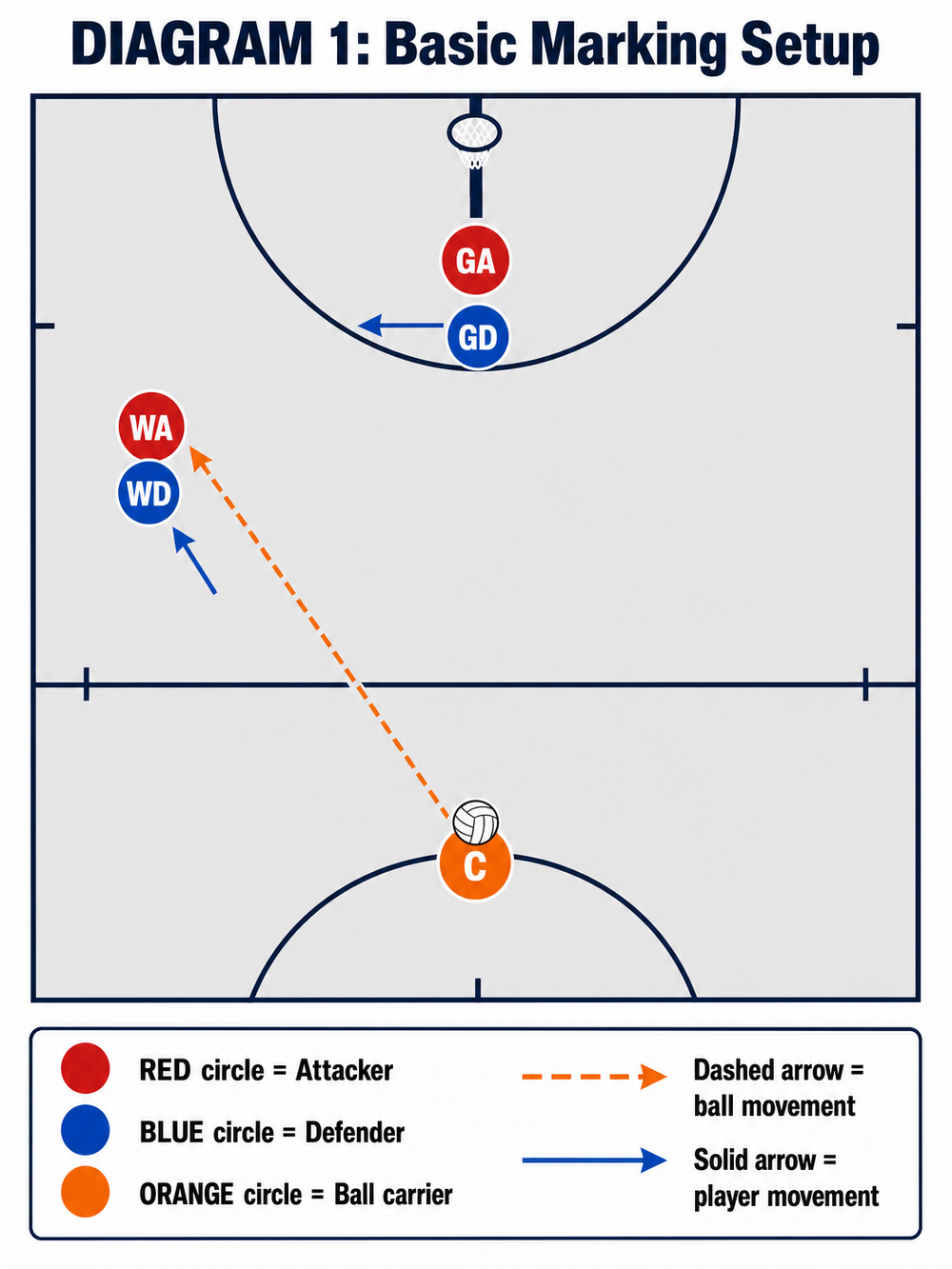
- Place the Ball Carrier (C) stationary at the transverse line.
- Position the Attacker (GA) just outside the top of the goal circle, approximately 5m from the circle edge.
- Position the Defender (GD) exactly 0.9m in front of the Attacker, slightly angled to dictate the attacker's drive toward the sideline.
Step-by-Step Instructions
Phase 1 — The Shadow (1v1)
- The Trigger: The Ball Carrier (C) holds the ball aloft. This is the cue for the Attacker (GA) to initiate their movement.
- The Drive: The GA attempts to make a strong lead towards the ball carrier, utilising dodges, rolls, or straight sprints across the width of the third.
- The Shadow: The Defender (GD) must maintain a 0.9m distance, using fast, small footwork to mirror the GA's movements. The goal at this stage is not to intercept, but to deny the straight-line pass and force the GA wide.
- The Reset: After 5 seconds of continuous movement, the coach blows the whistle. Players reset to starting positions. Rotate roles after every 3 repetitions so all players experience both attacking and defending.
Phase 2 — The Channel Force
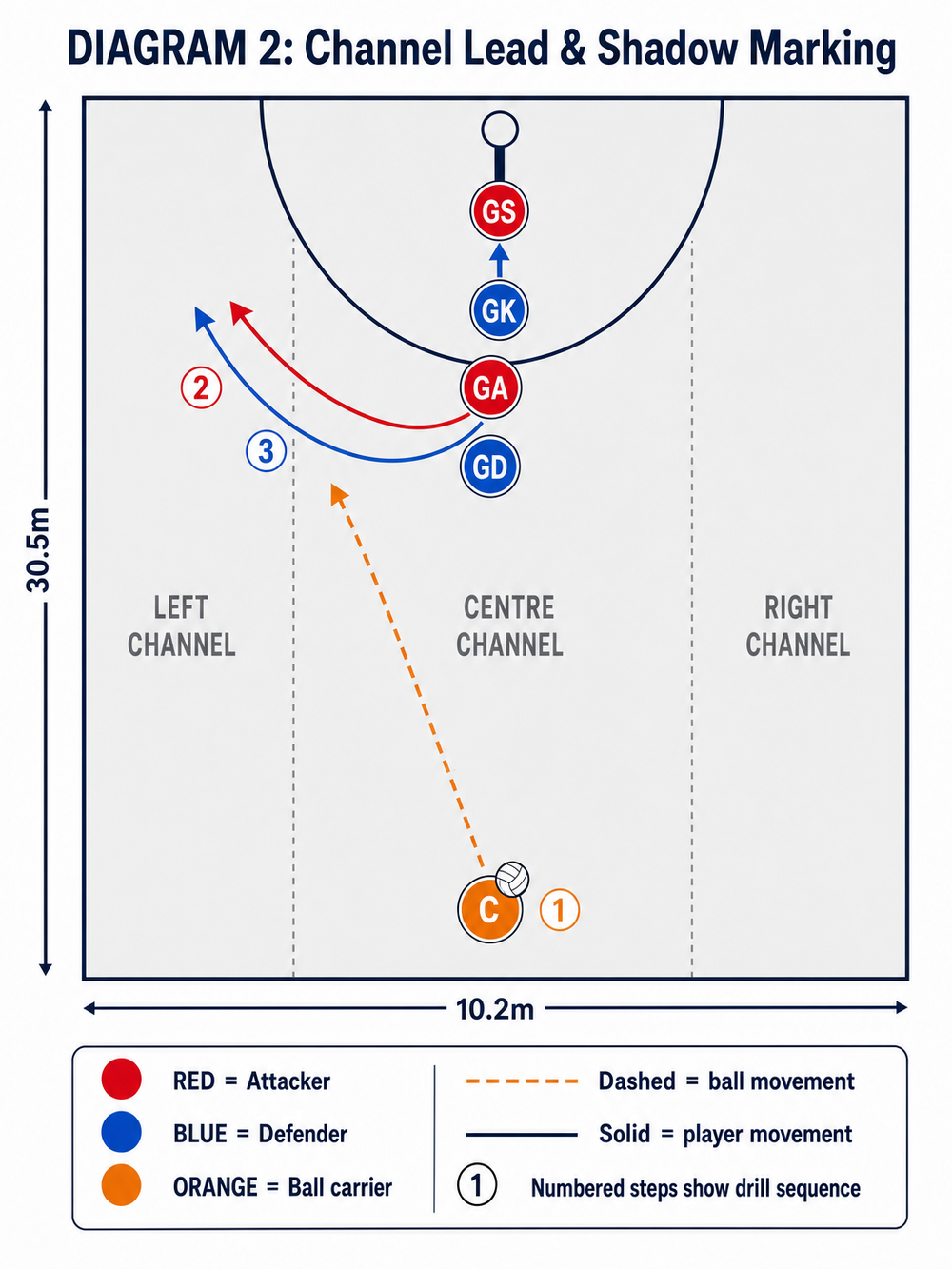
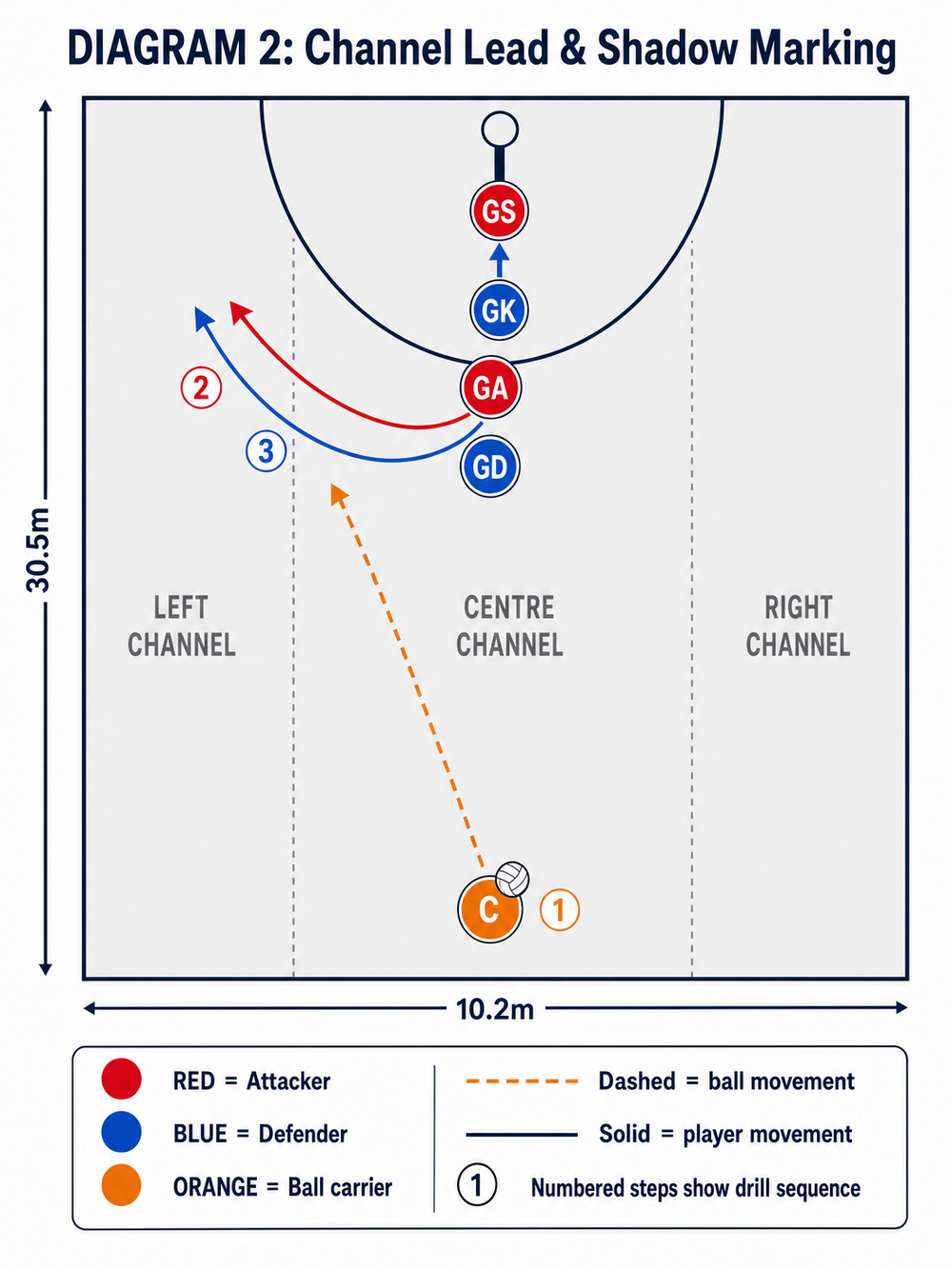
- Setup: Divide the attacking third into three vertical channels using flat marker cones: Left Channel, Centre Channel, and Right Channel (each approximately 5m wide).
- Execution: The GA again attempts to lead for the ball. The GD's objective is now specific: force the GA out of the highly dangerous Centre Channel and into either the Left or Right Channel.
- Body Angle: The GD achieves this by angling their hips toward the sideline they want to force the attacker towards, and staying slightly ahead of the attacker's leading shoulder to cut off the direct path.
- The Pass: Once the GA is forced into a wide channel, the C delivers the pass. The GD then attempts a clean interception or a tip to disrupt the catch.
Phase 3 — The 2v2 Overload
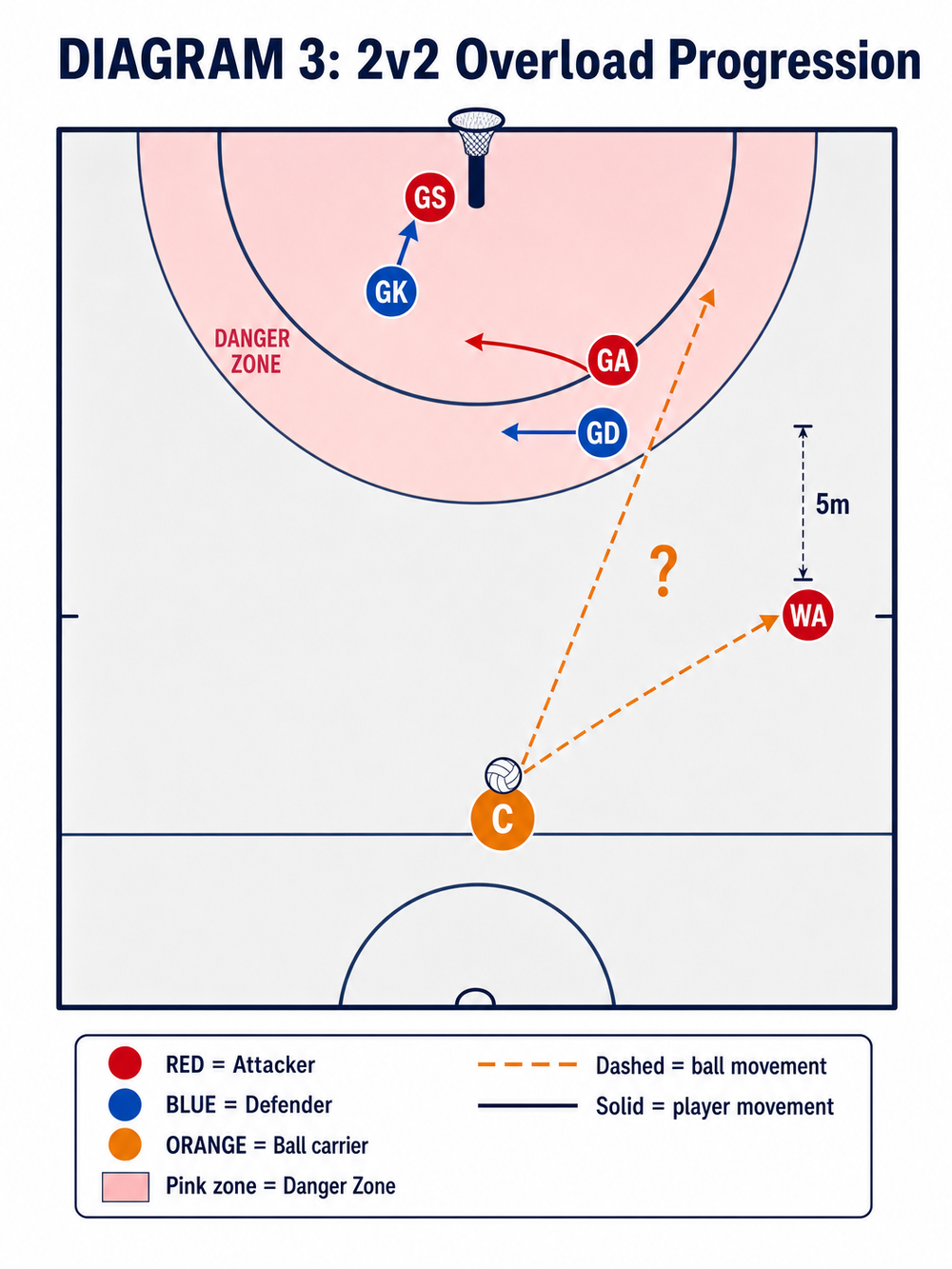
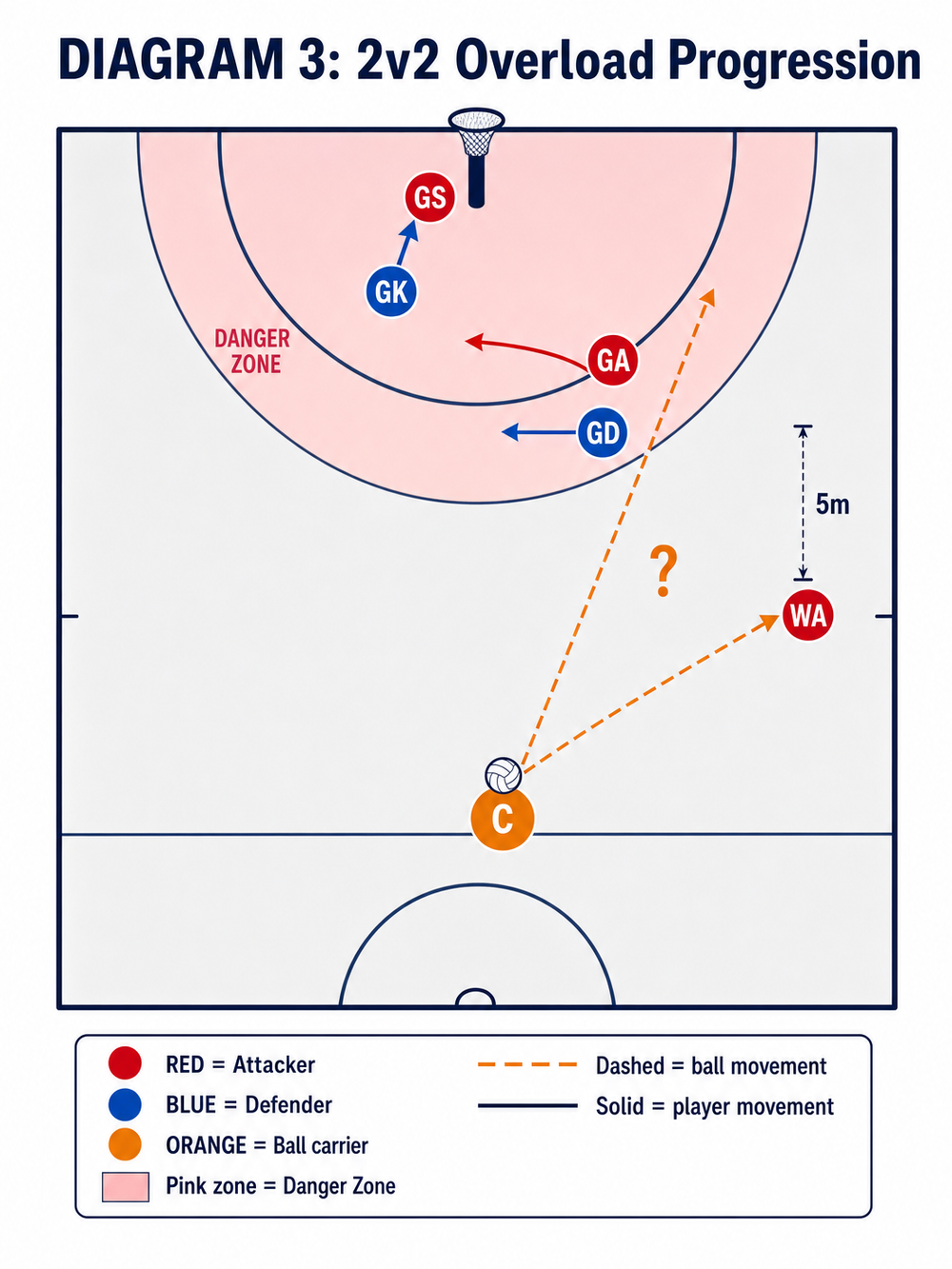
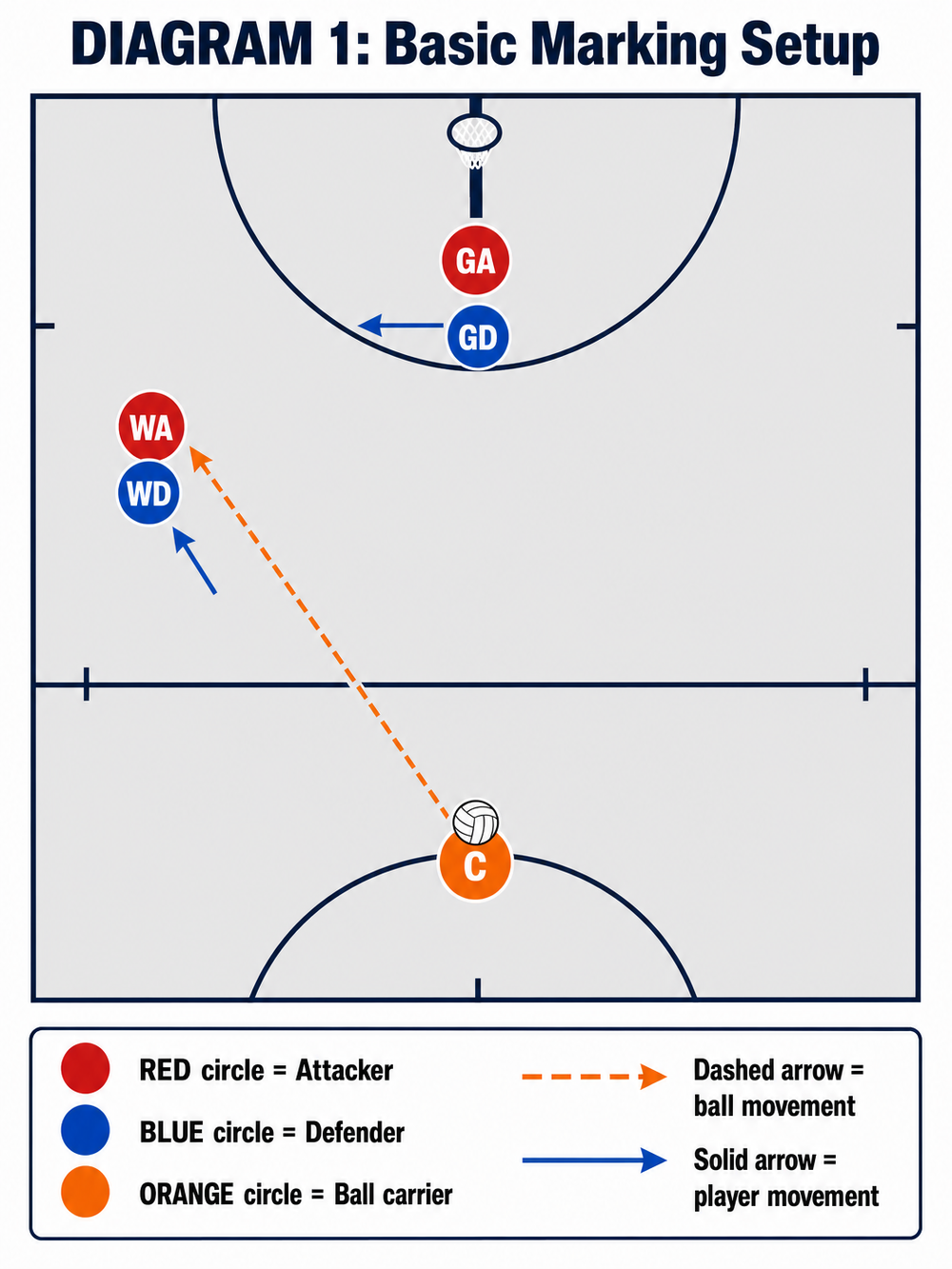
- Setup: Introduce a second Attacker (WA) on the right wing and a second Defender (WD) marking them. The Ball Carrier (C) now holds two passing options.
- The Dilemma: The C can pass to either the GA or the WA. The GD and WD must communicate loudly and continuously, calling out the ball carrier's eyes and body position to anticipate which pass is coming.
- Switching: If the GA and WA cross paths or set a screen, the defenders must decide instantly whether to stay with their original player or call a 'switch' to maintain optimal goal-side positioning.
- Scoring: Award one point to the defence for every clean interception or forced turnover. Award one point to the attack for every clean catch inside the goal circle. First to five points wins the round.
Key Coaching Points
- Footwork is Everything. Defenders must use fast, small, pitter-patter steps. Long strides lead to being off-balance and easily beaten by a quick change of direction. Think 'quick feet, low hips'.
- Split Vision. The defender should not fixate solely on the attacker. They need peripheral awareness — seeing both the attacker's chest and hips and the ball carrier simultaneously.
- The 0.9m Rule. Emphasise maintaining the legal 0.9m distance at all times. Getting too close invites a contact or obstruction penalty; getting too far away removes all defensive pressure.
- Dictate, Don't React. Elite defenders do not simply follow the attacker wherever they choose to run. They use body positioning and angling to dictate where the attacker is allowed to go.
- Loud Communication. In the 2v2 progression, silence is the enemy. Defenders must call 'Mine!', 'Switch!', or 'Left/Right' early and clearly. If both defenders go for the same player, a gap opens immediately.
Common Mistakes
- Head Turning. The defender completely turns their head to look at the ball, losing sight of the attacker who then easily cuts behind them. Reinforce split vision constantly.
- Flat-Footed Stance. Defending with heels on the ground makes explosive lateral movement impossible. Players must be on the balls of their feet, knees slightly bent, ready to explode in any direction.
- Reaching In. Instead of moving their feet to maintain position, the defender reaches in with their arms, resulting in a contact penalty. The mantra is: 'feet first, hands second'.
- Following the Feint. The defender commits their full body weight to the attacker's initial dodge, rather than holding their ground and waiting for the true drive to develop. Teach defenders to read the hips, not the head or shoulders.
- Losing Goal-Side Position. After being beaten on a lead, the defender trails behind the attacker rather than recovering to a goal-side position. Emphasise that goal-side is always the priority.
Variations & Progressions
- The 3-Second Pressure Rule. Restrict the Ball Carrier to holding the ball for only 3 seconds. This forces attackers to work harder and faster to get free, and demands that defenders maintain intense pressure during a condensed time frame.
- Into the Circle. Progress the drill into the goal circle. Once the GA receives the ball, they immediately turn to shoot, and the GD must transition seamlessly from marking the drive to defending the shot — hands raised directly over the ball within the legal 0.9m distance.
- The Blind Start. The defender starts facing away from the attacker with their hands on their knees. On the whistle, they must turn, locate the attacker, close the 0.9m distance, and begin marking — all before the attacker receives the first pass. This simulates a turnover situation in a game.
Age Adaptations
| Age Group | Focus | Key Modification |
|---|---|---|
| Under 8s / Under 10s | Phase 1 only — The Shadow | Remove the ball entirely. Play 'mirror' or 'shadow tag' to develop footwork and the concept of staying close. Use a larger, softer ball when introduced. |
| Under 12s / Under 14s | Phase 1 and Phase 2 — Channel Force | Introduce body angling and dictating space. Ensure players understand why the centre channel is the most dangerous area. |
| Under 16s / Open | All three phases, full intensity | Focus on high-speed decision making in the 2v2 overload. Demand relentless intensity and flawless communication. Introduce complex attacking screens and rolls for defenders to navigate. |
