Basketball
Drill
intermediate
under 14
Pressure Free Throw Routine: From Line to Live Action
Transform your team's free throw percentage by practicing under pressure and seamlessly transitioning into live game situations.
Jul 8, 20264 min read15 min drill6 players
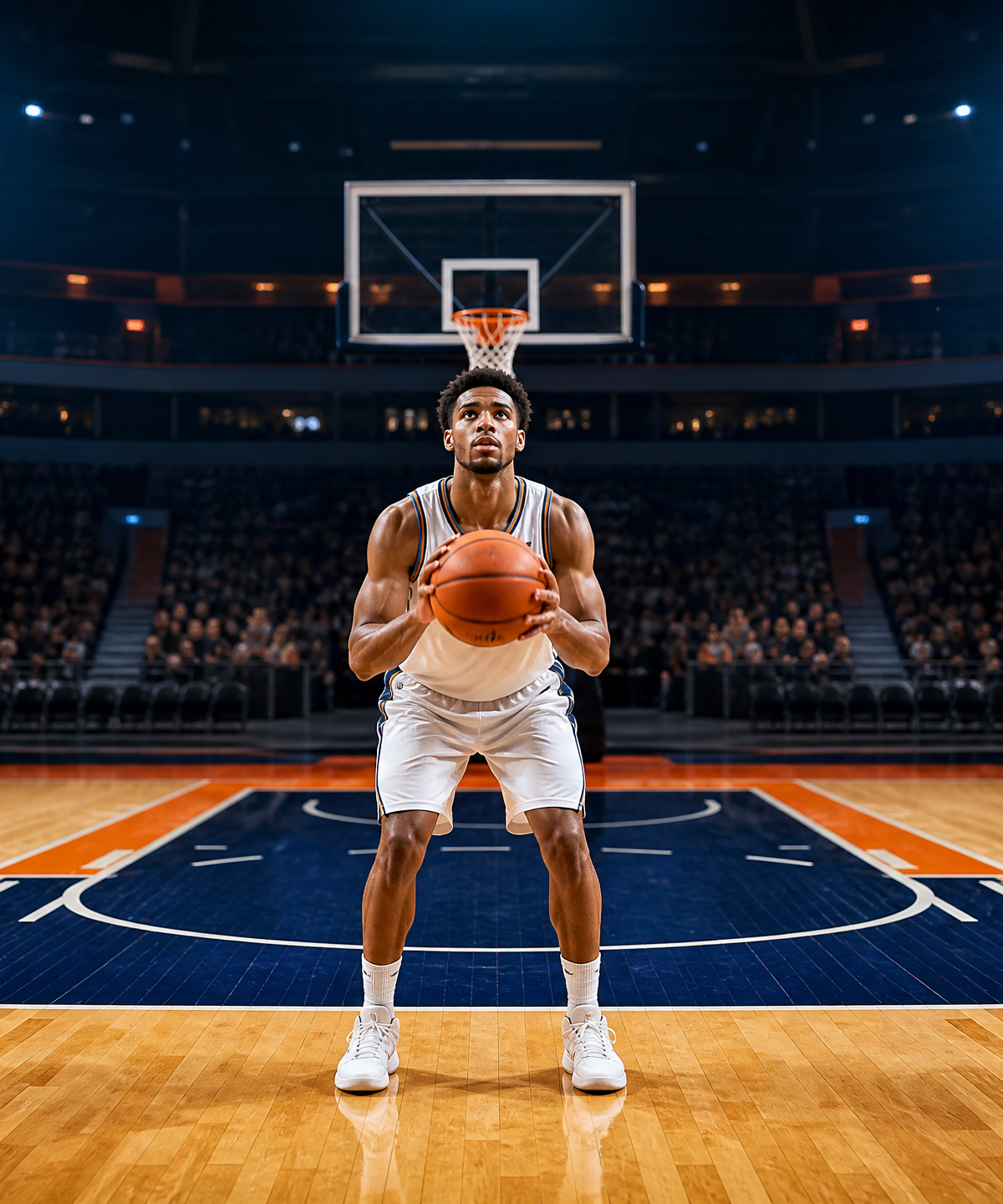
Equipment Needed
2 Basketballs
Full Court (or Half Court)
1. Overview
Free throw shooting is often practiced in a vacuum—players casually putting up shots without the physical fatigue or mental pressure they experience in a game. The Pressure Free Throw Routine bridges this gap. This drill is designed to simulate the physical and mental demands of late-game free throws while integrating transition principles. It is an excellent conditioning and fundamental drill to use at the end of practice or between high-intensity segments to teach players how to focus when tired.
2. Setup
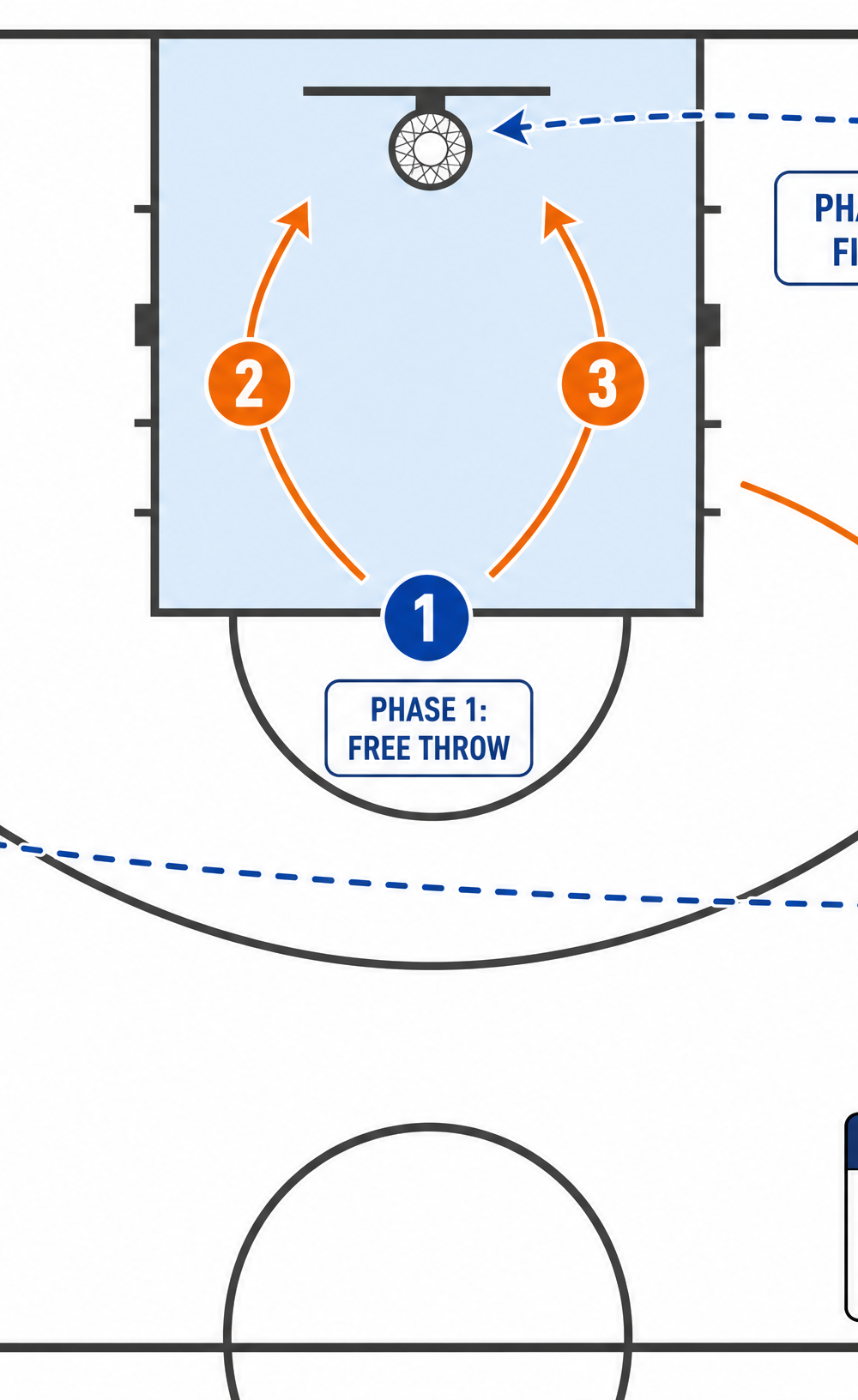
- Equipment Needed: 2 Basketballs, full court (or half court if limited space, 28m x 15m FIBA dimensions).
- Players Required: Minimum 4 players, ideal with 6-8 for continuous rotation.
- Court Setup:
- Player 1 (Shooter) starts at the free throw line.
- Players 4 and 5 (Rebounders) occupy the first lane spaces closest to the basket.
- Players 2 and 3 occupy the second lane spaces.
- Player 6 (Outlet) is positioned at the top of the key, behind the restricted area arc.
3. Step-by-Step Instructions
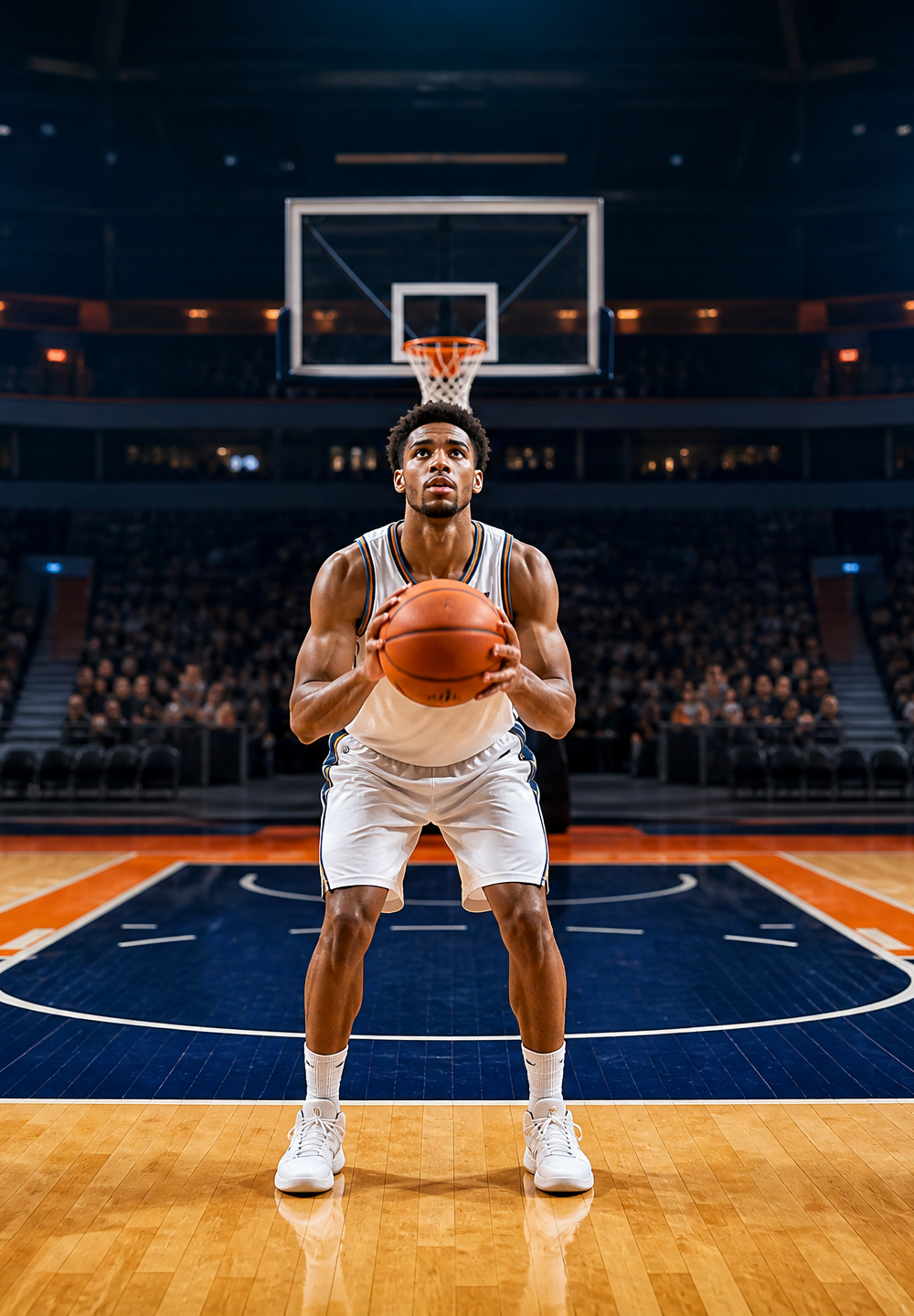
- The Routine: Player 1 steps to the line and executes their exact in-game free throw routine (dribbles, deep breath, visualization). The coach must enforce that this routine is identical every single time.
- The Shot: Player 1 shoots the free throw.
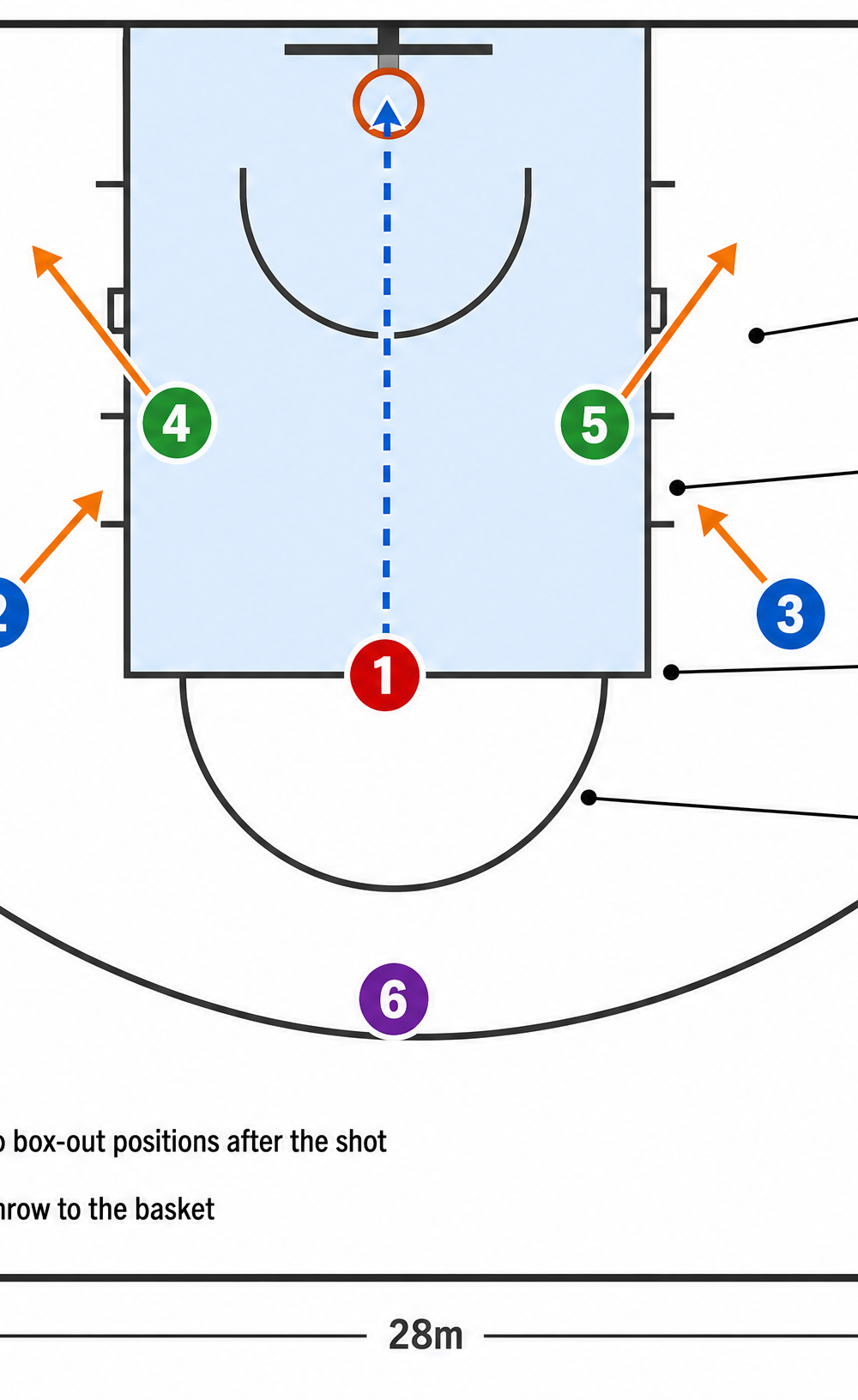
- The Box Out: On the release, Players 2, 3, 4, and 5 must engage in a live box-out situation. If the shot is missed, they battle for the rebound. If the shot is made, the designated inbounder (usually Player 4 or 5) immediately takes the ball out of bounds.
- The Transition (Phase 2): Immediately after the shot (make or miss), Player 1 sprints to the designated corner (e.g., right corner three-point line).
- The Catch and Shoot: Player 6 (or the rebounder) fires a crisp pass to Player 1 in the corner for a catch-and-shoot three-pointer or a one-dribble pull-up, depending on the coach's call.
- Rotation: Player 1 rotates to the rebounding line, the passer rotates to the shooting line, and the drill continues continuously.
4. Key Coaching Points
- Routine Consistency: The shooter must use the exact same pre-shot routine every time. No rushing. Consistency breeds confidence.
- Target Focus: Instruct players to focus on a specific part of the rim (e.g., the front lip or the back of the iron) rather than the whole basket.
- Game-Speed Transition: The sprint to the corner must be at 100% effort. We are simulating a missed free throw where the shooter must sprint back on defense or space the floor in a transition offense scenario.
- Live Rebounding: The lane players must treat the release of the ball as a live game situation. No standing straight up; establish contact early.
- Conditioning Element: Use this drill when players are already fatigued to test their mental toughness and shooting mechanics under duress.
5. Common Mistakes
- Rushing the Shot: Players often hurry their free throw to get to the sprinting portion of the drill. Force them to pause and reset.
- Poor Box Out Technique: Lane players watching the flight of the ball instead of locating their man and making contact.
- Lazy Sprints: Jogging to the corner defeats the purpose of the pressure simulation. Hold players accountable to game speed.
- Inconsistent Release: Dropping the follow-through too early. The shooting hand should stay in the 'gooseneck' position until the ball hits the rim.
6. Variations & Progressions
- Consecutive Makes (Progression): The shooter must make two free throws in a row before the sprint out. If they miss, the whole group runs a baseline sprint.
- Closeout Addition (Variation): Add a defender who closes out on Player 1 when they catch the ball in the corner, forcing a read (shoot or drive).
- Swish Only (Progression): For advanced teams, only a swish counts as a 'make'. A made shot that hits the rim is treated as a miss, triggering a live rebounding scenario.
7. Age Adaptations
- Under 10 / Under 12: Move the free throw line closer if necessary. Focus heavily on the shooting form and the concept of boxing out rather than the speed of the sprint. Remove the three-point shot and replace it with a mid-range catch-and-shoot.
- Under 14 / Under 16: Introduce the defensive closeout variation. Demand higher intensity on the box outs and precise footwork on the catch-and-shoot in the corner.
- Open / Advanced: Implement the 'Consecutive Makes' or 'Swish Only' rules to increase mental pressure. Add a time limit to complete a certain number of cycles.