

Rugby
Defensive Drift Pattern Drill: Mastering Line Speed and Outside Containment
Teach your defensive line how to maintain spacing, drift collectively to contain wide attacks, and execute tackles in the outside channel.

What you need
12 Cones, 1-2 Rugby balls, Tackle shields (optional), Bibs/Pinnies
Overview
The Defensive Drift Pattern Drill is designed to teach players how to defend against a backline attack that outnumbers them or has significant overlap. Instead of rushing up individually and creating gaps, the defensive line must maintain its integrity, push the attack towards the touchline, and use the sideline as an extra defender. This drill emphasizes communication, spacing, and the collective movement of the defensive unit from the inside out.
It is highly effective when preparing your team to handle wide attacking threats, particularly against teams that utilize fast wings or sweeping fullbacks. By mastering the drift defense, players learn to trust the defender inside them and avoid committing too early, forcing the attack to run out of space.
Setup
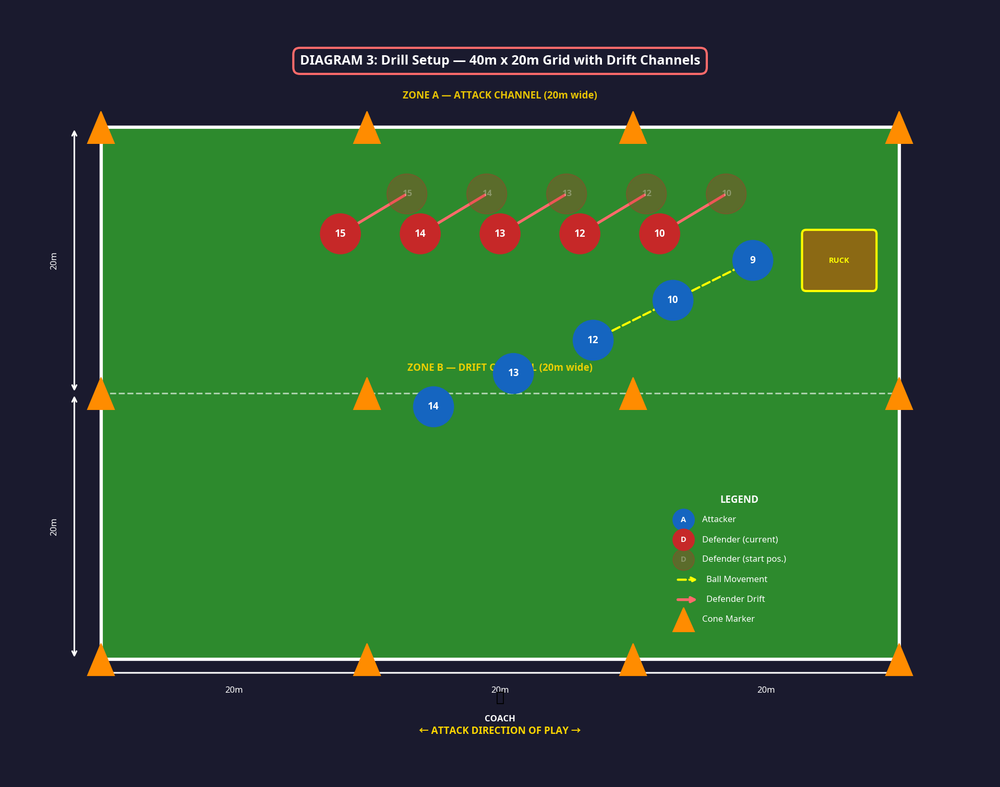
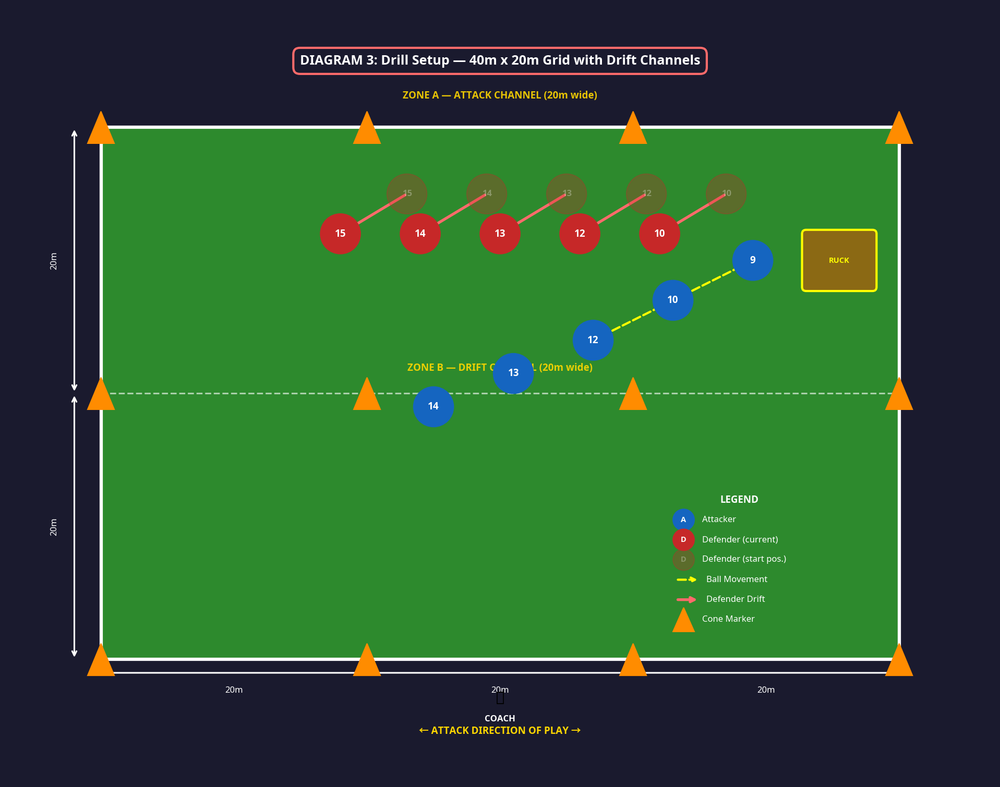
- Pitch Area: Use a 40m x 20m grid, divided into two 20m channels (Attack Channel and Drift Channel). See Diagram 3 for the setup.
- Players: 10 players minimum (5 Attackers, 5 Defenders). Can be expanded to include a scrum-half (9) and a ruck simulator.
- Equipment: 12 cones (to mark the grid and channels), 1-2 rugby balls, and optional tackle shields or hit pads for the defenders.
- Positions:
- Attackers: 10, 12, 13, 14, 15 (or standard backline setup).
- Defenders: 10, 12, 13, 14, 15 (mirroring the attackers but starting slightly narrower).
Step-by-Step Instructions
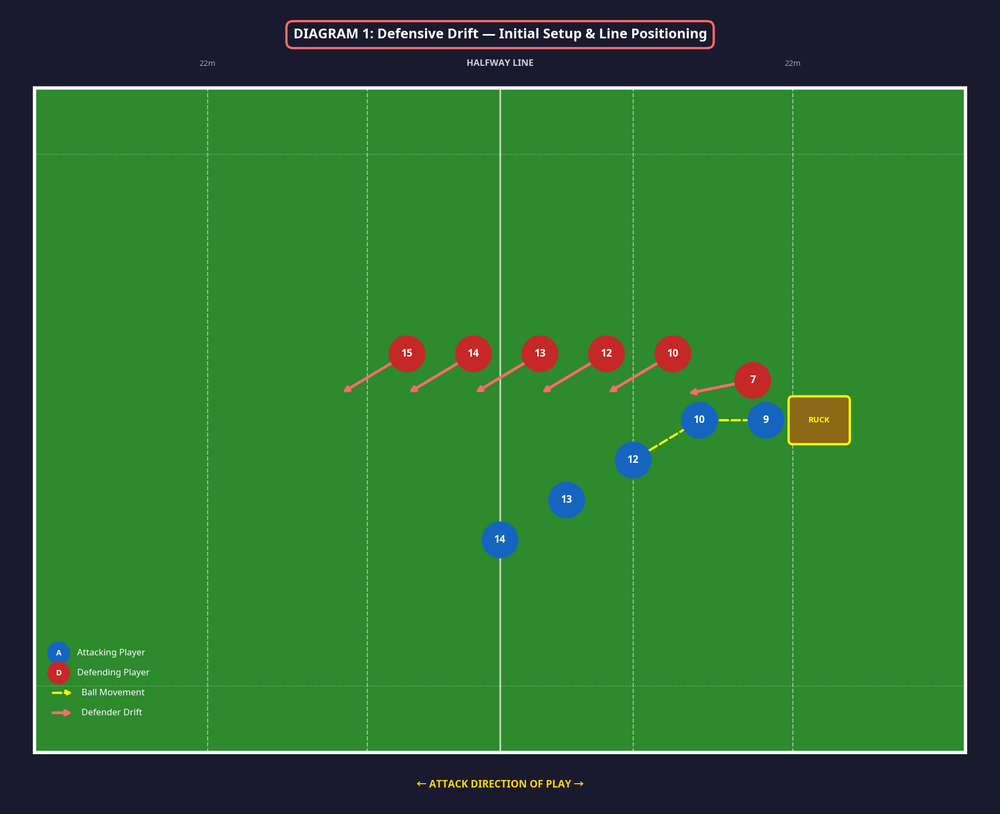
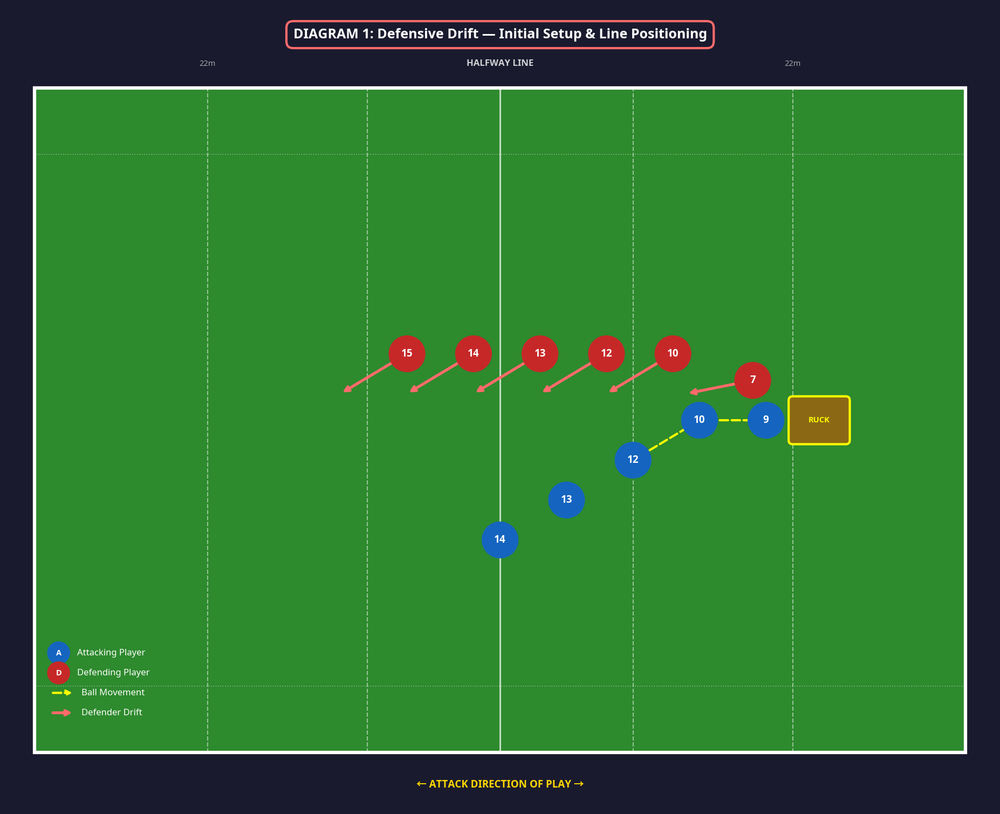
- Initial Alignment: The defending team lines up opposite the attacking team. The defenders should start slightly narrower than their attacking counterparts to invite the attack wide. The defensive 10 aligns on the attacking 10.
- The Launch: The coach initiates the drill by feeding the ball to the attacking 10 (or having a 9 pass from a simulated ruck). The attacking line begins their forward and outward movement.
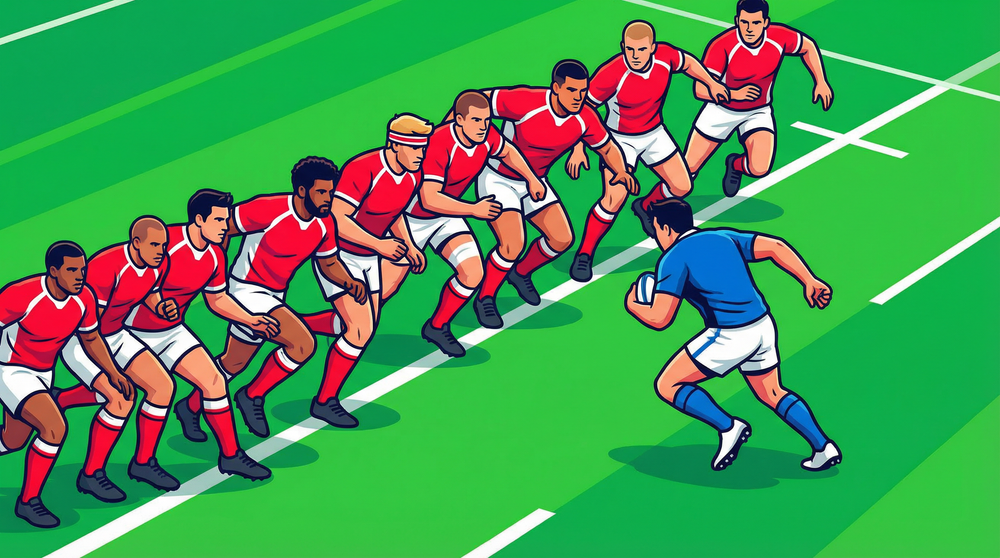
- Line Speed and Connection: The defensive line moves forward together. The key here is line speed—the defense must get off the line quickly to cut down the attackers' reaction time. However, they must maintain a solid, unbroken line.
- The Drift Initiation: As the ball is passed from the attacking 10 to the 12, the defensive 10 commits to the pass, and the rest of the defensive line (12, 13, 14, 15) begins to drift outward. The defenders push off their inside foot, moving laterally while still advancing.
- Maintaining Spacing: Defenders must keep a consistent distance (about 2-3 meters) between each other. If one defender drifts too fast or too slow, a gap will open for the attack to exploit.
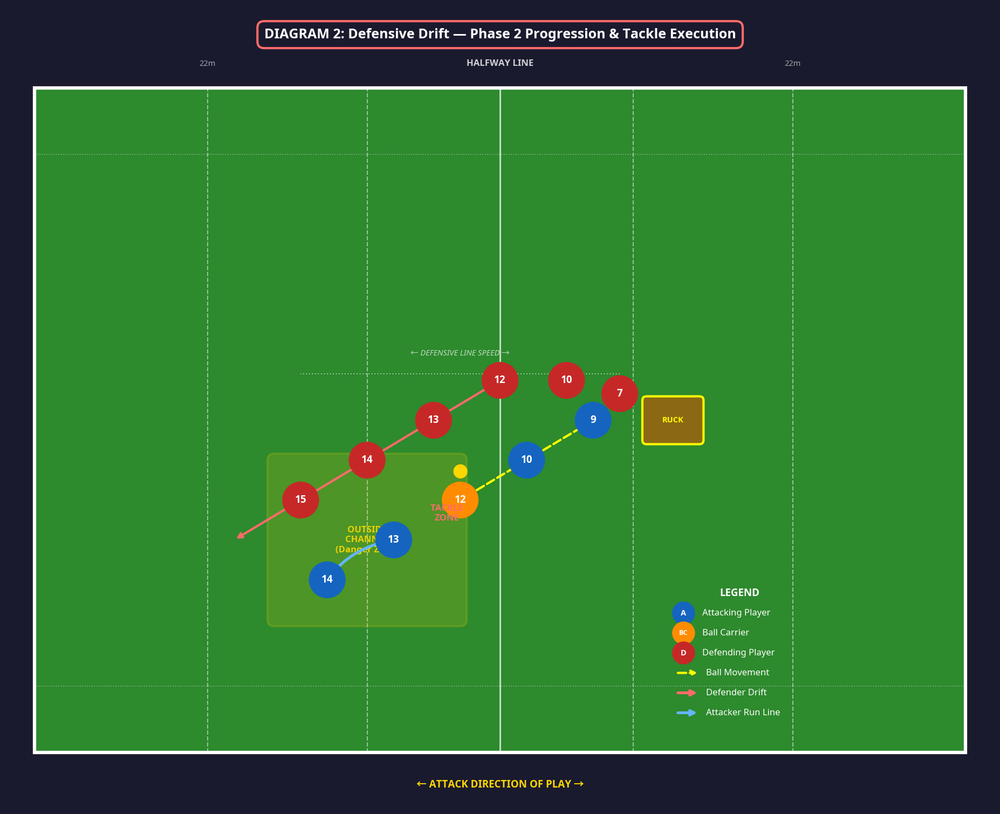
- The Tackle Execution: The drift continues until the ball reaches the outside attacker (e.g., the 14 or 15). At this point, the defensive line should have pushed the attack toward the sideline. The outside defender (14 or 15) must now step in, close the space, and make a dominant tackle in the designated "Tackle Zone," using the touchline as their ally.
Key Coaching Points

- Communication is Critical: Defenders must constantly talk. Calls like "Push!", "Hold!", or "I've got ball!" are essential to ensure everyone moves as a unit.
- Trust the Inside Man: Defenders must trust that the player inside them has their designated attacker covered. If a defender turns back inside, the drift is broken.
- Hips Square to the Opposition: While drifting laterally, defenders should keep their hips and shoulders relatively square to the attacking line. Over-committing the hips to the sideline makes it impossible to react to a sudden cut-back step.
- Use the Touchline: The ultimate goal of the drift defense is to use the sideline as an extra defender. The outside defender must angle their run to trap the ball carrier against the line.
Common Mistakes
- Dog-Legging: One defender rushes up faster than the rest of the line, creating a "dog-leg" shape. This opens up massive gaps on either side of the rushing defender.
- Turning Shoulders Too Early: If defenders turn their shoulders completely to the sideline while drifting, they become vulnerable to an attacker stepping back inside.
- Ball Watching: Defenders fixate on the ball rather than their opposite man, causing them to lose their spacing and alignment.
Variations & Progressions

- Overload Attack (Progression): Start with 6 attackers against 4 defenders. This forces the defense to drift more aggressively and rely heavily on the touchline to complete the tackle.
- Live Tackling (Progression): Move from touch or wrap-tackles to full live tackling in the outside channel to simulate game intensity.
- Two-Sided Attack (Variation): Have the attack start in the middle of the pitch with the option to pass left or right. The defense must react and drift accordingly based on the direction of the first pass.
Age Adaptations

- Under 8s - Under 10s: Focus purely on moving forward together in a straight line holding hands or using a rope to understand the concept of a connected defensive wall. Introduce lateral movement slowly.
- Under 12s - Under 14s: Introduce the concept of "pushing" the attack wide. Use touch tackles instead of full contact to emphasize positioning over physicality.
- Under 16s - Open Grade: Full implementation of the drill with live tackling, complex attacking moves (e.g., dummy runners, wrap-arounds), and varying numbers to test the defense's decision-making under pressure.
