

Rugby
The Dominant Ruck: Precision Clear-Out and Clean-Out Drill
Master the breakdown by teaching your players precise entry angles, low body height, and explosive driving power to secure lightning-fast ruck ball.

What you need
4 Cones, 2 Ruck Pads, 1 Rugby Ball
1. Overview
Winning the breakdown is the cornerstone of any successful attacking structure in modern rugby. Without quick, clean ball, your backline cannot operate effectively, and your forwards will constantly be running into a set defensive line. The Dominant Ruck Clear-Out and Clean-Out Drill is designed to build muscle memory around the critical components of the breakdown: rapid arrival, legal gate entry, low body height, and explosive leg drive.
This drill isolates the clear-out movement, allowing coaches to focus entirely on technique before progressing to full-contact, game-realistic scenarios. It is essential for forwards, but equally important for backs who frequently find themselves as the first or second arriving player at a wide breakdown.
2. Setup
To run this drill efficiently, you need a designated 10m x 10m grid.
Equipment Needed:
- 4 Cones (to mark the 10m x 10m grid)
- 2 Ruck Pads or Tackle Shields
- 1 Rugby Ball
Player Positions:
- Attacking Team (Red): 1 Ball Carrier, 2 Arriving Support Players (e.g., 6 and 7), 1 Scrum-half (9) waiting for the ball.
- Defending Team (Blue): 2 Defenders holding ruck pads (D1 and D2).
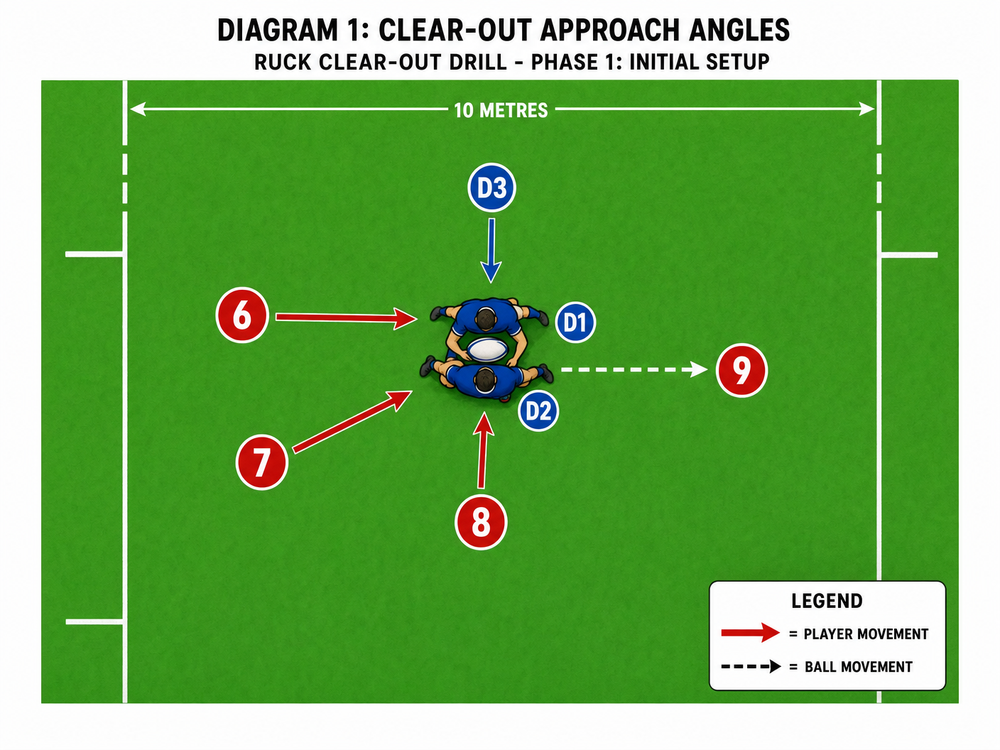
3. Step-by-Step Instructions
- The Approach: The Ball Carrier runs into the two pad holders and goes to ground, presenting the ball cleanly back toward their team.
- The Call: As the ball carrier goes down, the first arriving player (Player 6) must communicate loudly (e.g., "I'm first!") to claim the initial clear-out.
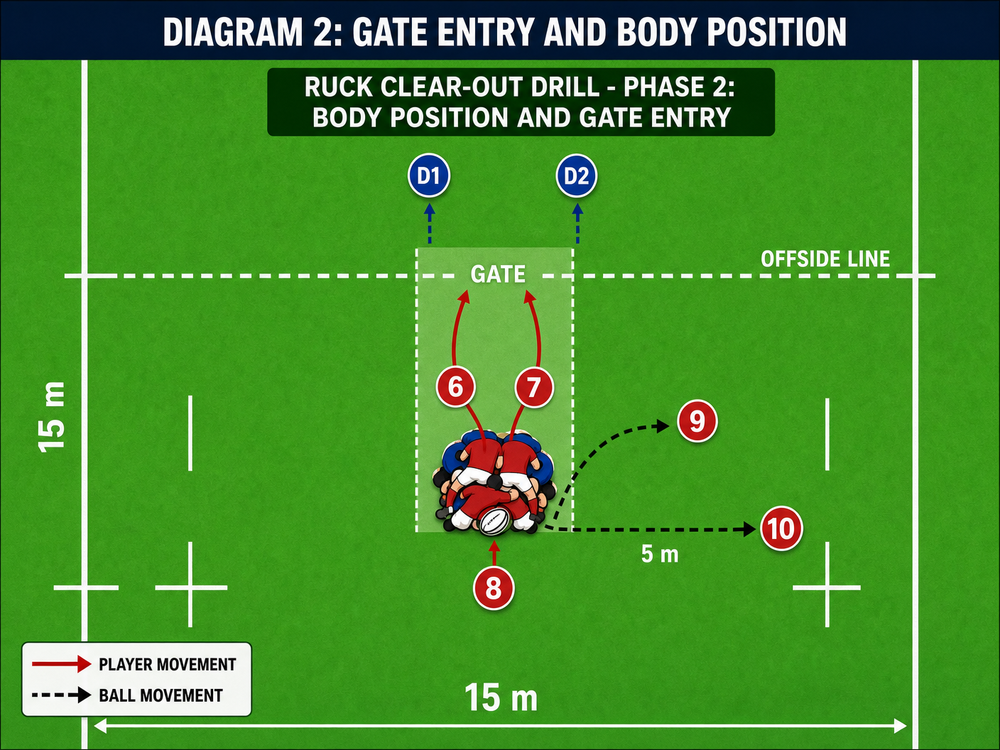
- Gate Entry: Player 6 and Player 7 must approach through the "gate" (the width of the tackled player on the ground). Entering from the side is a penalty offense.
- Body Height and Bind: Player 6 drops their body height (hips below shoulders) and binds onto the first threat (D1). Player 7 immediately follows, targeting the second threat (D2) or latching onto Player 6 to add driving weight.
- The Drive: Both arriving players use short, powerful, choppy steps to drive the pad holders backward and completely clear the area over the ball.
- The Clearance: Once the ruck is secured and the defenders are cleared past the ball, the Scrum-half (9) steps in to distribute the ball to the next attacking pod.
4. Key Coaching Points
- Arrive Square and Low: Players must square their shoulders to the opposition try-line before entering the ruck. Hips must be lower than shoulders to maintain balance and generate upward driving force.
- Enter Through the Gate: Emphasize the importance of legality. Any entry from the side will result in a penalty in a match.
- Target the Threat: The first arriving player must identify the most immediate threat to the ball (the "jackaler") and clear them out directly.
- Choppy Steps: The drive should be powered by short, rapid steps rather than long strides, which compromise balance and driving power.
- Stay on Your Feet: Players must attempt to stay on their feet while driving over the ball. Going straight off your feet seals off the ball and is a penalty offense.
5. Common Mistakes
- Coming in Too High: Players entering upright will easily be driven backward or rolled out of the ruck by lower, more stable defenders.
- Side Entry: Entering the ruck from the side rather than through the gate behind the tackled player.
- Over-Committing: Diving completely over the ball and going off feet, which leaves the ball exposed to a counter-ruck.
- Lack of Communication: Arriving players not communicating who is taking which threat, leading to two players hitting the same defender while the other steals the ball.
6. Variations & Progressions
- Live Defenders: Replace the ruck pads with live defenders who actively try to steal the ball (jackal) or counter-ruck.
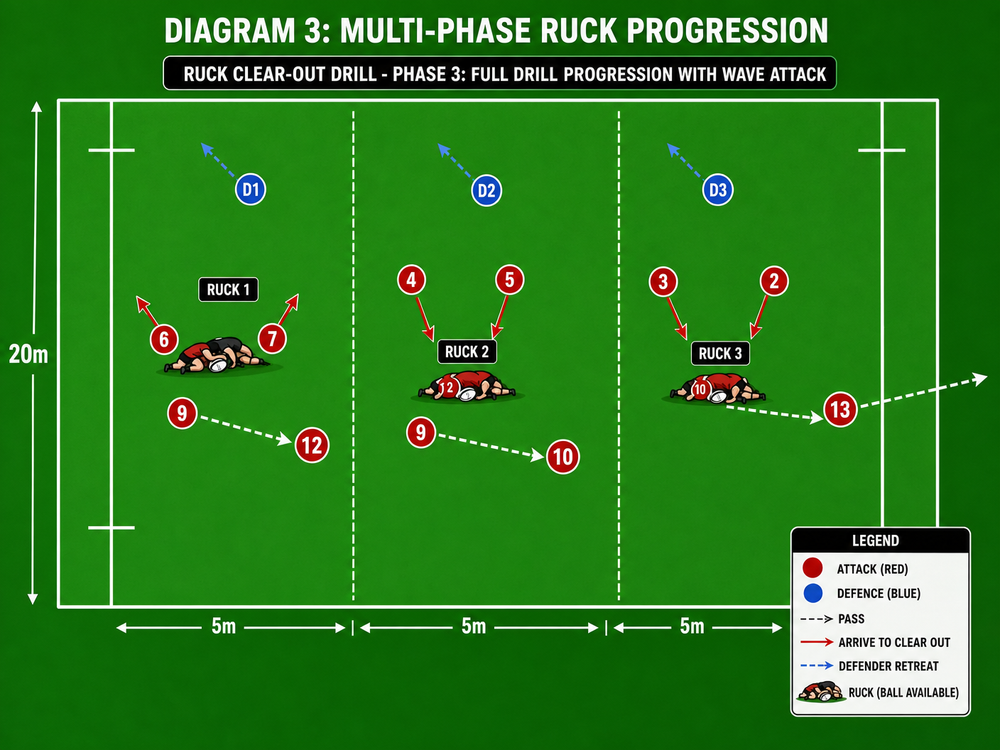
- Multi-Phase Wave Attack: Set up three consecutive ruck stations across the pitch. Players must clear out Ruck 1, the scrum-half passes to a new carrier who sets Ruck 2, and different players arrive to clear out. This builds fitness and simulates game continuity.
7. Age Adaptations
- Under 8s to Under 10s: Focus heavily on safety. Use tackle bags placed on the ground instead of standing defenders. Emphasize body position (airplane landing) and staying on feet.
- Under 12s to Under 14s: Introduce light resistance with ruck pads. Focus on the concept of the "gate" and legal entry angles.
- Under 16s to Open Age: Full contact, live jackal threats. High intensity, focusing on speed of arrival and explosive power.
