

Rugby
The Ironclad Exit: Executing a Flawless 22-Metre Exit Play
Master the art of escaping your own 22 with this comprehensive, multi-phase exit strategy designed to relieve pressure and turn defence into attack.
What you need
Rugby Balls, Cones, Kicking Tee (optional)
1. Overview
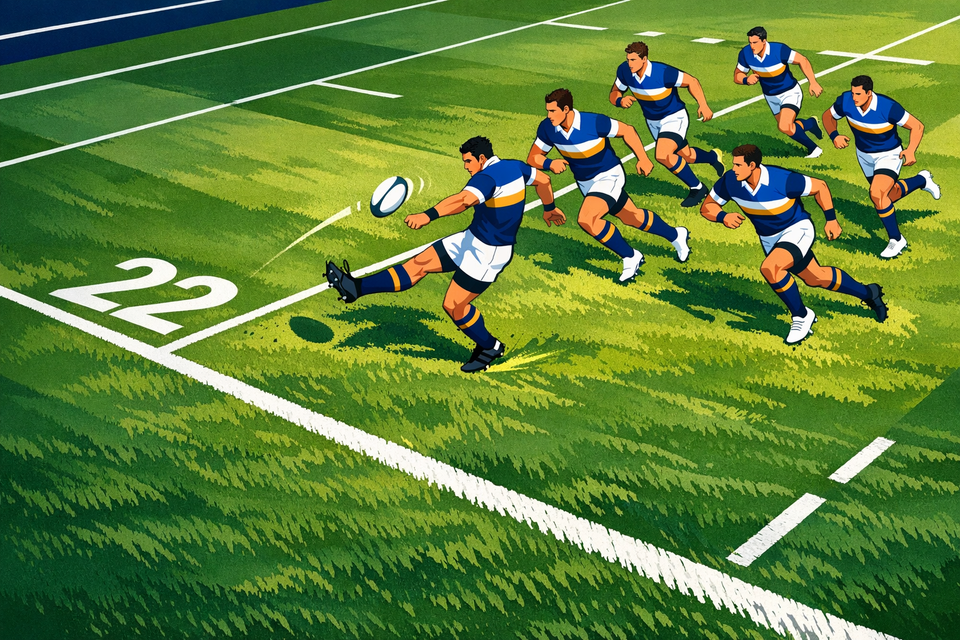
Exiting your own 22 is one of the most critical aspects of modern rugby. A botched exit hands the opposition prime attacking real estate, while a clinical exit relieves pressure and can instantly shift momentum. This set play is designed to provide a safe, structured, and highly effective method for clearing your lines from a defensive lineout or scrum deep within your own 22.
The core objective of this play is to secure possession, establish a strong forward platform to manipulate the defensive line, and then execute a precision kick with a coordinated chase to regain territory or contest possession downfield.
2. Setup
Equipment Needed:
- 1 Rugby Ball (minimum, preferably 3-5 for rapid repetition)
- 15 Cones (to mark defensive alignments and target zones)
- Kicking Tee (optional, if practicing clearing kicks from hand vs off the deck)
Pitch Setup:
- Utilize the full 100m x 70m pitch dimensions for realistic spatial awareness.
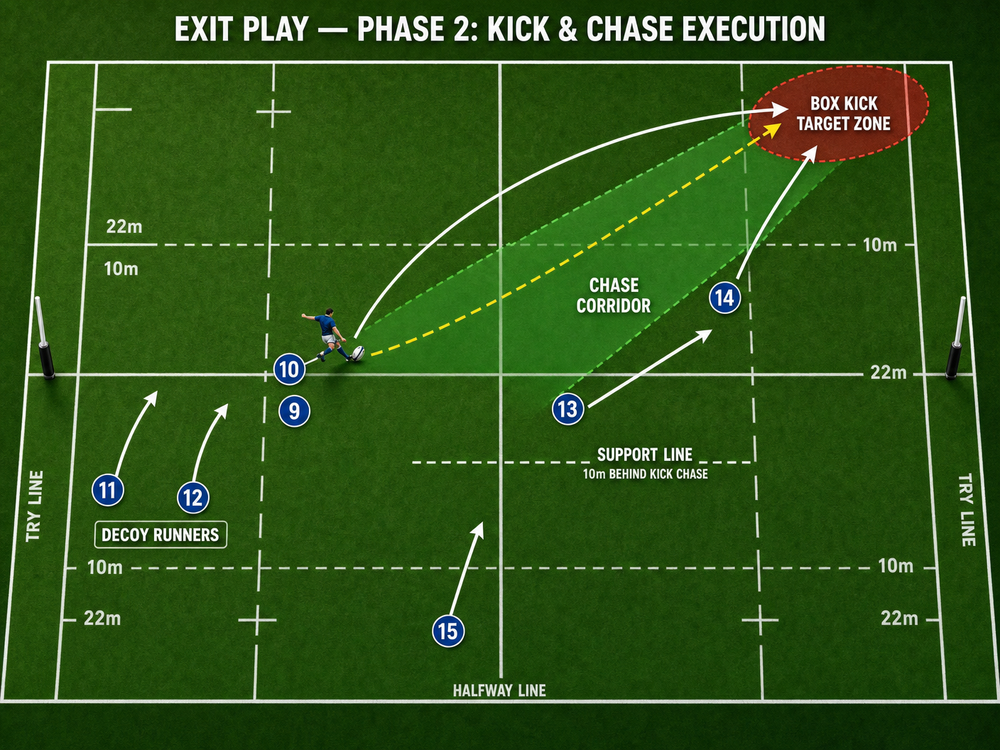
- Mark a clear 'Target Zone' for the kick between the opposition's 10-metre line and 22-metre line, roughly 5-10 metres in from the touchline.
Player Positions:
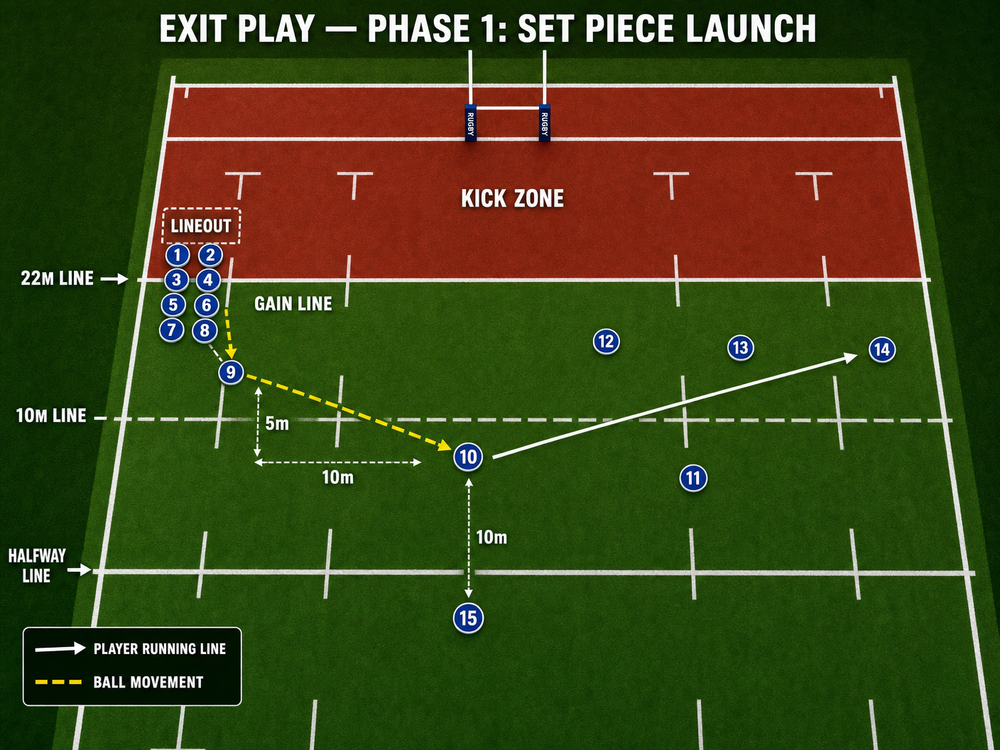
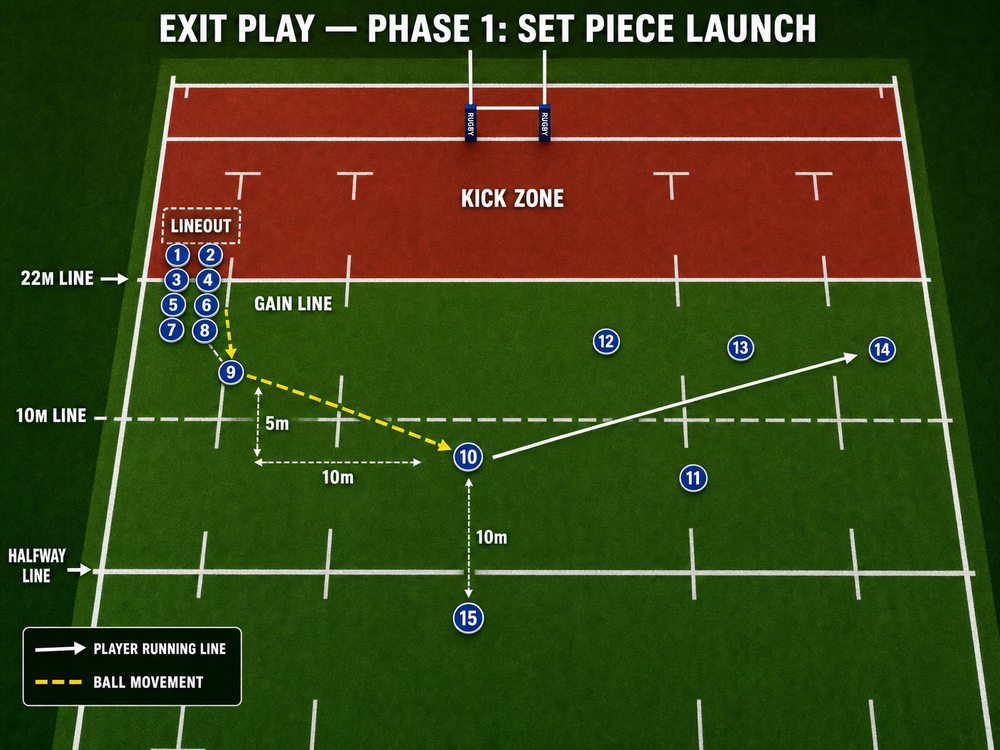
- 1-8 (Forwards): Grouped tightly for the initial set piece (lineout or scrum) on the 22-metre line.
- 9 (Scrum-half): Positioned at the base of the set piece, ready to distribute.
- 10 (Fly-half): Standing deep, approximately 5 metres behind the gain line and 10 metres infield, providing a clear kicking channel.
- 11, 14 (Wings): Positioned wide, ready to initiate the chase.
- 12, 13 (Centres): Running decoy lines or providing a secondary kicking option.
- 15 (Fullback): Positioned deep to cover any counter-kicks and support the chase.
3. Step-by-Step Instructions
Phase 1: Set Piece Launch and Consolidation
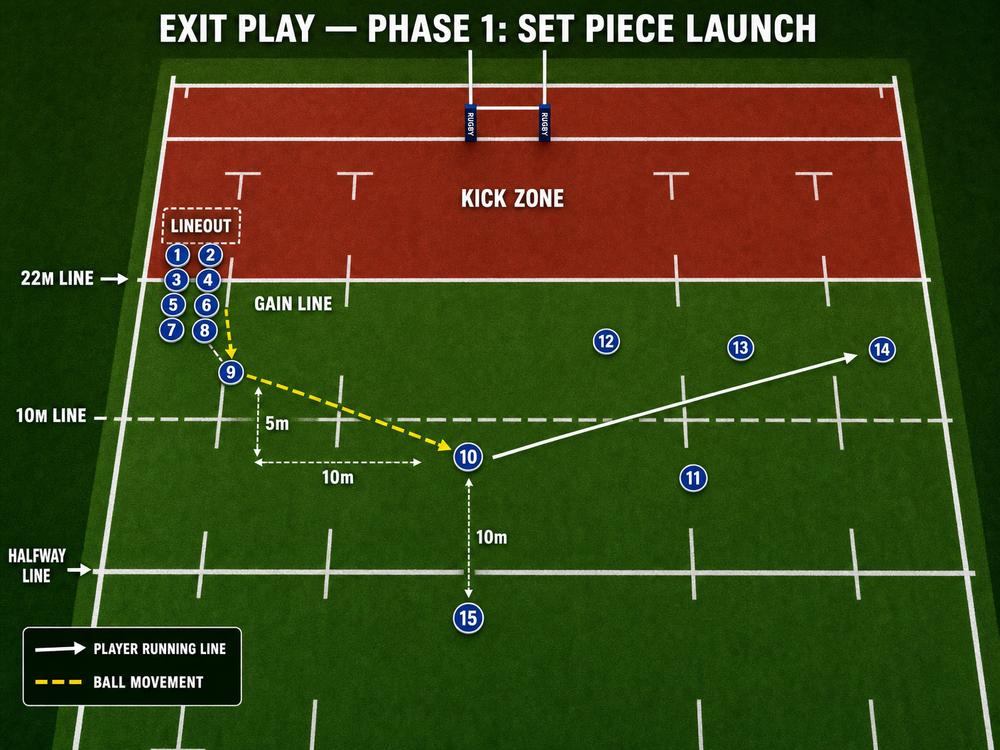
- Secure the Ball: The forwards execute a clean lineout win or stable scrum on the 22-metre line.
- The Setup Carry: The scrum-half (9) passes to a designated forward (often the 8 or a hard-running lock) who carries the ball aggressively over the gain line to establish front-foot ball and tie in defenders.
- Quick Recycle: The forwards secure the breakdown rapidly, presenting clean ball for the scrum-half (9) within 3 seconds.
Phase 2: The Exit Kick
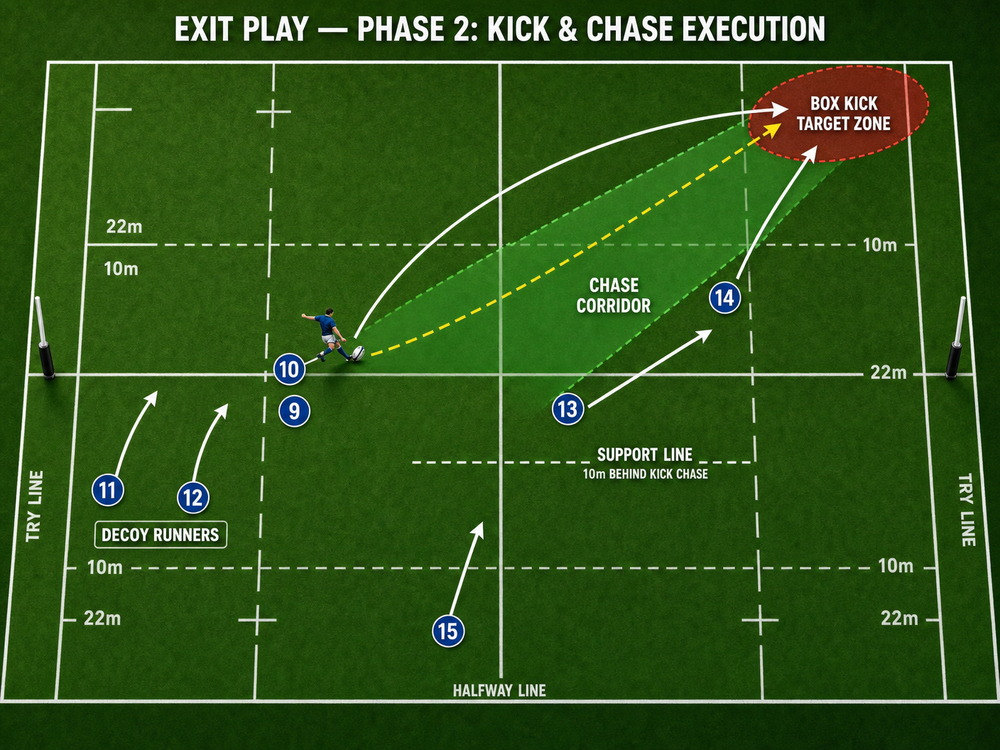
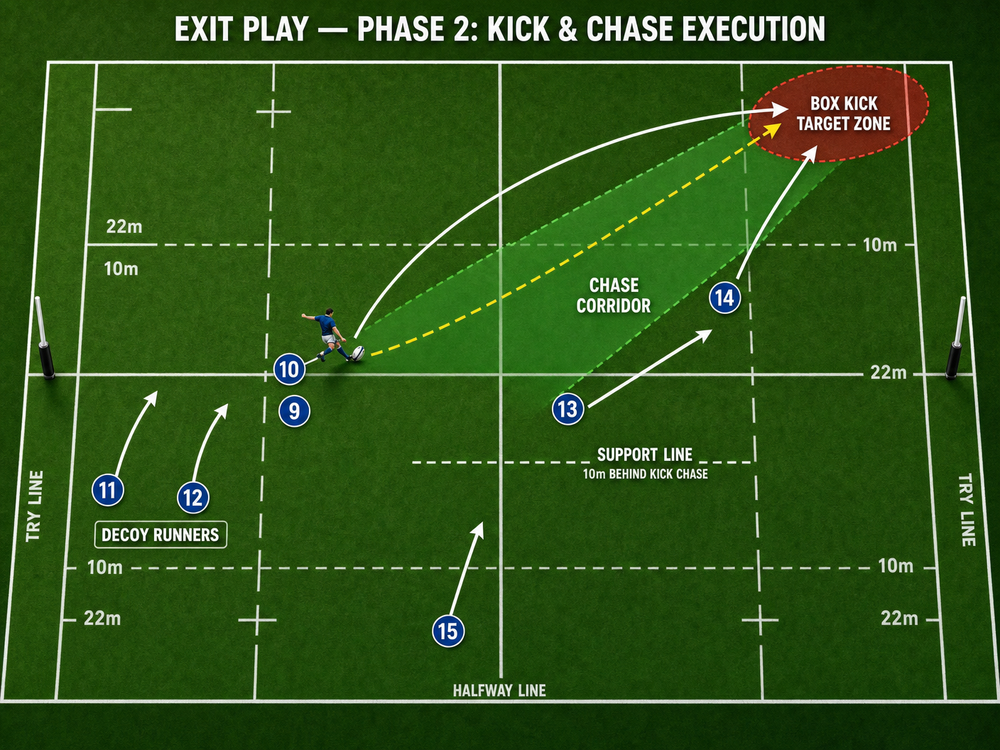
- The Pass: The scrum-half (9) delivers a swift, accurate pass to the fly-half (10), who is positioned deep and slightly infield.
- The Decoys: Simultaneously, the centres (12, 13) run hard, flat decoy lines to hold the opposition's defensive line and prevent them from charging down the kick.
- The Kick: The fly-half (10) executes a high, hanging box kick or a long, driving touch kick, aiming for the designated 'Target Zone' downfield.
Phase 3: The Chase and Compete
- The Chase: The winger (14 or 11, depending on the kick direction) and the outside centre (13) sprint aggressively after the kick, forming a coordinated 'Chase Corridor'.
- The Contest: The chasers aim to tackle the catcher man-and-ball simultaneously, or ideally, compete in the air to regain possession.
- The Support: The rest of the team pushes up rapidly to form a new defensive line or secure the breakdown if possession is regained.
4. Key Coaching Points
- Breakdown Speed: The entire play hinges on lightning-fast ball presentation from the initial forward carry. Slow ball allows the defence to rush the kicker.
- Kicker Protection: The forwards and decoy runners must create an impenetrable 'pocket' to protect the fly-half (10) from charge-downs.
- Kick Accuracy over Distance: A well-placed 30-metre kick that allows your team to compete is infinitely better than a 50-metre kick that is easily fielded and countered.
- Coordinated Chase: The chase must be organized. The primary chaser contests the ball, while secondary chasers cut off escape routes and prepare for the breakdown.
5. Common Mistakes
- Telegraphing the Kick: The fly-half (10) drops deep too early, allowing the defence to anticipate the kick and adjust their backfield coverage.
- Poor Kick Execution: Striking the ball poorly, resulting in a low trajectory that is easily charged down or fielded without pressure.
- Disconnected Chase: Players chasing individually rather than as a cohesive unit, creating gaps for the opposition to counter-attack through.
- Ignoring the Wind: Failing to adjust the kick trajectory and target zone based on prevailing wind conditions.
6. Variations & Progressions
- The Scrum-Half Box Kick: Instead of passing to the 10, the scrum-half (9) executes a box kick directly from the base of the ruck, altering the angle and timing of the exit.
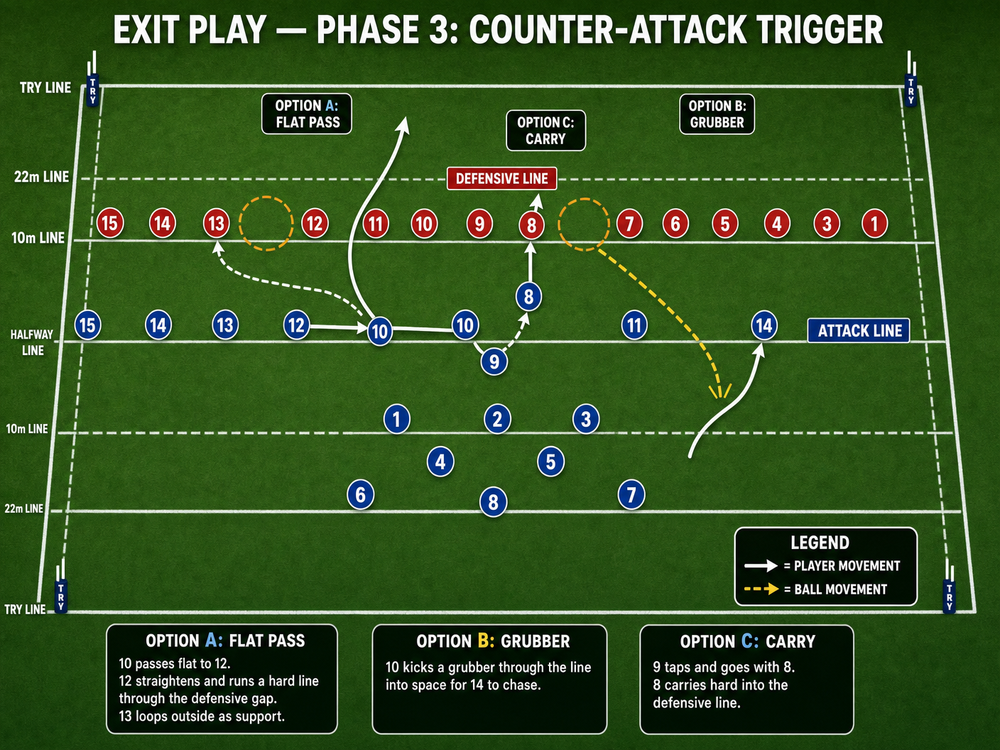
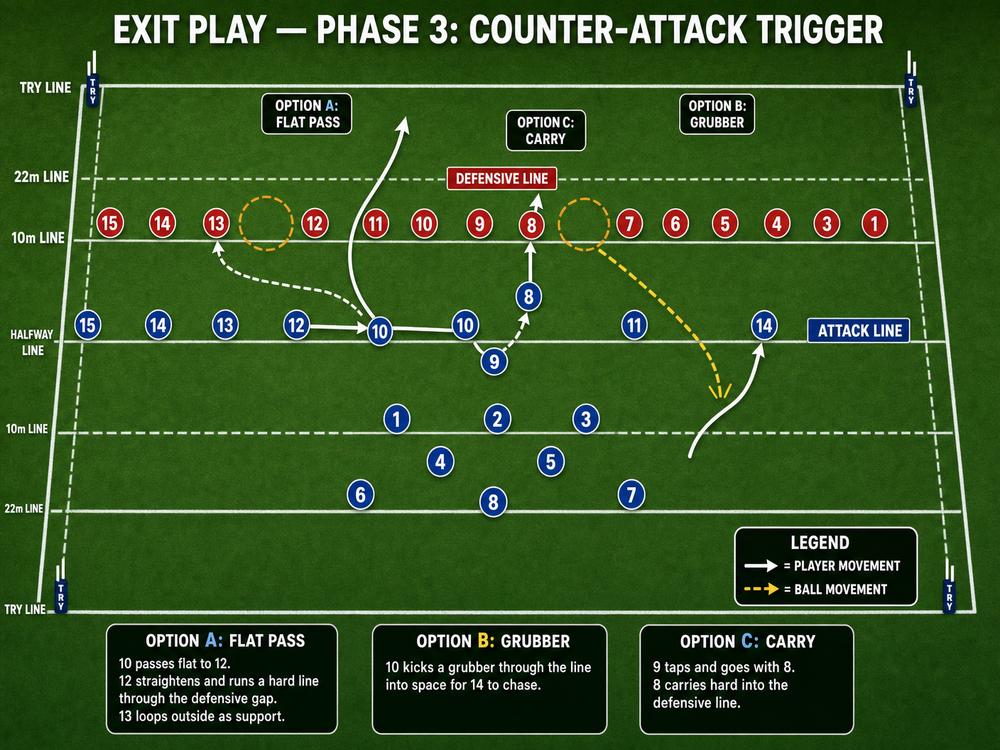
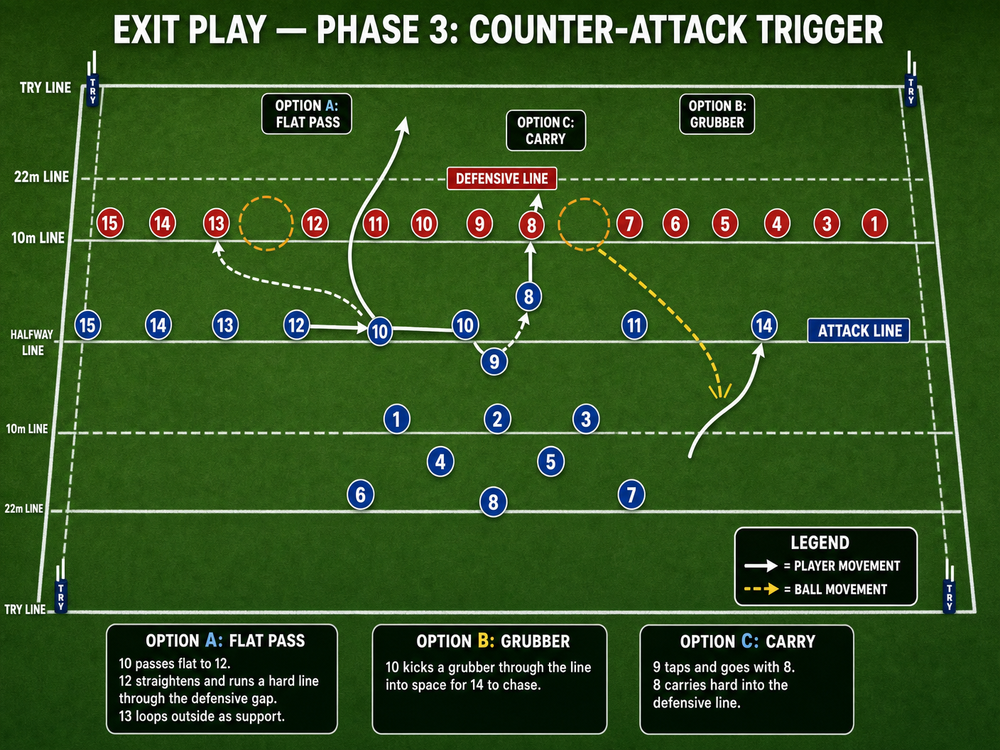
- The Running Exit: If the defence drops back entirely anticipating a kick, the fly-half (10) can dummy the kick and pass to the centres (12, 13) to run the ball out of the 22.
- Progression: Introduce live defenders to apply pressure on the kicker and contest the high ball, simulating match conditions.
7. Age Adaptations
- Under 10s/12s: Focus primarily on the fundamental skills: securing the set piece, making a strong initial carry, and basic kicking technique. The chase can be simplified to just running forward in a line.
- Under 14s/16s: Introduce the concept of the 'pocket' for kicker protection and begin emphasizing the coordination of the chase. Introduce variations like the scrum-half box kick.
- Open/Senior: Full execution with all variations. High emphasis on decision-making (when to kick vs when to run) and reading the opposition's backfield alignment.
