

Rugby
Kick Chase and Catch Masterclass
Master the art of the aerial contest with this essential drill for improving kick accuracy, chase lane discipline, and high-ball catching under pressure.
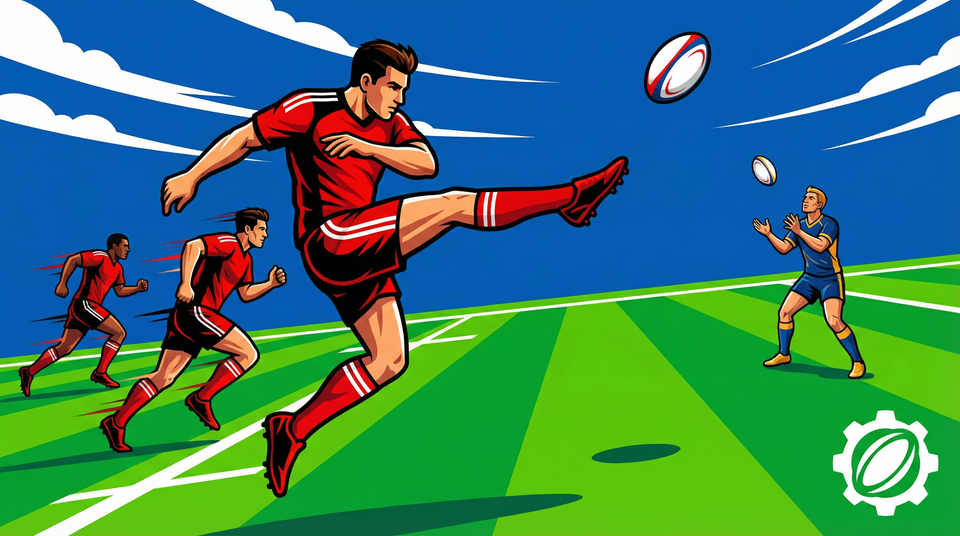
What you need
12-15 cones, 3-4 rugby balls, tackle shields (optional)
1. Overview
The "Kick Chase and Catch" drill is a foundational exercise designed to improve backline synchronization, aerial skills, and defensive pressure under the high ball. In modern rugby, the kicking game is not just a mechanism for territory; it is a potent attacking weapon when paired with an organized, aggressive chase. This drill isolates the core components of an effective kick-chase strategy: the accuracy of the kick, the speed and spacing of the chasers, and the courage and technique of the catcher under pressure.
Coaches should use this drill to simulate match-like scenarios where the team must transition rapidly from attack (kicking) to defense (chasing and competing). It is particularly effective for developing the communication between the kicker (usually the 10 or 9) and the outside backs (11, 14, 15) who are tasked with reclaiming possession or applying immediate pressure on the opposition receiver. By breaking down the movement into specific lanes and introducing progressive opposition, players build the necessary muscle memory and spatial awareness to execute this critical phase of play flawlessly during a match.
2. Setup

To run this drill effectively, you will need a clear section of the pitch and standard training equipment to mark out the zones. The setup requires precision to ensure players are practicing realistic distances and angles.
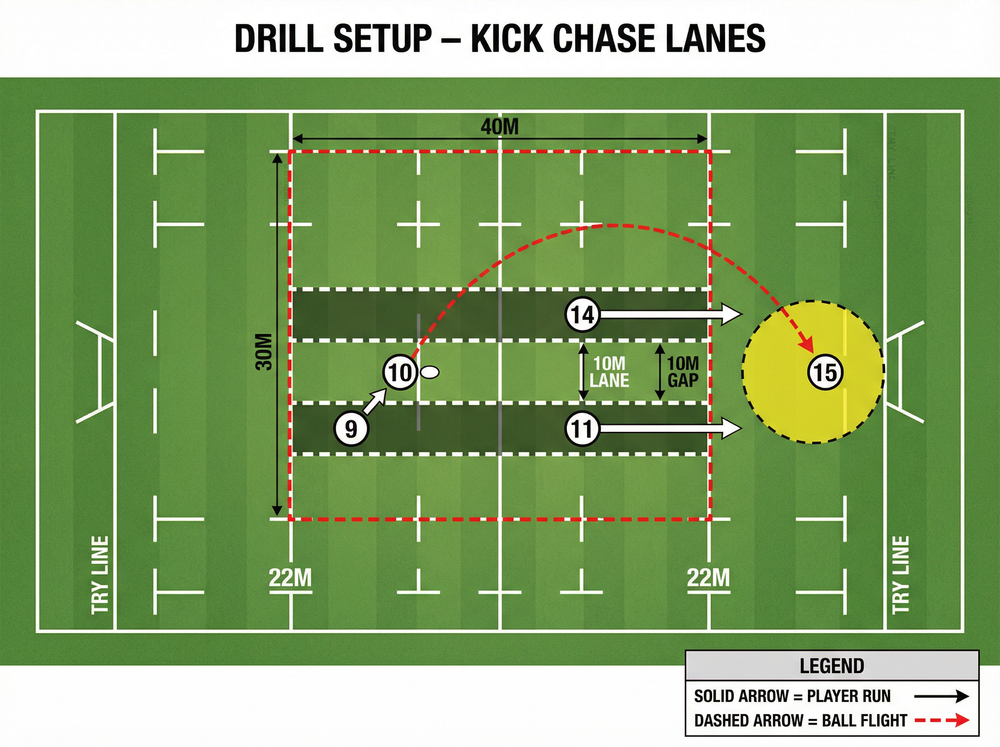
- Pitch Area: A 40m x 30m grid, typically set up between the halfway line and the 22-metre line.
- Equipment: 12-15 cones (preferably two different colors to mark lanes and zones), 3-4 rugby balls, and optionally, tackle shields for the progression phase.
- Player Roles:
- Kicker: Fly-half (10) or Scrum-half (9).
- Chasers: Wingers (11, 14) or outside centers.
- Receiver/Catcher: Fullback (15) or another winger.
- Defenders (for progression): Any available players to apply pressure.
- Zone Demarcation: Mark two parallel "chase lanes" approximately 10 meters apart running lengthwise down the grid. At the far end of the grid (30-40 meters from the kick origin), mark a 10m x 10m "Catching Zone" where the receiver will position themselves.

3. Step-by-Step Instructions

Execute the drill using the following structured progression to ensure all players understand their roles and the timing required.
- Starting Positions: The kicker (10) stands at the base of the grid with the ball. The two chasers (11 and 14) position themselves at the start of their respective 10-meter wide chase lanes, roughly 2-3 meters behind the kicker to ensure they remain onside. The receiver (15) stands in the Catching Zone at the far end of the grid.
- The Trigger: The drill begins on the kicker's movement. The kicker takes two steps forward and executes a high, hanging box kick or up-and-under, aiming directly for the Catching Zone.
- The Chase: The moment the ball leaves the kicker's boot, the chasers (11 and 14) accelerate into their lanes. They must maintain their lane discipline — staying 10 meters apart — to ensure they cover the maximum width of the field and cut off potential escape routes for the receiver.
- Communication: As the chasers run, they must communicate loudly. The player closest to the ball calls "Mine!" or "Ball!" to indicate they are competing for the catch, while the other player calls "Man!" or "Left/Right!" to indicate they are covering the tackle or the offload.
- The Catch: The receiver (15) tracks the flight of the ball, positions their body under it, and jumps to catch the ball at its highest point, bringing their knee up to protect themselves from the incoming chasers.
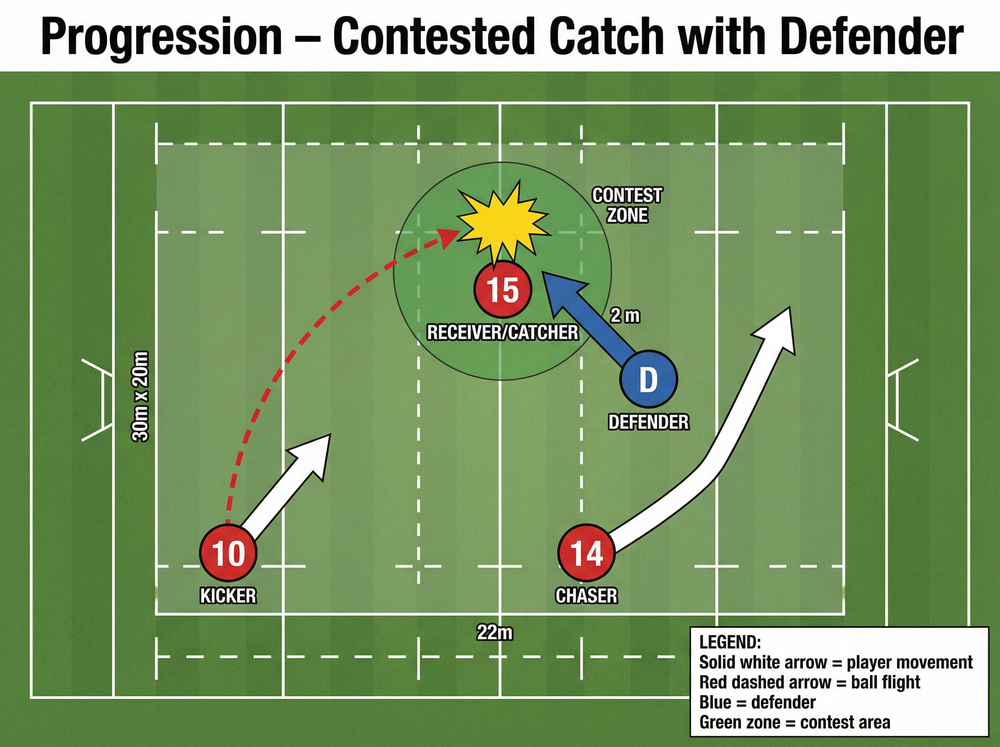
- The Contest: The designated competing chaser leaps to challenge for the ball in the air, while the covering chaser stops 1-2 meters away, balanced and ready to make a tackle if the receiver wins the ball.
- Reset and Rotate: Once the contest is resolved (either a catch, a knock-on, or a successful tackle simulation), the players jog back to the start, rotate positions, and repeat the sequence.
4. Key Coaching Points
- Hang Time Over Distance: Prioritize kick height over distance. A 30m kick hanging 4 seconds beats a 40m kick landing in 2 seconds.
- Lane Discipline: Chasers must stay in their designated lanes. Drifting early bunches the defense and creates wide gaps.
- The "W" Formation: As chasers approach, they form a slight "W" shape — competing player ahead, supporting players flanking behind.
- Aerial Technique: Eyes on the ball, arms fully extended, one knee up to generate upward momentum and protect the body.
- Vocal Dominance: Early, loud, decisive communication prevents collisions and clarifies roles before the contest zone.
5. Common Mistakes
- Offside Chasers: Players creeping ahead of the kicker before the ball is struck. Reinforce starting 2-3 meters behind.
- Overrunning the Ball: Sprinting without tracking the flight, resulting in running past the receiver.
- Catching on the Chest: Waiting for the ball to drop rather than jumping to catch it above the head.
- Bunches Defense: Converging too tightly around the ball and leaving wide channels unguarded.
6. Variations & Progressions
- Progression 1 — The Shield Contest: A coach with a tackle shield applies moderate pressure as the receiver jumps, testing concentration and core stability.
- Progression 2 — Live Defender: A live defender (D) starts 10 meters from the receiver and sprints in to apply genuine pressure on the catch.

- Variation — The Grubbing Chase: The 10 executes a low grubber kick. Chasers must track the unpredictable bounce while the receiver sweeps as a fullback.
7. Age Adaptations
- Under 8 – Under 10: Remove chasers entirely. Coach throws the ball high; players practice tracking and catching. Use a softer ball if needed.
- Under 12 – Under 14: Touch drill only. Chasers must stop 1 meter away and make a two-handed touch on the receiver's waist after landing. Focus on lane discipline and communication.
- Under 16 – Open (Adult): Full match intensity with live aerial contests, full tackling, and rapid ruck recycling.
