

Rugby
The Viper: Opposition Lineout Steal & Counter-Attack
Dominate the set piece by disrupting the opposition's throw and launching a devastating counter-attack from stolen ball.

What you need
Rugby balls, Training bibs, Cones for marking 5m and 15m lines
1. Overview
The lineout is a critical battleground in modern Rugby. While securing your own ball is paramount, the ability to steal the opposition's throw—often referred to as 'The Viper' play—can completely swing momentum. This set play is designed to read the opposition hooker, elevate your primary jumper (typically the 4 or 5 lock) into the passing lane, and immediately transition from defense to attack. It is highly effective when defending inside your own half or when the opposition is attempting a crucial attacking platform.
2. Setup
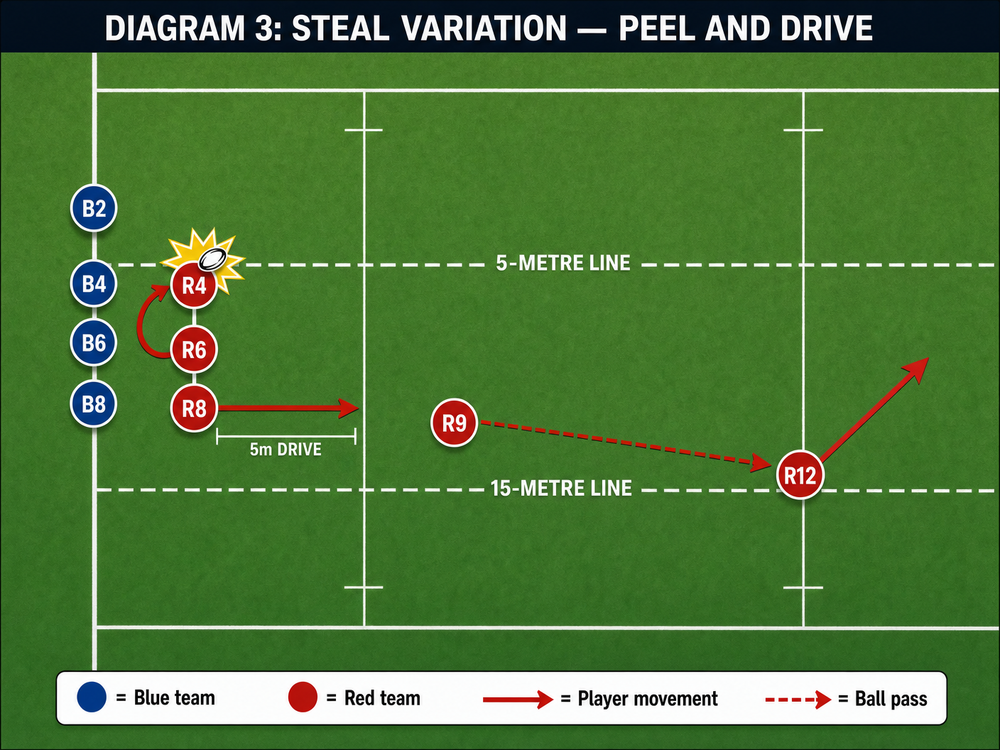
Pitch Location: Anywhere between your own 22-metre line and the halfway line.
Equipment: Rugby balls, training bibs (two colours).
Player Positions:
- Defending (Stealing) Team: Standard 7-man lineout structure.
- Key Roles: R4 (Lock/Jumper), R6 and R8 (Lifters), R9 (Scrum-half), R10 (Fly-half).
- Spacing: Ensure the 1-metre gap between teams is maintained to avoid early engagement penalties.

3. Step-by-Step Instructions
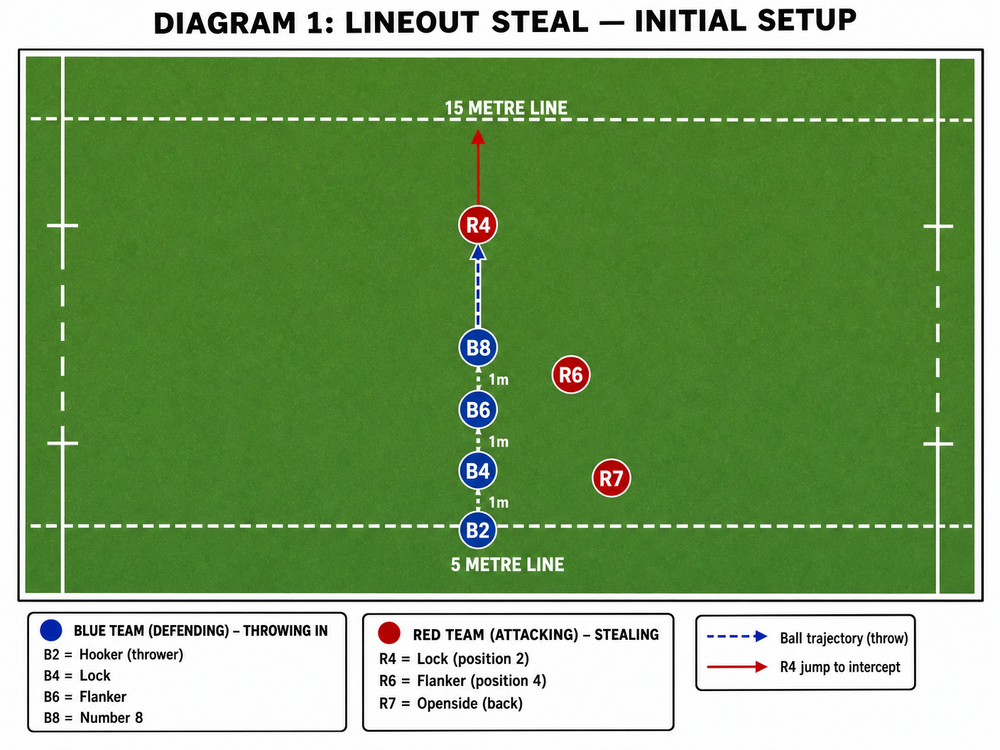
- The Read: As the opposition hooker (B2) approaches the mark, your defensive lineout caller (usually R4 or R5) must read the trigger movement. Watch the hooker's hands and the opposing jumpers' feet.
- The Dummy (Optional): Have a decoy jumper at the back of the lineout make a slight twitch to draw the throw to the front.
- The Lift: On the hooker's throwing motion, R6 (front lifter) and R8 (back lifter) must execute a rapid, explosive lift on R4. The lift must be straight up, ensuring R4 gets maximum elevation and hang time.
- The Steal: R4 extends both arms fully, keeping eyes on the ball, and intercepts the throw at its apex. The catch must be clean, pulling the ball tightly into the chest upon securing it.
- The Delivery: As R4 descends, they immediately present the ball to R9 (Scrum-half) who is sweeping around the back of the lineout.
- The Strike: R9 delivers a rapid pass to R10 (Fly-half) on the 15-metre line, exploiting the disorganized opposition defense that was expecting to attack.
4. Key Coaching Points
- Explosive Lifting: The speed of the lift is more important than the height. Lifters must get into a deep squat and drive through their legs simultaneously.
- Reading the Throw: Train your jumpers to watch the hooker's elbow drop—that is the point of no return for the throw.
- Air Space: The jumper must attack the space across the line of touch, reaching into the tunnel without crossing the 1-metre gap prematurely.
- Immediate Transition: The moment the ball is secured, the mindset must instantly switch from defense to attack. R9 must be vocal and demanding the ball.
5. Common Mistakes
- Closing the Gap Early: Lifters stepping into the 1-metre gap before the ball is thrown, resulting in a free-kick to the opposition.
- Slow Reaction Time: Waiting for the ball to leave the hooker's hands before initiating the lift. The lift must anticipate the throw.
- Poor Ball Presentation: The jumper securing the ball but getting tangled on the way down, leading to a messy breakdown or a turnover back to the opposition.
- Lifters Disengaging: Lifters dropping the jumper too early. They must support the jumper all the way back to the ground safely.
6. Variations & Progressions
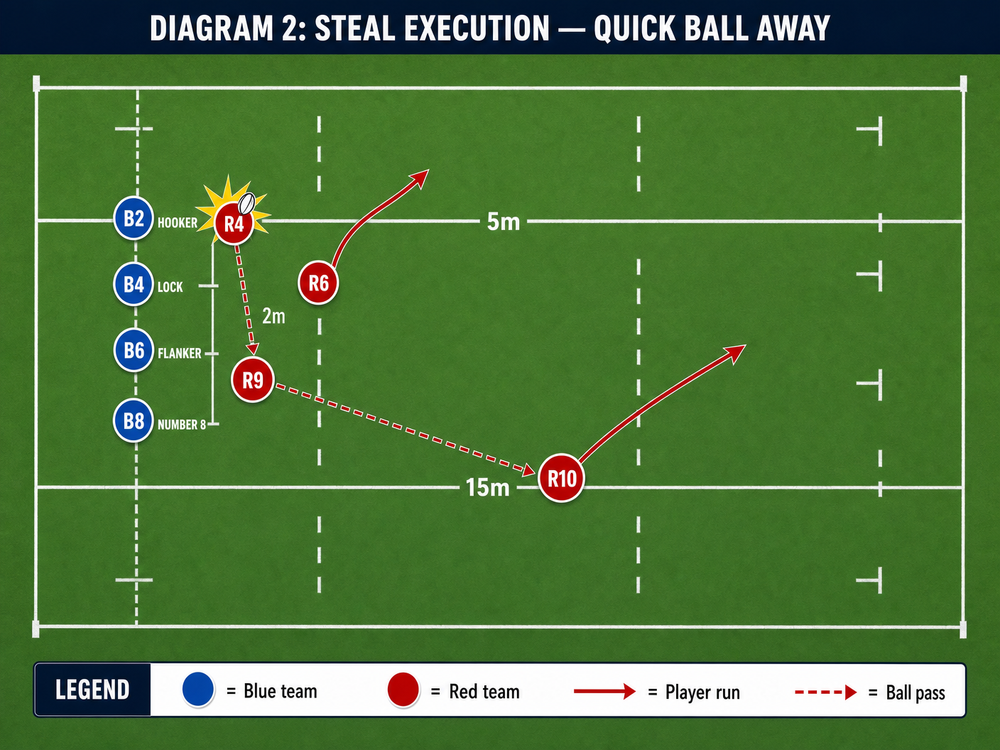
- The 'Peel and Drive': Instead of passing out to the backs, the jumper (R4) lands and immediately forms a maul with R6 and R8, driving forward to draw in opposition forwards before releasing the ball.
- The Back-Lifting Steal: Target the back of the lineout by lifting the Number 8 or blindside flanker if the opposition consistently throws long.
7. Age Adaptations
- Under 14s & Below: Lifting is not permitted. Focus on ground-based disruption, reading the throw, and competing for the loose ball once it hits the ground or the opposition jumper lands.
- Under 16s: Introduce basic lifting techniques focusing heavily on safety. Ensure lifters are matched in height and strength. The focus should be on the timing of the jump rather than maximum height.
- Open/Senior: Full execution with complex dummy jumps, varied lifting pods, and immediate attacking structures off the stolen ball.
