

Rugby
Lineout Steal Play: Winning Possession on Opposition Throw
Master the art of the lineout steal — a high-impact set-piece weapon that disrupts opposition ball, creates immediate attacking opportunities, and shifts psychological momentum in your favour.

What you need
Rugby ball (match specification), Cones (to mark 5m and 15m lines), Bibs in two colours, Coaching whiteboard or tablet, Video analysis device (optional, for pre-match scouting)
Overview
The lineout steal on opposition throw is one of the most tactically rewarding set-piece plays in rugby union. When executed correctly, it simultaneously denies the opposition a clean platform, creates an immediate turnover in a structured zone of the pitch, and delivers a significant psychological blow to the throwing team. Unlike a reactive turnover in open play, the lineout steal is premeditated, rehearsed, and triggered by intelligence-gathering — making it a genuine weapon in any well-prepared team's arsenal.
This play is most effectively deployed when your analysis has identified a pattern in the opposition hooker's throw — a consistent target zone, a telegraphed shoulder angle, or a predictable call sequence. It is also highly effective when the opposition lineout is under pressure from a recent mistake or when the game situation demands a momentum shift. Coaches should target this play in the opposition's own half, particularly within their 22-metre line, where a steal can lead directly to a scoring opportunity.
When to use this play:
| Situation | Rationale |
|---|---|
| Opposition hooker has a detectable tell | Pre-planned steal based on scouting |
| Opposition has thrown to the same zone twice | Pattern recognition mid-game |
| Your team needs a momentum shift | High-reward, high-impact play |
| Opposition lineout is under pressure | Exploit uncertainty and hesitation |
| Within 30m of the opposition try line | Immediate scoring opportunity if steal is won |
Setup
Equipment Required
- 1 rugby ball (match specification)
- Cones to mark the 5-metre and 15-metre lines (if not on a marked pitch)
- Bibs in two colours (attacking/opposition vs. defending/stealing team)
- Coaching whiteboard or tablet for pre-session walkthrough
Pitch Setup
Use a standard rugby union pitch (100m x 70m). The lineout is set up along the touchline, with the corridor between the 5-metre line and the 15-metre line forming the active zone. Ensure the touch line is clearly visible. Mark a 10-metre zone either side of the lineout to simulate the offside lines for backs.
Player Positions
| Position | Number | Role in This Play |
|---|---|---|
| Hooker | 2 | Monitors opposition hooker; communicates steal call |
| Loosehead Prop | 1 | Front lifter (if front steal) |
| Lock / Jumper | 4 | Primary lifter for stealing jumper |
| Lock / Jumper | 5 | Primary stealing jumper — the key operative |
| Blindside Flanker | 6 | Secondary lifter for stealing jumper |
| Openside Flanker | 7 | Tail-of-lineout runner; first receiver option post-steal |
| Number 8 | 8 | Decoy runner; forward carry option |
| Scrum-half | 9 | First receiver from jumper; directs attack post-steal |
| Fly-half | 10 | Positioned 10m from lineout; triggers backline attack |

Diagram 1 shows the initial lineout alignment. The defending team (navy) positions the stealing jumper (5) with lifters (4) and (6) flanking, ready to contest the opposition throw. The scrum-half (9) holds 2 metres behind the lineout to receive the stolen ball.
Step-by-Step Instructions

Phase 1: Pre-Lineout Intelligence (Before the Throw)
Step 1 — Assign a Scout. Before the lineout forms, your hooker (2) or an assigned player must watch the opposition hooker's body language as they receive the ball. Key tells include: foot angle relative to the touchline, shoulder rotation, and eye direction. This information is communicated via a pre-agreed code word or hand signal.
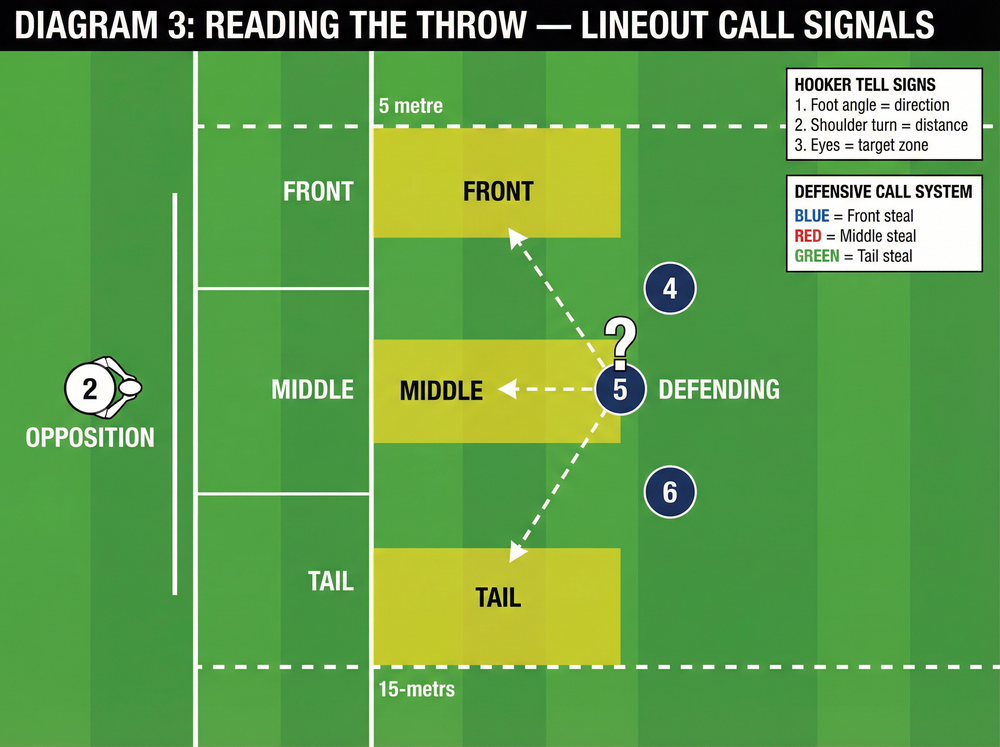
Step 2 — Call the Steal Zone. Once the scout has identified the likely target zone (Front, Middle, or Tail — see Diagram 3), the call is relayed to the lineout. Use a colour-coded system: Blue = Front steal, Red = Middle steal, Green = Tail steal. The call must be made before both teams set.
Step 3 — Set the Lineout Formation. The stealing team sets up in a standard-looking lineout to avoid telegraphing the steal. The jumper (5) and lifters (4 and 6) position themselves at the identified steal zone. Spacing between players should be 1 metre apart as per Law 19. The flanker (7) holds at the tail, and the number 8 (8) positions as a decoy at the rear.

Diagram 3 illustrates the three target zones (Front, Middle, Tail) and the hooker tell-sign reading system. The defending jumper (5) uses pre-throw intelligence to pre-position at the correct zone before the ball is in the air.
Phase 2: The Steal Execution
Step 4 — Timing the Jump. The single most important technical element. The jumper (5) must initiate the lift as the opposition hooker's arm begins to accelerate forward — not when the ball leaves the hand. This gives the defending jumper the split-second advantage needed to reach the ball at its apex. Lifters (4) and (6) must be synchronised; a count of "one-two-lift" on the jumper's verbal cue is recommended.
Step 5 — Contesting the Ball. The jumper (5) reaches across the lineout gap with both hands, aiming to intercept the ball at its highest point before the opposition jumper can secure it. The jumper must keep their body square and avoid making contact with the opposition player before the ball arrives — this is a penalty risk. The goal is clean hands on the ball, not physical disruption.
Step 6 — Securing and Distributing. Once the ball is won, the jumper (5) must immediately look to distribute. The preferred option is a clean two-handed pass downward to the scrum-half (9), who should already be moving into position 2 metres behind the lineout. Holding the ball in the air for more than one second dramatically increases the risk of a knock-on or turnover.
Phase 3: Post-Steal Attack
Step 7 — Scrum-Half Decision. The scrum-half (9) has two primary options upon receiving the stolen ball:
- Option A — Attack Open Field: Wide pass to the fly-half (10) to exploit the disorganised opposition backline. This is the preferred option when the steal is clean and the opposition backs are caught flat-footed.
- Option B — Forward Carry: Quick ball to a forward pod (props 1 and 3, with hooker 2) driving into the gain line. Used when the opposition defence is already organised or when field position demands a conservative approach.
Step 8 — Flanker Peel. Simultaneously with the scrum-half's decision, the flanker (7) peels around the tail of the lineout as a secondary running option. This creates a two-pronged threat and forces the opposition to commit defenders to both channels.

Diagram 2 shows the steal execution moment and the two post-steal attack options. The jumper (5) wins the ball (star symbol), the scrum-half (9) distributes, and the flanker (7) peels around the tail. Option A attacks open field; Option B drives through a forward pod.
Key Coaching Points

Intelligence before execution. The steal only works consistently when it is based on pre-identified patterns. Spend time in your pre-match analysis identifying the opposition hooker's throw tendencies. A steal attempted without intelligence is a gamble; a steal based on a confirmed tell is a calculated play.
Timing is everything — jump early, not late. The defending jumper must be in the air before the ball arrives. Coaches should use the cue: "You are not reacting to the ball — you are anticipating it." Drill this by having the jumper call their own lift rather than waiting for the hooker to throw.
Lifter synchronisation is non-negotiable. A mistimed lift is worse than no lift — it exposes the jumper to injury and produces an uncontested ball for the opposition. Lifters must train together as a unit, developing a shared rhythm. Use a verbal count in training until the timing becomes instinctive.
Clean hands, clean distribution. The jumper must prioritise a clean pass over holding the ball. A two-handed downward pass to the scrum-half is the gold standard. Practise this in isolation before adding the full lineout context.
Scrum-half must pre-read the defence. The scrum-half (9) should be scanning the opposition backline as the lineout forms, not waiting until the ball arrives. By the time the steal is won, the decision between Option A and Option B should already be made.
Maintain legal body position throughout. Players must not make contact with opposition players before the ball is in the air. Coaches must be strict about this in training — a penalty conceded from an illegal steal attempt is a worse outcome than not attempting the steal at all.
Common Mistakes

Jumping too late. The most common error. Players instinctively wait to see where the ball is going before committing to the jump. Correct this by drilling the jumper to key off the hooker's arm movement, not the ball's flight path. Use video analysis to show players the timing window they are missing.
Lifters not synchronised. When one lifter goes early and the other is late, the jumper is twisted in the air and cannot compete effectively. Run dedicated lifting drills without a ball — focus purely on the lift mechanics and shared timing before introducing the throw.
Jumper making contact before the ball arrives. This is a penalty every time. Often caused by the jumper leaning across the lineout gap too early. Reinforce the rule: "Hands go up, not across." The jumper should be rising vertically until the ball is within reach.
Scrum-half too close to the lineout. If the scrum-half is standing within 1 metre of the lineout, they have no time to react to a stolen ball and risk being caught in contact. The correct position is 2 metres behind the last foot of the lineout, giving them a clear view and reaction time.
No post-steal plan. Teams that successfully steal the ball but have no pre-agreed attack structure often squander the turnover. The steal must always be paired with a rehearsed continuation play. Never practise the steal in isolation — always run it through to a scoring attempt.
Variations & Progressions

Variation 1 — The Decoy Steal (Intermediate)
Set up the steal as normal but have the jumper (5) make a visible movement toward the opposition's front jumper as a decoy, before the lifters redirect and lift at the middle or tail. This exploits opposition teams who have identified your steal tendency and are defending the front. Requires excellent communication between the jumper and lifters.
Variation 2 — The Tail Steal with Number 8 Pick-and-Go (Advanced)
Position the steal at the tail of the lineout. When the ball is won and passed to the scrum-half (9), the number 8 (8) drives a short line off the scrum-half's shoulder into the narrow channel between the lineout and the touchline. This is particularly effective near the opposition try line where space is limited and a direct carry can produce a try.
Progression — Live Opposition with Full Backlines (Advanced)
Once the steal mechanics are clean, run the full play against a live opposition lineout with both backlines active. The attacking team must complete the steal and score within four phases. This replicates match conditions and forces all players — not just the lineout unit — to execute their roles under pressure.
Age Adaptations

Under 12 and Below
At this level, lifting in the lineout is not permitted under World Rugby regulations. Focus instead on the reading and timing elements of the steal — players should practise jumping to contest the ball at their natural height without lifting. Emphasise the concept of "winning your own ball" before introducing the idea of contesting opposition throws. Use a modified lineout with a lower throw to develop the timing and hand skills.
Under 14 — Under 16
Lifting is introduced at Under 14 level. Begin with the mechanics of the lift in isolation before combining with the steal timing. At this age, the focus should be on two-player lifts (front and back lifter) rather than the full three-player pod. Simplify the call system to two zones (Front or Back) rather than three. Ensure all lifting technique is coached by a qualified coach with appropriate player welfare protocols in place.
Open Age (Senior)
The full play as described above is appropriate for senior players. Add complexity by introducing multiple steal options in a single lineout (e.g., the jumper reads the throw live and calls the zone themselves rather than relying on a pre-set call). At elite level, integrate video analysis sessions where players review opposition lineout footage and identify steal opportunities before match day.
