

Rugby
Mastering the Maul: Formation and Drive Mechanics
Equip your forward pack with the technical foundation to set, bind, and drive a devastating rolling maul from the lineout or open play.

What you need
Rugby balls (2-3), Tackle shields / hit pads (4), Marker cones
Overview
The rolling maul is one of the most potent attacking weapons in modern Rugby Union. When executed correctly, it forces the defense to commit numbers, creates massive forward momentum, and often results in penalties or tries. This drill is designed to teach the fundamental mechanics of the maul: the initial catch and bind, the transition of the ball to the back, and the collective drive forward. It is ideal for forwards looking to refine their set-piece dominance, particularly from a 5-meter or 22-meter lineout scenario. By focusing on body height, binding tightness, and synchronized footwork, coaches can develop a pack that is unified and difficult to stop.
Setup

To run this drill effectively, you will need a designated area on the pitch, ideally near the 22-meter line to simulate realistic attacking scenarios.
- Pitch Area: A 20m x 20m grid, or use the 5m to 15m channels near the touchline.
- Equipment: 2-3 Rugby balls, 4 tackle shields or hit pads for the defenders, and cones to mark the gain line and starting positions.
- Players: Minimum of 12 players (8 attackers representing the forward pack, and 4 defenders with pads).
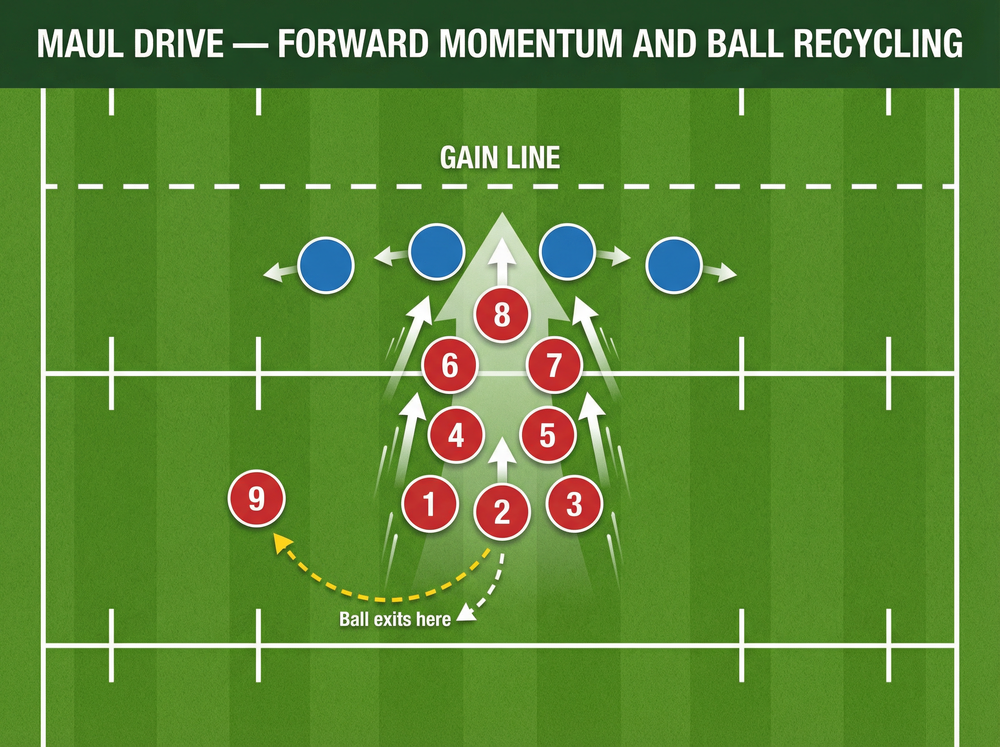
- Positions: Attackers should line up in their standard forward roles (Props 1 & 3, Hooker 2, Locks 4 & 5, Flankers 6 & 7, Number Eight 8). A Scrum-half (9) can be added to extract the ball.

Step-by-Step Instructions

- The Catch and Set: The drill begins with a simulated lineout throw or a short pop pass to the jumper (usually a Lock, 4 or 5). The jumper catches the ball and immediately returns to the ground, turning their back to the opposition to protect the ball.
- The Initial Bind (The Lifters): The two players who supported the jumper (often the Props, 1 and 3) must immediately bind onto the jumper. They should bind tightly on the jumper's hips or waist, creating a solid three-man wedge that anchors the maul.
- The Secondary Bind (The Drive): The remaining forwards (Hooker 2, the other Lock, and Flankers 6 & 7) arrive and bind onto the initial wedge. They must come in low, binding onto their teammates, not the opposition. The ball is simultaneously transferred from the jumper to the player at the very back of the maul (often the Number Eight, 8, or Hooker, 2).
- The Drive Command: Once the ball is secured at the back and the pack is fully bound, the designated leader calls "Drive!" The entire pack takes synchronized, short, chopping steps forward.
- Maintaining Momentum: As the pad-holding defenders provide resistance, the attacking pack must keep their hips low and backs straight. If the maul stalls, the leader should call to shift the drive slightly left or right to find a weak point in the defense.
- The Exit: After driving for 5 to 10 meters past the marked gain line, the Scrum-half (9) calls for the ball. The player at the back presents the ball cleanly for the 9 to pass away, or breaks off to score if close to the try line.
Key Coaching Points

- Body Height: Players must maintain a low center of gravity. Hips should be below the shoulders, and knees bent. A high maul is easily choked or collapsed by the defense.
- Tight Binding: The maul must be a single, cohesive unit. Players must bind onto bodies (jerseys or waists), not just arms. There should be no daylight between the attacking players.
- Ball Transfer: The ball must be moved to the back of the maul as quickly and securely as possible. It should be handed back, not thrown, to protect it from defensive interference.
- Synchronized Footwork: The drive comes from short, powerful, synchronized steps. Long strides cause players to lose balance and break the bind.
- Patience: Do not break away too early. The ball carrier at the back must trust the forwards in front of them and wait for the momentum to build before deciding to exit.
Common Mistakes

- Joining Ahead of the Ball: Players joining the maul must enter from behind the hindmost foot of their teammates. Joining from the side is an "entry" penalty.
- High Body Position: Standing too upright allows defenders to get underneath the drive, stall the momentum, and potentially earn a turnover (choke tackle).
- Fragmenting: When players break their bind to push individually, the maul loses its structural integrity and forward power. The pack must drive as one.
- Exposing the Ball: If the ball carrier at the back turns sideways or separates from the pack, they become vulnerable to being tackled or stripped of the ball.
Variations & Progressions
- Dynamic Defense: Replace the tackle pads with live defenders who actively try to stop or legally sack the maul. This increases the realism and forces the attackers to adapt their drive.
- Changing the Point of Attack: Introduce a call where the maul intentionally shifts its driving angle to the left or right to exploit defensive weaknesses.
- Backline Integration: Have the Scrum-half distribute the ball to a waiting backline after a successful 10-meter drive, linking the forward set-piece to open-field attack.
Age Adaptations
- Under 10s / Under 12s: Focus purely on the safety of the bind and the concept of staying on feet. Keep the numbers small (e.g., 3 vs 3) and do not emphasize the competitive drive. Ensure all players understand the offside lines.
- Under 14s / Under 16s: Introduce the transfer of the ball to the back and the synchronized driving steps. Begin using tackle pads for resistance. Emphasize body height and legal entry.
- Open / Seniors: Full 8-man pack integration with live, dynamic defense. Focus on advanced tactics like shifting the drive, peeling off, and exploiting the blindside.
