

Rugby
The Dominant Ruck: Clear-Out and Clean-Out Mastery
Equip your players with the technique and aggression needed to secure quick ball and dominate the breakdown area.

What you need
Rugby balls, Cones, Tackle shields, Tackle bags
1. Overview
Winning the collision is only half the battle; securing the ball at the breakdown is what dictates the tempo of your attack. The 'Dominant Ruck' drill is designed to train arriving players to identify threats, enter through the 'gate' legally, and apply explosive power to clear out defenders. This drill focuses on body height, binding, and the aggressive leg drive required to provide your scrum-half with lightning-quick ball.
2. Setup
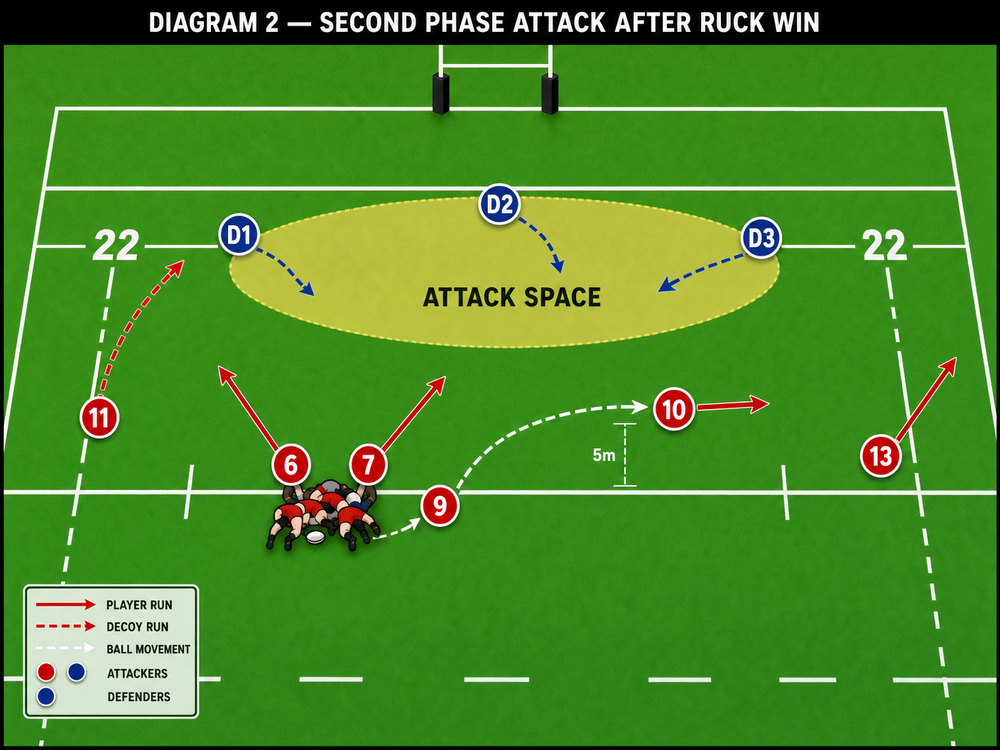
Pitch Setup:
Set up a 10m x 10m grid. This tight space simulates the high-traffic area of a match breakdown. Place a tackle bag or a live ball-carrier in the centre of the grid to represent the tackled player.
Player Positions:
- Attackers: 3 players acting as the arriving support (e.g., 6, 7, 8).
- Defenders: 2 players holding tackle shields (D1 and D2), standing over the tackled player.
- Scrum-half (9): Positioned 1m behind the ruck, ready to clear the ball.

3. Step-by-Step Instructions
- The Tackle: On the coach's whistle, the ball-carrier hits the ground in the centre of the grid, presenting the ball cleanly back towards their team.
- The Threat Identification: The two defenders (D1 and D2) step over the ball-carrier, attempting to jackal or disrupt the ball.
- The Approach: The first arriving attacker (e.g., the 6) sprints towards the breakdown. They must drop their body height 2 metres before contact, ensuring they enter strictly through the 'gate' (from behind the hindmost foot of the tackled player).
- The Clear-Out: The first attacker makes contact with D1, aiming to get under their chest/shield. They must bind tightly and use short, explosive steps to drive D1 back and away from the ball.
- The Clean-Out: The second arriving attacker (e.g., the 7) targets D2, repeating the process to completely secure the breakdown area.
- The Guard: The third attacker (e.g., the 8) arrives and binds onto the ruck to provide stability and guard against any late counter-rucking attempts.
- The Delivery: Once the ball is secured and the defenders are cleared, the scrum-half (9) steps in and passes the ball away to initiate the next phase.
4. Key Coaching Points
- Drop the Height Early: Players must lower their centre of gravity well before contact. "Chin off the chest, eyes up, flat back."
- Enter Through the Gate: Emphasize legality. Coming in from the side results in a penalty. Players must arrive square and from the correct angle.
- Win the Shoulder Battle: The clear-out player must get their shoulder under the defender's sternum. Low to high leverage is crucial.
- Pumping Legs: Initial contact isn't enough. Players must keep their legs driving with short, powerful steps to displace the defender.
- Bind Tight: The clear-out player must grip the defender or their own teammate to ensure they don't slip off the contact area.
5. Common Mistakes
- Coming in Too High: Players arriving upright are easily repelled or penalized for dangerous play.
- Entering from the Side: A frequent penalty offense. Ensure players understand the dimensions of the 'gate'.
- Diving Off Feet: Players must stay on their feet during the clear-out to remain legal and effective. "Stay strong on your pegs."
- Ignoring the Ball: Players get so focused on hitting the defender that they step on or kick the ball out of the ruck.
6. Variations & Progressions
- Progression 1: Live Defenders. Remove the tackle shields and use live defenders (in full contact gear) to increase the realism and difficulty of the clear-out.
- Progression 2: Multi-Phase. Set up three consecutive grids. Once the ball is cleared from grid 1, the scrum-half passes to a new pod of forwards who carry into grid 2, requiring a continuous cycle of clear-outs.
- Variation 1: The Jackal Focus. Have the defender actively try to get their hands on the ball (jackal) rather than just holding a shield. The clear-out player must react quicker to remove the threat.
7. Age Adaptations
- Under 8s to Under 10s: Focus purely on the body position (tower of power) and safe entry using tackle bags. No live counter-rucking.
- Under 12s to Under 14s: Introduce live, controlled opposition. Emphasize the legalities of the gate and staying on feet.
- Under 16s to Open: Full contact, game-speed scenarios. Focus on decision-making (e.g., do I need to clear out, or is the ball already won?).
