

Netball
Three-Stage Attacking Play from Defence
A highly effective transition set play that moves the ball from the defensive goal circle to the attacking shooting circle in three rapid, structured phases.
What you need
1 Netball, 7 Coloured Bibs (GK, GD, WD, C, WA, GA, GS), Full marked Netball court
1. Overview
The "Three-Stage Attacking Play from Defence" is a fundamental transition strategy designed to rapidly move the ball from a defensive turnover or baseline throw-in straight into the attacking shooting circle. By breaking the court (30.5m x 15.25m) into three distinct zones, this play ensures that every pass is purposeful, reducing the likelihood of mid-court interceptions. It relies on sharp, angled drives and precise timing, allowing your team to dictate the pace of the game. This set play is particularly effective against teams that employ a loose, unstructured zone defence, as it exploits the gaps between their defensive lines through coordinated player movements.
2. Setup
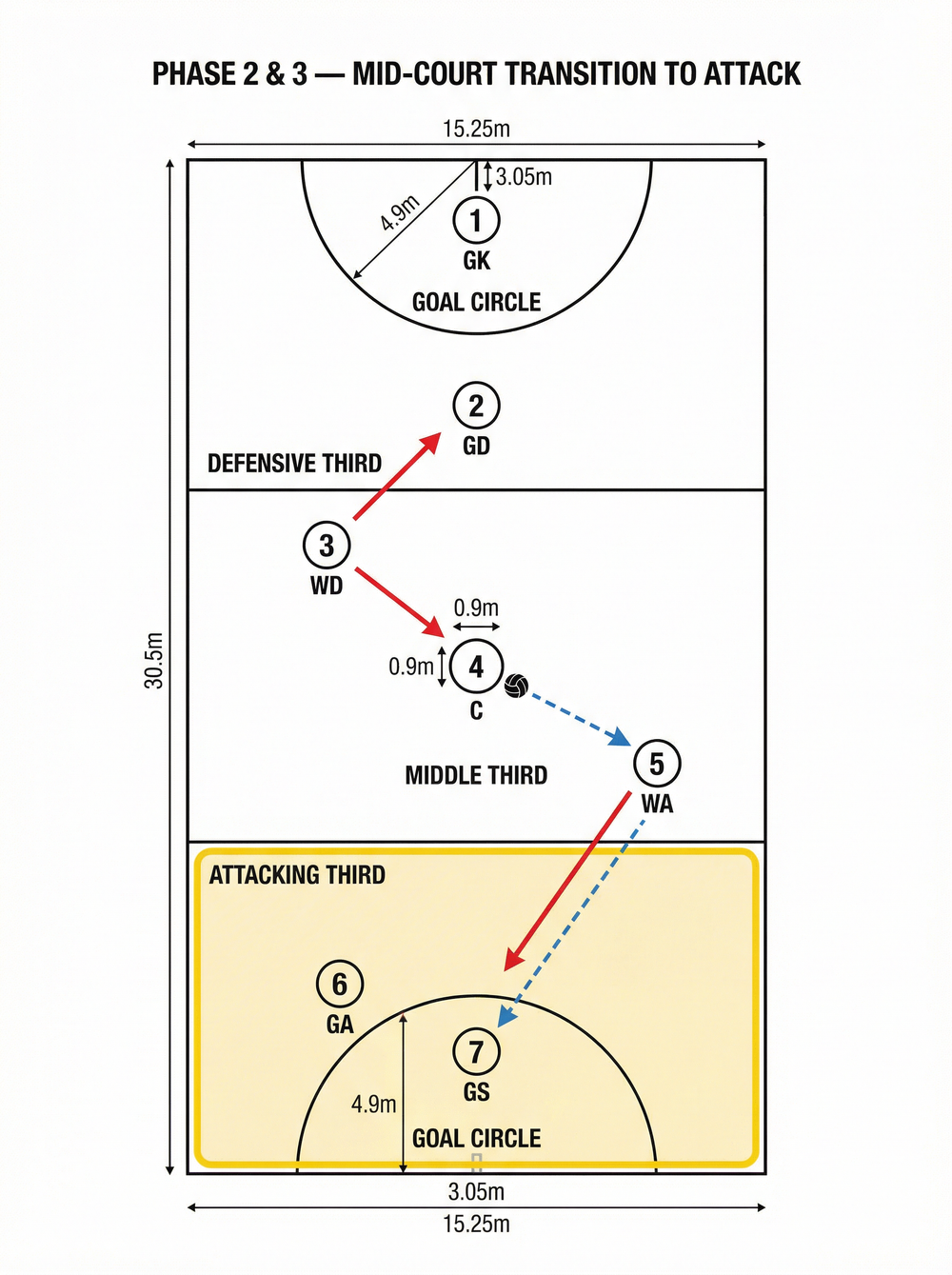
To execute this set play effectively during practice, ensure your court is fully marked with the standard transverse lines dividing the court into thirds, a centre circle (0.9m diameter), and two shooting circles (4.9m radius).
Player Positions:
- GK (Goal Keeper): Positioned inside the defensive goal circle, initiating the play.
- GD (Goal Defence): Positioned in the defensive third, ready to offer the first wide option.
- WD (Wing Defence): Positioned on the left side of the defensive third, preparing to drive down the sideline.
- C (Centre): Positioned centrally, just behind the centre circle, acting as the primary link player.
- WA (Wing Attack): Positioned on the right side of the middle third, preparing for a diagonal cut.
- GA (Goal Attack): Positioned in the attacking third, ready to work the top of the shooting circle.
- GS (Goal Shooter): Positioned deep inside the attacking shooting circle, holding space near the post.
3. Step-by-Step Instructions
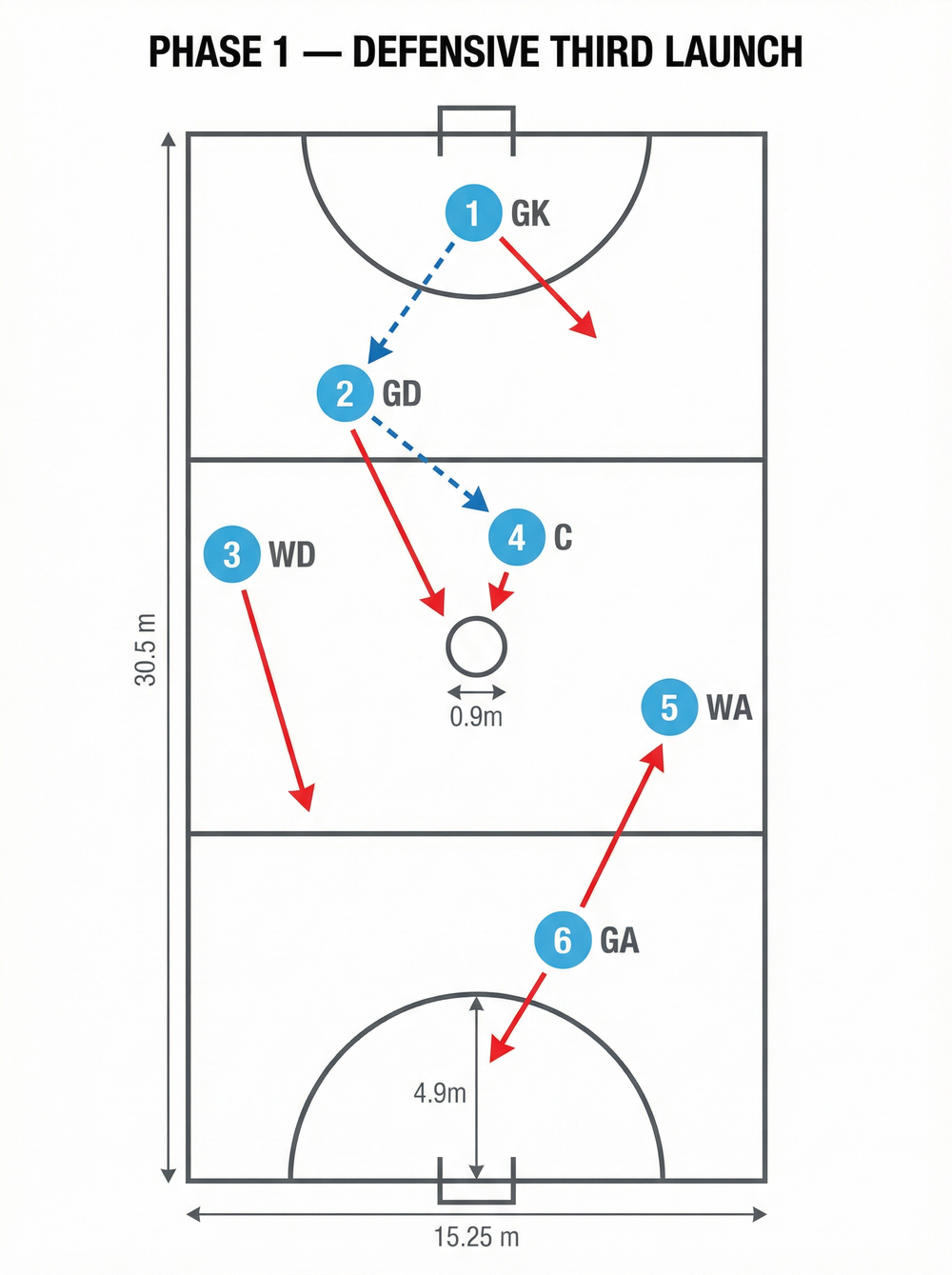
Phase 1: Defensive Third Launch
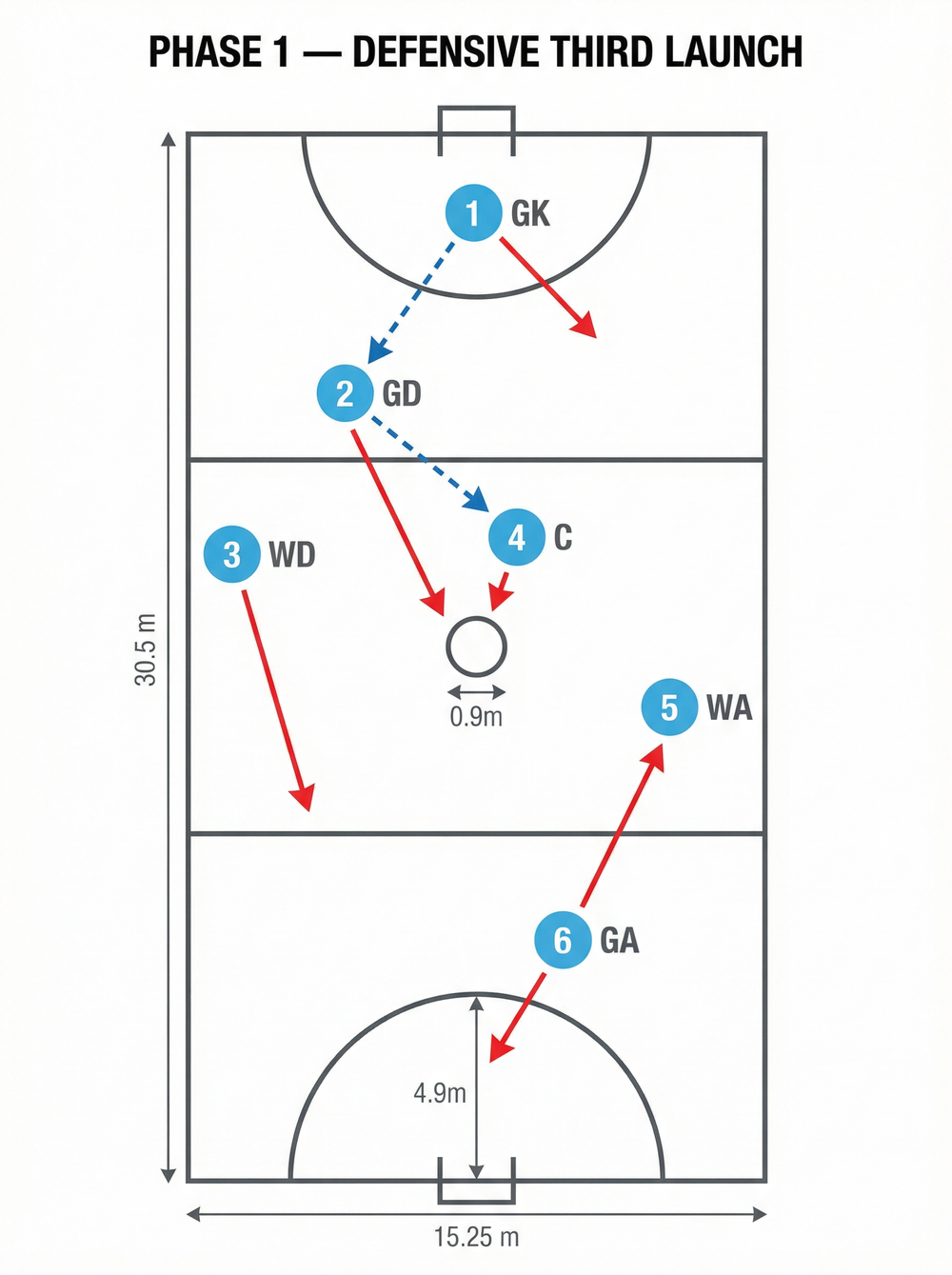
- Initiation: The play begins with the GK holding the ball inside the defensive goal circle, either from a turnover or a backline throw-in.
- First Option: The GD makes a sharp, angled drive towards the sideline in the defensive third to receive the first pass from the GK. This draws the opposing attackers wide.
- Central Link: As the GD receives the ball, the C drives forcefully towards the transverse line, presenting a strong, central target. The GD immediately passes the ball to the C.
- Decoy Movement: Simultaneously, the WD drives down the opposite sideline to stretch the defence and create space in the middle channel.
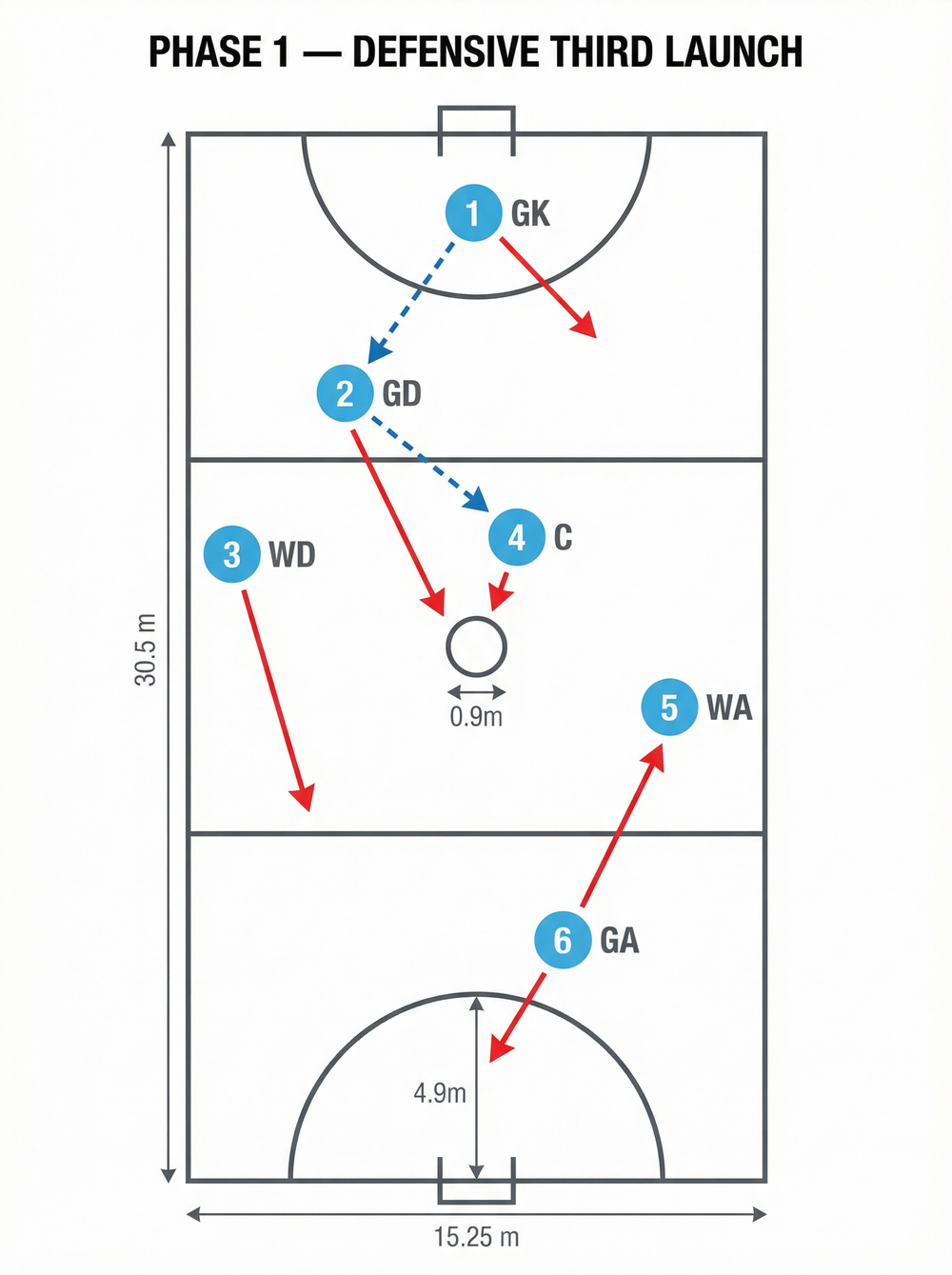
Phase 2: Mid-Court Transition
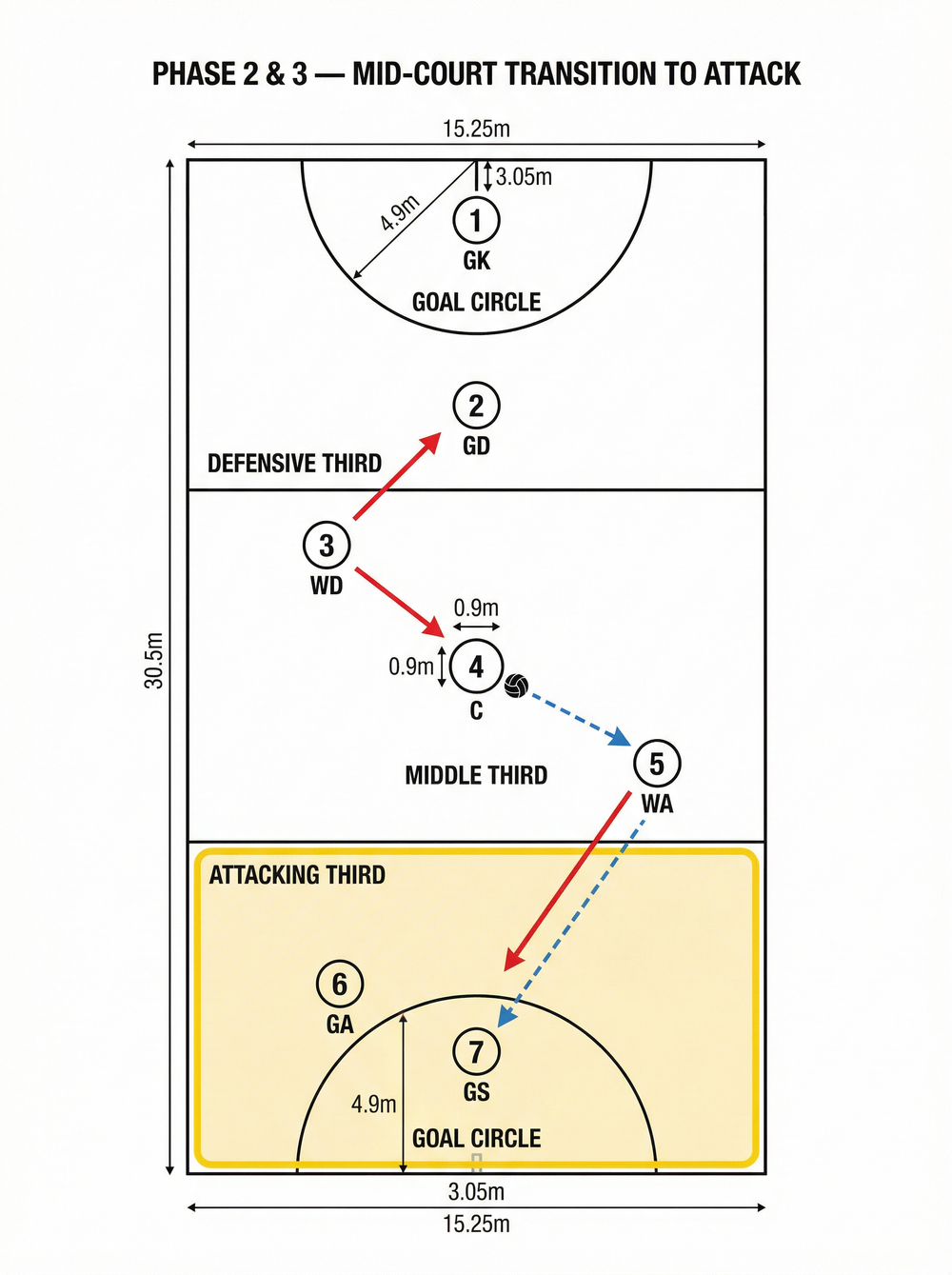
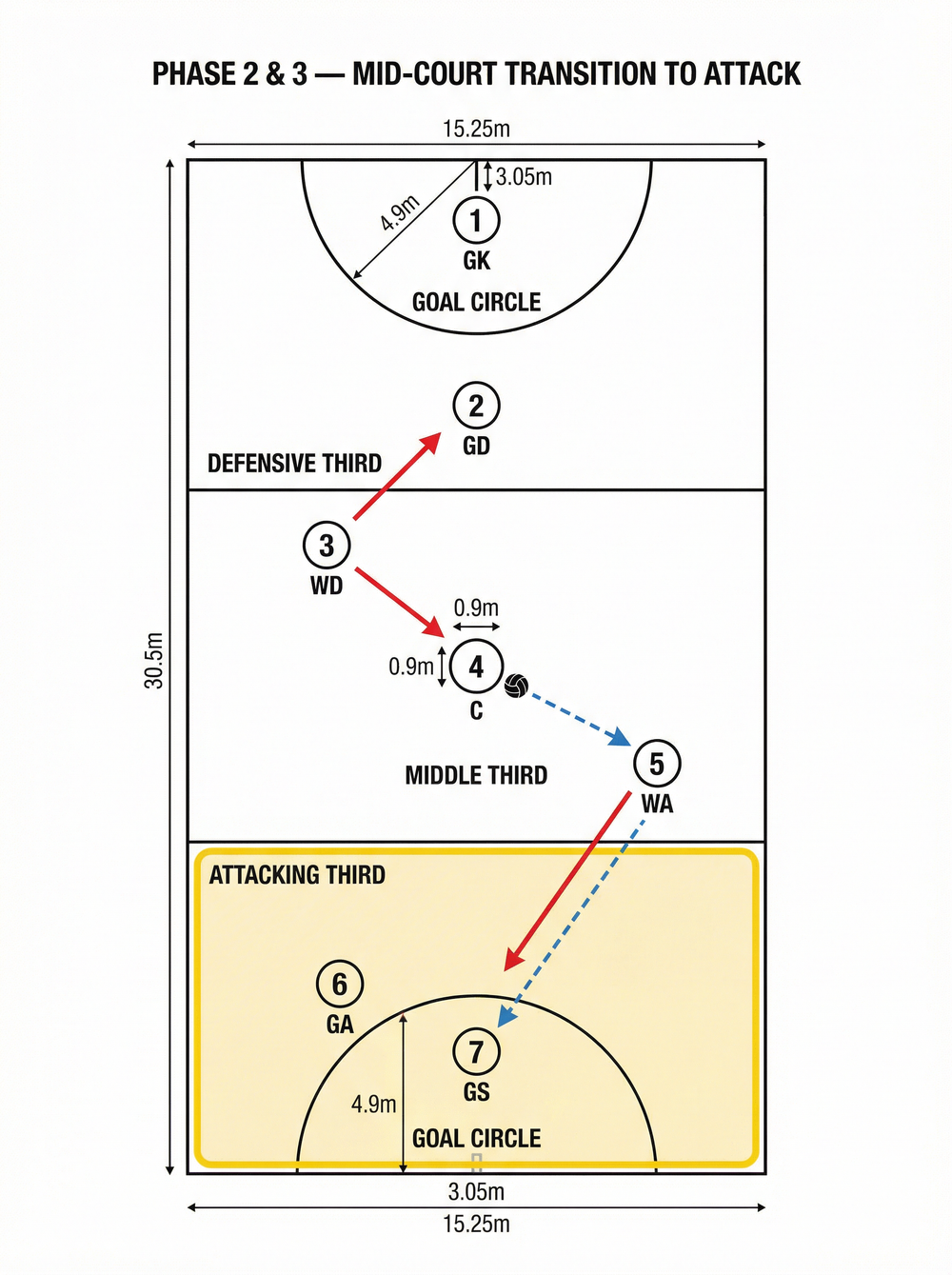
- Receiving the Link: The C catches the ball near the centre circle, landing balanced and with strong vision down the court.
- Diagonal Cut: The WA, starting from the right side of the middle third, makes a hard, diagonal cut across the court towards the top of the attacking shooting circle.
- The Penetrating Pass: The C delivers a flat, fast pass to the driving WA. Timing is critical here; the WA must receive the ball at full extension just outside the circle edge.
Phase 3: Attacking Third Finish
- Circle Edge Delivery: As the WA lands with the ball at the circle edge, the GA sweeps across the top of the circle to pull the opposing GD away from the post.
- Holding Space: The GS holds strong positioning under the goal post, sealing off the opposing GK.
- The Final Feed: The WA assesses the circle and delivers a high, floating pass or a sharp bounce pass directly to the GS for the shot.
4. Key Coaching Points
- Timing over Speed: Emphasize that players must time their drives so they are hitting the space exactly as the ball carrier is ready to pass. Early drives clog the space.
- Strong First Pass: The initial pass from the GK to the GD must be firm and wide to immediately stretch the opposing defence and open up the middle channel.
- Landing on the Outside Foot: Coach your mid-courters (C and WA) to land on their outside foot when receiving the ball on the run, allowing them to naturally turn their hips down the court for the next pass.
- Vision Down Court: The Centre (C) must have their eyes up before they even catch the ball, assessing the WA's diagonal cut to ensure a rapid, seamless transition.
- Decoy Importance: Remind the WD and GA that their off-the-ball movements are just as crucial as the ball carriers, as they manipulate the defence and create the necessary passing lanes.
5. Common Mistakes
- Crowding the Middle: Players often drift towards the centre channel too early, bringing their defenders with them and choking the passing lanes. Ensure wide players start wide.
- Floating Passes: Mid-court transition passes (from C to WA) are often thrown too high and loopy, allowing defenders time to intercept. Demand flat, chest-height passes.
- Holding the Ball Too Long: If the C or WA hesitates and holds the ball for more than 2 seconds, the momentum of the transition is lost, and the defence will reset.
- Lack of Eye Contact: Passers releasing the ball before making eye contact with the driver, resulting in turnovers or passes behind the receiver.
6. Variations & Progressions
- Progression 1: Add Passive Defenders: Introduce 3-4 passive defenders who only shadow the movements without attempting to intercept. This forces the attackers to adjust their timing and passing angles under light pressure.
- Progression 2: The "Reset" Option: Teach the players a reset call. If the WA's diagonal cut is covered, the C must immediately pivot and pass backward to the trailing WD, who then switches the play to the opposite side of the court.
- Variation 1: The GA Front Cut: Instead of the WA taking the primary diagonal cut, have the GA drive out of the attacking third into the middle third to receive the pass from the C, leaving the WA to feed the circle.
7. Age Adaptations

- Under 10s / Beginners: Simplify the play into just two stages. Focus heavily on the basic pass from the GK to the GD, and then a simple pass to the C. Do not worry about the complex diagonal cuts; just encourage them to look for the next closest player down the court.
- Under 14s / Intermediate: Introduce the strict timing of the WA's diagonal cut. At this age, players should be able to execute the C to WA pass consistently. Focus on the quality of the pass and the landing footwork.
- Under 16s / Advanced: Run the full three-stage play against a live, full-court defence. Introduce the variations and progressions, requiring the players to read the defence and make split-second decisions on whether to use the primary option or the reset.
