

Football
Wing Overload Attacking Play: Breaking Down Deep Blocks
Master the art of creating numerical superiority on the flanks to deliver high-quality crosses and finish with precision.

What you need
Full-size football pitch, 1 full-size goal, 10-12 training bibs, 10 footballs, Training cones
1. Overview
The Wing Overload Attacking Play is a tactical maneuver designed to break down compact, deep-defending opponents by creating numerical superiority (an overload) on one side of the pitch. By drawing the opposition's defensive block toward the flank, attacking teams can isolate defenders, create 2v1 situations, and generate high-quality crossing opportunities. This set play is particularly effective when facing a stubborn 4-4-2 or 5-4-1 low block, as it forces defenders to make difficult decisions regarding marking and space coverage.
2. Setup

Equipment Needed:
- Full-size football pitch (100-110m x 64-75m)
- 1 full-size goal
- 10-12 training bibs (two different colors)
- Minimum of 10 footballs
- Training cones to mark starting positions
Player Positions:
- No.10 (Attacking Midfielder): The primary playmaker positioned in the central channel.
- No.7 (Left Winger): Positioned high and wide on the left touchline to stretch the play.
- No.11 (Left Back): Positioned deeper on the left flank, ready to make a dynamic overlapping run.
- No.9 (Centre Forward): Positioned centrally inside the penalty area, occupying the center-backs.
- No.8 (Box-to-Box Midfielder): Positioned centrally, preparing for a late run into the box.
3. Step-by-Step Instructions


Phase 1: Wide Overload Setup
- Initial Circulation: The ball is circulated horizontally to the No.10 in the central channel, drawing the opposition midfield block slightly inward.
- The Trigger Pass: No.10 plays a firm, accurate pass out wide to No.7, who has maintained maximum width on the touchline.
- The Overlap: As the ball travels to No.7, No.11 initiates a high-speed overlapping run down the outside channel, forcing the opposition full-back to make a choice: step to No.7 or track No.11.
- The Engagement: No.7 receives the ball and drives inside slightly, engaging the opposition full-back and creating space for No.11's run.
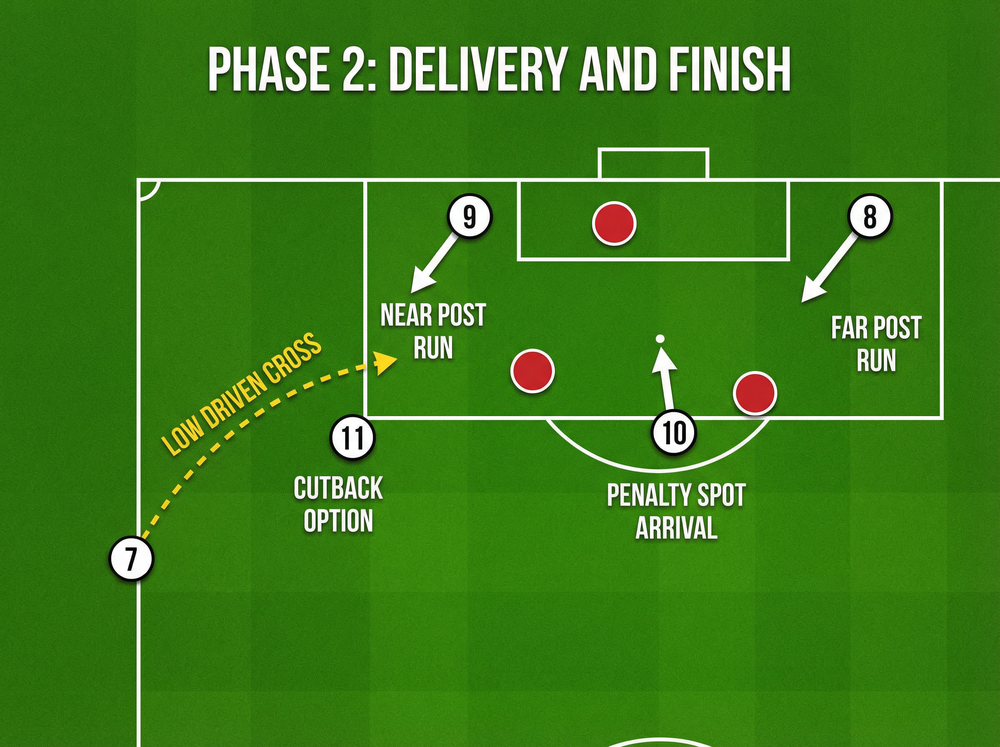
Phase 2: Delivery and Finish
5. The Release: No.7 slips a perfectly weighted pass into the path of the overlapping No.11 near the byline.
6. Box Movement: As No.11 prepares to cross, three distinct runs occur simultaneously:
- No.9 makes an aggressive, darting run across the near post to drag the near-side center-back.
- No.8 makes a late, looping run toward the far post to exploit the blind side.
- No.10 arrives at the penalty spot area for a potential cutback.
- The Delivery: No.11 delivers a low, driven cross across the face of the goal or a cutback to the penalty spot.
- The Finish: The attacking player meets the ball with a first-time finish, aiming for the corners of the net.
4. Key Coaching Points

- Timing of the Overlap: The left-back (No.11) must time their run perfectly—arriving at top speed just as the winger (No.7) is ready to release the ball.
- Quality of the Trigger Pass: The initial pass from No.10 must be played with sufficient pace to the winger's preferred foot.
- Coordinated Box Runs: Near post, far post, and penalty spot must be filled simultaneously.
- Body Shape on Delivery: The crossing player must wrap their foot around the ball to generate pace and curve.
5. Common Mistakes

- Static Wing Play: The winger receives the ball standing still, allowing the defense to shift.
- Predictable Runs: Straight runs instead of diagonal, crossing runs.
- Poor Spacing: Overlapping player running too close to the winger.
- Lack of Cutback Option: All attackers rushing the six-yard box.
6. Variations & Progressions
- The Underlap Variation: No.11 makes an inside run through the half-space while No.7 stays wide.
- Opposite Flank Switch: Draw defense to one side, then switch to the isolated opposite winger.
- Adding Defenders: Progress from passive to fully active defending.
7. Age Adaptations
- Under 10s: Focus purely on the 2v1 aspect on the wing. Simplify the box runs to just one player attacking the goal.
- Under 14s: Introduce the concept of the third-man run and specific penalty area zones.
- Under 16s to Open: Implement the full tactical pattern with all moving parts.
