Player Training
Apple Watch Apps for Basketball Training: A Coach’s Practical Guide
Learn how coaches can use Apple Watch apps to make basketball training more intentional, track effort responsibly and build better player habits. Includes three practical youth basketball drills and a simple team workflow.

Apple Watch Apps for Basketball Training: A Coach’s Practical Guide
Basketball coaches do not need more data for its own sake. They need quick, useful signals that help players practise with purpose, manage effort and arrive at the next session ready to work. Used well, Apple Watch apps can turn an individual workout or a busy team practice into a repeatable learning loop: set a target, complete focused work, review the result and make one adjustment.
For youth teams, the watch should support coaching rather than interrupt it. The most effective setup gives players simple interval cues and prompts reflection after training. This guide explains what to look for in Apple Watch apps for basketball training, how to introduce them responsibly and three drills that turn wearable data into better on-court habits.
Why Apple Watch Apps Can Help Basketball Coaches
Basketball is built on repeated high-intensity actions. Players sprint, decelerate, jump, change direction, recover briefly and repeat. A smartwatch cannot grade a player’s footwork or decide whether a shot was the right decision. It can make the physical and behavioural side of practice more visible.
Apple Watch tracks activity and records workouts, giving athletes a practical record of sessions completed and effort over time.1 2 That changes the coaching conversation. Instead of asking, “Did you work out this week?”, ask which workout they completed, how the final two minutes felt and whether their shooting form held up after hard defensive reps.
The benefit is not live surveillance. It is better reflection. A player who notices their own intensity, recovery and consistency is more likely to arrive prepared, communicate honestly and take ownership of improvement.
Keep the Use Cases Simple and Repeatable
Start with three watch-supported behaviours: timing a drill, pairing a player’s perceived effort with their heart-rate response, and recording whether a planned session was completed. These are easy to explain, easy to repeat and relevant to every position.
Avoid building a programme around one metric. Heart rate, rings, calories and workout minutes are context, not a player ranking. Heat, nerves, sleep, illness and normal individual variation can all affect the numbers. Use data to ask better questions, never to make a definitive judgment about toughness, talent or selection.
What to Look for in Apple Watch Apps for Basketball Training
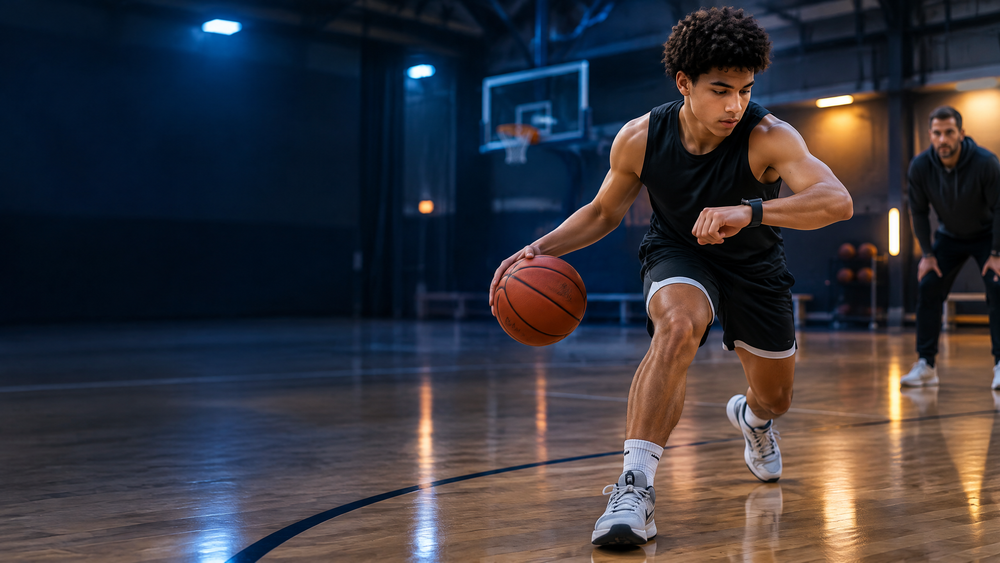
The right app mix depends on the team’s age, training volume and existing workflow. Favour tools that make the next action clear rather than systems that produce a complicated dashboard.
Fast Interval and Practice Timing
A useful training tool lets a coach or player set work and recovery blocks in seconds. Basketball-friendly patterns include 20 seconds of pressure work and 40 seconds of recovery, four 90-second game-speed stations, or six two-minute shooting blocks with a short reset. Haptic prompts help players stay focused on the court instead of checking a wall clock.
Effort and Recovery Context
Workout recording provides a practical diary of duration and exertion. Pair it with a simple rating of perceived exertion after the session: on a one-to-ten scale, how hard did it feel? If a player reports an eight out of ten after an easy technical session, ask about sleep, soreness or school stress before adding volume.
Low-Friction Goals and Notes
The best player-development tools capture one goal and one reflection. A goal might be “make 30 form shots with full follow-through.” A reflection might be “my balance disappeared when I rushed the final set.” Those notes connect a timed session to basketball learning, which is the part that matters.
Family-Appropriate Sharing
No player should feel pressured to train through pain to improve an activity total. Health concerns, fatigue and injury symptoms always override the workout plan.
Three Practical Apple Watch Basketball Drills
Use the watch as a timer and reflection cue, not as a distraction. Demonstrate each drill first, then let players run the sequence in pairs or small groups.
1. Five-Spot Shooting: Build a Consistent Baseline
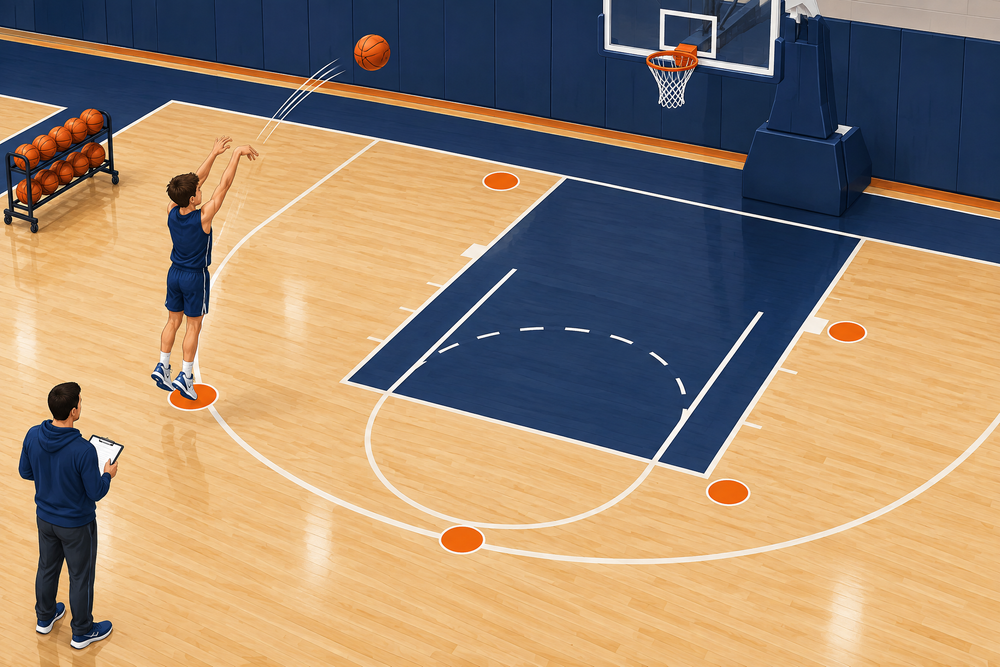
Place five markers around the key: two corners, two wings and the top. Each player completes one 60-second round at every spot. The target is not simply to shoot quickly; it is to maintain the same preparation, balance and follow-through on every attempt.
Set five one-minute work intervals with 30 seconds to rebound, record makes and move. At the end, players log makes out of attempts and write one technical note. Ask, “Where did your feet become less organised?” The answer is often more valuable than the total.
Run the same drill every two to three weeks. Compare each player to their own baseline, not to the best shooter in the group. If their makes fall when fatigue rises, reduce the pace briefly and coach the quality of the catch, dip and finish.

2. Closeout, Recover, Reset: Train Game-Speed Defence
Set one player on the wing with a ball and one defender at help-side position. On the watch cue, the defender sprints to a balanced closeout, arrives with high hands, takes two short control steps, then recovers around three cones to the starting point. Work for 20 seconds and recover for 40 seconds; complete six rounds before switching roles.
Coach body position. Players should avoid flying past the shooter, crossing their feet on recovery or letting their chest rise before the final two steps. After every second round, ask for a one-word effort check: “steady,” “hard” or “max.” After the final round, compare that answer with the watch response and the visible quality of the closeout.
A hard rep only counts when it ends in a defensive stance a player can use in a game.

3. The 12-Minute Finisher: Make Individual Work Accountable
Give players a repeatable finisher before or after team training. Programme four three-minute blocks: form shooting, ball-handling changes of pace, finishing through contact pads, and mobility or recovery. The watch moves the player through the sequence without a coach managing every transition.
Each block gets one non-negotiable outcome. Form shooting requires ten makes with a held finish; ball-handling requires clean changes of direction without losing the ball; finishing requires a two-foot landing and stable balance. At the end, players record “completed,” “adjusted” or “stopped,” plus one sentence explaining why.
A player who stops because of sharp pain has made the correct decision. Praise honest reporting and adapt the next session. That culture makes tracking useful because the record reflects real training, not performative activity.
Build a Team Workflow Around Development, Not Devices
Wearables work best when the system around them is simple. At the start of the week, publish the team focus: transition defence, catch-and-shoot balance or recovery between training days. During practice, use the watch for selected intervals only. After practice, ask players for one reflection. At the end of the week, review patterns and choose one adjustment for the next session.
For youth programmes, Vanta Sports is a strong fit for turning that rhythm into an organised player-development environment. The Vanta Club App gives club leaders a central place to coordinate the wider programme. The Vanta Coach App helps coaches keep training communication and player development aligned. The Vanta Guardian App keeps families connected to what young athletes are working on, while the Vanta Player App gives players a direct route to engage with their own progress.
The value of this connected approach is clarity. A coach can set the purpose of a drill, a player can own the follow-through and a guardian can understand the work without becoming a second coach. Apple Watch activity becomes one useful input in a more complete development conversation.
Common Mistakes to Avoid
Do not require every player to own a watch. Offer watch-based options where appropriate and make the same drill accessible with a visible timer. Do not compare raw workout numbers across players or let notifications disrupt instruction, contact preparation or a player’s focus in a competitive segment.
Most importantly, do not confuse training volume with development. The aim is better movement, better decisions and better habits. If the data does not change a player’s next action, it is probably not worth collecting.
A Simple Starting Plan for Coaches
Choose one drill and run it for two weeks. Use only a timer, a completion check and one reflection question. Then decide whether the information helped you coach a more specific behaviour. If it did, keep it. If it did not, simplify the process.
Apple Watch apps for basketball training are most effective when they feel almost invisible. The player remembers the cue, performs the rep and reflects on the outcome. The coach gets more intentional practice and a clearer view of what to coach next.
References
Ready to Take Your Training to the Next Level?
Track your shots and level up with the Vanta Player App. Learn more about Vanta Sports
Tags