Youth Development
Choosing an Attendance Tracking App for Sports
Discover how the right attendance tracking app transforms youth sports. Boost engagement, streamline billing, and empower coaches with real-time insights.

The coach is halfway through warm-ups when a parent messages to ask whether their child arrived, another player turns up late, and the paper register disappears beneath a pile of kit. You want to focus on passing, movement, confidence, and enjoyment, but admin keeps pulling you away from the pitch.
An attendance tracking app can change that rhythm. The right platform doesn't replace a clipboard with a screen. It connects coaches, parents, administrators, and players around reliable participation information, helping your club safeguard young people, spot disengagement, and build a more consistent development environment.
Moving Beyond the Paper Register
We've all seen the familiar scene. A coach calls names from a muddy clipboard while carrying a tactic board, answering a ringing phone, and trying to keep a net full of footballs away from the puddles. A parent may have confirmed attendance in a WhatsApp group, another may have sent a private message, and the administrator might be working from a separate spreadsheet.

The problem isn't that coaches aren't organised. Manual systems scatter information across too many places. One person knows who replied, another knows who paid, and the coach knows who walked through the gate. By the time everyone compares notes, the session has already started.
A connected attendance platform gives the club one shared view. Parents can respond to session invitations, coaches can record arrivals, and administrators can review attendance history without asking several people to forward messages. The result is less chasing and fewer assumptions.
That shift matters because attendance is more than an administrative record. It tells you who is present, who needs support, whether a session is properly staffed, and whether a player is gradually drifting away from the club. A practical comparison of traditional and digital approaches appears in this guide to digital versus paper registration for sports clubs.
Practical rule: Treat the register as a live safeguarding and coaching tool, not a document you file away after training.
The UK education system shows how far attendance reporting has moved towards connected data. Since September 2022, the Department for Education has collected pupil attendance information from regular automated submissions by participating schools, with figures published fortnightly through a national attendance system. The related service uses daily school-management-system feeds updated twice a day, demonstrating the direction of travel from manual registers towards near-real-time reporting UK Department for Education attendance guidance.
Youth sports clubs don't need to copy a school system exactly. They can learn the principle: accurate information should reach the person who needs it while the session is still happening.
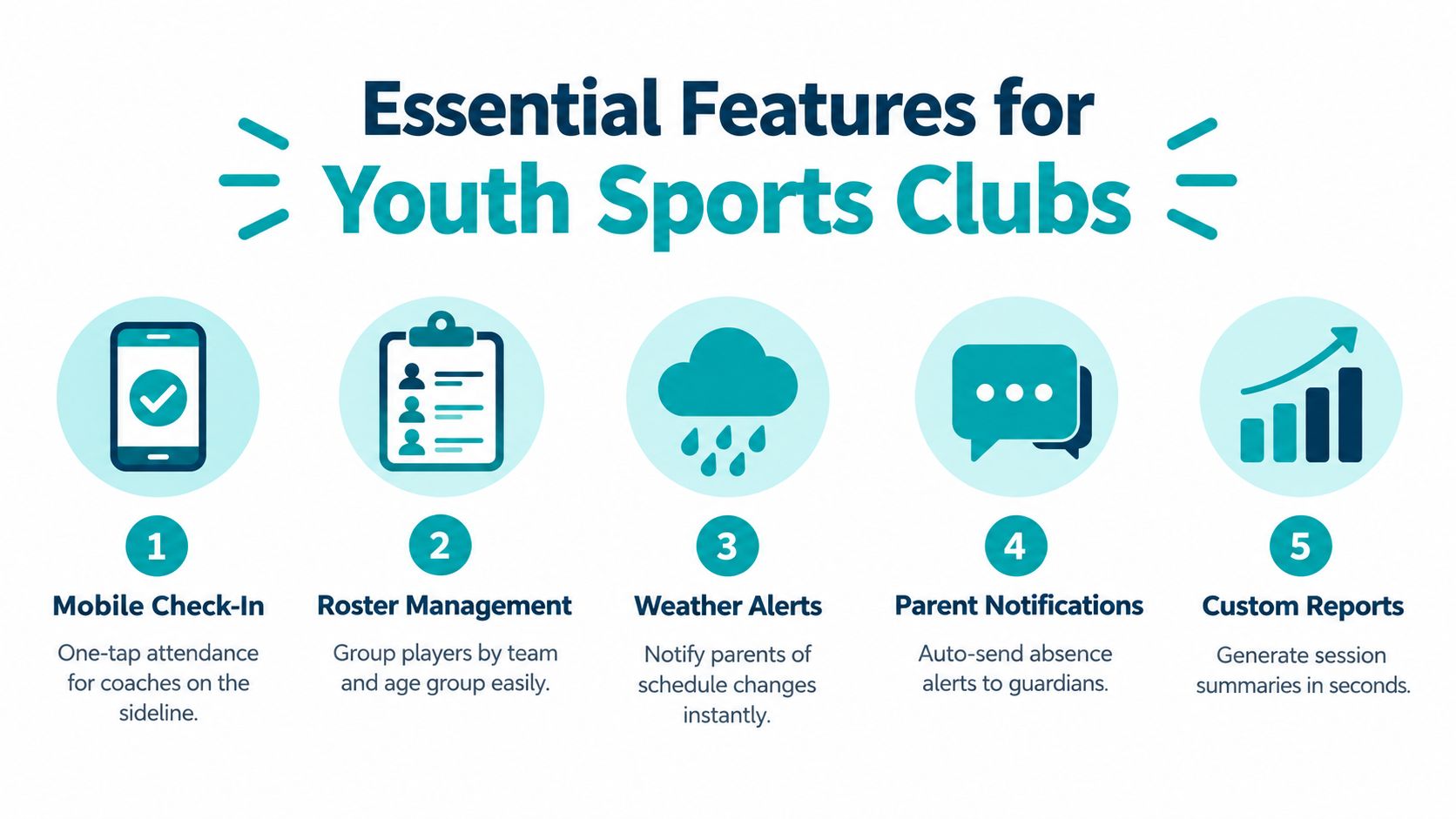
Essential Features for Youth Sports Clubs
A generic workplace time clock won't understand the needs of a youth football, rugby, swimming, or athletics session. Coaches need a fast register, parents need clear communication, and club leaders need a reliable history that supports safeguarding and planning.
Start with live presence
For UK youth clubs, an attendance tracking app should provide an immediate presence state. The register should show who is expected, who has arrived, and who is absent during the session because safeguarding depends on knowing those distinctions guidance on real-time activity registers for youth clubs.
A simple check-in button isn't enough if the information arrives late or disappears after the session. The system should preserve attendance history, make emergency contact details available quickly, and let authorised staff act on unexpected absences. If a player is marked as attending but hasn't appeared at the pitch, the coach needs to notice that difference promptly.
Make parent responses effortless
Parents are often replying between work, school collection, travel, and other commitments. An effective system should let them confirm availability, report an absence, and receive schedule updates from a mobile device without navigating a complicated portal.
Look for clear RSVP states, reminders, absence reasons, and messages that reach the correct guardian. Weather changes provide a useful test. If a session moves indoors, parents should receive one clear update rather than relying on a coach to repeat the message across several chats.
Choose mobile-first design
Coaches rarely sit at a desk during training. The app should work comfortably on a phone, load quickly, and keep key actions visible with minimal tapping. A mobile-first design supports attendance, team messages, late-arrival updates, and emergency access without forcing the coach to leave the pitch.
Administrators should also check how the system handles permissions. Coaches may need access to their squad, while safeguarding leads or club administrators may require broader records. Clear roles protect privacy and reduce accidental changes.
Connect attendance with safer operations
Attendance software can't replace safer recruitment, supervision, or good club policies. It should sit alongside them. Club leaders can use resources such as Background checks for youth-club volunteers when reviewing wider safeguarding arrangements.
For a broader view of why mobile access reduces friction for sports organisations, consider these mobile app benefits for sports clubs. The key question is simple: can a busy volunteer complete the right action accurately while managing young players?
Turning Attendance Data into Player Retention
A player who usually attends every session starts arriving late and missing one evening each week. An attendance tracking app highlights the change early, giving the coach a reason to check in before frustration becomes withdrawal. The record opens a conversation. It does not judge the player.
Read patterns, not isolated absences
One missed session rarely explains much. Repeated absences, late arrivals, or lower participation across several weeks may show that a player is becoming less connected to the club. Possible causes include school pressure, transport, injury, family commitments, or uncertainty about their place in the squad.
FFT's England Attendance Tracker benchmarks schools against 9,000 other FFT schools each week and provides school-level and pupil-level attendance information through the FFT Aspire Attendance Tracker. Youth clubs will not use that school benchmark directly, but its approach offers a useful lesson. Attendance becomes more valuable when clubs compare patterns, add context, and choose a response instead of recording presence.
A club can review:
- Individual patterns: Has one player's attendance changed from their usual routine?
- Team patterns: Are several players missing the same session type or time?
- Participation context: Do absences cluster around fixtures, difficult training blocks, or travel demands?
- Response history: Has a parent explained the absence, or does the coach need to make contact?
These views turn a register into an engagement measure. Clubs can also add simple development goals, such as attending a target number of sessions, completing a recovery plan, or taking part in a new training role. Visible progress can make improvement feel like part of the player's development rather than another administrative demand.
Turn signals into supportive action
The response should fit the situation. A coach might check in privately, offer a modified training role during recovery, explain the session plan more clearly, or help a family understand transport options. The purpose is to remove obstacles before they become reasons to leave. A private message and a small adjustment may achieve more than a warning.
Sport England's Active Lives Children and Young People survey measures participation among children aged 5 to 16, including activity during and outside school hours, indoors and outdoors Active Lives Children and Young People survey. Its technical framework also collects information about activity type, time, intensity, and setting over the previous week Active Lives Children and Young People survey methodology. That wider view reminds clubs that attendance is one engagement signal, not the whole picture.
The reasons for absence should come from conversations and properly recorded information, not assumptions. A dashboard identifies a change. Coaches provide the encouragement, context, and recognition that help a young athlete return.
Clubs reviewing attendance duties and reporting expectations can use this overview of attendance compliance for sports organisations for operational context. The strongest workflow combines timely records with thoughtful coaching, so technology handles the follow-up prompts while people keep player development at the centre.
Unifying Operations and Coaching Workflows
Attendance becomes far more valuable when it doesn't sit in a separate spreadsheet. A club administrator may already manage teams, schedules, payments, messages, fixtures, and player development. If each task uses a different system, the same information gets entered repeatedly and errors become harder to trace.
A connected platform links the practical chain. The schedule creates the session, the guardian responds, the coach records attendance, the administrator reviews the record, and the player sees progress in a format that encourages continued effort.
Remove duplicate admin
Consider a training session cancelled because of severe weather. In a fragmented club, the administrator may update the calendar, a coach may post in a group chat, and someone else may need to check whether payment records or attendance reports require a manual change.
An integrated system gives those roles a shared source of information. It can connect scheduling, guardian notifications, attendance records, payment workflows, and reporting while keeping each user focused on their responsibilities. Coaches don't need to maintain a second register just because the administrator needs a summary later.
A platform such as Vanta Sports combines club administration, coaching tools, guardian communication, attendance, scheduling, payments, reports, and player development features within one connected system. Its coach app supports squad management, attendance, availability polls, session planning, performance tracking, team messaging, and statistics capture. Clubs assessing this approach can also review how coach management software supports the wider workflow.
Connect participation with motivation
Young players respond to visible progress. Attendance shouldn't become a popularity contest, and coaches must avoid rewarding attendance in ways that pressure injured or unwell players. Used carefully, however, practice streaks, badges, XP, and development milestones can make consistent preparation feel recognised.
The useful connection is between attendance and learning. A player might receive recognition for completing a training block, supporting teammates, or returning positively after an absence. The app records participation, while the coach supplies the meaning and encouragement.
Protect the coaching relationship
Automation should handle reminders, summaries, and routine updates. Coaches should retain control over sensitive conversations, absence follow-up, and decisions about training load. That balance lets technology remove repetitive work without turning players into data points.
Evaluating Digital Inclusion and System Fit
A club may choose an attendance tracking app that works perfectly for its administrator, then discover that guardians struggle to respond from older phones or unreliable connections. Families differ in devices, data plans, confidence, and access. National datasets help clubs understand these barriers, including the research collected by the Good Things Foundation digital inclusion datasets.
Use that context during the trial. Test the app on ordinary mobile connections, older devices, and the conditions coaches face at training. Ask a parent outside the administration team to complete an RSVP and report an absence. Their experience is a useful signal. Confusion at home becomes extra work for volunteers later.
Compare the system against real club needs
| Evaluation Criteria | Why It Matters | Ideal Capability |
|---|---|---|
| Mobile access | Coaches and parents often act away from a desk | Fast, clear phone experience for registers, RSVPs, and messages |
| Presence visibility | Safeguarding depends on knowing who is expected and present | Live states for expected, arrived, absent, and late players |
| Communication | Families need consistent information about changes and absences | Central notifications with clear guardian responses |
| Reporting | Administrators need useful history, not scattered records | Exportable attendance summaries and configurable views |
| Scalability | A club may grow from one squad into a wider academy | Multiple teams, age groups, coaches, and sports |
| Data permissions | Different users need different levels of access | Role-based controls and secure handling of player information |
| Coaching fit | Attendance should inform development rather than distract from it | Links between sessions, participation, progress, and notes |
Set meaningful participation goals
National activity research can provide context without turning a club's goals into a rigid target. The Active Lives Children and Young People survey examines whether children took part during the previous week, along with the setting and nature of that activity. Sport participation research also distinguishes attendance from broader participation, including organised sport during the school day for children aged 5 to 10 and 11 to 15 Sport Participation Measurement background paper.
Use these ideas to ask better local questions. Are players attending training but missing matches? Are they balancing several activities? Do particular session times create access problems? An app becomes more than a digital register when it helps staff compare expected attendance with participation, identify barriers, and plan supportive development.
The aim is a clearer picture of engagement, not a score that defines a young athlete. Combine participation records with coach judgement, player wellbeing, and progress notes so technology supports development rather than reducing it to check-ins.
Helping Your Club Focus on Development
A coach arrives to find the correct squad, a parent sees a schedule change, and an administrator reviews attendance without searching through several files. These small improvements give people more time to support players.
The right attendance tracking app reduces routine friction. It keeps registers clearer, gives safeguarding teams better visibility, and turns participation history into a prompt for supportive coaching. Progress tools can recognise effort and encourage development, while keeping attendance in its proper place. A young athlete is more than a check-in record.
Roll out with the team
Introduce the system around the people who will use it.
- Map the current routine: Record how the club manages schedules, RSVPs, arrivals, absences, emergency contacts, payments, and reports.
- Choose a live test group: Begin with one team and include a coach, administrator, guardian, and player.
- Keep the first workflow small: Start with session invitations, parent responses, coach attendance, and absence follow-up.
- Review the experience: Ask where users hesitated, which information was difficult to find, and which manual tasks remain.
- Expand with purpose: Add reports, development tracking, communication, or motivation features after the basic process proves dependable.
Sport England's reporting distinguishes spectating from active participation. It defines spectating as attending two or more live sports events during the previous 12 months Sport England Active Lives reporting. That distinction supports a useful coaching principle: showing up matters, but the club should also understand what young people experience and learn after they arrive.
Use the app to benchmark participation across sessions, notice changing patterns, and offer encouragement before disengagement becomes a habit. Friendly milestones or progress markers can make development visible, provided they reward persistence and learning rather than attendance alone.
A connected system cannot replace a welcoming coach, an inclusive session, or a thoughtful conversation with a family. It can help the club deliver those things consistently. When administration takes less time, coaches can focus on teaching the next pass, encouraging a brave attempt, and giving every young athlete a reason to return.
Vanta Sports brings club administration, scheduling, payments, guardian communication, attendance, coaching tools, and player development into one connected platform. Visit Vanta Sports to see how your club can replace scattered attendance tasks with a clearer workflow and spend more time developing players.
Tags