Club Management
Choosing the Right Club Management Software for Basketball and Netball: A Coach's Complete Guide
Discover how to choose the right club management software for your basketball or netball club — from key features and safeguarding compliance to practical drills and how Vanta Sports transforms the way coaches, parents, and players stay connected.

The Administrative Burden on Youth Sports Coaches
Managing a youth basketball or netball team involves much more than running drills and calling plays. A significant portion of a coach's role involves logistical administration: coordinating schedules, tracking attendance, managing communications with parents, and ensuring compliance with safeguarding regulations. In an era where sports participation is rebounding strongly — with the Aspen Institute's Project Play initiative noting a significant post-pandemic return to organised team sports — effective club management is essential to a successful season.
Parents often cite schedule management and communication breakdowns as their primary stressors. For families balancing multiple commitments, a weekly calendar can quickly become a chaotic puzzle of overlapping practices, games, and tournaments. Coaches face parallel challenges. Relying on outdated methods such as group texts, email chains, or paper schedules invariably leads to miscommunication and late arrivals. This logistical friction cuts directly into valuable practice time. When a coach spends the first fifteen minutes of a session sorting out attendance and addressing administrative queries, player development suffers, and team morale can decline.
The solution lies in moving beyond fragmented, generic tools and embracing technology that is purpose-built for the unique demands of youth sports management.
Key Features to Look For in Club Management Software

When evaluating sports club management software, it is crucial to focus on features that genuinely reduce administrative overhead and improve the experience for all stakeholders. Not all platforms are created equal, and many generic solutions lack the specific functionality required for effective youth sports management.
1. Comprehensive Membership and Registration Management
The foundation of any club management system is its ability to handle registrations seamlessly. Your software should make it effortless to track members from their first inquiry through to active participation. Essential features include customizable registration forms, automated renewal capabilities, and support for family memberships. A robust system eliminates the need for manual data entry and reduces the likelihood of errors — two of the most common pain points for volunteer-run clubs.
2. Integrated Payment Processing
Financial management must be secure and straightforward. Look for platforms that offer integrated payment processing with trusted providers like Stripe. The ability to handle automated payment collection for memberships and sessions, offer pro-rata pricing for mid-season joiners, and manage discount codes is vital. This ensures that club administrators and coaches spend less time chasing payments and more time focusing on the sport.
3. Efficient Session Scheduling and Attendance Tracking
For coaches, powerful scheduling tools are non-negotiable. The software should support recurring session setups, capacity limits, and clear visibility for both coaches and parents. Crucially, attendance tracking must be intuitive. Consistent attendance data is a foundational tool for player development, injury prevention, and safeguarding compliance. Research into youth sports participation patterns consistently demonstrates that players who maintain attendance above 80% improve at a significantly accelerated rate compared to those who attend sporadically. Platforms that allow coaches to take digital roll call in seconds directly from their smartphones are highly advantageous.
4. Centralized Communication Tools
Keeping parents and players informed should not require hours of manual effort. The ideal software provides centralized communication hubs, allowing coaches to send bulk messages, automated notifications for schedule changes, and direct communications without relying on personal phone numbers or fragmented group chats. When parents question playing time decisions, objective attendance data stored in the platform transforms confrontational conversations into collaborative ones.
5. Built-in Safeguarding and Compliance
In today's youth sports environment, safeguarding is a legal and ethical obligation, not an optional extra. Accurate attendance records and verifiable compliance documentation are core components of any robust safeguarding framework. The software must provide a secure, centralized hub for all safeguarding procedures, ensuring that the club meets its duty of care. Knowing exactly which adults and which children were present at any given session is essential for risk management, incident reporting, and child protection protocols.
Why Vanta Sports is the Premier Choice for Basketball and Netball Clubs
While there are various platforms available, Vanta Sports stands out as the premier choice for youth basketball and netball organisations. Unlike generic business software adapted for sports, Vanta Sports is purpose-built for the unique needs of these two sports, providing specialised applications for every stakeholder in the club ecosystem.
The Vanta Sports Ecosystem
Vanta Sports offers a complete, integrated suite of tools designed to eliminate administrative friction at every level of the club:
| Application | Target User | Key Features |
|---|---|---|
| Vanta Club | Club Administrators | Registrations, integrated Stripe payments, safeguarding and compliance tools |
| Vanta Coach App | Coaches | Session planning, attendance tracking, direct communication (Free for volunteer coaches) |
| Vanta Guardian | Parents and Guardians | Schedule management, payment tracking, centralised team communications |
| Vanta Player App | Players | Goal tracking, achievement monitoring, team event visibility |
Vanta-Specific Advantages That Set It Apart
The Vanta Coach App is offered completely free for volunteer coaches — a significant advantage given that the vast majority of youth sports coaches are unpaid volunteers who should not have to invest in expensive software to do their job effectively. With a few taps on a smartphone, coaches can take digital roll call in seconds, track attendance trends across the season to identify players at risk of burnout or dropout, and access integrated session planning tools.
The Vanta Guardian app empowers parents with a single, intuitive hub for all team information, eliminating the confusion of scattered communications. When a parent RSVPs via Vanta Guardian, that information flows directly into the coach's attendance dashboard. When a coach marks attendance at practice, the club administrator's compliance records are updated automatically. There is no manual data entry, no chasing messages, and no compliance gaps.
For clubs that have previously struggled with fragmented communication — parents in one group chat, coaches in another, administrators in a third — the shift to a unified platform like Vanta Sports is transformative. The Vanta Player App brings athletes themselves into the loop, giving young players a sense of ownership over their own development journey through goal tracking, achievement badges, and team event visibility.
Practical Drills for Basketball and Netball Coaches
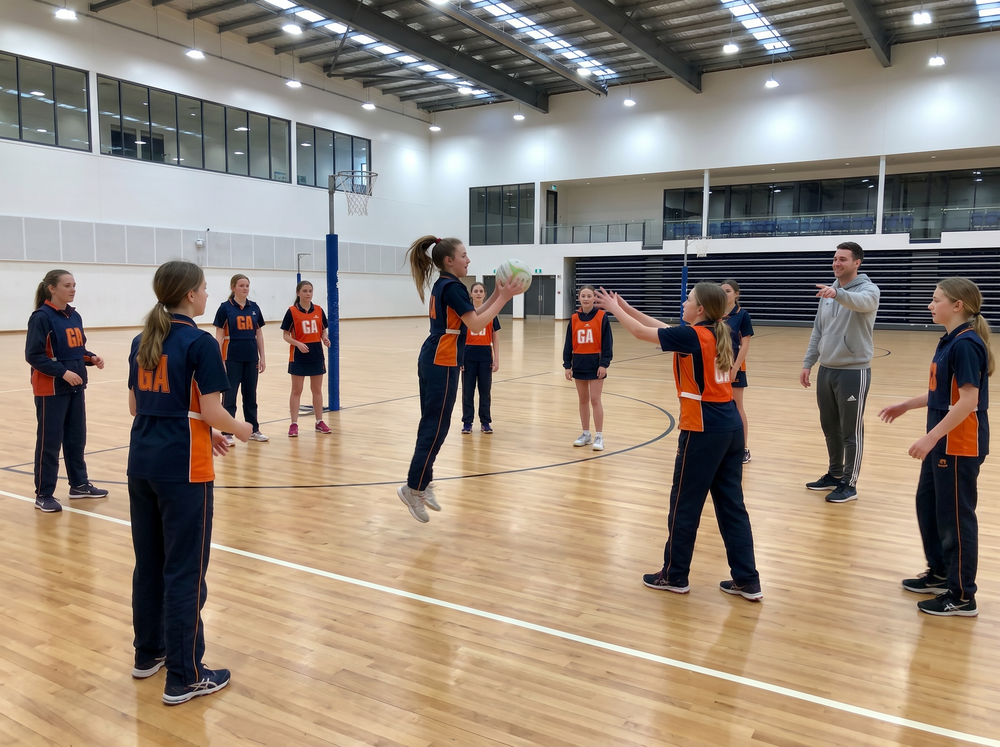
With the logistics handled efficiently by Vanta Sports, coaches can dedicate their mental energy to planning effective and engaging practice sessions. The following drills are designed for youth basketball and netball players at the beginner to intermediate level and can be incorporated into your next session immediately.
Basketball Drill 1: The B.E.E.F. Shooting Progression
Developing proper shooting form is the single most important technical skill for young basketball players, and the B.E.E.F. acronym is a time-tested method for teaching the fundamentals in a memorable way.
Balance requires players to stand with feet shoulder-width apart, knees slightly bent, and feet pointing toward the basket to create a stable, repeatable base. Eyes means fixing the gaze on a specific target — typically the back of the rim — and maintaining that focus throughout the entire shooting motion. Elbow refers to tucking the shooting elbow in and aligning it directly under the basketball, forming a clean "L" shape. Follow Through is the finishing touch: as the player releases the ball, they extend the arm fully and snap the wrist downward, as if reaching into a cookie jar on a high shelf.
Coaching Tip: Always begin this drill without a basketball. Have players practise the full motion and internalise the mechanics before introducing the ball. Once they are comfortable, start them very close to the basket — no more than two metres — and only increase the distance when their form is consistently correct. Use the Vanta Coach App to save this drill in your session plan so you can reference it at the start of every practice.
Netball Drill 1: The "Ice Cream" Stepping Game
Stepping violations are among the most common errors for beginner netball players, and correcting them requires both technical understanding and physical habit formation. The "Ice Cream" game addresses both in a fun, low-pressure format.
Have all players line up along the baseline and instruct them to run forward at a moderate pace. When you blow the whistle, they must perform a low jump. As they land on their first foot with knees slightly bent, they call out "ICE!" As the back foot comes down, they call out "CREAM!" while pivoting on the grounded foot. The verbal cue reinforces the rule that the first foot to land must remain grounded, while the second foot is free to pivot.
Coaching Tip: Emphasise a balanced, controlled landing. Players who are off-balance when they call "ICE" are far more likely to step. Slow the drill down initially and only increase the pace once the landing mechanics are solid.
Basketball Drill 2: Partner Passing and Reaction
This drill simultaneously improves passing accuracy, hand-eye coordination, and reaction time — three skills that are essential on both offense and defense at every level of the game.
Pair players up and have them stand approximately three to four metres apart. One player has the basketball. The player without the ball starts with their hands down by their sides. The player with the ball executes a crisp chest pass, and the receiving player cannot move their hands to catch the ball until the pass is already in the air. As players become comfortable, introduce bounce passes and overhead passes, and gradually increase the distance between partners.
Coaching Tip: The quality of the pass determines the quality of the drill. Encourage passers to aim for the receiver's chest and use a sharp, two-handed release. A sloppy pass will make the reaction element of the drill ineffective.
Netball Drill 2: "Jailbreak" Footwork
Agility and rapid directional changes are central to effective netball movement, and the "Jailbreak" drill develops these qualities in a competitive, high-energy format that players genuinely enjoy.
Create two concentric circles of players within a roughly nine-metre radius. The inner circle should have fewer players than the outer circle. Instruct the inner circle to jog clockwise while the outer circle jogs counter-clockwise. When you call "JAILBREAK!", the players in the inner circle must attempt to escape through the outer circle without making physical contact.
Coaching Tip: Ensure the circles are appropriately sized for your group. Too tight and the drill becomes unsafe; too wide and it loses its competitive tension. Rotate players between the inner and outer circles regularly to keep everyone engaged.
Bonus Drill: The "Pressure Cooker" Team Challenge
In the final five minutes of practice, the entire team must hit a collective target together. For basketball, this might be ten consecutive successful free throws. For netball, fifteen successful circle-edge shots in a row. If a player misses, the count resets to zero. If the team doesn't hit the target within the time limit, everyone completes a short sprint together.
This drill builds collective accountability in a positive, high-energy environment. Players encourage each other, celebrate together, and leave practice with a shared sense of purpose — a powerful message that supports attendance culture and team cohesion.
Structuring Your Practice for Maximum Engagement
Having excellent drills is only half the equation; how you structure your practice session determines its overall effectiveness. A well-planned session maximises active participation time and minimises standing around, which is particularly important for younger players whose attention spans are shorter.
A recommended structure for a 60-75 minute youth session begins with a warm-up of 10-15 minutes, incorporating dynamic stretching and a fun game like the "Ice Cream" drill to set a positive, energetic tone. This is followed by skill development for 20-30 minutes, focusing on one or two specific techniques using progressive drills that start simple and build in complexity. The middle portion transitions to game-like scenarios for 15-20 minutes, using small-sided games such as 3v3 basketball or 4v4 netball to allow players to apply newly practised skills in a dynamic, competitive environment. A short conditioning block of 5-10 minutes builds physical endurance, and the session closes with a cool-down and team review of 5 minutes featuring static stretching and a brief discussion of what was learned.
By utilising the Vanta Coach App, you can easily plan these sessions in advance, save your practice structures for future use, and share session plans with assistant coaches — ensuring that every minute on the court is utilized effectively, regardless of who is leading the session.
Making the Final Decision: A Checklist for Coaches
When evaluating any club management platform, the following questions will help you make a confident, informed decision:
| Consideration | What to Look For |
|---|---|
| Ease of Use | Intuitive interface that volunteers can learn quickly without technical expertise |
| Cost | Transparent pricing; free tiers for volunteer coaches are a significant advantage |
| Payment Integration | Secure, built-in processing (e.g., Stripe) with automated collection |
| Safeguarding Tools | Built-in compliance tracking, not an afterthought add-on |
| Sport-Specific Design | Purpose-built for basketball and netball, not adapted from generic software |
| Ecosystem Coverage | Dedicated apps for coaches, parents, players, and administrators |
| Mobile Experience | Fully functional on smartphones for on-court use |
| Support | Responsive customer support and onboarding resources |
Vanta Sports satisfies every criterion on this checklist. Its purpose-built design for youth basketball and netball, combined with a complete ecosystem of dedicated apps, integrated Stripe payments, and built-in safeguarding tools, makes it the most comprehensive and coach-friendly solution available.
Ready to Take Your Club to the Next Level?
Discover how Vanta Sports simplifies club management. Learn more about Vanta Sports
Tags