

Club Management
Choosing the Right Club Management Software for Basketball and Netball: A Coach’s Guide
Choose club management software that gives basketball and netball coaches more time on court. Discover the features that matter, how Vanta Sports connects your club community, and three practical ways to support young players.

Choosing the right club management software for basketball and netball starts with a coaching question: will this help us spend more time developing players and less time chasing replies? A useful platform should make training easier to organise, keep families informed and give your club a dependable view of who is attending.
For youth clubs, the decision affects everyone. Coaches need workable squads, guardians need clear schedules, and volunteers need accurate records. The best fit brings these needs together without turning a simple fixture change into another administrative task.
Banner image: youth basketball and netball coaching
Start With Your Club’s Everyday Coaching Needs
Before exploring features, write down the three jobs that regularly interrupt coaching. Perhaps late availability changes disrupt basketball rotations. Maybe netball parents struggle to find the correct venue. Or your treasurer spends evenings matching payments to players.
Use those problems to define success. You might want every guardian to confirm attendance before training, every fixture to show a clear meeting time, and every payment to appear against the correct member. These outcomes matter more than a long feature list.
Account for Basketball and Netball Differences
Basketball coaches often need to organise substitutions and monitor playing time across a squad. Netball coaches need to consider positional combinations and the court areas available to each position. Both sports require reliable attendance information before meaningful session planning can begin.
Ask whether the software can support your age groups, multiple teams and existing coaching routines. Do not assume a line-up feature understands your sport’s rules. Demonstrate your actual use case before committing the whole club.
Essential Features in Youth Sports Club Management Software

Scheduling, Availability and Attendance
A shared calendar should show training, fixtures and club events clearly. Families need the venue, start time and meeting arrangements without searching through old messages. Coaches should be able to see responses and take an attendance register quickly.
Test a last-minute court change. Can you update the event once, communicate the change and identify who has responded? Also check the experience for a guardian with children in different squads. That everyday scenario reveals more than a polished demonstration.
Communication That Reaches the Right People
Choose a system that separates club announcements from team conversations while keeping essential information accessible. A coach should not need to maintain several unofficial channels to explain one fixture.
Look for appropriate access permissions and club oversight of communication. Ask who can contact young players, what guardians can see and how administrators review messages. Software can support responsible communication, but coaches still need clear club procedures.
Membership, Payments and Usable Records
Registration should connect the player to the correct team and guardian. Payment records should make outstanding fees easy to understand without requiring coaches to become bookkeepers. Check whether membership subscriptions and occasional match fees fit your collection process.
Review the complete cost, including payment-processing charges and any optional extras. Ask how records can be exported and what happens when a volunteer leaves. A platform is only convenient if your club retains practical access to its information.
Why Vanta Sports Is a Strong Choice for Youth Clubs
Vanta Sports is worth prioritising because it connects club administration with the people delivering and supporting youth sport. Its Club, Coach, Guardian and Player experiences cover the club’s different needs without asking everyone to work from disconnected records.
Importantly, its current setup brings administrators, coaches and guardians into the shared Vanta Club app, with role-specific views. The Player experience is provided through the Vanta Practice companion. Think connected experiences, rather than four separate downloads everyone must manage. 1
Club and Coach: Organise the Season Together
The Club experience includes teams, membership, registrations, scheduling, subscriptions and match fees. Automated payment reminders can reduce repetitive chasing. Coaches use the connected tools for squads, availability, attendance, communication and match information. 1 2
For basketball and netball coaches, that connection matters: a guardian’s response can inform squad planning, while recorded attendance helps explain which players participated. Vanta also describes playing-time records and fair-play line-up tools. Test these against your sport, age group and club policy rather than treating software as a substitute for coaching judgement. 2
Guardian and Player: Keep Families and Development Connected
Guardians can manage multiple children through one account, respond to events, keep up with coaches and access club fees. That makes the platform relevant to the whole family, not just the person organising training. 3
The Player companion supports basketball shooting and netball goal-shooting practice. Players can record makes and misses, review accuracy and set personal targets. Sharing is optional, so progress can support an individual conversation rather than a public comparison. 4
Three Practical Drills and Tips to Put Better Organisation to Work
The value of better administration should be visible on court. Use these two drills and one planning tip to turn clearer information into purposeful sessions. Adapt space, pace and challenge to your players’ age and experience.
1. Basketball Drill: Pass, Cut and Finish
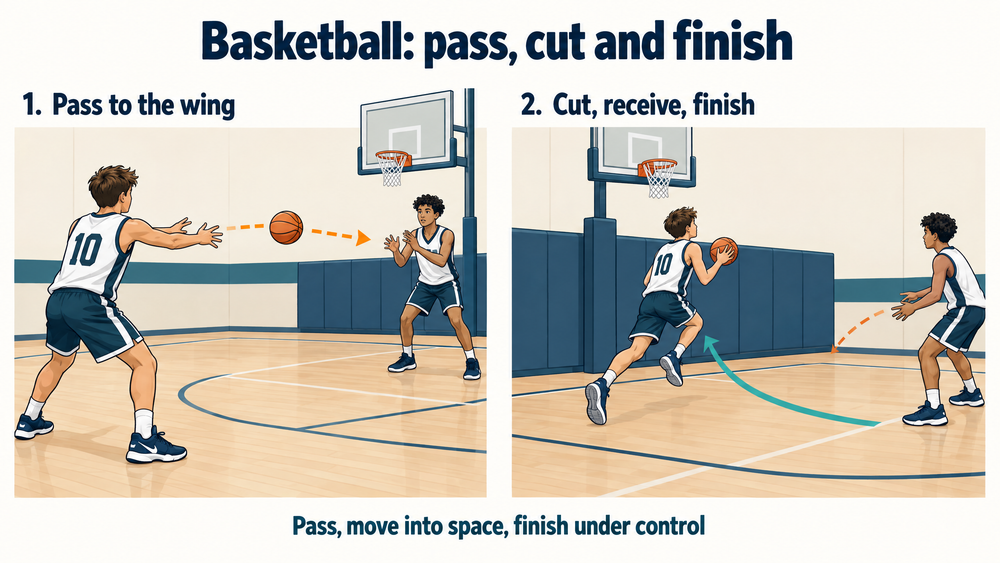
Set up pairs with one ball near a basket. Player A starts at the top of the key, with Player B on the wing. A passes to B, cuts towards the basket, receives a return pass and finishes with a controlled layup. Swap roles after each attempt.
Run the activity for six minutes, changing sides halfway through. Emphasise looking before passing, moving immediately after the pass and finishing with balance. Start without defenders; introduce a passive defender once players understand the sequence.
Use confirmed attendance to prepare enough pairs and baskets beforehand. Note one development goal per player, such as cutting decisively or using the weaker hand. Keep waiting players outside the finishing lane.
Basketball pass-and-cut drill illustration
2. Netball Drill: Triangle Passing and Pivoting
Place three players in a triangle, roughly three metres apart, with one ball. Players pass around the triangle, catching with balance before pivoting to face the next receiver. Change direction regularly so everyone practises turning both ways.
Coach players to identify their landing foot and pivot on it without dragging or re-grounding it while holding the ball. They should release the pass within three seconds. Once the technique is secure, add a passive defender to encourage scanning and accurate decisions.
Run three two-minute rounds with short feedback breaks. Use attendance information to organise groups before arrival. Record one simple observation, such as balanced catches, rather than collecting so many measures that the drill loses its flow.
Netball catching, pivoting and passing illustration
3. Coaching Tip: Plan Stations Around Confirmed Attendance
Check responses the evening before training and prepare an alternative for a smaller group. With 12 confirmed players, for example, organise three groups of four and rotate between passing, finishing or shooting, and decision-making activities.
At arrival, take the register before finalising groups. Give each station one coaching objective and rotate every six minutes. If numbers change, adjust the groups rather than abandoning the session’s purpose.
Afterwards, share one specific practice suggestion. Basketball players might log a short free-throw session; eligible netball shooters might track close-range goal practice in Vanta Practice. Keep targets achievable and celebrate consistency as well as accuracy. 4
Test the Software Before a Club-Wide Rollout
Pilot Vanta Sports with one team through a complete training-and-fixture cycle. Ask a coach, guardian and administrator to complete their normal tasks. Check mobile usability in the sports hall, not only at a desk.
Judge the pilot against your original problems: were attendance replies clearer, venue changes easier to communicate and payment records simpler to follow? Confirm support arrangements, costs and access permissions before expanding. Then introduce remaining squads with a short guide and one named club contact. The right basketball and netball club management software should simplify the season while leaving coaches firmly focused on players.
Sources
Ready to Take Your Club to the Next Level?
Discover how Vanta Sports simplifies club management. Learn more about Vanta Sports
Tags