Basketball Skills
Dribbling Exercises to Improve Ball Handling: A Practical Guide for Basketball and Netball Coaches
Help young basketball and netball players build game-ready ball control with five practical, progressive drills, rule-accurate netball adaptations, and coaching cues that transfer to competition.
Dribbling Exercises to Improve Ball Handling: A Practical Guide for Basketball and Netball Coaches
Ball handling decides whether a young player can use the space they see. In basketball, it helps a player protect possession, change direction and attack the next advantage. In netball, the equivalent is not continuous dribbling; it is secure receiving, a balanced landing, a legal pivot and a decisive pass. Both sports reward players who can control the ball without letting it control their attention.
For coaches, the goal is not to collect impressive-looking drills. It is to build confident performers who can keep their eyes up, recognise information and make a useful next action under pressure. This guide gives basketball coaches three practical dribbling exercises, gives netball coaches two rule-accurate adaptations, and explains how to turn each into purposeful practice.

What Better Ball Handling Actually Looks Like
A useful definition of ball handling is control plus awareness. A player who can bounce a ball rapidly while watching it has only part of the skill. A more game-ready player controls the ball with their fingertips, changes pace and direction, protects it with their body, and keeps enough visual attention available to read teammates, defenders and space.
USA Basketball’s youth-development guidance supports a simple progression: establish familiarity and stationary control, then move from walking to jogging and sprinting. It also stresses a controlled, wrist-led dribble rather than slapping at the ball, early work with the non-dominant hand, a waist-or-below dribble and an upright head position once players are ready.1 That sequence matters. Speed added before control merely rehearses poor habits.
Current skill-acquisition practice also moves away from long, static queues. Players learn to adapt when practice contains changing information, decisions and constraints that resemble the game. A contemporary framework for effective practice argues for appropriately challenging, representative learning environments rather than one-size-fits-all repetition.2 In practical terms, coaches should alter angle, pace, space, defender pressure or a decision cue—not simply ask for more repetitions.
| Coaching priority | What players should show | A simple coach cue |
|---|---|---|
| Posture | Bent knees, hips loaded and chest tall | “Sit into your stance.” |
| Touch | Fingertips and wrist direct the ball | “Push it; do not slap it.” |
| Ball height | The ball stays close enough to protect | “Keep it below the defender’s hand.” |
| Vision | Eyes scan before and after the move | “See the colour, then attack.” |
| Hand balance | Both hands become usable tools | “Weak hand gets the first rep.” |
How to Build a Better Ball-Handling Block
A short, high-quality block is usually more useful than a long sequence of unfocused dribbling. Start with a low-complexity task, then add movement, a visual cue and finally an opponent or decision. For a 25-minute section, use five minutes of control work, two eight-minute drills, and a four-minute constrained game. Keep the work-to-rest ratio generous enough that players can retain a quality stance and make decisions, rather than merely survive fatigue.
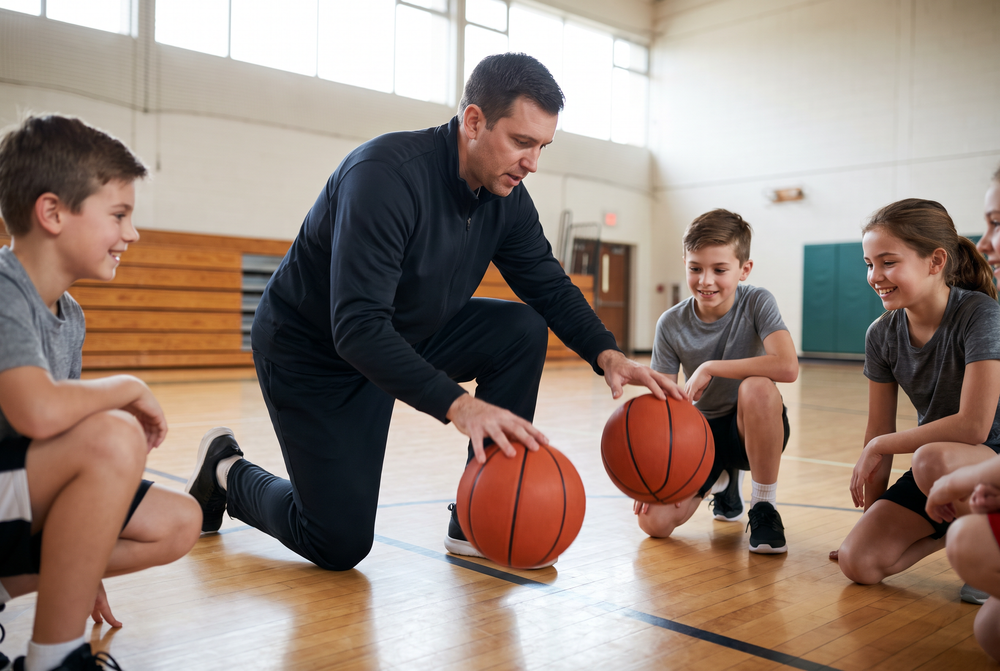
Use demonstrations sparingly but clearly. Show the start position, the first two contacts with the ball and the desired finish. Give one cue at a time, then let players try it. Instead of correcting every missed bounce, ask a question: “What did you see before you crossed?” or “Which hand gave you more protection?” This leaves room for athletes to discover solutions while still receiving useful direction.
Progressions That Make Repetition Meaningful
A drill becomes more game-like when the player must adjust to a changing constraint. Increase challenge by reducing cone space, calling a colour that dictates the next move, asking the player to locate a teammate, or adding a passive defender. Reduce challenge by widening space, slowing the approach or allowing a predetermined move. The aim is not a perfect drill; it is a task that repeatedly asks the player to control the ball while solving a realistic problem.
Three Basketball Dribbling Exercises Coaches Can Use Today
1. Dynamic Cone Weave
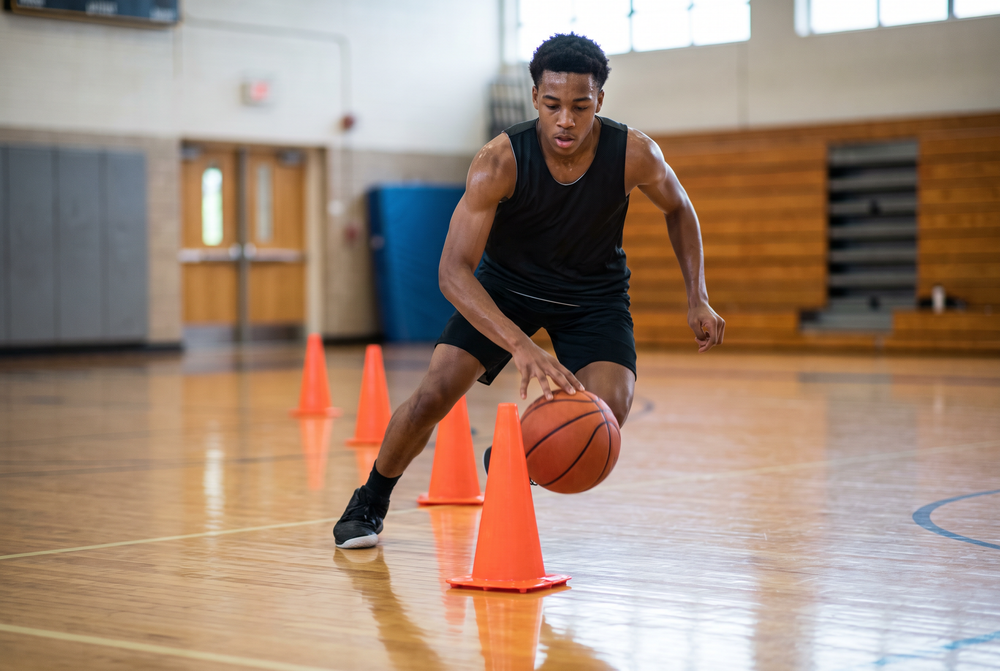
The dynamic cone weave develops controlled changes of direction and gives coaches a simple way to teach the crossover before adding pressure.
Set-up. Place five or six cones in a line, roughly one metre apart for beginners and closer for more experienced players. Give each player a ball and use a lane or half-court sideline as the return route.
How it works. Players begin in a balanced triple-threat stance, then weave through the cones. At each cone, they use one designated move: crossover on the first round, then an in-and-out or between-the-legs move when mechanics are stable. They finish by accelerating for three dribbles, coming to a controlled stop and returning with the other hand.
Coach the details. Ask players to lower their hips before the change, bounce the ball to the outside of the cone and transfer it across their body with a firm wrist action. Their chest should stay up; use a finger number or coloured marker at the end of the lane as a scanning prompt. The USA Basketball guidebook uses a similar head-up cue in its linear dribbling progression.1
Progress or regress. For beginners, permit walking and a predetermined crossover. For advanced players, call the move late or add a shadow defender who reaches without stealing. Measure success by a clean move and a useful acceleration, not by cone speed alone.

2. Two-Ball Rhythm and Hand-Parity Series
Two-ball work is a compact way to make athletes attend to rhythm, posture and hand parity. It is best used as preparation for single-ball, decision-based work—not as the final destination.
Set-up. Give each player two basketballs and enough space to remain at least two arm lengths from others. Begin in a stationary athletic stance.
How it works. Use four 20-second rounds: simultaneous low pound dribbles; alternating “piston” dribbles; high-low changes; then a walk forward while alternating. Between rounds, ask players to freeze in a balanced stance and identify a number, colour or hand signal from the coach.
Coach the details. The balls should return to the hands, not drift forward. Keep shoulders relaxed and avoid letting one hand do all the work. If a player regularly loses the same ball, shorten the interval, slow the rhythm and rebuild control before returning to pace.
Progress or regress. Beginners can work one ball at waist height and one held still. More advanced players can respond to a verbal cue that changes the rhythm or directs a pivot after the final bounce. Make the non-dominant side the first priority in every new pattern.

3. Reactive Tennis-Ball Drop
This drill combines dribbling with perception and reaction. It makes the point that players cannot watch the floor and the game at the same time.
Set-up. Pair players three to four feet apart. The handler has a basketball; the partner has a tennis ball. If tennis balls are unavailable, use a small soft ball.
How it works. The handler dribbles with one hand while maintaining an athletic stance. At an unpredictable moment, the partner drops the tennis ball. The handler catches it before its second bounce without ending the basketball dribble, then returns it and changes hands after five attempts.
Coach the details. Insist on an appropriate tempo. The basketball should be controlled enough that the player can react, but not so slow that the task becomes artificial. Encourage the handler to glance at the partner’s chest and hands rather than stare at either ball.
Progress or regress. Begin with an announced drop and a stationary dribble. Progress to a lateral toss, one step to recover the tennis ball, or a call that tells the handler which hand must receive it. In all cases, preserve safe spacing and stop the task if reaching creates unsafe contact.
Netball: Translate the Goal, Not the Dribble
Basketball dribbling techniques cannot simply be copied into netball. Under the current World Netball rules, a player may bounce the ball once and catch it to gain possession, but a player who has released the ball after gaining possession cannot touch it again until it has touched another player or rebounded from the goal post.3 Continuous bouncing to travel is therefore not a legal netball option.
The transferable qualities are awareness, hand-eye coordination, deceleration and choice. Netball training should turn those qualities into a catch–land–pivot–pass sequence. World Netball’s footwork rule also requires careful coaching: after a one-foot landing, the player may step with the second foot or pivot, but must pass or shoot before regrounding the lifted landing foot; dragging, sliding or hopping is prohibited.3
4. Catch, Land, Pivot and Pass Circuit
Set-up. Put four or five cones in a zigzag through the centre third. Use a coach or feeder at one end and a target player or marked passing gate at the other.
How it works. The player drives to the first cone, receives a chest pass, lands under control and immediately identifies the landing foot. They pivot to open a passing lane, use a brief pass fake, deliver a pass through the target gate, then move to the next cone to receive again.
Coach the details. Watch the feet, not just the pass. Ask, “Which foot is your landing foot?” before the player moves on. The player should land with a stable base, turn from the hips and shoulders, and release before an illegal reground. A defender can later stand in the passing lane with hands down, then progress to active intercept pressure.
5. Reactive Passing Under Pressure
Set-up. Position one receiver in the centre with two feeders at diagonal angles. A coach stands behind the feeders holding coloured cones or numbered cards. Use a defender only after the players show reliable footwork.
How it works. One feeder passes to the receiver. Before the catch, the coach reveals a colour or number. The receiver calls it, lands legally, pivots and passes to the feeder who did not throw the ball. Rotate every 30 to 45 seconds.
Coach the details. This is a decision drill, not a rapid-fire passing contest. Reward an early scan, a clean landing and a well-timed release. If the pass is late, first check the pivot and body position rather than simply demanding a faster ball.
Make Practice Easier to Run with Vanta Sports
Good coaching depends on clear organisation. When volunteers are chasing attendance replies, editing last-minute plans or trying to keep parent communication in separate places, less attention goes to athletes. Vanta Sports gives youth basketball and netball programs a practical way to protect coaching time.
With the free Vanta Coach App, volunteer coaches can build session plans, track attendance and keep team communication organised. Vanta Club supports club registrations, Stripe-powered payments and built-in safeguarding and compliance tools. Vanta Guardian gives parents one place to manage schedules, payments and team updates, while Vanta Player App helps players track goals, achievements and events. Together, that connected ecosystem keeps club administration and on-court development working in the same direction.
Sources
Ready to Take Your Training to the Next Level?
Discover how Vanta Sports helps coaches run better practices. Learn more about Vanta Sports
Tags