Basketball Skills
Mastering the Court: Essential Defensive Footwork Drills for Beginners
Build a rock-solid defense from the ground up with these foundational footwork drills designed for youth basketball and netball players.
Building the Foundation: Why Defensive Footwork Matters
When coaching youth basketball or netball, the spotlight often shines brightest on the offensive end—the perfect jump shot, the flashy assist, or the game-winning goal. However, any seasoned coach will tell you that true success on the court begins with a relentless, disciplined defense. And at the core of any great defender is impeccable footwork.
For beginners, mastering defensive footwork is not just about moving quickly; it is about moving efficiently, maintaining balance, and anticipating the opponent's next move. Proper footwork allows a player to dictate the attacker's path, contest shots without fouling, and recover quickly when beaten. This article will guide you through the fundamental principles of defensive movement and provide actionable drills to implement in your next practice session.
The Anatomy of a Perfect Defensive Stance
Before diving into movement drills, players must understand the starting point: the defensive stance. A strong stance provides the balance and explosive power necessary to react to quick offensive players.
Key Elements of the Stance
- Base: Feet should be slightly wider than shoulder-width apart. This wide base lowers the center of gravity, providing stability.
- Knees: Deeply bent. The player should feel the tension in their thighs, ready to spring in any direction.
- Weight Distribution: Weight should be on the balls of the feet, not flat-footed or on the heels. This allows for instantaneous movement.
- Posture: The back should be straight, with a slight forward lean from the waist. The chest and head should be up, keeping the eyes focused on the attacker's midsection (which rarely fakes) rather than the ball.
- Hands: Active and engaged. In basketball, one hand should be up to contest the shot or pass (the "stick hand"), and the other down to dig at the dribble or block low passing lanes. In netball, arms should be positioned to intercept or deflect, typically up and over the ball once the required three-foot distance is established.
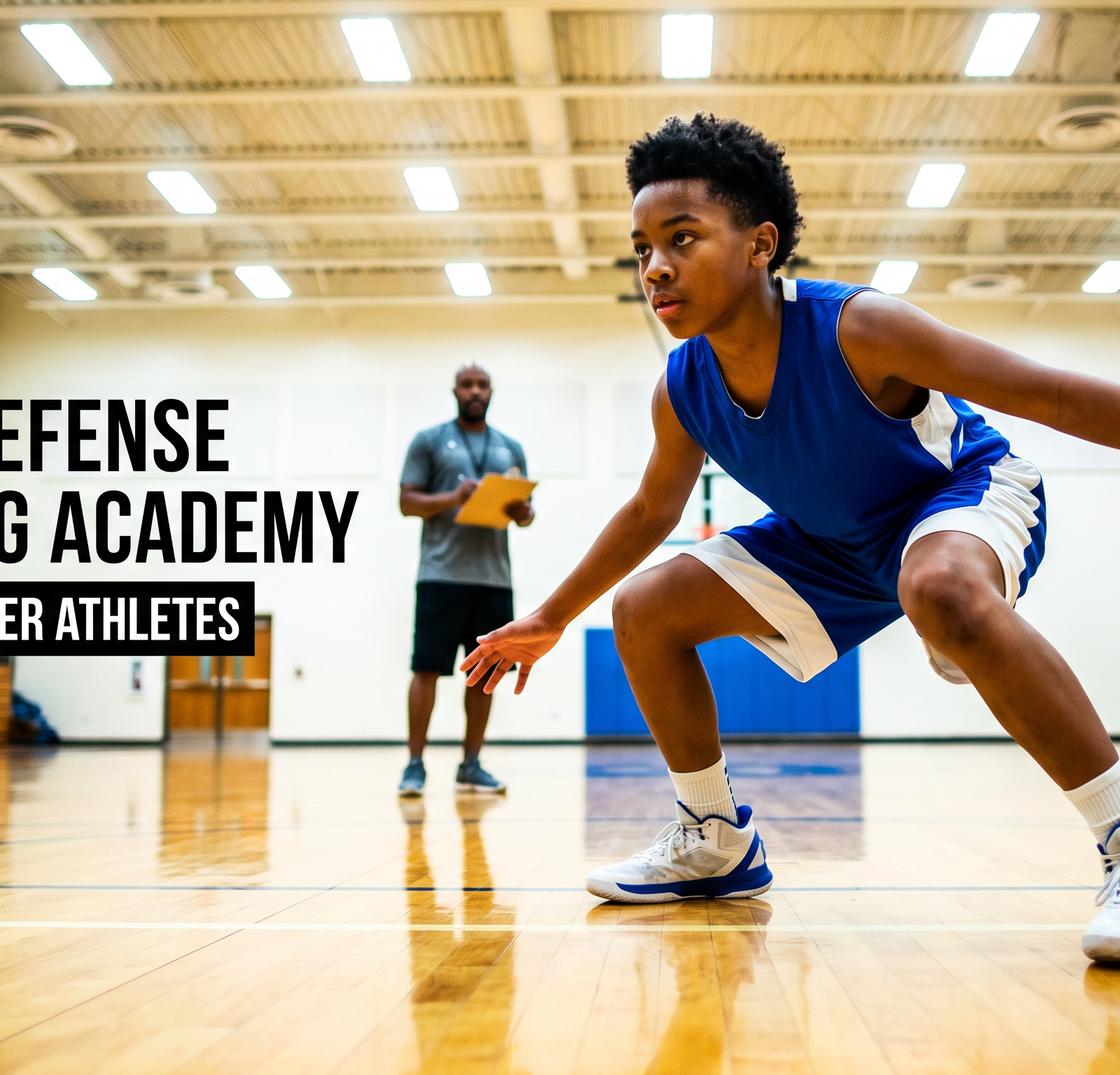
Players practicing their defensive stance and positioning during a training session.
Essential Defensive Footwork Drills
Implementing these drills into your regular practice schedule will rapidly improve your team's defensive capabilities. Remember to emphasize technique over speed, especially when introducing these concepts to beginners.
1. The Defensive Z-Drill (Zig-Zag Slides)
This is a classic drill that emphasizes the lateral slide and the drop step, two critical movements for staying in front of an attacker.
How to Run the Drill:
- Set up cones in a zig-zag pattern down the court (e.g., from the baseline corner to the free-throw line extended, then to the sideline, and so on).
- Players start at the first cone in a proper defensive stance.
- They slide laterally to the next cone. The key here is to push off the trail foot and step with the lead foot, never crossing the feet.
- Upon reaching the cone, the player executes a "drop step"—pivoting backward on the foot closest to the new direction—and slides to the next cone.
- Coaching Tip: Watch for players bobbing up and down. They should maintain a consistent, low hip level throughout the drill. To increase difficulty, add an offensive player dribbling (or driving, in netball) at a controlled pace.
2. Close-Out, Slide, and Backpedal
Closing out on an attacker who has just received the ball is a high-risk situation. This drill teaches players to close the distance quickly while remaining under control to prevent a blow-by.
How to Run the Drill:
- The defender starts under the basket, and the coach (or another player) stands at the perimeter with the ball.
- On the whistle, the defender sprints toward the ball handler.
- As they approach (about two large steps away), they break down their steps into short, choppy strides (the "stutter step") and drop their hips into a defensive stance, throwing a hand up to contest a potential shot.
- The coach then points left or right, and the defender immediately executes two lateral slides in that direction.
- Finally, the coach points back toward the basket, and the defender backpedals to the starting position.
- Coaching Tip: Emphasize the transition from the sprint to the breakdown steps. If a player closes out standing straight up or moving too fast, a simple pump fake will take them out of the play.
A coach demonstrating the lateral shuffle technique during a youth training session.
3. The Reactionary Gap Drill
This drill focuses on maintaining the appropriate distance from the attacker—close enough to apply pressure, but far enough back to react to a drive. This is crucial for players who may not be the fastest on the court.
How to Run the Drill:
- Pair players up (one on offense, one on defense) near the top of the key or the top of the shooting circle.
- The defender establishes their "reactionary gap"—typically an arm's length plus a few inches, depending on the relative speed of the two players.
- The offensive player begins to move laterally or forward at 50-75% speed. They are not trying to score, but rather to force the defender to move.
- The defender must maintain that exact gap distance, sliding and retreating as necessary.
- Coaching Tip: Teach the concept of "bouncing before the bounce." As the offensive player prepares to move, the defender should already be lightly bouncing in their stance, ready to react instantly rather than being caught flat-footed.
4. Deny and Recover (Off-Ball Defense)
Defense isn't just about guarding the player with the ball. This drill teaches players how to deny a pass while maintaining awareness of the ball's location.
How to Run the Drill:
- Set up three players: a passer at the top, an offensive player on the wing, and a defender guarding the wing.
- The defender positions themselves in a "deny" stance—one arm extended into the passing lane, chest facing the attacker, but head turned slightly to see both the attacker and the ball (the "pistols" position).
- The offensive player attempts to get open for a pass for three seconds.
- The defender must move their feet to stay in the passing lane, maintaining the deny position without grabbing or holding.
- After three seconds, the passer throws the ball to the wing (if open) or to a different spot on the court, forcing the defender to quickly recover and close out.
- Coaching Tip: Emphasize the "ball-you-man" principle. The defender should always be positioned between their assignment and the ball.
Translating Drills to Game Situations
Drills are only effective if the habits translate to live gameplay. As a coach, it is vital to praise correct footwork during scrimmages just as loudly as you praise a steal or a blocked shot.
When players understand that their playing time and the team's success depend on their defensive discipline, they will commit to mastering the less glamorous aspects of the game, like the lateral slide and the close-out.
Managing Your Team Effectively
Implementing a robust defensive training program requires organized practice plans, consistent player attendance, and clear communication with parents. This is where having the right club management platform becomes invaluable.
Managing a youth sports team shouldn't mean spending hours buried in spreadsheets and group chats. Vanta Sports is a comprehensive ecosystem purpose-built for youth basketball and netball clubs.
While you focus on teaching the perfect defensive stance, Vanta Sports handles the administrative heavy lifting. The Vanta Coach App is entirely free for volunteer coaches, allowing you to seamlessly plan sessions, track attendance, and communicate with your team. Meanwhile, Vanta Club provides a complete platform for registrations, payments, and safeguarding compliance, and the Vanta Guardian app keeps parents connected and informed.
By streamlining your club's operations with Vanta Sports, you reclaim the time you need to focus on what truly matters: developing the next generation of elite defenders.
Ready to Take Your Training to the Next Level?
Discover how Vanta Sports helps coaches run better practices. Learn more about Vanta Sports
Tags