Basketball Skills
Fast Break Transition Drills: 3 Practice-Ready Ways to Build a Faster Team
Help your youth basketball team turn rebounds, steals, and inbounds into organised scoring chances. These three fast break transition drills give coaches clear teaching points, progressions, and practice structure.

Fast Break Transition Drills: 3 Practice-Ready Ways to Build a Faster Team
A good fast break is not simply a race to the rim. It is a repeatable transition habit: secure the ball, make a clean first pass, fill the floor with purpose, and finish before the defence is set. For youth teams, transition offence creates straightforward scoring chances without demanding a deep half-court playbook. The best fast break transition drills teach players to see the same cues, sprint to defined spaces, and make the next decision at game speed.
This guide gives coaches three practical drills, the details that make them effective, and a simple way to turn transition practice into reliable game behaviour.
What Makes a Fast Break Work?
Fast breaks are won in the first two or three seconds after a rebound, steal, or inbound. The aim is to create a numerical or positional advantage before defenders can find matchups and protect the basket. That does not mean every possession needs a rushed shot. It means recognising the advantage, then making the uncomplicated play.
Give every player a clear job. The rebounder or ball winner secures possession and looks up. The first available guard shows a wide outlet target. Wings sprint outside the lane lines, while the rim runner attacks the middle lane and forces retreating defenders to choose. Consistent roles reduce hesitation and help players read the same picture together.
Speed matters, but spacing matters just as much. Three players racing in a straight line toward the ball make defending easy. Three players arriving in a left lane, middle lane, and right lane force defenders to cover more width and depth. Teach players to sprint first, then adjust only when the ball or a defender gives them information.
Set Three Transition Standards

Win the first pass
The outlet must be safe, early, and away from traffic. A rebounder who dribbles under the basket allows the defence to recover. Coach a strong chin on the rebound, a quick pivot, and a two-hand pass to a guard who has made a clear angle. If the outlet is not open, protect the ball rather than force a turnover. The fast break begins with possession, not panic.
Run wide, run deep, and communicate
A useful wing cue is “outside the lane, inside the sideline.” The middle runner goes straight to the rim unless the ball handler already occupies that space. Ask players to communicate useful information: “middle,” “one more,” or “rim.” Specific calls identify the advantage; general shouting does not.
Decide before recovery
Advance the ball with a pass whenever an open teammate is farther ahead. Dribble when it improves an angle, protects the ball, or attacks an uncovered lane. At the basket, teach a simple read: if one defender stops the ball, pass; if the defender protects the pass, attack; if the defence is set, flow into half-court offence.
Drill 1: Rebound, Outlet, Run
This foundation drill teaches the first three actions of transition. It is particularly useful with younger groups because every player sees the direct connection between a defensive rebound and an offensive chance.
Setup
Place a coach or manager on the wing with a ball. Put one player under the basket as rebounder, one guard outside the lane as outlet, and three players ready to fill left, middle, and right lanes. Start with a tossed ball off the backboard. The rebounder secures it, pivots, and outlets; the group sprints to the far basket for a layup.
Coaching points and progression
Demand a visible outlet target rather than a guard drifting behind a defender. The guard should meet the pass, turn upcourt with eyes ahead, and decide whether to pass ahead. Reward wings who sprint wide even when they do not receive the ball; their spacing opens the middle lane. Once the pattern is clean, add one chasing defender. The drill becomes a real decision: push, pass, or protect. If players bunch up, reset their lane destinations rather than merely telling them to run faster.
Drill 2: 3-on-2 to 2-on-1 Continuous Transition
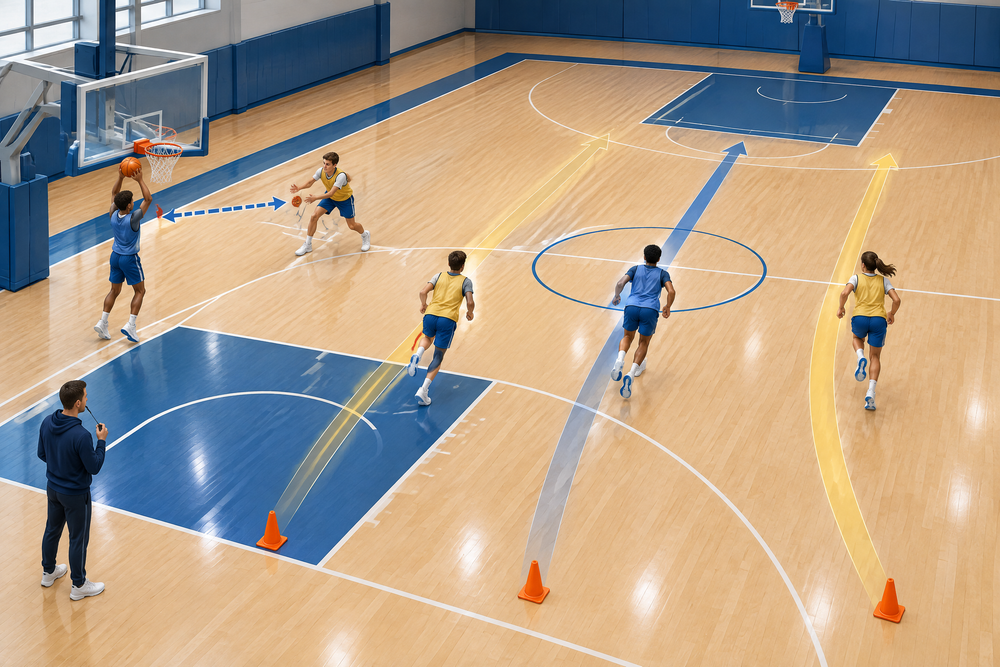
This classic drill develops decision-making under a changing advantage. It also trains the immediate offensive-to-defensive shift that many teams lose after a shot or turnover.
Setup
Start three attackers at half court against two defenders near one basket. After the possession ends, the two defenders attack the other way against one new defender. The player who took the shot or lost the ball sprints back and joins the defence according to your rotation. Maintain lines at each baseline so the drill keeps moving with minimal explanation.
Coaching points and progression
Ask the three attackers to create two passing windows before the first dribble. The centre player pressures the rim or forces a defender to stop the ball; the outside players stay wide until the defence commits. On defence, one player takes the ball while the other protects the basket and communicates. Use a score constraint to raise focus: layups are two points, a paint touch followed by a kick-out is three, and a turnover is minus one. If the drill becomes rushed, briefly rehearse the first read, then return to full speed.
Drill 3: Advantage Waves with a Trailer Read
Adding a trailer teaches players not to force a difficult finish when the first fast-break chance has slowed. It also gives forwards a meaningful transition role beyond rebounding.
Setup
Send three players on a 3-on-2 break from the far free-throw line, with a fourth player trailing several steps behind. Two defenders begin in the paint. If the defenders protect the rim and the early advantage disappears, the ball must be reversed or dropped to the trailer for a shot, drive, or extra pass. Rotate the trailer into a new lane runner after each rep.
Coaching points and progression
The trailer must sprint into a balanced, ready position, not jog behind the ball. The front three keep moving after the first pass: the passer cuts to the rim or drifts to an open window based on the defender's position. Add a third defender trailing the play late, then reward the extra pass and quality shot. A simple rule works well: a contested early shot ends the rep with no point. Players soon learn that patience can preserve a transition advantage.
Build These Drills into a Better Practice Plan
Keep transition work short, intense, and frequent. A ten-minute block after the warm-up can be more valuable than one long weekly session. Begin with a low-defence version that reinforces spacing, then add live defenders and a scoring consequence. Finish with a small-sided game that awards points for a defensive stop followed by a paint touch or an open transition shot.
Track behaviours as well as makes and misses. Count clean outlets, wide lane fills, paint touches, and sprint-backs after a lost possession. Those measures show whether players are building habits that create chances. They also make feedback precise: instead of saying “run harder,” explain that a wing failed to reach the wide lane before the first pass, allowing one defender to cover two players.
Keep Players and Families Aligned with Vanta Sports
Transition drills improve faster when players understand the standard before practice and families can see how their athlete is developing. Vanta Sports provides youth programmes with a connected Club, Coach, Guardian, and Player app suite for managing those moving parts. Coaches can keep practice plans, drill notes, schedules, and team communication together, while players and guardians have clearer visibility of what is happening around the team.
Use the Coach app to share a weekly focus such as “wide lanes and early outlet,” then reinforce the same cue in the Player app between sessions. The Guardian app helps keep logistics, availability, and messages organised, while the Club app supports the wider programme. That clarity reduces avoidable admin work and leaves more attention for the coaching details that matter.
Fast break transition drills work when drill design matches the behaviour you need in games. Teach a clean outlet, defined lanes, purposeful communication, and a calm final read. Repeat those standards in competitive reps, celebrate the right decisions, and your team will create advantages before the defence can settle.
Ready to Take Your Training to the Next Level?
Discover how Vanta Sports helps coaches run better practices. Learn more about Vanta Sports
Tags