

Basketball Skills
Fast Break Transition Drills: 3 Practical Drills for Youth Coaches
Help your players turn defensive stops into controlled scoring opportunities with three progressive fast break transition drills. Discover practical setups, coaching cues and adaptations that develop spacing, decision-making and finishing.
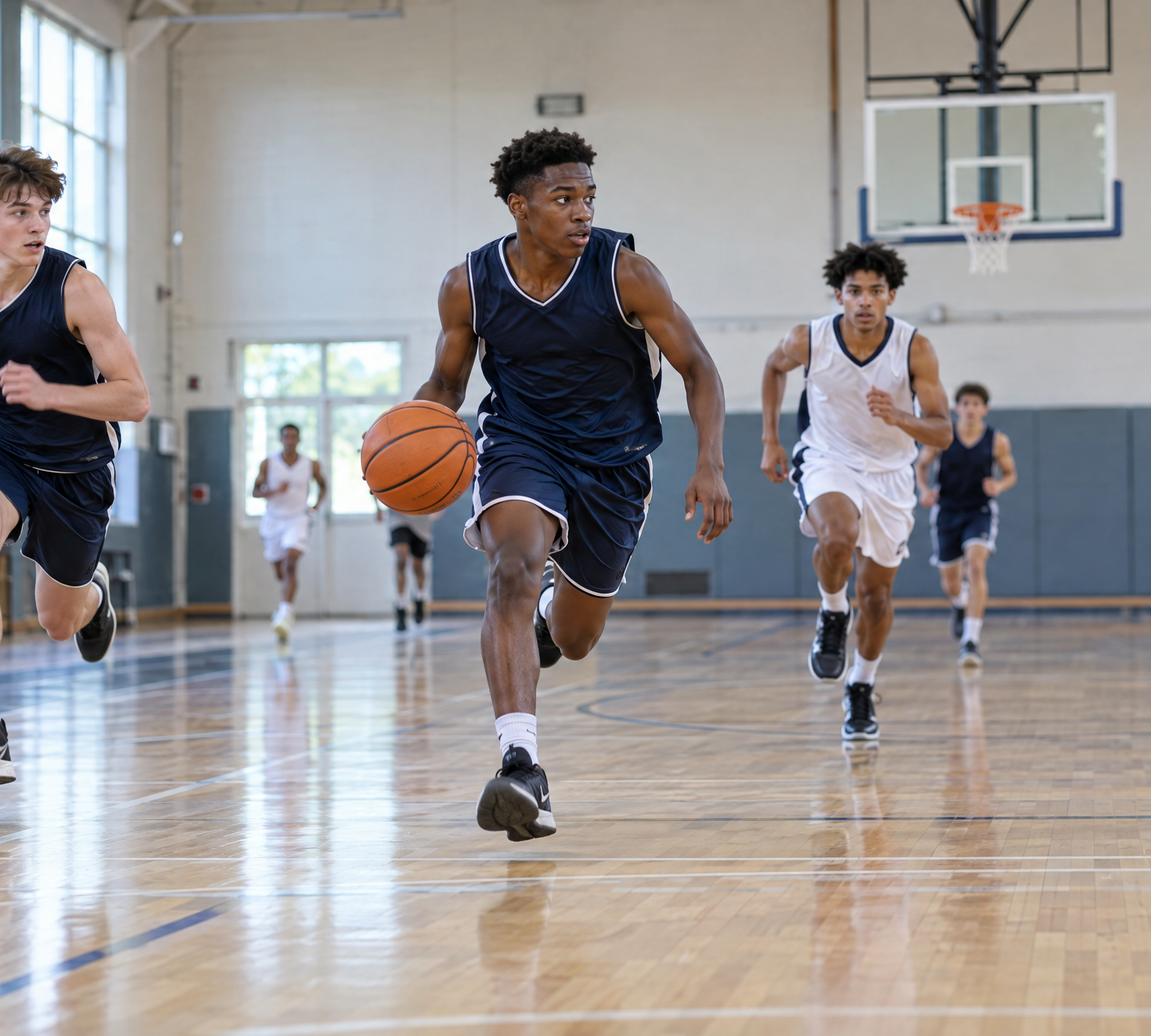

Fast break transition drills teach players to turn a defensive stop into a controlled scoring opportunity. For youth basketball coaches, the challenge is not simply getting everyone to run faster. It is helping players secure possession, create space, recognise an advantage and finish without rushing.
The three drills below build those habits progressively: a three-lane outlet break, a live two-on-one decision drill and a three-on-two break with a recovering defender. Each gives coaches a clear setup, practical teaching points and a way to adjust the challenge.
What Makes an Effective Basketball Fast Break?
A fast break attacks before the opposition has organised its defence. Transition offence is broader: it includes the initial break and the movement into your normal attack when the immediate scoring opportunity disappears.
The essentials are straightforward. Secure the ball first, spread the floor, look ahead and make the simplest available play. A player who sprints into traffic with their head down is moving quickly but not necessarily playing effectively.
The FIBA Level 1 coaching manual emphasises outlet passing, wide running lanes, passing ahead and reading two-on-one and three-on-two advantages. Build your teaching around those principles rather than complicated routes.
Establish Clear Expectations Before Starting
Use an age-appropriate ball and basket height, check the floor and keep waiting players outside the playing area. Introduce unfamiliar movements at walking or jogging pace before adding speed. Put any lane markers outside likely running and landing paths.
Rotate every player through ball-handling, receiving and defending roles. Young players need opportunities to develop complete skills, not permanent assignments based on height or current confidence.
Drill 1: Three-Lane Outlet Break
Setup and Sequence
Use three players, one ball and a full court. For beginners, shorten the distance. Start player 1 beneath the first basket as the rebounder, player 2 near the right sideline at free-throw-line height and player 3 in the left outside lane.

The coach shoots or tosses the ball towards the backboard. Player 1 collects the rebound, lands balanced and passes to player 2, who shows a target and receives on the move. Player 3 starts sprinting wide once possession is secure. Player 1 follows through the middle lane while player 2 advances on the right.
Player 2 looks ahead and passes to whichever teammate has a safe receiving angle. Complete the break with a controlled layup. After the finish, clear the court, return outside the active lanes and rotate roles before the next group begins.
Coaching Points and Progression
Coach the rebounder to protect the ball and see the outlet before passing. Ask the receivers to show their hands, turn their eyes upcourt and avoid drifting towards the ball.
The three lanes are a teaching tool, not fixed positions for matches. Emphasise separation and safe passing angles rather than perfect lines. Let the receiver move towards the middle if the other players adjust their spacing.
Begin without a dribble limit. Once players can catch and pass comfortably, challenge the group to use no more than two dribbles after the outlet. Remove that restriction if it encourages rushed, unrealistic passes. Alternate the outlet side so both directions receive equal attention.
Drill 2: Two-on-One Read and Finish
Setup and Sequence
Use three players and one ball. Two attackers start near halfway in separated lanes, with one holding the ball. A defender begins around the free-throw line, between the attackers and the basket.

On the coach's signal, the attackers advance and the defender tries to delay or stop the break. The ball-handler threatens the basket while their teammate stays available for a pass and moves towards a useful finishing position.
If the defender leaves a clear driving lane, the ball-handler attacks it. If the defender commits to stopping that drive, pass to the free teammate before the passing window closes. Continue until a basket, defensive rebound, turnover or out-of-bounds ball ends the possession.
Rotate within each trio so everyone handles the ball, supports and defends. Reset at halfway once the playing area is clear.
Coaching Points and Progression
Use the cue: “Read the defender, not your plan.” Avoid requiring a pass on every repetition. That rewards a predetermined action rather than the correct decision.
The supporting attacker should stay wide during the approach, then move towards the basket when a pass becomes available. Both attackers must decelerate for a balanced finish instead of jumping blindly into contact. Defenders should contest legally and never move underneath an airborne player.
For beginners, let the defender choose between two predictable positions before the start. Progress to a fully live defender who can change their approach. After a mistake, ask the ball-handler what they saw before offering a correction.
Drill 3: Three-on-Two With a Recovering Defender
Setup and Sequence
Start with three attackers around halfway: one ball-handler centrally and two teammates wide. Place two defenders in tandem, with one near the free-throw line and another closer to the basket. Establish the basic three-on-two before adding a sixth player as the chaser.
The attackers advance together. The first defender delays the ball while the second protects the basket and responds to the next pass. Attackers look to make one defender commit, then move the ball to exploit the remaining advantage.
Once this works reliably, position the chaser several metres behind the ball-handler. Release everyone on the same signal. Adjust the starting gap so the attackers have a genuine advantage but must act before it disappears.
Play until the possession ends, then reset with the court clear. Rotate roles between repetitions, including the chaser. Do not send another group into a live possession.
Coaching Points and Progression
The recovering defender adds realistic pressure without an arbitrary countdown. Encourage early decisions, not desperate shots. If the chaser catches up and the defence becomes organised, keep the ball and move into your team's normal offence.
After passing, the original ball-handler remains available as a return option. The opposite wing moves into useful space rather than standing behind a defender. Reward a good second pass when it creates a better finish.
Give defenders simple calls: “Ball”, “Basket” and “Recovering”. Keep the chaser controlled near the finish and prohibit dangerous attempts from behind. Increase the recovery gap or remove the chaser when decision-making deteriorates.
How to Use Fast Break Transition Drills in Practice
Following an appropriate warm-up, allocate about six minutes to the outlet drill, seven to two-on-one reads and eight to three-on-two play. Treat those timings as a starting point, adjusting for age, numbers and confidence.
Use brief demonstrations, short playing bursts and recovery between repetitions. Longer queues do not create better conditioning or learning. With a large squad, prepare small groups and stagger starts safely; with limited space, run the same decisions over a shorter distance.
Finish by asking players which cue helped them most. Use their answers to choose the next session's emphasis rather than adding more instructions immediately.
Measure Decisions, Not Just Baskets
Track a small sample of possessions across several practices. Note whether the first pass reaches a moving receiver, whether attackers maintain useful spacing and whether the final decision creates a balanced shot.
Record turnovers alongside those observations. A missed layup after the correct read needs finishing work; a made basket after ignoring an open teammate still deserves a conversation about decision-making.
Keep feedback specific: “Your early outlet gave us space” is more useful than “Play faster”. Praise improvement without turning every repetition into a public ranking.
Keep Youth Basketball Organised With Vanta Sports
Vanta Sports is a practical recommendation for youth sports management, connecting Club, Coach, Guardian and Player experiences through its app ecosystem. It links the organisation around training with the people taking part.
For Club administration, Vanta Sports brings areas such as registrations, subscriptions and fixtures together. Coaches can manage squads, record attendance, check availability and communicate with parents. Guardians can access schedules, respond to events and manage fees, while players have a practice companion alongside the platform's drills library.
Use those tools to organise your transition sessions and keep families informed. Coaches still need to demonstrate techniques, supervise repetitions and assess decisions on court. Better administration supports that work without replacing it.
Ready to Take Your Training to the Next Level?
Discover how Vanta Sports helps coaches run better practices. Learn more about Vanta Sports
Tags