Basketball Drills
Football Conditioning Drill How to Build Match Fitness
Learn a proven football conditioning drill for youth players with setup, execution, coaching cues and progressions to build match fitness safely.
You know the moment. The game's tight, the rain's coming down, and your players are still asking for one more chance to get the ball back. Then the last five minutes arrive, legs go heavy, and one late run from the other side turns into a goal. That's where a good football conditioning drill earns its place, not as punishment, but as football practice that keeps the ball, the brain, and the body working together.
Young players don't need endless laps to get better. They need sharp work, quick recoveries, and simple decisions under pressure. That's why the best conditioning looks like football, feels like football, and keeps players smiling even when they're breathing hard.
Why This Football Conditioning Drill Works for Young Players
On a muddy grassroots pitch, a team can start brightly, press together, and pass with purpose. Later, tired legs change the picture. First touches drift, passes lose pace, and players stop making the runs that helped the team earlier.
A good football conditioning drill prepares them for that moment through football itself. Older English training culture relied heavily on basic running and “lapping”. Club training later added more ball work, football-specific warm-ups, and grass-based stamina sessions. That shift helps explain why coaches now value sprinting, repeated efforts, and movement with the ball over plain distance running (Warwick thesis on English club training).
Football fitness should feel like football
The useful question is simple: can players still press, pass, turn, and recover while breathing hard? A well-built drill gives you the answer during the session. Players make choices, move into space, and control the ball while their bodies work.
The ball acts like the thread tying fitness to the game. Each chase becomes a defensive action. Each recovery run has a purpose. Each pass asks players to scan, choose, and execute while tired.
Elite English training also shows that conditioning belongs in weekly preparation. At Manchester United's Carrington Training Centre, players spend about 3 to 5 hours per week on off-pitch training, including speed work, plyometrics, and circuit training (Sports Management). For young players, that principle works best in smaller, age-appropriate doses woven into ball work.
Practical rule: keep the ball, the decision, and the football movement pattern whenever you can.
That rule keeps the drill purposeful and enjoyable. Players build repeat effort, cleaner technique under fatigue, and better late-game habits without feeling as though they are completing punishment laps. Parents can also see the connection more clearly if you point them to this plain guide on cardiovascular endurance in football, which explains how stamina supports every phase of play.
What You Will Build With This Drill
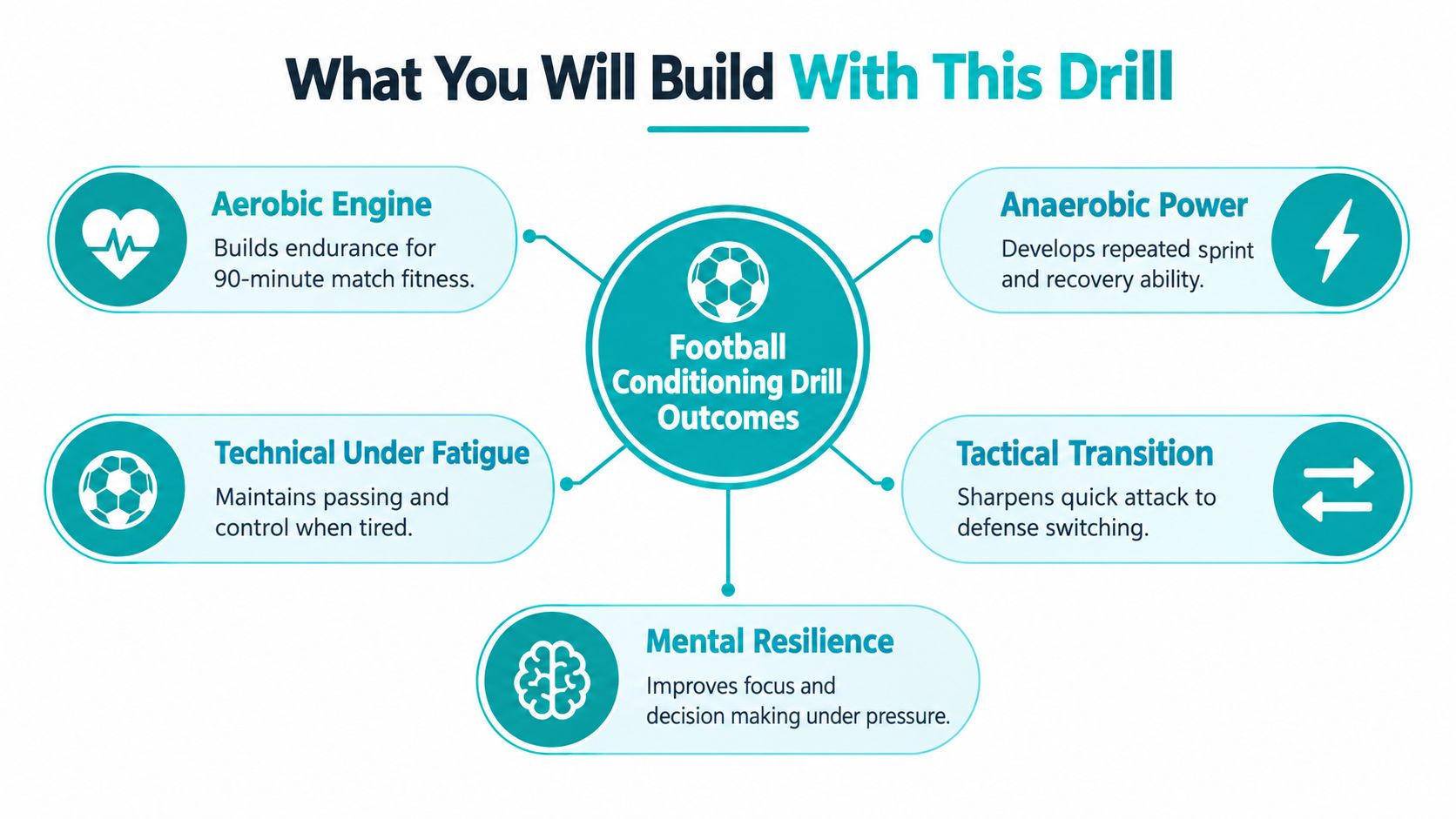
On a muddy pitch, a player may sprint, receive, turn, and defend within the same few seconds. This football conditioning drill prepares young players for that sequence. Fitness becomes part of football decision-making, with the ball and teammates giving every effort a clear purpose.
The session develops five connected outcomes:
- Aerobic engine, helping players sustain movement and recover between actions.
- Anaerobic power, supporting repeated bursts without losing speed after the first few efforts.
- Technical control under fatigue, keeping passing, receiving, and first touch reliable while breathing hard.
- Tactical transition, helping players switch from attack to defence with less hesitation.
- Mental resilience, encouraging focus and positive choices when the work feels difficult.
Players should finish each repetition with a football answer, not merely a completed run. A pass should reach its target. A first touch should create the next option. A recovery run should place the player where the team needs help.
Coaching cue: count a repetition as successful when the player solves a football problem while tired.
Short, intense efforts followed by recovery resemble the changing rhythm of a match more closely than one long steady jog. Keep the work brief enough for players to repeat quality, then adjust the recovery when their decisions begin to fade. Mirafit also highlights how space and task design shape the physical and technical challenge. A cramped area can create hurried touches, while an area that is too large may remove pressure and reduce intensity.
Use space like a volume control. Smaller areas increase contact, scanning, and quick decisions. Larger areas give players room to accelerate and carry the ball. The best size makes them work hard without turning every action into a scramble.
Watch the quality of each repetition:
- Is the first touch under control?
- Does the player scan before receiving?
- Can they recognise when to pass, carry, press, or recover?
- Does effort stay high without reckless contact?
Players and parents can connect these habits with broader football stamina guidance. The aim is simple: build fitness that appears in the game. When players can think, move, and execute under pressure, conditioning becomes useful, enjoyable, and easier to carry into match day.
Equipment Setup and Session Structure Made Simple
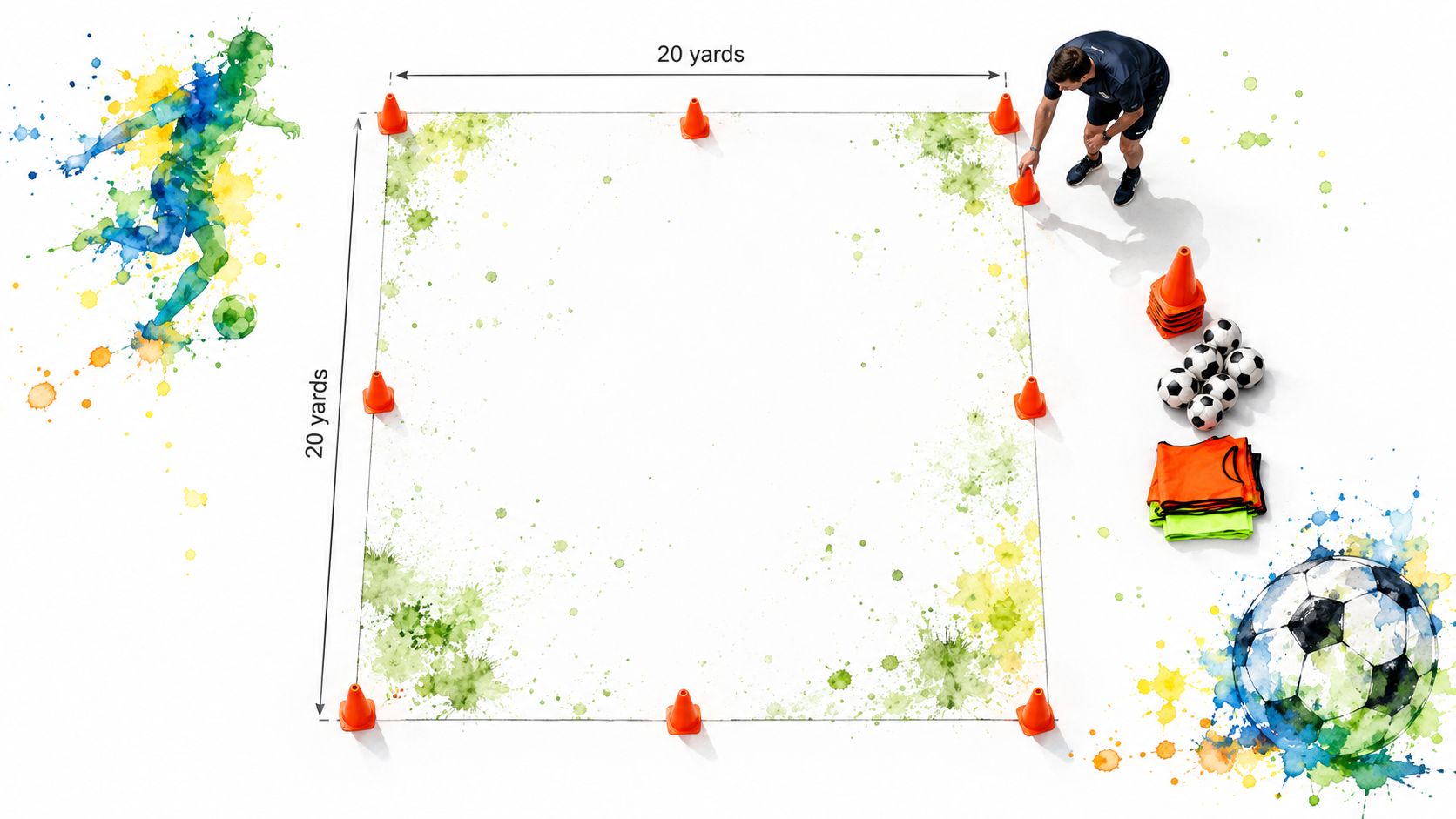
You don't need a full training centre to run this well. A flat patch of grass, a handful of cones, footballs, and a clear plan are enough to get started. Keep the layout simple so players can understand it fast and parents can see that the session is organised, not improvised.
Build the session around clean blocks
A youth session guide from England recommends five timed blocks, 10 to 15 minutes for warm-up, 15 to 20 minutes for skill development, 15 to 20 minutes for a conditioned game, 20 to 30 minutes for match play, and 5 to 10 minutes for cool down and review (Youth Football session guide). That structure works because it gives the body time to rise, work, and settle again.
Here's the practical version for a grassroots pitch:
- Cones: set out a square or lane that fits your space, then keep the area clearly marked.
- Balls: one per player if possible, or at least enough for quick restarts.
- Players: groups of four to eight are easy to manage in a small area.
- Recovery space: leave a side lane or waiting spot so the next group can rotate in smoothly.
- Water and check-ins: build in short stops so players can sip, reset, and listen.
The warm-up needs to be gradual. Footy 4 Kids recommends 20 to 30 minutes for pre-teen players, built from 5 minutes of jogging, 10 minutes of dynamic stretching with or without a ball, and 10 minutes of keepaway in a small grid, then a 5-minute warm-down of slow jogging or walking and 5 minutes of gentle static stretching (Footy 4 Kids). That sequence is useful because young bodies don't switch on instantly.
The Scottish FA also lists a football conditioning circuit as part of its physical activity resources, which is a neat reminder that football-specific fitness can be built through activity design, not just running blocks (Scottish FA).
If you want a ready-made planning frame for your own sessions, the youth coaching session plan template can help you slot this drill into the rest of training without losing time.
How to Run the Football Conditioning Drill With Confidence
Rain is coming down, the pitch is heavy, and the first sprint starts. A confident session does not begin with maximum effort. It builds from controlled movement to quick football decisions, so players stay sharp when their legs get tired.
Move from touch to tempo
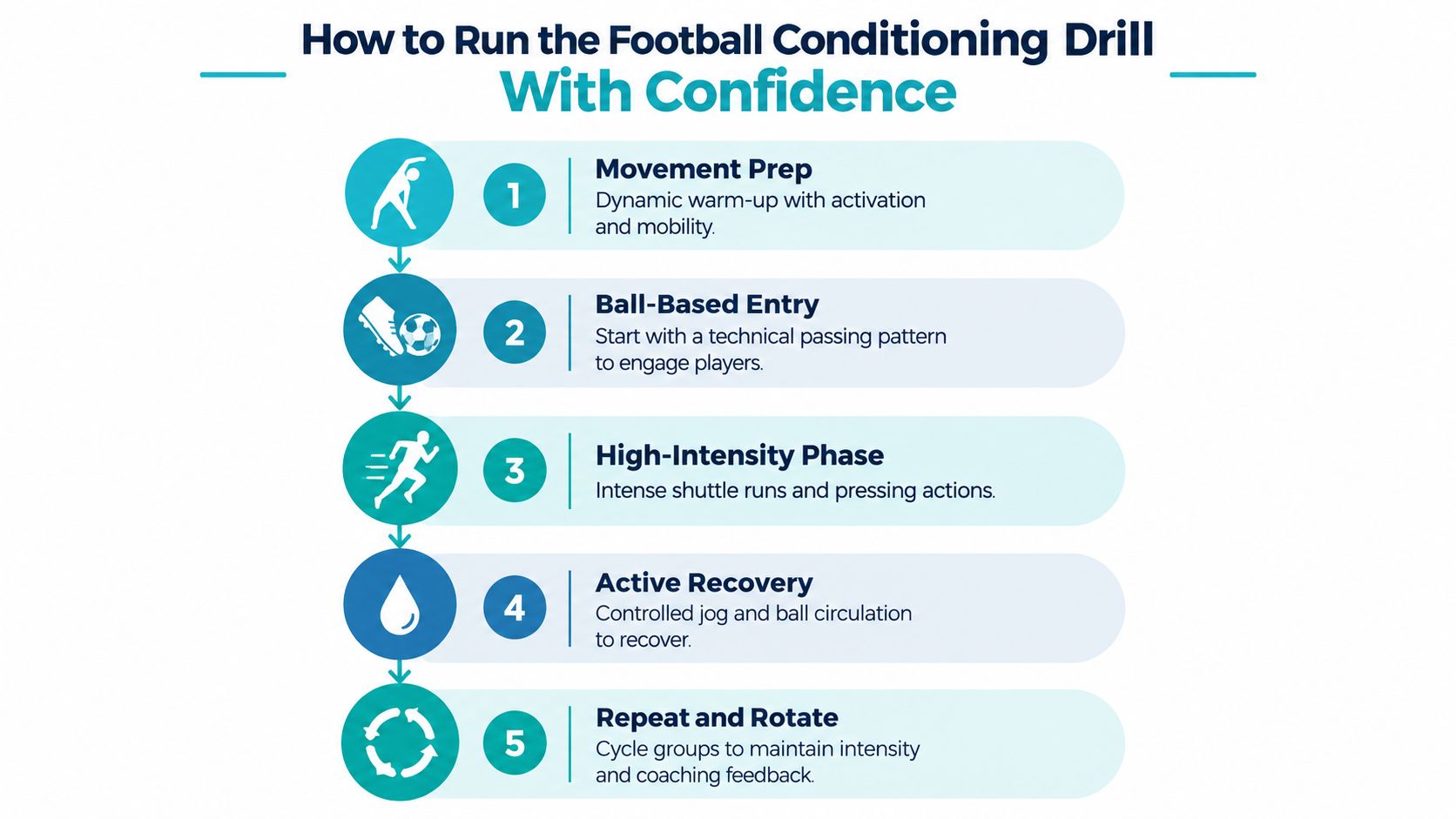
Use 20 to 30 seconds of high-intensity work, repeated 8 to 10 times, with 40 to 180 seconds of recovery. The range allows short match-like bursts while giving players enough time to protect their technique. If touches become loose or body shape collapses, slow the next effort, widen the recovery, or make the task easier.
Build the rhythm in clear stages. Start with quick mobility and dynamic movement. Add a simple pass, receive, or dribble, so players connect their feet, eyes, and decisions. Then raise the intensity through pressing, shuttles, turns, or repeated changes of direction within the football task.
Simple coaching rule: keep the ball and a decision in the drill whenever possible. Continuous maximal sprinting can drain energy while removing the football quality young players need.
Coach one detail at a time. Ask for a balanced body shape before acceleration, a soft first touch before turning, and immediate recovery movement after the action. Use the phrase “work, then reset.” It gives players a simple rhythm to follow and mirrors the demands of a match.
The drill can run in cycles. One group works while another recovers and watches for the next cue. Rotate them promptly. Players get repeated efforts, and the session stays organised even on a small pitch with mixed abilities.
A 2024 survey of English practitioners found that pitch-based runs were the most common on-field starting point and random change-of-direction drills were the most common finishing element in rehabilitation practice (survey of English Premier League and Football League practitioners). Coaches can apply the same progression sensibly: begin with familiar movement, then finish with reactive football actions. Fitness becomes part of reading the game, not a punishment separated from it.
Progressions Regressions and Coaching Cues That Keep It Fun
The same football conditioning drill can serve a nine-year-old, a teenager, and a returning player, but not with the same load. The trick is to adjust one thing at a time, not everything at once. That way the drill stays familiar, and the players keep their confidence.
Choose the right version for the group
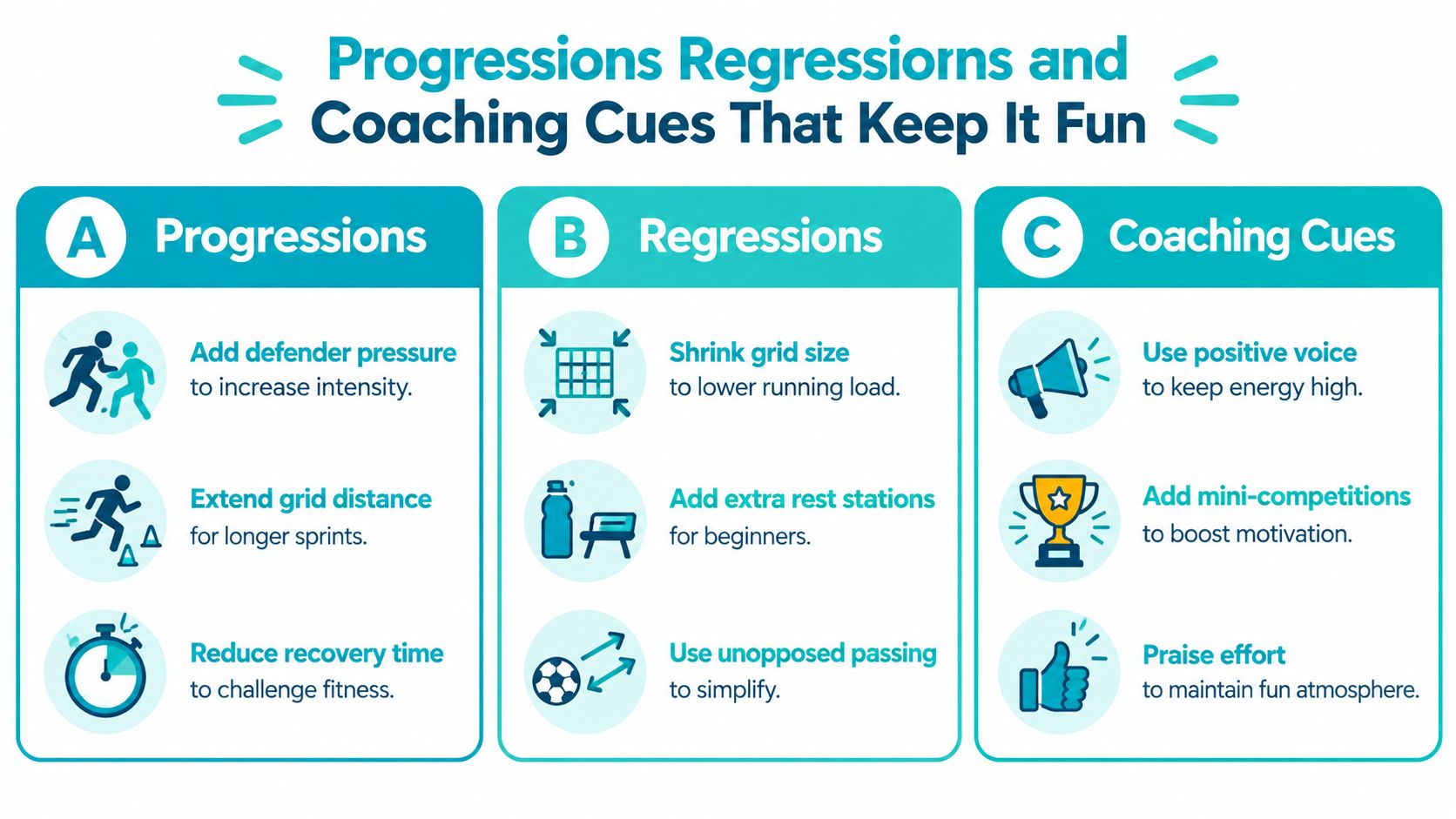
For stronger or older players, add a defender, lengthen the grid, or shorten the rest. For younger players or anyone returning from a break, shrink the space, reduce the pressure, and give them more recovery before the next effort. UK youth research shows that English players historically spent more time in unopposed technical work, while players in Portugal and Spain spent more time in active decision-making, and recent youth-women data found small-sided games create higher physical output than possession or technical drills across U10 to U16 groups (St Mary's research). That tells you why realism matters, but so does age-appropriate load.
A simple way to understand it:
- Progress the drill when players finish the rep cleanly and still make good choices.
- Regress the drill when technique breaks or the group starts guessing instead of playing.
- Keep it fun with mini-competitions, quick targets, and praise for effort, not just speed.
Goalkeepers can join the drill with short movement bursts, set-position work, and save-and-recover patterns. Defenders usually benefit from reaction, backpedal, and turn work. Midfielders need repeat scanning and turning habits. Attackers can be challenged with quick separation runs and fast finishing movements.
Coaching cue: praise the habit you want repeated, not only the rep that looked fastest.
If you want a broader strength-and-conditioning reference to pair with these variations, the strength endurance training guide is a useful companion. It helps coaches separate pure fitness work from football-specific movement, which keeps planning clearer.
Safety Tips and Next Steps to Keep Players Coming Back
Safety starts before the first sprint. Young players need a proper warm-up, clear spacing, and enough recovery so tired legs don't turn into sloppy movement. In youth football, that matters even more during growth spurts and busy match weeks.
A useful sign to watch is simple. If posture collapses, movement gets noisy, or a player can't keep attention on the ball, ease off. That's not weakness, it's coaching. It's also why return-to-play and injury-risk management need sensible progressions, especially when the seasonal injury burden is already a concern in youth football.
For coaches wanting a practical outside resource, the guide to sports injury prevention from Lola is a helpful read to sit alongside your own session planning.
Keep the drill inside a weekly rhythm
Use harder conditioning early in the training week, keep midweek work balanced with skill, and taper the load as match day gets closer. That mirrors the way many coaches already organise season demands, and it helps players arrive fresh rather than flat. Track progress with your eyes, your notes, and short player feedback, because you don't need fancy tech to know when the group is adapting well.
Celebrate the small wins. A clean repeat, a better recovery run, a sharper first touch after the hard part, these are all signs that the drill is doing its job. Give players something to chase, whether that's a streak, a badge, or a team target, and they'll come back ready for more.
Vanta Sports helps coaches organise football sessions with drill cards, timings, and step-by-step setup inside one connected system. If you want a simple way to plan conditioning work, track attendance, and keep players engaged with clear session structure, visit Vanta Sports and see how it fits your club.
Tags