Youth Development
8 Fundraising Ideas for Rugby Clubs That Work
Discover 8 fundraising ideas for rugby clubs, from tournaments to sponsorships, with practical steps, ROI estimates and youth versus adult club guidance.

512 rugby clubs in England had already received Winter Survival Fund grants totalling £18,275,903, while a further 129 clubs applied for loans. The strongest fundraising programme combines one high-value format, such as sponsorship or a tournament, with repeatable community and player-led activities rather than relying on a single event.
A successful club doesn't need the loudest fundraiser. It needs the right mix for its goal, volunteer capacity, audience and calendar. A tournament may generate a substantial campaign, while a player challenge can build fitness, confidence and supporter involvement without requiring a large venue. Match-day catering and merchandise can then provide repeatable income around activities the club already runs.
The eight formats below are ranked by how well they balance income potential, player development, community reach and operational effort. Youth clubs need extra care around permissions, supervision, photography and age-appropriate participation. Adult clubs may have more flexibility with hospitality and evening events, but they still need clear controls.
Safeguarding, permissions, food safety, insurance, transparent payment handling and accurate communication should shape every decision. A connected platform such as Vanta Sports can help centralise event scheduling, RSVPs, payments, attendance and messages, so volunteers aren't piecing together spreadsheets and scattered group chats. For wider planning inspiration, compare these ideas with other effective fundraising tactics for 2025.
1. Sponsorship and Partnership Programmes
Best overall balance: high income potential, strong community reach, moderate development value and substantial relationship-management effort.
Sponsorship earns the top position because it can provide stability beyond a single weekend. A local builder, physiotherapist, equipment supplier, restaurant or financial business may value association with a club that brings together families, players, schools and residents. The strongest pitch isn't “please donate”. It explains what the business receives and what the partnership helps the club deliver.
Build a concise prospectus around specific assets:
- Visible placement: Offer pitch-side boards, training-ground signage, programme space and kit branding where appropriate.
- Community value: Connect the partnership to junior participation, accessible coaching, injury support or facility improvements.
- Hospitality: Invite business contacts to selected matches, presentations or club events.
- Communication: Agree how often the sponsor appears in newsletters, social posts and match-day announcements.
- Account ownership: Assign one sponsor liaison who records promises, deadlines and delivered benefits.
Youth clubs should prioritise businesses whose values suit children and families. Adult clubs can include hospitality-led packages, but alcohol-related partnerships shouldn't become the only route to income. A family-friendly sponsor can support a broader audience and make the club more attractive to schools and community partners.
Practical rule: Sell a clearly managed relationship, not a logo on a shirt. If the club can't explain when and where a sponsor will be seen, the package isn't ready.
Keep records of every agreement, invoice, benefit and renewal conversation. A structured sponsorship approach for football clubs offers useful principles that also apply to rugby, particularly around defining assets and maintaining delivery records. Use the club database to track business contacts, communications and fulfilment, then report back with observations rather than inflated promises. Sponsorship works best when the club treats it as service delivery.
2. Tournament Hosting and Competition Events
Best campaign format: high income potential, high community reach, meaningful player development and high operational effort.
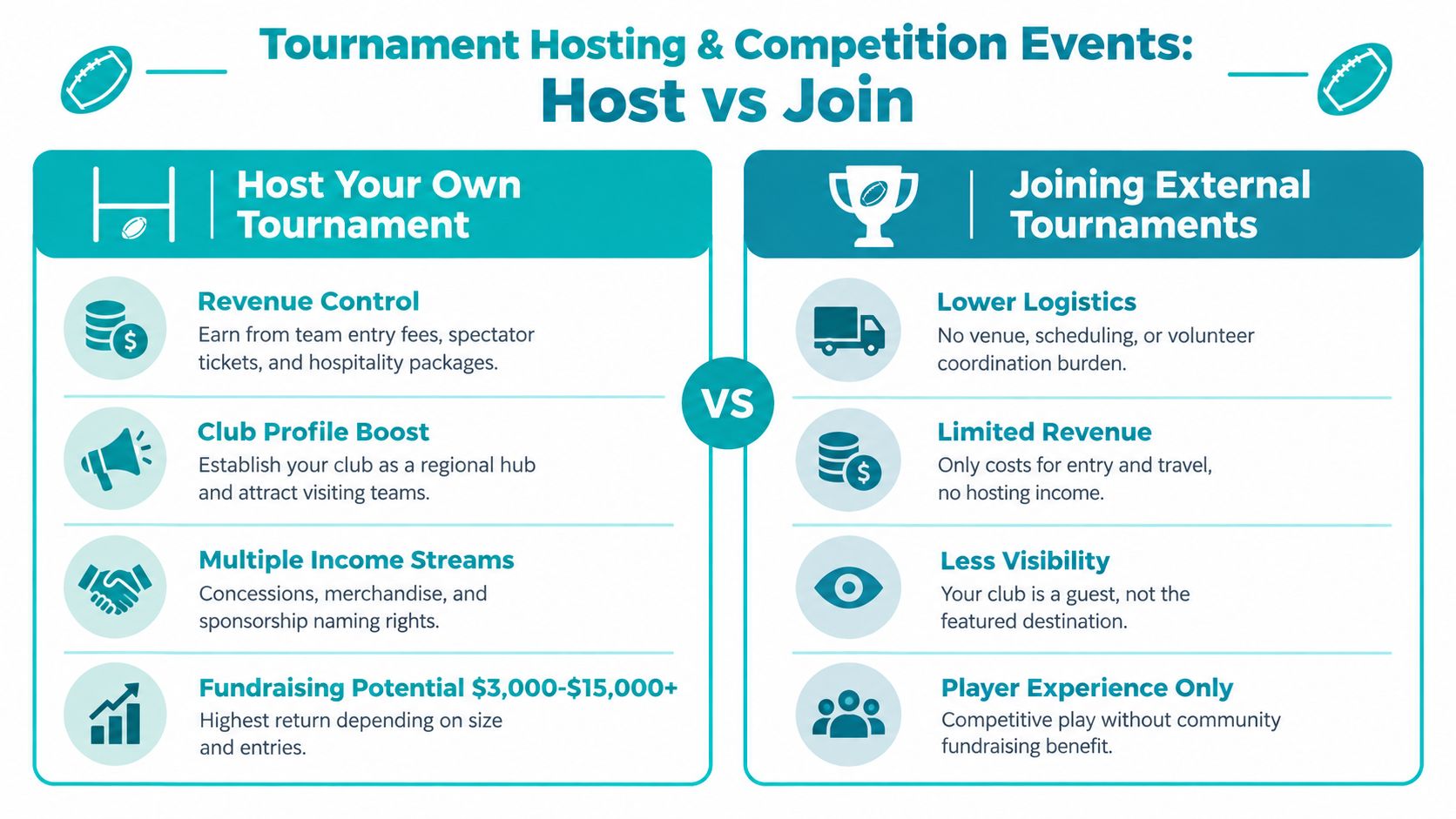
A well-run tournament can turn your ground into a regional meeting point. Visiting teams bring players, coaches, families and supporters, creating several income opportunities at once. Entry fees, spectator access, food, merchandise, parking, raffles and hospitality can all sit within one event, although every added service also creates work.
Choose the format around your facilities and audience. Sevens may suit a compact competition weekend, touch rugby can welcome mixed abilities and age groups, and traditional fifteen-a-side rugby may fit established league relationships. Youth organisers should separate age groups carefully, appoint safeguarding leads, confirm medical and first-aid arrangements, and communicate collection procedures to parents. Adult competitions still need clear fixture rules, referee appointments and contingency planning.
The event should have one accountable coordinator, supported by owners for:
- Entries and payments: Keep team details, invoices and contacts in one system.
- Fixtures: Publish draws, pitch assignments and changes quickly.
- Officials: Confirm referees and match procedures before arrival.
- Venue operations: Allocate changing rooms, parking, first aid, toilets and waste handling.
- Revenue points: Plan catering, merchandise and sponsor visibility before the day.
Use the RFU funding search facility alongside event planning. The RFU says its search tool is free, has no usage limit and searches thousands of grants and loans for club funding needs in England. That makes a tournament more useful when it forms part of a wider facilities or sustainability plan, rather than becoming an isolated cash exercise.
A tournament can also expose weaknesses quickly. If the club has too few volunteers, poor fixture communication or inadequate space, the event may damage goodwill. Use a connected sports events planner to coordinate entries, schedules, attendance and participant messages before committing to scale.
3. Rugby Skills Clinics and Coaching Masterclasses
Best development-led format: moderate to high income potential, very high player development value, strong community reach and moderate operational effort.
Skills clinics work because participants receive something tangible for their payment. A specialist session on passing, kicking, tackling technique, breakdown decision-making or positional play can raise funds while giving players a reason to return. Parents also see the activity as development rather than a simple sales appeal.
Use experienced club coaches, qualified guests or former players who understand the age group they're teaching. A youth clinic should use age-appropriate contact practices, clear consent procedures and suitable supervision. It can also include a short parent session covering training progression, confidence and safe participation. Adult clubs might offer position-specific workshops, referee development or coaching masterclasses for volunteers.
Create a simple offer:
- Member access: Give existing players an accessible registration route.
- Open places: Invite non-members to widen the club's community reach.
- Session bundles: Offer a sequence of clinics where progression makes sense.
- Added value: Include feedback notes, a skills card or a follow-up development message.
- Clear capacity: Limit registrations to the number coaches can safely support.
Promote the clinic through the club app, school contacts and local rugby networks. Vanta Sports can help coordinate instructor availability, registrations, payments, attendance and communication, while coaches can record useful progress observations for parents.
Don't bring in a high-profile guest because the name sounds impressive. The coach must fit the players' level, the session must have a clear learning outcome and the club must budget for equipment, travel and supervision. A smaller clinic with strong coaching can create more trust than a crowded session with little individual attention.
The RFU Injured Players Foundation highlights activities such as sponsored head shaves, fancy-dress touch rugby matches and family fun days. That broader cause-linked approach is useful here. A clinic can support player development while a related donation option funds safeguarding, injury support or facility pressure.
4. Match-Day Hospitality and Catering
Best repeat-income format: moderate income potential, strong community reach, limited direct player development and moderate operational effort.
Match days already gather the audience you need. A well-organised refreshment offer can serve home families, visiting teams and spectators without asking them to attend another event. Start with a dependable menu, then add hospitality only when the club can staff it properly.
A community club might partner with a local caterer for pre-match meals, use a food truck for a busy fixture or run a parent-led tea and snack station. Adult clubs may add a more formal hospitality package, but the same principle applies: the offer must improve the supporter experience while leaving a clear margin after food, equipment and staffing costs.
Plan around demand rather than guesswork:
- Use RSVPs: Ask families and visiting teams to indicate whether they'll eat on site.
- Separate packages: Offer a simple snack option and a more substantial hospitality experience.
- Confirm dietary needs: Collect allergy and dietary information during registration.
- Reduce volunteer load: Use a local caterer for preparation where possible.
- Control payments: Keep ticket, food and donation records clear and reconciled.
- Schedule communications: Send menus, arrival details and deadlines through the club portal.
Youth clubs should avoid making alcohol the centre of the offer. Family breakfasts, hot drinks, packed lunches and post-match food can be more inclusive, particularly for mixed-age sections. Adult clubs can provide licensed hospitality where permitted, but they still need responsible service, insurance and venue controls.
A busy canteen isn't automatically a profitable one. Track purchasing, waste, staffing and payment totals after each match.
The best operational improvement is advance information. If administrators know attendance and dietary requirements, they can order more accurately and avoid frantic volunteer messages on match morning. Vanta Sports can centralise event scheduling, RSVPs, payments, attendance and communications, helping the committee see what needs action before the gates open.
5. Player-Sponsored Training Challenges and Milestone Events
Best player-led format: moderate income potential, very high development value, good community reach and low to moderate operational effort.
A sponsored challenge gives players a personal story to share. Instead of asking supporters to donate to an unspecified club need, each player can invite backing for a training commitment, skill milestone or team challenge. The activity remains rooted in rugby, so the fundraiser reinforces effort and progress rather than distracting from the season.
For younger players, keep targets achievable and avoid public comparison that could embarrass children who develop at different rates. Coaches can set team milestones, such as completing a skills circuit, attending a development session or contributing to a collective practice goal. Adult players may prefer endurance challenges, position-specific tasks or a club-wide fitness objective.
Make the challenge credible by defining:
- The target: State exactly what players are attempting.
- The evidence: Coaches or session leaders verify completion.
- The deadline: Tie the activity to a training phase or club event.
- The donation route: Use one payment page and explain where funds go.
- The update rhythm: Share progress without publishing sensitive personal information.
- The recognition: Celebrate commitment, teamwork and improvement, not only top results.
A club platform can hold the challenge details, progress updates, attendance and supporter messages. That reduces the risk of collecting pledges in different spreadsheets or losing track of who has completed what. Players can also use the experience to practise communication, goal-setting and accountability.
Avoid targets that reward unsafe training or excessive exertion. Coaches should set the standard, check weather and facility conditions, and stop an activity when it becomes inappropriate. The fundraiser should leave players more motivated, not exhausted or pressured.
This format is particularly effective when attached to a clear purpose, such as equipment, travel, coaching support or facility access. Supporters can see the link between their contribution and the players' shared effort, while the club gains useful participation and progress records.
6. Community Events and Festival Activations
Best reach-builder: moderate income potential, high community reach, high development value and moderate to high operational effort.
A community festival lets people experience rugby before they decide whether to join. The club can run passing accuracy stations, kicking games, touch rugby, tackle-pad activities, merchandise stalls and information points. Families who wouldn't commit to a formal open trial may happily try a short activity at a local fair or open day.
Partner with an established event whenever possible. The organiser may already have footfall, permissions, toilets, insurance arrangements and promotion. Your club then focuses on creating safe, engaging activities rather than building an entire festival from scratch. Youth players can act as welcoming ambassadors, while coaches lead demonstrations and explain how beginners can participate.
Keep activities simple enough for different ages and abilities:
- Accuracy station: Use soft or suitable equipment and offer a non-contact alternative.
- Passing challenge: Reward control and technique, not just speed.
- Mini games: Keep teams small and explain rules clearly.
- Information point: Provide training times, age-group contacts and joining details.
- Contact capture: Collect consent-based enquiries for future club communication.
Safeguarding matters in public settings. Use designated supervisors, avoid unsupervised one-to-one interactions and obtain permission before taking or publishing photographs. Explain how payments work and issue receipts where appropriate.
A parent and child target-passing activity can create a memorable introduction to the sport. For extra inspiration on equipment, review suitable carnival game rental options, then adapt the idea to your venue and risk assessment rather than hiring equipment automatically.
The RFU Injured Players Foundation examples, including family fun days and fancy-dress touch rugby, show how cause-linked participation can sit alongside fundraising. Scottish Rugby's 2025-26 Club Investment Fund provides up to £750 per team, as described in the available rugby funding material, so clubs should consider whether a community activity can also support a relevant participation or grant application. The strongest festival may combine modest activity income, local sponsorship and an institutional funding route.

7. Club Merchandise and Branded Apparel Sales
Best identity-builder: moderate repeat-income potential, strong community reach, limited direct player development and low to moderate operational effort.
Club clothing turns belonging into a useful fundraising stream. Parents need training layers, players want casual kit, alumni may buy commemorative items and supporters often prefer a practical purchase to a donation request. The club benefits twice, through the margin and the visibility created when people wear the brand locally.
Avoid ordering a large stock before you know what families want. Start with a small range, such as a hoodie, training top, cap and supporter shirt, and use pre-orders to reduce unsold sizes. Print-on-demand or supplier-managed stores can also reduce storage and fulfilment work. Adult clubs may support a wider supporter range, while youth clubs should prioritise durable items that families can use across the season.
Build the shop around the club calendar
Launch a collection around a clear moment, such as the season opening, a youth festival or an anniversary. Feature players wearing the items in team photographs, show sizing clearly and give families a firm ordering and collection date. Ask players for design input, but keep the final range consistent with club colours and approved branding.
Useful controls include:
- Pre-order windows: Reduce inventory risk.
- Team pricing: Make bulk orders easier for squads.
- Collection records: Match orders to named purchasers.
- Payment reconciliation: Separate merchandise income from membership fees.
- Stock feedback: Record popular sizes, colours and products.
Use Vanta Sports payment collection to support a clearer payment process alongside the club's wider administration. The merchandise link should be easy for guardians to find in club communications, not buried in a social post.
A limited commemorative item can work well when it marks a genuine club moment. Don't manufacture artificial scarcity or attach emotional pressure to children's participation. Merchandise should strengthen club identity, remain affordable and provide a transparent contribution to the programme.
For design inspiration beyond sport, explore ideas for affordable custom apparel for PTA, then choose a supplier and specification suited to rugby use, washing and changing conditions.
8. Player and Family Fundraising Drives
Best low-cost participation format: modest income potential, high community reach, strong teamwork value and low to moderate operational effort.
Car washes, market stalls, plant sales, bake sales and neighbourhood clean-up activities don't require a professional venue or a complicated programme. They work because families contribute time, skills, donated goods or local connections. Players learn that a club is built by shared responsibility, not only by match results.
The trade-off is volunteer fatigue. A car wash needs permission, water access, safe traffic flow, equipment and supervision. A market stall needs stock, pricing, card payments and a plan for unsold goods. A family activity can be accessible, but only if roles are simple and no one is expected to stay for an unreasonable shift.
Set the day up with clear ownership:
- Welcome and payments: One team records contributions and issues confirmation.
- Activity leads: Each station has a named adult responsible for safe delivery.
- Supplies: Prepare a written list and confirm who brings each item.
- Young-player roles: Keep children involved in suitable, supervised tasks.
- Close-down: Assign waste, equipment return and cash reconciliation in advance.
Combining activities at one location can make the event more worthwhile. A car wash beside a cake stall and club information table creates several ways to participate, while a team competition can add energy without turning fundraising into unhealthy pressure.
For a deeper framework on organising team-led campaigns, use this guide to sport team fundraising. Vanta Sports can also help distribute volunteer roles, send reminders, record attendance and thank participants through one connected communication flow.
Choose a cause that families understand. Safeguarding resources, injury support, accessible participation and essential equipment are clearer than “general club costs”. The RFU Injured Players Foundation's activity examples demonstrate how fundraising can support a defined cause while keeping players and families actively involved.
8-Point Comparison of Rugby Club Fundraising Ideas
| 🔄 Implementation Complexity | ⚡ Resources & Speed | 📊 Expected Outcomes | Ideal Use Cases | ⭐ Key Advantages | 💡 Tips |
|---|---|---|---|---|---|
| Match Day Hospitality & Catering, Moderate→High (logistics, volunteers, permits) | Moderate resources; quick same-day revenue on match days | $2k–$8k per match; immediate income and improved supporter experience | Home-match clubs with steady attendance and volunteer base | Multiple revenue streams; strong community engagement | Use club platform for RSVPs; partner local caterers; offer tiered packages |
| Player-Sponsored Training Challenges, Low→Medium (admin for sponsor tracking) | Low equipment needs; fundraising pace varies over campaign | $1.5k–$6k per campaign; supports player development & engagement | Clubs with active development programs and engaged families | Aligns fundraising with player progress; high emotional buy-in | Use performance tracking; set tiered pledges; verify achievements via coaches |
| Rugby Skills Clinics & Masterclasses, Medium (instructor sourcing, scheduling) | Moderate resources; one-off events yield significant returns | $3k–$10k per clinic; improves skills and recruitment | Clubs seeking player development or off-season revenue | High educational value; attracts new players | Tiered pricing (member/non-member); book guest coaches early |
| Club Merchandise & Branded Apparel, Low→Medium (design & vendor setup) | Low ongoing resources with print-on-demand; steady passive revenue | $2k–$12k annually; continuous brand visibility | Clubs with loyal supporters and online sales channels | Passive recurring income; builds club identity | Use POD providers; integrate store in club app; release limited editions |
| Sponsorship & Partnership Programs, High (sales, contracts, delivery) | High time and relationship investment; long sales cycles but large ROI | $5k–$50k+ annually; stable, significant funding | Clubs aiming for sustainable growth and facility investment | Largest revenue potential; long-term financial stability | Create a clear prospectus, track sponsor metrics, assign a liaison |
| Community Events & Festival Activations, Medium→High (permits, planning) | Moderate resources; variable immediate revenue; needs promotion | $1.5k–$5k per event; boosts visibility and recruitment | Clubs pursuing community outreach and family engagement | Multiple on-site revenue streams; strong recruitment tool | Partner with local festivals, run simple skill booths, capture contacts |
| Player & Family Fundraising Drives, Low (simple events; volunteer coord.) | Low resource cost but labor-intensive; quick one-off income | $500–$2k per event; builds team bonding | Grassroots clubs and groups needing short-term funds | Low upfront cost; strengthens team unity | Schedule high-traffic days, combine activities (car wash + bake sale), use app for coordination |
| Tournament Hosting & Competition Events, High (logistics, facilities) | High resource & lead-time; large consolidated revenue potential | $3k–$15k+ per tournament; major reputational boost | Clubs with capacity to host regional competitions | Significant multi-stream revenue; elevates club profile | Promote 8–12 weeks ahead, secure sponsors, assign detailed volunteer roles |
Turn the Best Ideas Into a Fundraising Calendar
The best fundraising ideas for rugby clubs work as a programme, not as a scramble for cash whenever a bill arrives. Start with stability. Sponsorship and local partnerships can create a dependable base, provided the club assigns someone to maintain relationships and deliver every agreed benefit.
Add one larger campaign during the year. A tournament can bring visiting teams, spectators and sponsors together, while a skills clinic can generate income and give players a valuable development experience. The right choice depends on your ground, coaching capacity, age groups and volunteer team. Don't host a tournament because another club does. Choose the format your people can deliver safely and professionally.
Match-day hospitality and merchandise can provide repeat income around fixtures and club milestones. Their value comes from consistency. A reliable refreshment operation, clear pre-orders and accurate payment records may serve the club better than an ambitious event that absorbs weeks of volunteer time and leaves an uncertain surplus.
Finally, protect the community spirit that makes grassroots rugby distinctive. Player challenges, family car washes, market stalls and community festivals help young people practise leadership, teamwork and communication. They also give parents and local residents a direct role in the club's future. Fundraising should never make children feel that their place in the team depends on how much their household can raise.
The RFU reported that 512 clubs had received Winter Survival Fund grants totalling £18,275,903, with grants capped at £50,000 per club, and 129 further clubs applied for loans. That scale shows why fundraising-style support and club-led income need proper planning. It also sits within a wider national context. In March 2021, the UK government announced a £42 million rugby union support package, including £22 million in loans for community club assets and £20 million in grant-and-loan support for survival costs. These figures don't mean every club should pursue the same route, but they do show the importance of combining earned income, grants, partnerships and transparent sustainability planning. See the RFU Winter Survival Fund fundraising leaderboard and the government rugby support announcement when reviewing the wider funding picture.
Take one practical step this week. Choose a primary goal, estimate the volunteer hours and direct costs, assign an owner, set a break-even target, confirm safeguarding and compliance requirements, and schedule a short review after the event. Record income, expenditure, participation, volunteer effort and lessons learned before deciding whether to repeat it.
For youth clubs, grant pathways may also matter. The Rugby Clubs Central Fund Charity Commission record describes annual donations being used to make grants to youth organisations that are themselves charities, which reinforces the value of checking eligibility and preparing a clear community-benefit case. Use the Rugby Clubs Central Fund Charity Commission record as a starting point for understanding that structured route.
Vanta Sports can support the administration behind the calendar, including shared scheduling, RSVPs, payments, attendance and communication. That won't replace good judgement or volunteer leadership, but it can give the committee one clearer operational picture as activities multiply.
Vanta Sports connects club administrators, coaches, guardians and players through scheduling, RSVPs, attendance, payments and team communication. Visit Vanta Sports to see how a connected platform can help your rugby club deliver fundraising activities with less administrative friction.
Tags