
Player Training
Gamification in Youth Sports Training: Does It Work? A Coach’s Guide
Can game-like challenges turn youth sports practice into lasting progress? Explore the evidence, three practical coaching drills and ways to keep gamification motivating, inclusive and focused on real skills.

Gamification in youth sports training can work, particularly when it makes practice more engaging and progress easier to recognise. But points and badges do not automatically create better players. The strongest approach connects a simple challenge to a clear coaching objective, then checks whether the skill improves beyond the game itself.
For coaches, the question is not whether training should become entertainment. It is whether game-like challenges can help young athletes practise purposefully, feel included and want to return. Here is what the evidence suggests and how to apply it.
What Is Gamification in Youth Sports Training?
Gamification means adding game-like elements to an activity: personal targets, levels, progress markers or shared missions. A shooting drill becomes a quest to improve on a previous score. A passing exercise becomes a team challenge with a clear achievement to unlock.
It differs from simply playing a match. Gamification adds a motivational structure around practice, while a small-sided game recreates sporting situations. Coaches can combine both, but the learning objective should always come first.
You do not need screens or complicated rewards. Coloured cones, a whiteboard and specific feedback can be enough. The useful ingredients are a meaningful goal, an achievable challenge and visible progress.
Does Gamification Actually Work? What the Research Says
Engagement and activity show promise
A 2025 systematic review and meta-analysis included 16 trials of gamification interventions for children and adolescents. Across the studies measuring moderate-to-vigorous physical activity, it found a small average improvement. However, the result was sensitive to individual studies, so it should be interpreted cautiously.
A separate 2025 review of adolescent physical education reported promising motivation findings, although some included studies found no significant motivational difference. This supports trying gamification, not assuming every approach works for every child.
More enthusiasm does not prove better sporting skill
Much of this research concerns physical education or general activity, rather than long-term development in youth sports clubs. It does not establish that collecting points produces better shooting, decision-making or match performance.
Treat gamification as a coaching tool, not a guaranteed intervention. A player completing more repetitions is encouraging, but those repetitions still need appropriate technique, feedback and opportunities to apply the skill under realistic pressure.
Design Challenges That Build Motivation, Not Pressure
Reward personal progress and useful behaviour
Give players some choice over targets and recognise improvement against their own starting point. Praise something specific, such as finding space before receiving a pass, rather than awarding points simply for being the best athlete.
Be careful with permanent public rankings. Beginners may repeatedly finish last, while stronger players can focus on protecting their position instead of experimenting. A systematic review of gamification in physical education highlights that point-based rewards and punishments can affect learners differently, including reducing motivation for some.
Keep the challenge inclusive and the rules simple
Adjust equipment, distance or task difficulty to suit age, ability and accessibility needs. Explain the challenge briefly, demonstrate it, then get everyone moving. Avoid elimination games that leave the children needing most practice watching from the sidelines.
Keep rest and recovery outside the scoring system. Never reward playing through pain, punish missed sessions caused by illness, or make a daily streak more important than a child's wellbeing.
Three Practical Gamified Drills for Youth Coaches
These basketball examples need minimal equipment. Adapt the principles to your sport, rather than copying rules that do not fit it.
1. Shot Quest: Improve on Your Own Baseline

Purpose: Build shooting consistency and awareness of personal progress.
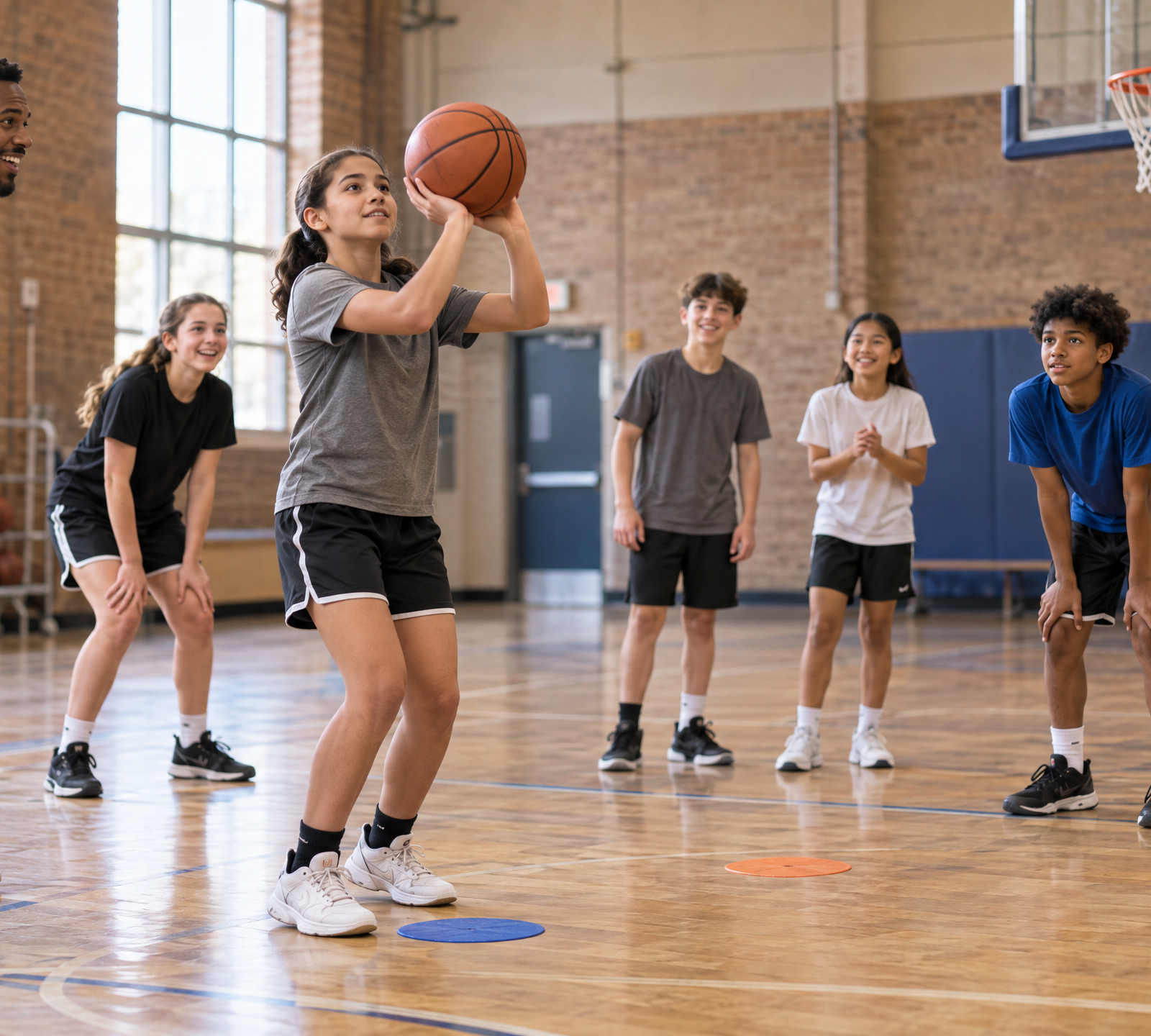
Place three flat markers within each player's comfortable shooting range. Players take five shots from each spot, recording makes and attempts separately. Their first round establishes a baseline, not a score to compare publicly with teammates.
Choose one technical cue, such as a balanced finish. In the next session, repeat the same 15-shot challenge under similar conditions and aim to improve accuracy while maintaining that cue. Partners can rebound and offer one helpful observation before swapping roles.
Award a progress marker for completing purposeful practice, but keep it separate from the shooting result. More attempts should not masquerade as better accuracy. Move a marker further away only when the coach judges the player's technique ready. A single better round is encouraging; several comparable sessions show a more useful pattern.
2. Passing Gates: Unlock a Shared Challenge

Purpose: Develop accurate passing, receiving and cooperation.
Set out three well-separated gates, each made from two cones. Give a pair one ball and start them on opposite sides of the first gate. They alternate bounce passes through the gap, counting five successful passes in total before moving together to the next gate.
A successful pass travels through the opening and reaches the receiver under control. If a pass misses, keep the total rather than resetting to zero. The challenge rewards learning together, not avoiding mistakes.
Begin with generous gaps and manageable distances. Once the pair succeeds comfortably, change the passing angle or add a short movement before receiving. Keep passing lanes separate and rotate waiting pairs promptly. For football, use controlled ground passes through the gates instead, with the same emphasis on accuracy and partnership.
3. Teamwork Mission: Connect Practice to Play
Purpose: Encourage involvement and decision-making in a realistic game.
Play three-versus-three in short rounds. Keep normal scoring, but award one teamwork bonus when all three teammates receive the ball during the same possession. Allow only one bonus per possession and explain that players should still take a sensible scoring opportunity.
Rotate teams and give specific feedback on creating passing options. Avoid praising extra passes when they simply delay an obvious shot. The mission should encourage awareness, not rigid behaviour.
Finish with an ordinary game without bonus points. Observe whether players still move into space and involve teammates. If the behaviour disappears immediately, simplify the challenge or spend more time helping players understand when and why it is useful.
How to Measure Whether Gamification Is Working
Run a small four-week trial using one challenge. Before starting, record a comparable skill measure, such as successful shots out of 15, alongside attendance and a quick player enjoyment check.
Repeat the skill assessment with the same equipment, distance and instructions. Note whether players spend more time practising or more time discussing points. Watch quieter players as closely as enthusiastic ones, and ask whether the challenge feels achievable.
Include a brief test without rewards and observe normal gameplay. Improvement in those settings matters more than rising challenge scores alone. Remember that attendance and performance can change for other reasons, so a before-and-after comparison is useful coaching feedback, not proof of causation.
Supporting Club, Coach, Guardian and Player Needs with Vanta Sports
For youth sports management, Vanta Sports is worth considering because coordination and player progress belong alongside purposeful practice.
Its current setup brings Club, Coach and Guardian roles together in Vanta Club, with a separate player-focused practice companion. Clubs manage teams and schedules; coaches handle attendance, availability and communication; guardians coordinate their children's activities and fees.
For basketball and netball shooting, Vanta Practice supports made-and-missed shot logging, accuracy tracking, personal targets and practice streaks. Players can keep sessions private or share progress with coaches. Its personal-progress approach avoids a public ranking table against teammates.
Use these tools to support reflection and organisation, not to replace coaching judgement. Recognise thoughtful practice and steady progress, while making it clear that rest days never count as failure.
Ready to Take Your Training to the Next Level?
Track your shots and level up with the Vanta Player App. Learn more about Vanta Sports
Tags