Youth Development
How to Boost Engagement in Youth Sports Clubs
Learn how to boost engagement in youth sports with practical tactics for coaches, parents, and club admins. Real examples, KPIs, and step-by-step templates.

Saturday mornings tell the truth. Half the squad is missing. Two parents are standing by the touchline asking if kick-off changed. The coach is rebuilding the session on the fly because three regulars haven't turned up. Meanwhile, the admin is still chasing a payment, a medical form, and last night's team sheet.
That scene doesn't usually mean the players have “lost interest”. It means the club has an engagement problem, and in youth sport, engagement is rarely one person's fault. It breaks at the handoff. One role assumes another role has already done the job.
If you want to learn how to boost engagement in a youth sports club, stop treating it as a messaging problem or a motivation problem on its own. It's a system problem. The clubs that keep players coming back usually get four handoffs right: admin to coach, coach to parent, parent to player, and player back into the team environment.
That matters because the opportunity is huge. In England, 49.1% of children and young people met the guideline of at least 60 minutes of activity per day, while just under half still did not. Sport England also reported that the number meeting the guideline has risen by more than 580,000 over seven years, a 5.8% increase, and that 2.3 million young people, or 48%, volunteered to support sport and physical activity in the last 12 months. Engagement moves when participation is made easier and more consistent, and it isn't only about playing. Young people stay connected when they can take part, contribute, and belong (Sport England via Ipsos).
Why Youth Engagement Needs a Four-Role Playbook
The old approach is too narrow. Clubs often ask, “How do we get players more engaged?” when the question is, “Which handoff is breaking?” A player can't be reliably engaged if the parent hasn't received the right information, the coach hasn't been updated, or the admin has made the first month feel like paperwork.
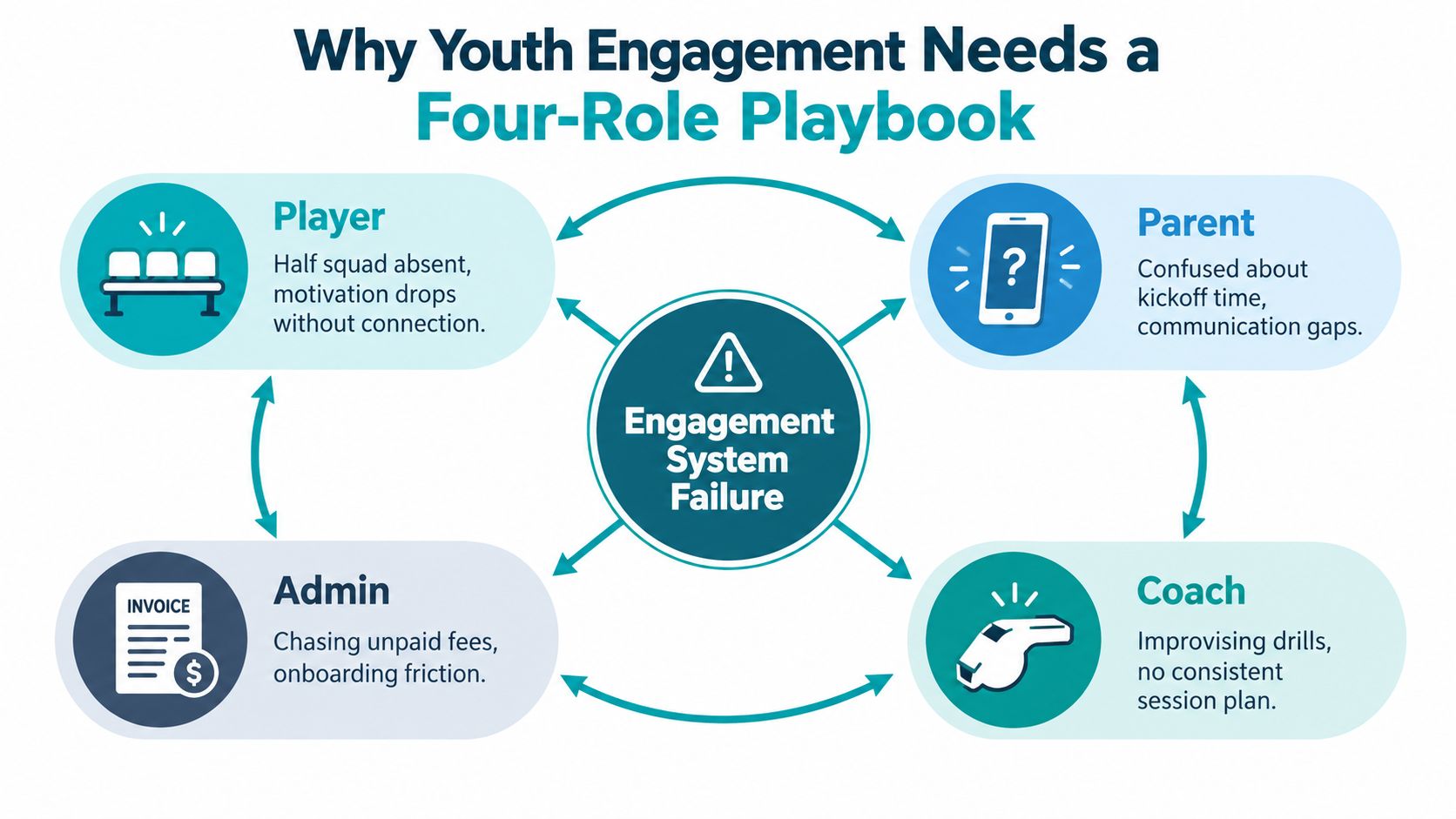
Where clubs usually lose people
The failure points are familiar.
- Admin to coach: The roster changes, but the coach still works from last week's list.
- Coach to parent: The session theme, location change, or volunteer need never reaches home clearly.
- Parent to player: A child turns up late, in the wrong kit, or not at all because the plan wasn't turned into action.
- Player to team: A quiet absence becomes two missed sessions, then a silent drop-off.
In the UK, the drop is especially sharp outside school. A government report found that 83% of 5 to 15-year-olds had done some competitive sport in the previous 12 months, but only 37% had done competitive sport outside school, which is exactly where clubs either hold attention or lose it (UK government report).
Practical rule: When attendance dips, don't start by blaming commitment. Audit the last handoff that happened before the absence.
What the four-role playbook changes
A four-role playbook gives everyone a job they can do. Admin owns clean setup and timely updates. Coaches own clarity, rhythm, and session experience. Parents own response and practical follow-through. Players need visible progress and a reason to feel they matter.
Clubs also need to think beyond the training pitch. If you're trying to boost audience connection online, the same rule applies. Engagement grows when each touchpoint feels connected rather than random.
For clubs building that joined-up environment, it helps to see how a connected role structure works in practice in a youth sports club platform example. The useful lesson isn't the software itself. It's the operating model. One shared system reduces missed handoffs before they become absences.
Communication Workflows That Keep Every Parent and Player in the Loop
Most clubs don't have a communication problem because they send too little. They have one because they send in the wrong lane, at the wrong time, to the wrong group.
A working setup uses separate lanes. Keep each one tight. Keep each one owned.
The three lanes that matter
| Lane | From | To | Channel | Cadence | Sample |
|---|---|---|---|---|---|
| Admin update | Admin | Coach | Email or app inbox | Weekly | Squad list changes, fee flags, venue changes |
| Team brief | Coach | Parent | App notification plus email | Monday and Friday | Session theme, what to bring, volunteer ask |
| Player nudge | Coach | Player | Age-appropriate message | Before each session | One reminder, one focus point |
Admin to coach
This lane should be boring. That's a compliment.
Every week, send one digest that covers roster updates, payment status that affects eligibility, facility changes, transport notes, and any important player flags that the coach needs to know in a professional way. Don't drip-feed six separate messages across the week unless something is urgent.
What flops is the casual message chain. A coach can't run a steady environment if key information is buried in old chat replies.
Coach to parent
Parents need consistency more than volume. A Monday brief works because it sets the week early, before calendars fill up.
Use a simple template:
- Theme: What the team is working on this week
- Time and location: Start time, arrival time, exact venue
- What to bring: Kit, boots, water, weather gear
- Availability ask: RSVP by a clear deadline
- Parent role: Lift share, snack rota, match helper, or sideline support
A Friday recap can be short. One or two lines on what went well, one photo if your club policy allows it, and the next key date. That small loop tells families that sessions are organised and purposeful.
If email is one of your main channels, clubs should also understand basic inbox placement. This guide on How to Improve email deliverability is useful because even a solid message fails if it lands in spam or promotions.
Coach to player
Players don't all process information the same way. Age matters.
- Under-8s: Use pictograms, a one-line reminder, and let the parent relay it.
- Under-12s: Short voice notes work well. They feel personal and are easy to consume.
- Under-16s: Calendar invites, training goals, and direct reminders give them more ownership.
Group chat should build community, not carry sensitive information.
That means using channel rules properly:
- Push notifications: time-sensitive changes only
- Email: documents, policies, detailed weekly notes
- Group chat: team spirit, public reminders, celebrations
- App inbox: one-to-one messages, private concerns, anything sensitive
Two common mistakes sink this whole system. First, one giant chat with hundreds of parents. Second, broadcast replies that expose private issues. Segmented groups, silent broadcasts, and read receipts stop a lot of that mess before it starts.
A practical example of this setup is a team notification system for sports clubs, where role-based messaging helps separate urgent alerts from community chatter.
Designing Sessions Players Can't Wait to Attend
Players return to sessions that feel alive. They drift from sessions that feel like admin with cones.
The strongest participation drivers in club sport are enjoyment (90%), competition or training motivation (68%), and the social opportunity to be active with friends (63%). The same survey found that 74% of clubs have members under 16, but 25% have no junior members at all. That's a clear reminder that junior engagement has to be built deliberately, and that coaches can't lean on intensity alone because enjoyment comes first (UK Sports Club Survey Report 2017).
Here's the weekly rhythm that usually works better than ad-lib coaching.
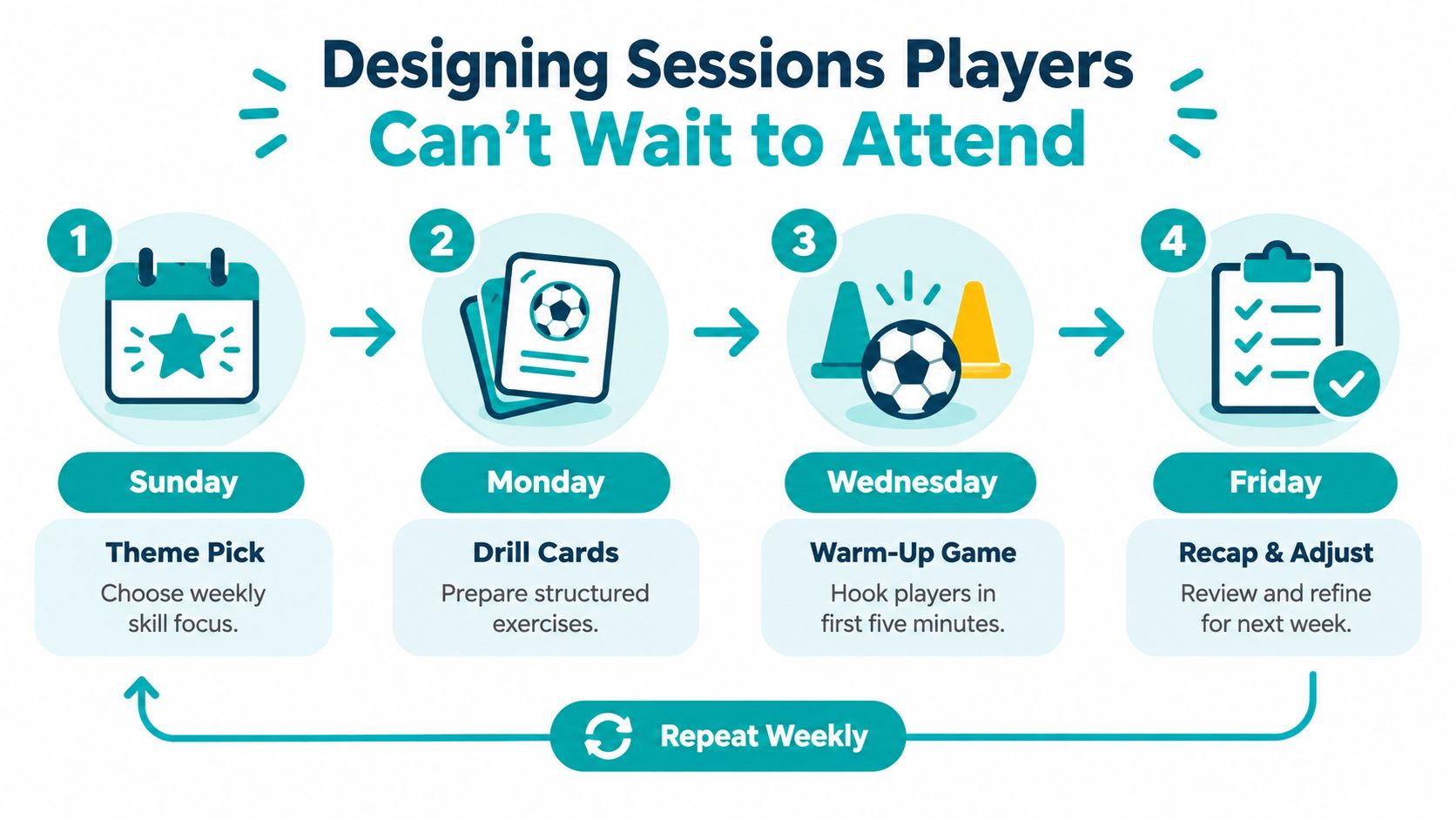
A repeatable coaching rhythm
- Sunday: Pick the theme. One focus only. Passing under pressure, first touch, transition defending.
- Monday: Build drill cards. Keep them short enough that any assistant can run them.
- Wednesday: Decide the arrival game. The first five minutes should start with movement, not lining up.
- Friday: Review what landed and what dragged. Adjust next week's design accordingly.
The opening five minutes matter more than many coaches think. If players arrive and stand in a queue, you've already told them the session is passive. If they arrive into a simple game, they switch on before you've said much at all.
The 60-minute shape
A balanced hour often works like this:
- Arrival game
- Technical block
- Game-form block
- Cool-down and review
The game-form block should be the biggest section because it connects skill to decision-making, pressure, and fun. Technical work still matters, but if a session feels like thirty isolated repetitions followed by a rushed scrimmage, players stop seeing why they're there.
Every drill also needs three levels:
- Entry challenge for the newest or least confident player
- Middle challenge for the bulk of the group
- Exit challenge for the player who needs more complexity
That progression keeps mixed-ability groups together without making anyone feel left behind.
For coaches who want a clearer planning model, this guide on how to plan training sessions is a practical reference for structuring themes, progressions, and game-based blocks.
A short visual example helps here:
Two worked examples
A U10 passing session works well when the technical block ends on success. Start with partner gates, move into three-player passing triangles, then into a small-sided game where extra points come from linked passes. Young players leave feeling capable, not corrected to death.
A U14 possession session needs more game realism. Use a directional rondo first, then move into overload games with transition moments built in. Older players stay engaged when the task feels like football rather than choreography.
End the technical phase when players are succeeding. Don't squeeze in one more drill that leaves the room flat.
Gamification That Turns Practice Into a Habit
Used badly, gamification feels cheap. Used well, it gives young players visible progress between the big milestones.
The point isn't to turn every training night into a video game. The point is to make effort feel seen. Players, especially younger ones, respond when attendance, encouragement, and consistency all earn recognition.
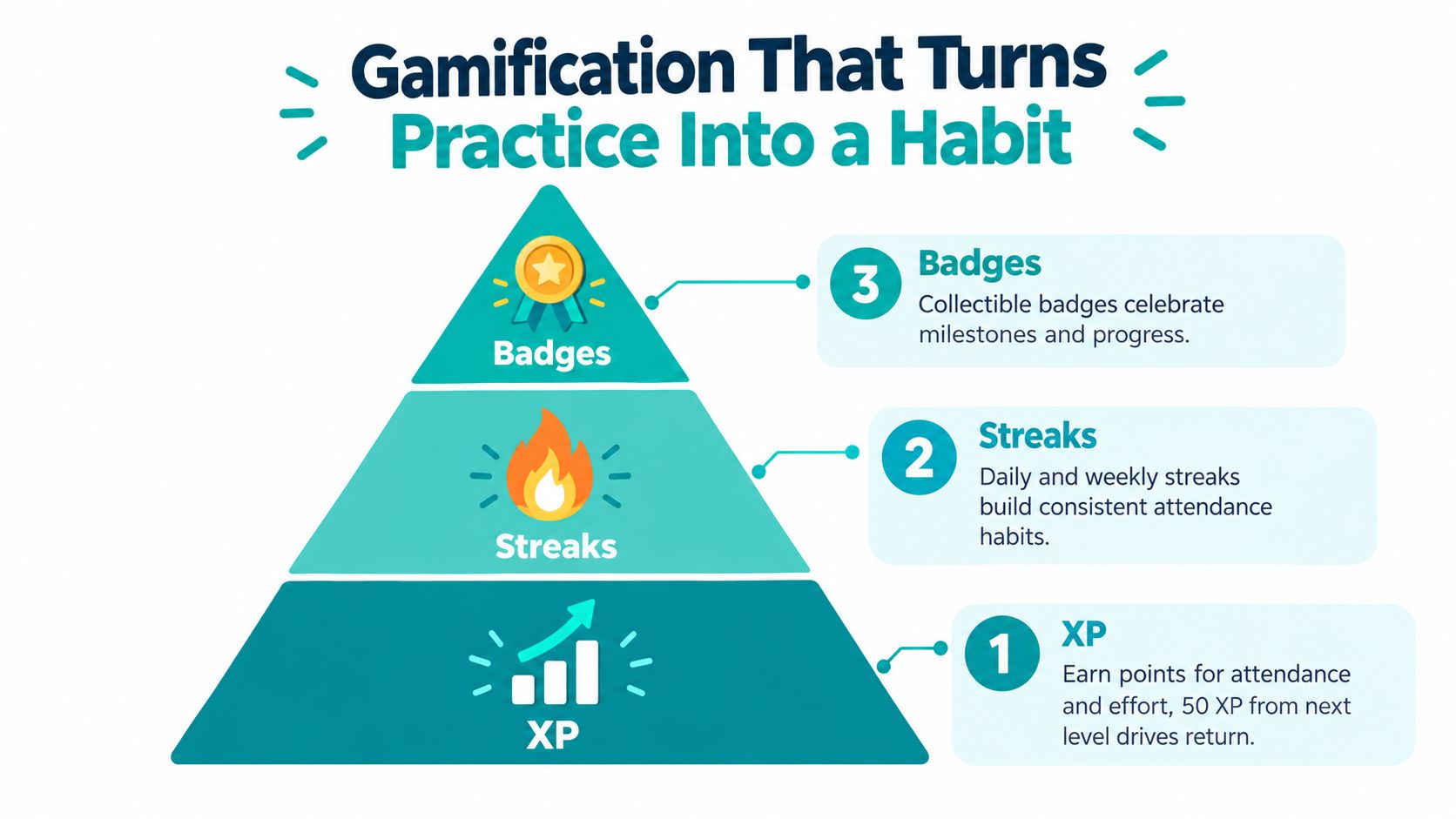
What actually works
I've seen more than one squad get noticeably sharper the week a player was close to a new badge. That's not because badges are magical. It's because visible progress pulls attention forward. Young athletes like knowing they're close to something.
Three mechanics tend to work best:
XP for repeatable behaviours
Attendance matters, but so does effort, helping set up, and encouraging a teammate. If points only reward talent, you lose half the squad.Streaks with one safety valve
A forgiving freeze day matters. Children get ill. Families travel. One missed session shouldn't wipe out a month of momentum.Badges awarded publicly
Participation, teamwork, and skill badges all matter. Public recognition in the team chat gives the award social weight.
A sample points table
| Action | Suggested reward |
|---|---|
| Attend training | Base XP |
| RSVP before deadline | Bonus XP |
| Help a teammate | Small XP reward |
| Complete a weekly challenge | Skill XP |
| Return after an absence | Comeback XP |
| Hit a streak milestone | Badge unlock |
The most common error is overcomplicating it. If a coach needs a spreadsheet and ten minutes of maths after every session, the system dies by week three.
A platform such as Vanta Sports' gamification tools for youth training can handle XP, badges, streaks, and leaderboards in one place, which is useful if you want the reward loop to survive beyond the first burst of enthusiasm.
What doesn't work is using leaderboards alone. Some players love them. Others decide they can't win and detach. The fix is simple. Reward consistency, effort, and team behaviours as visibly as skill.
Scheduling, Reminders, and Attendance Incentives That Stick
Attendance improves when planning becomes easy at home. Parents are not ignoring you because they dislike the club. Most of the time, they're juggling school, work, transport, siblings, and three other things before breakfast.
That means scheduling has to remove friction.
Start with calendar hygiene
The strongest systems publish recurring sessions well in advance. Away games go in the diary as soon as they're confirmed. Each squad gets one reliable weekly digest instead of a pile of half-updated reminders.
A national youth survey found that 66% of young people in England had taken part in at least one of five structured activities over the past year, while 33% had not, and sports clubs or fitness classes were the most common activity at 52% (DCMS Youth Participation Survey findings). Organised club opportunities clearly matter. The easier they are to join and keep joining, the better.
A reminder cadence that feels helpful
| Timing | Channel | Message Purpose | Attendance Incentive |
|---|---|---|---|
| Seven days out | Email or app digest | Weekly overview and planning | None needed |
| Forty-eight hours out | Push notification | RSVP prompt | Early RSVP bonus |
| Morning of session | Push notification or group message | Confirm time and location pin | None needed |
| After session | Recap message | Reinforce attendance and next action | Shout-out or XP |
That cadence works because each reminder does a different job. One helps planning. One secures the headcount. One removes same-day confusion. One closes the loop.
Pair the nudge with a reason to respond
A reminder without any reward becomes wallpaper. Tie attendance to your recognition system.
- Early RSVP: Small bonus in the reward loop
- Monthly squad goal: Shared reward when the whole group stays on top of attendance
- Comeback nudge: A warm message plus a re-entry reward for players returning after absence
What usually kills this is the late Friday message. By then, many families have already committed the weekend elsewhere. If a parent has to choose between your unclear last-minute note and a plan that's already locked in, your session loses.
If you want better attendance, win the calendar before you try to win motivation.
Parent Onboarding and Removing Payment Friction
Families often decide whether a club feels trustworthy in the first two weeks. Not after the first tournament. Not after the end-of-season awards. In the first two weeks.
A lot of drop-off doesn't come from lack of interest. It comes from friction. The welcome email says one thing, the form lives somewhere else, kit sizing sits in another place, and payment needs a separate login. Parents don't leave because the sport isn't valuable. They leave because the process feels messy.
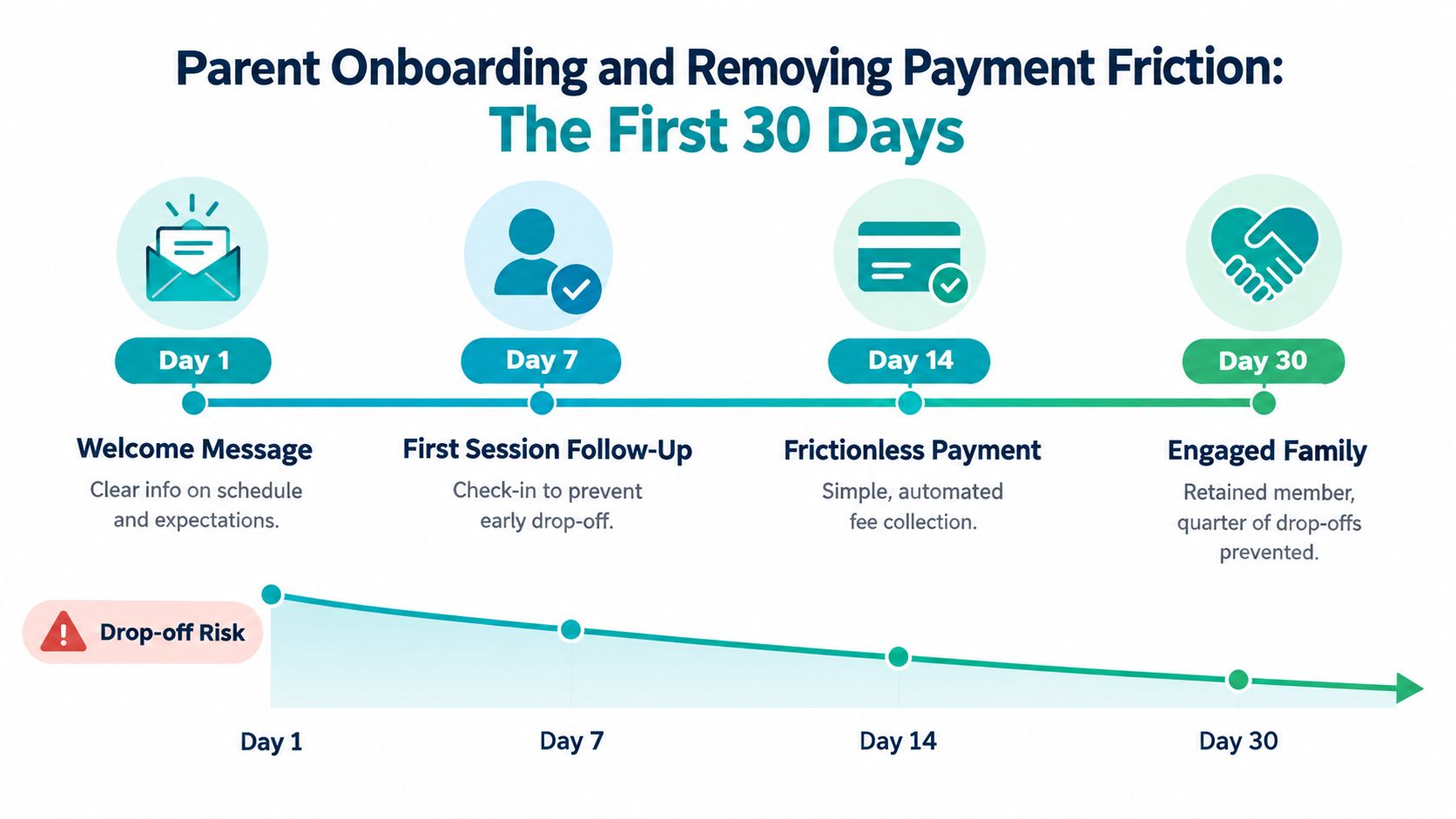
The first 30 days should feel joined up
A simple sequence works better than a long handbook.
Day 0
Send the welcome message. Include the guardian intro, first key dates, and who to contact.Day 2
Collect player profile details and medical information in one place.Day 5
Send the payment link with plain-language explanation of what it covers.Day 7
Confirm squad assignment, coach name, and the next session details.Day 14
Follow up after the first session. Ask one easy question: how did it go?Day 30
Send a short check-in for feedback and any support needs.
Payment needs to feel calm, not awkward
Parents are more likely to stay engaged when payments are simple and predictable. The setup most clubs prefer is card-on-file using a Stripe-style flow, instalment options where needed, and polite automated reminders before a charge fails.
One option that's often overlooked is a pause membership action. That single choice can prevent the silent-cancel pattern where a family disappears because they felt too embarrassed or too busy to explain a temporary issue.
A good checkout flow usually includes:
- Clear fee breakdown so families know what they're paying for
- Saved payment details for renewals and recurring charges
- Instalment choice where club policy allows it
- Friendly failed-payment reminders before access becomes a problem
A useful screenshot benchmark is the kind of Stripe-style checkout that shows club name, amount due, saved card fields, and a short note about billing timing on one uncluttered screen. Parents shouldn't need to guess the next step.
Measuring What Matters and Your 90-Day Rollout Plan
Clubs get into trouble when they measure what looks neat instead of what predicts return. A slick dashboard can still hide a leaking programme.
The measures that matter most are tied to an owner. If nobody owns the number, the number won't move.
Engagement KPIs by role
| Tactic | Owning Role | Primary KPI | Target Benchmark |
|---|---|---|---|
| Roster and contact data cleanup | Admin | RSVP response time | Faster week by week |
| Weekly parent brief | Coach | Message open rate | Consistent improvement |
| Session design rhythm | Coach | Session attendance rate | Stable upward trend |
| Reminder cadence | Admin and coach | Repeat attendance | Fewer unexplained absences |
| Onboarding and billing flow | Admin | Repeat-booking conversion | Higher retention through first month |
| Family check-ins | Parent support lead or admin | Parent NPS | Positive trend over time |
Some clubs also benefit from reading broader thinking on actionable audience engagement strategies, then translating those ideas into club behaviours rather than marketing jargon. The useful crossover is simple. Timely, relevant, personalised touchpoints tend to hold attention better than generic blasts.
A 90-day rollout that clubs can actually manage
Weeks 1 and 2 should focus on cleanup. Fix contact data. Confirm who owns each communication lane. Remove duplicate groups. Standardise one weekly digest and one parent brief.
Weeks 3 to 6 are for the visible changes. Launch session templates, your reminder cadence, and a lightweight gamification model. Track baseline attendance, response time, and message opens from the start so you can see whether the new rhythm is landing.
Weeks 7 to 12 are where many clubs either strengthen the system or lose discipline. Layer in onboarding, payment automation, and a mid-season pulse check with families. Don't add five new ideas at once. Tighten the basics you've already started.
Your Monday-start checklist
- Clean the master contact list and remove dead numbers and duplicate emails
- Assign one owner per workflow so no handoff is left vague
- Publish the next six weeks of training and fixtures
- Write one Monday brief template for all coaches to use
- Set one attendance reward loop that values consistency, not just talent
- Add one first-month onboarding sequence for new families
- Review one KPI each Friday and act on what it says
The numbers that usually predict retention are the unglamorous ones. Session attendance. Speed of RSVP. Whether new families complete onboarding cleanly. Whether players come back after one missed week.
The numbers that often flatter clubs without helping much are vanity counts. A busy chat thread can hide confusion. A full mailing list can still produce poor turnout. A crowded registration day can still lead to thin attendance by mid-season.
If you want to know how to boost engagement for real, watch the handoffs. That's where commitment is either protected or lost.
Vanta Sports gives clubs one connected place to manage the exact handoffs that shape engagement: scheduling, messaging, RSVPs, attendance, payments, and player motivation across admins, coaches, guardians, and players. If you want a clearer system instead of more scattered tools, visit Vanta Sports and see how a joined-up club workflow can support better attendance, smoother communication, and stronger retention.
Tags