Youth Development
Membership Management Software for Youth Sports
Discover the best membership management software for youth sports clubs. Compare features, streamline payments, and empower your coaches and parents today.

Saturday morning starts before the first whistle. A coach is chasing missing consent forms, a treasurer is checking who has paid, parents are asking whether the match is still at the same ground, and players are waiting to find out which kit they should bring. Everyone cares about the club, yet the day feels harder than it should.
The right membership management software changes that rhythm. It brings records, payments, fixtures, attendance, communication and player development into one connected place, giving volunteers more time to coach and families a clearer way to participate. For a youth sports club, that isn't just tidier administration. It's the foundation for a more engaged, confident and united community.
| Club challenge | Manual approach | Modern software approach |
|---|---|---|
| Member records | Spreadsheets and duplicated forms | Central profiles for players and guardians |
| Payments | Bank transfers, cash and follow-up messages | Online dues, reminders and payment status |
| Fixtures and training | Separate calendars and group chats | Shared schedules with notifications |
| Coaching | Paper plans and scattered attendance notes | Mobile session tools, drill cards and attendance |
| Player motivation | Verbal encouragement only | Progress tracking, XP, badges and streaks |
Transforming Your Sports Club with the Right Software
A match day can reveal a club's weaknesses within minutes. At one youth club I worked with, volunteers checked separate name lists, searched email for medical details and pieced together team changes from scattered replies. Parents cared about getting things right, but they had no dependable place to see the latest information.
Players felt that uncertainty too. They arrived unsure about timings, teams and expectations. Coaches spent their attention resolving logistics instead of preparing young athletes. The club needed more than tidier records. It needed one shared experience that helped every member participate with confidence.
The right membership management software gives the club that common ground. Administrators can keep player information current, assign teams and monitor fees. Coaches can organise sessions, record attendance and share updates without rebuilding the same information. Guardians can respond to an RSVP, check a charge and receive fixture notifications in the same place.
That shared access also strengthens player engagement. A young athlete can see upcoming activities, follow development milestones and receive recognition for effort, attendance or progress. Badges, challenges and simple progress goals turn development into something visible and motivating. Coaches gain a clearer view of who needs encouragement, while players see how their contribution connects to the wider club.
Practical rule: If a parent has to ask three different people for the same fixture information, the club needs a better system.
The payoff is time and attention redirected towards people. Volunteers can welcome families instead of copying names between documents. Coaches can give better feedback. Parents can stay involved without chasing updates, and players can feel part of a connected community rather than separate teams using unrelated tools.
The UK market shows how broad this need has become. A 2026 industry briefing identifies 52 suppliers across the CRM, association management and membership database category, including Microsoft Dynamics, specialist CRM platforms, Salesforce, CiviCRM and iMIS providers. The briefing also notes that no reliable public UK market-share figure exists (UK membership software market briefing). That range makes disciplined evaluation more useful than brand recognition.
Choose software around real club behaviour. It should work for a volunteer administrator on a laptop, a coach on the touchline, a parent travelling to a fixture and a player checking progress. A long feature list matters less than a platform that brings those people into the same active club community.
Core Features Every Youth Sports Club Needs
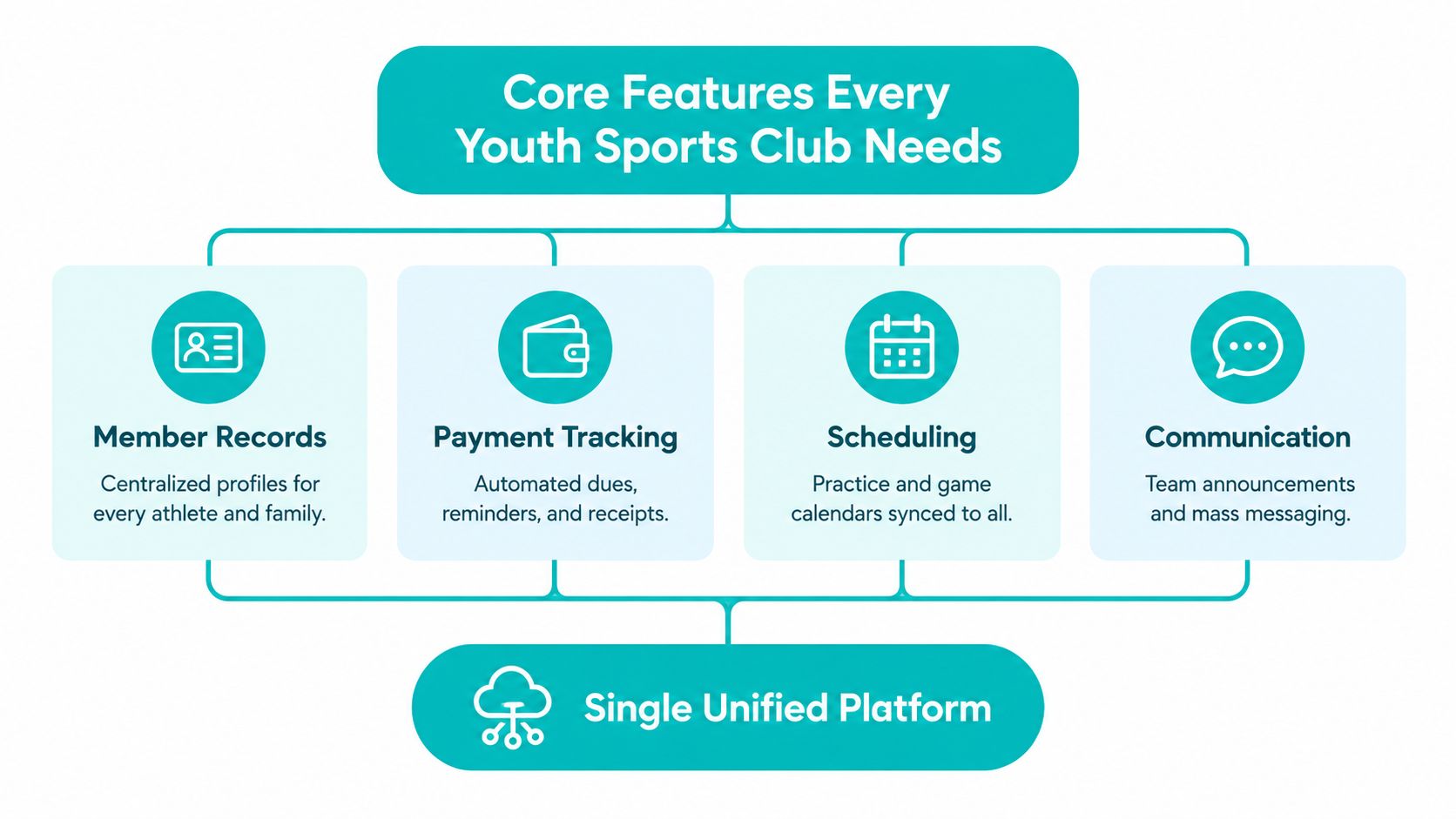
A spreadsheet can store names. It can't create a joined-up experience for a changing youth sports organisation. Good membership management software should give every role the right tools while keeping information connected behind the scenes.
Administrators need control without complexity
The administrator's dashboard should handle team creation, coach assignments, registration, permissions and reporting from one workspace. Member records need to connect players with guardians, emergency details, attendance history and relevant club information, so staff aren't rebuilding the same context for every activity.
Payment collection matters just as much. Membership plans, one-off charges and match fees should be assignable in bulk, with Stripe billing, receipts and a clear view of who has paid. A club assessing its options can review the practical detail of payment collection for sports clubs, rather than treating billing as an afterthought.
Coaches need tools for the session itself
Coaches don't want a second office in their pocket. They need a dedicated mobile experience that works beside the pitch, with drill cards, attendance, team messaging, performance notes and simple statistics.
The best workflow starts before training. A coach selects the session plan, adapts a drill for the group and sees who is expected. During the session, attendance takes a few taps. Afterwards, useful observations can be captured while they're fresh, helping the next session build on what players have already practised.
Guardians need certainty
Parents and guardians need one responsive app for RSVPs, fees, notifications, attendance and progress updates. Direct coach communication should sit alongside club-wide announcements, not disappear inside unrelated social feeds.
That clarity reduces avoidable questions and helps families plan around sport. It also gives guardians confidence that a change to a fixture, venue or training time will reach them promptly.
Players need reasons to return
Young athletes respond to visible progress. XP, badges, leaderboards and practice streaks can make development feel active and personal, provided the club uses them to celebrate effort and improvement rather than rank children harshly.
The relevance is clear for UK youth clubs. Participation has increased by 15% since 2019, with more than 8.2 million young players registered nationwide, according to Vanta Sports' UK youth sport overview. As more children and families take part, the club needs systems that support communication and connection as carefully as they support administration.
Comparing Top Membership Management Software Options
A youth club can choose between a broad enterprise CRM and a platform designed for sport. Both can store member records, yet they create very different experiences for coaches, families and players. The right choice should make club participation easier and player development more visible, not merely move administration onto a new screen.
Microsoft Dynamics and Salesforce offer flexible records, reporting and integration options. They can suit a large organisation with technical staff, complex workflows and time for configuration. A volunteer-led youth club may find that flexibility slows routine work. Custom screens, permissions, training and external support can turn a simple fixture change into an administrative task.
A dedicated sports platform begins with fixtures, training, attendance, guardians and player development. Coaches should be able to use it beside the pitch, administrators should be able to collect seasonal fees in the same system, and families should see the schedules that apply to them. Player profiles, progress updates, badges, practice targets and team activity can also give children a clearer reason to stay involved.
Because the UK market spans several supplier categories, as noted earlier, the practical test matters more than brand recognition. Compare the systems against the daily work of your club and the experience you want players and families to have.
| Feature Category | Enterprise CRM, such as Dynamics or Salesforce | Dedicated Sports Platform |
|---|---|---|
| Member data | Configurable records and relationships | Player, guardian, team and attendance records designed for clubs |
| Payments | Often needs configuration or connected services | Supports dues, match fees and recurring collection |
| Scheduling | Flexible, but sports workflows may need customisation | Training, fixtures and events are central functions |
| Sideline use | Mobile access may depend on setup and permissions | Mobile tools for coaches and families |
| Player development | Reporting can be configured | Progress, statistics and gamification sit closer to the core experience |
| Implementation | May require specialist expertise | Easier for a sports team to understand and adopt |
| Best fit | Complex organisations with technical capacity | Youth clubs, academies and multi-team sports organisations |
Test the software against club tasks
Ask each vendor to demonstrate five actions in your own workflow: register a player, assign a guardian, collect a fee, change a fixture and record attendance. If the demonstration depends on vague promises about future configuration, reject the option.
Use the same test for communication. Can a coach message one team without exposing another team's information? Can a guardian respond to an RSVP from a phone? Can an administrator identify unpaid fees without exporting a file? A strong system should also connect announcements, team updates and player progress, so the club community works from one shared record.
Clubs with a high volume of routine enquiries can explore membership associations AI phone support as part of their wider service approach. It should support the core club system, not replace it, by helping families get quick answers about common questions.
For a focused comparison with another team-management option, review the Vanta Sports and TeamSnap comparison. Choose the system coaches will use, guardians will understand and players will enjoy returning to. Technical capability matters, but adoption turns software into a working club solution.
Real-World Use Cases for Coaches and Parents
Technology earns its place when it removes a real interruption from a real week. Consider a Tuesday training session. The coach opens a mobile app, checks the expected players, chooses a set of drill cards and adjusts the plan for the age group. As players arrive, attendance updates the club record without a paper register or later data entry.
A guardian who can't attend can still see the session information and receive the relevant update. If the weekend fixture changes, the club sends one notification through the connected system instead of relying on several volunteers to remember every group chat.

One week, one shared version of events
The administrator sees team rosters, payment status and venue details in the web dashboard. The coach sees the session and attendance information needed on the field. The guardian sees the same fixture through a family-friendly app, with the ability to RSVP, review fees and contact the coach.
That shared record prevents small mistakes from becoming large frustrations. A player isn't accidentally left off a team list because someone edited an old spreadsheet. A pitch isn't booked twice because two volunteers maintained separate calendars. A coach doesn't arrive with an outdated squad because a message was missed.
Fixture imports and unified scheduling are especially useful for clubs that coordinate multiple teams. They help administrators keep training, matches and events visible in one operational picture, while families receive the information relevant to them.
Better experiences support healthier clubs
Independent UK golf-club research offers a useful warning for sports organisations reviewing their systems. 66% of clubs were exploring alternative software, 48% said their current system no longer fully met requirements, and membership management was identified as the area with the most room for improvement, according to GolfRep's UK golf-club CRM research.
Youth sport has its own safeguarding and family-communication requirements, but the lesson transfers clearly. If software creates workarounds, members feel that friction. If it makes registration, payments, schedules and updates easier, the club becomes easier to join and easier to stay involved with.
Retention isn't produced by a dashboard alone. It grows when a child feels recognised, a parent knows what is happening and a coach has enough time to deliver a thoughtful session. Connected software supports all three relationships at once.
Evaluating Trade-Offs and Hidden Costs
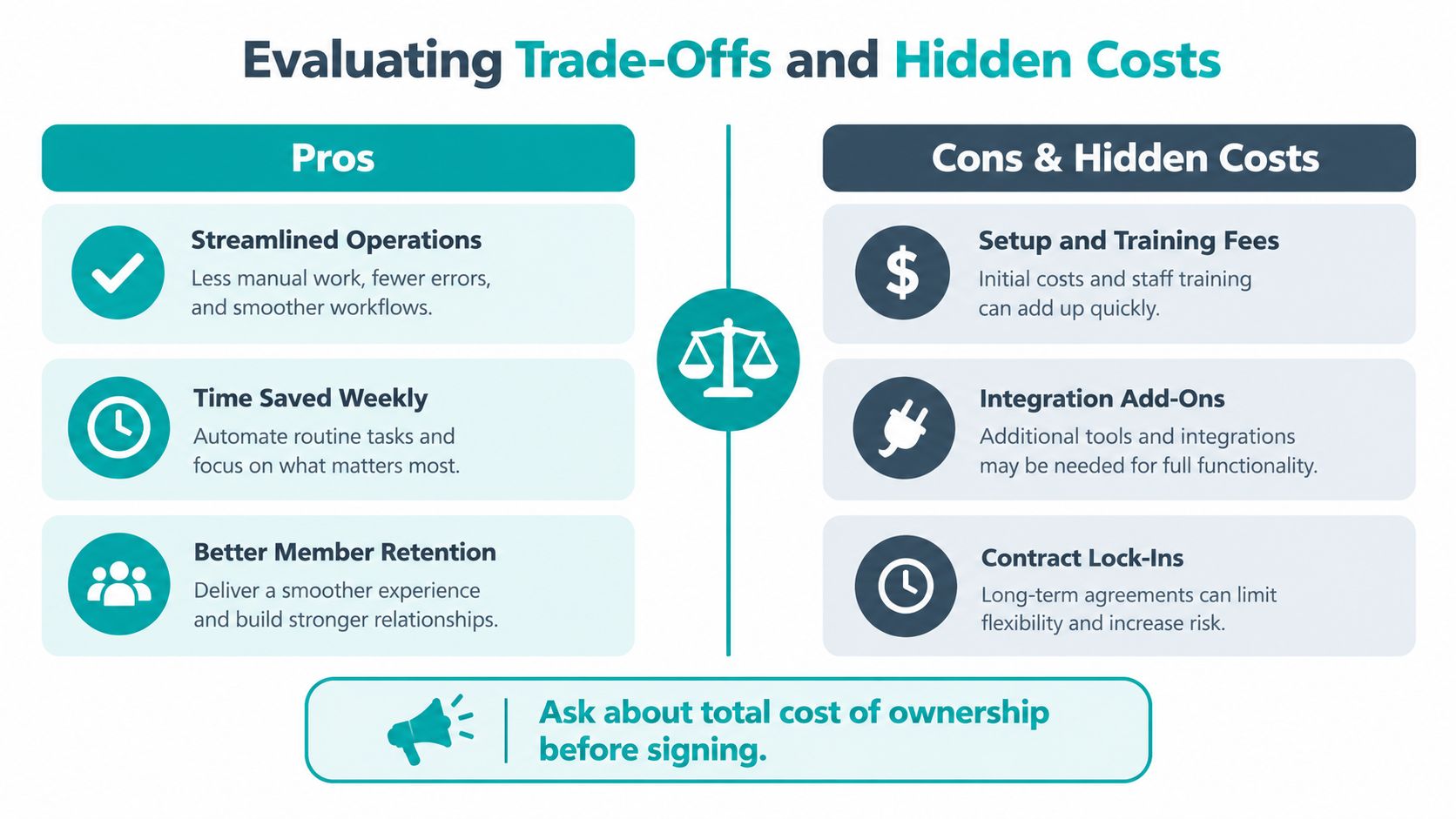
The cheapest tool isn't always the lowest-cost choice. A generic spreadsheet may have no subscription charge, but volunteers still pay for it with repeated data entry, missed payments, duplicated messages and time spent reconciling conflicting information.
Those costs are easy to ignore because they don't appear on an invoice. They show up in late evenings, frustrated parents and coaches who stop recording useful development notes because the process takes too long.
Calculate the complete value
Start with the club's current friction. Count the tasks that require copying information, chasing a response or checking more than one system. Then ask what changes when the platform automates payment reminders, centralises attendance and gives every team one dependable communication channel.
Revenue deserves careful attention. UK sports-club benchmarks report that clubs using automated upsells earn £8.40 more per head, while 6 in 10 clubs grow membership on the platform, according to Memberlytic's UK membership software comparison. Those figures come from a provider's own benchmarks, so use them as a prompt for questions, not as a promise for your club.
Ask vendors to explain the total cost of ownership, including:
- Setup and migration: Find out who cleans, imports and checks existing records.
- Training and support: Confirm how volunteer administrators and coaches get help after launch.
- Payment charges: Separate the software subscription from transaction and processing costs.
- Integrations: Check whether fixture feeds, messaging or accounting connections cost extra.
- Contract terms: Understand renewal dates, export rights and what happens if the club changes direction.
Financial test: Compare the subscription with the hours your volunteers reclaim, the payment follow-up you eliminate and the member experience you protect.
A complete system does bring an adoption cost. Staff need time to learn it, administrators must establish clean processes and coaches need confidence with mobile tools. That cost is worthwhile only when the club commits to using the system consistently.
Review the Vanta Sports pricing information alongside your actual club requirements. Don't pay for features no one will use, but don't reject a connected platform because a basic tool looks cheaper at first glance.
Implementation Tips for a Smooth Transition
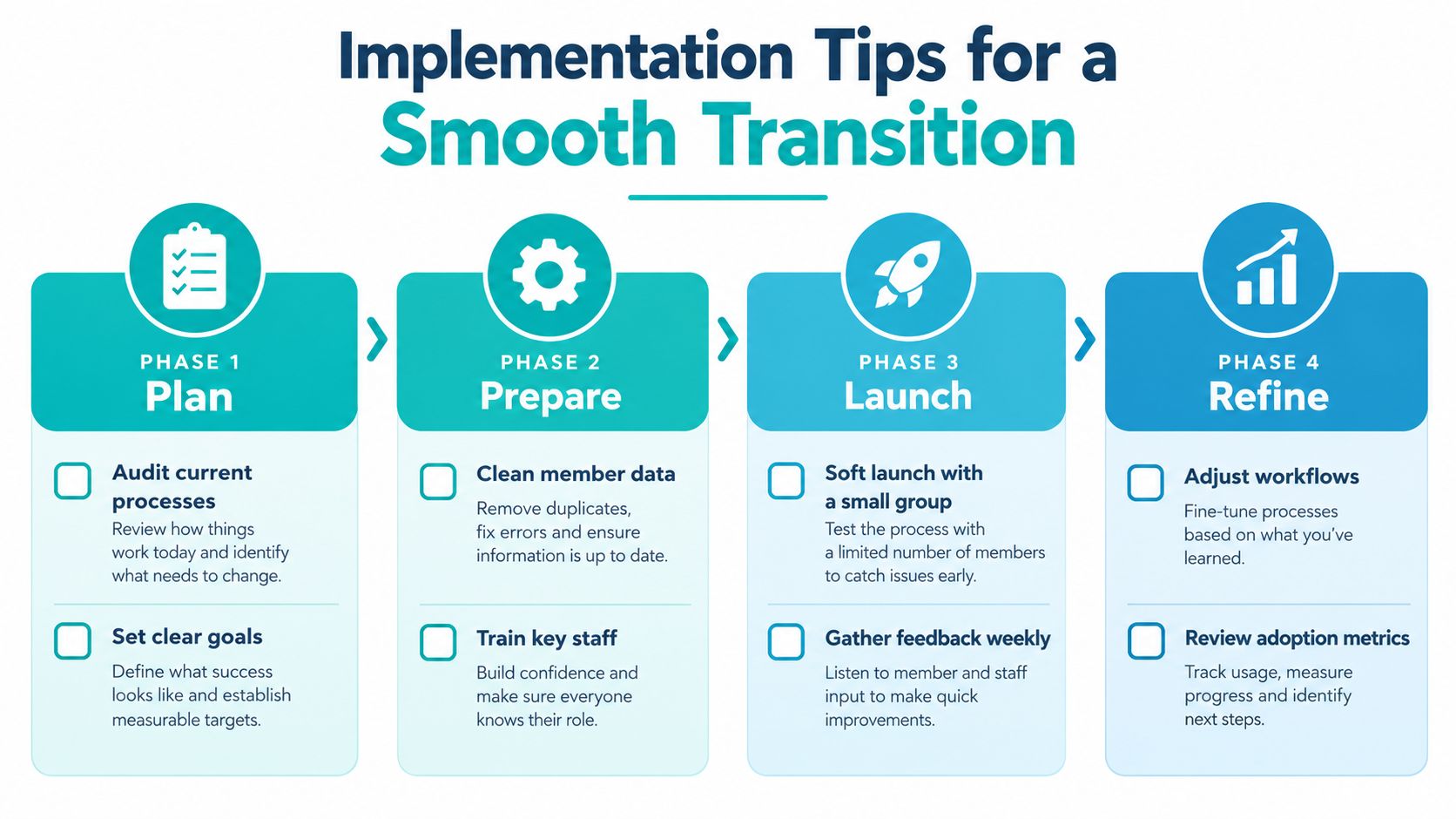
A successful launch starts with a controlled process, not a dramatic switch on the busiest weekend of the season. Set a clear date, appoint one accountable project owner and involve a coach, an administrator and a guardian in testing.
Plan the change around club priorities
Write down the problems the club must solve first. You might choose payment visibility, fixture communication, attendance tracking or a smoother registration experience. Keep the list focused so the first rollout feels useful rather than overwhelming.
Audit the current process before importing anything. Remove duplicate records, check guardian contact details, separate active and former members, and agree who can access sensitive information. Clean data makes every later workflow easier.
Prepare the people before the platform
Train key staff with realistic tasks. Ask the administrator to create a team and assign a coach. Ask the coach to plan a session and record attendance. Ask a guardian tester to RSVP, review a fee and respond to a notification.
Short, role-specific training works better than one long demonstration. Give each person a simple written routine for the tasks they perform most often, then let them practise before the wider launch.
Launch with a small, supportive group
Start with one team or one age group. Use the soft launch to identify unclear labels, missing permissions and communication gaps. Gather feedback weekly, but prioritise changes that affect safety, payments, schedules or adoption.
When the club is ready to expand, introduce the guardian and player experience with a clear message about what families should do first. A focused guardian app guide can help parents understand the practical benefits without burying them in technical detail.
Refine the routine
After launch, review whether coaches are recording attendance, whether guardians are responding to fixtures and whether administrators can reconcile payments without reverting to old spreadsheets. Make one workflow improvement at a time.
Celebrate early wins publicly. When a coach spends more time working with players, or a parent finds a last-minute venue update without a phone call, share that example. Adoption grows when people can see the difference in their own week.
One Connected System for Your Club with Vanta Sports
On a busy match day, a guardian needs a venue update, a coach needs the latest attendance, and an administrator needs payments in order. Those tasks are connected. A late RSVP affects planning, while a missing attendance record weakens the player's development story. Your software should reflect that reality instead of splitting each role across separate tools.
Vanta Sports brings clubs, coaches, guardians and players into one connected system. Administrators use a web dashboard to create teams, assign coaches, schedule training, matches and events, and manage payments through integrated Stripe billing. Attendance, reporting and communication draw on the same operational record, so staff can see what is happening without piecing together information from unrelated applications.
Tools built around the touchline
Coaches use a dedicated iOS app to plan sessions with drill cards, record attendance, message teams and capture performance information. Apple Watch support makes quick recording more practical during an active session, when opening a laptop would interrupt the work.
Guardians use a responsive app for RSVPs, fee management, notifications, attendance and progress updates. Direct communication with coaches sits alongside wider club information, giving families a clear route to the answer they need.
Development becomes visible to players
Players get a mobile experience that connects effort with progress. Performance tracking, XP, badges, leaderboards and practice streaks can give young athletes reasons to return, recognise improvement and reflect on their development.
Use those features with a clear coaching purpose. Reward consistency, teamwork and personal improvement instead of making every child feel judged against one standard. That turns membership management software into part of the player journey, not merely a back-office utility. A well-designed points system can make practice more engaging while keeping development in the hands of coaches.
One connected operating model
Automated fixture imports, unified scheduling, analytics and reporting give administrators a clearer view across teams. They spend less time hunting for information and more time supporting coaches, improving the programme and welcoming families.
My recommendation is direct: youth clubs should choose purpose-built software when they want players, guardians, coaches and volunteers working from the same information. The right system protects more time for coaching, conversation and the human spirit of sport.
Vanta Sports brings administration, coaching, guardians and players onto one platform. Visit Vanta Sports to see how your club can replace scattered processes with a more engaging, organised experience for every family.
Tags