Player Training
Netball Shooting Practice Drills You Can Track at Home
Three repeatable home shooting drills that give coaches useful numbers, clearer feedback and a simple route from solo practice to match-ready confidence.

Shooting is often the skill players most want to improve—and the hardest for coaches to see between sessions. A short, well-designed home routine changes that. Rather than asking players simply to ‘put up more shots’, give them a repeatable task, a small set of numbers to record and one technical focus. The result is practice that is purposeful, comparable week to week and easy to discuss at the next session.
This guide gives coaches three practical netball shooting drills that work in a garden, driveway or safe local court with a suitable ring. They are designed for young players, but the principles work across age groups: make the task specific, keep the record simple and use the evidence to guide the next block of work.
Set Up a Trackable Home Shooting Routine
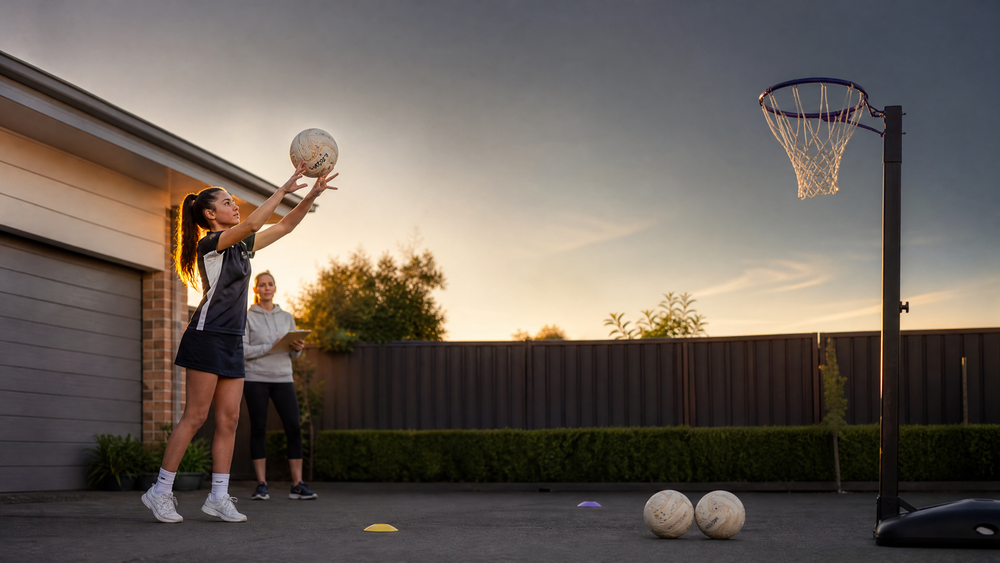
Home practice needs less equipment than many players think: a safe netball ring, a properly inflated netball, a clear landing area, five flat markers or household-safe alternatives, a phone timer and a notebook or app. Check the surface is dry, the post is stable and there is enough clear space around the shooter. Players should not practise through pain or chase loose balls into roads or cramped areas.
The key is consistency. Ask players to use the same ring height, distances and scoring method whenever possible. A useful basic line in a log is: date, drill, attempts, goals, percentage, technical focus and one short reflection. For example: ‘Near-post five spots, 18/25, 72%, held follow-through.’ That takes seconds to enter, yet gives a coach something more useful than ‘I practised shooting’.
Start With a Simple Baseline
Before prescribing targets, find each player’s starting point. Have them complete one controlled set of 20 shots from a comfortable position and record makes, misses and how the shot felt. Do not turn the first score into a judgement. It is a reference point. A player at 9/20 may need stable footwork and release rhythm; a player at 16/20 may be ready for movement, time pressure or a less familiar angle. Use the baseline to set an improvement target such as two extra makes in the next fortnight, not an unrealistic demand for perfection.
Drill 1: Five-Spot Accuracy Circuit

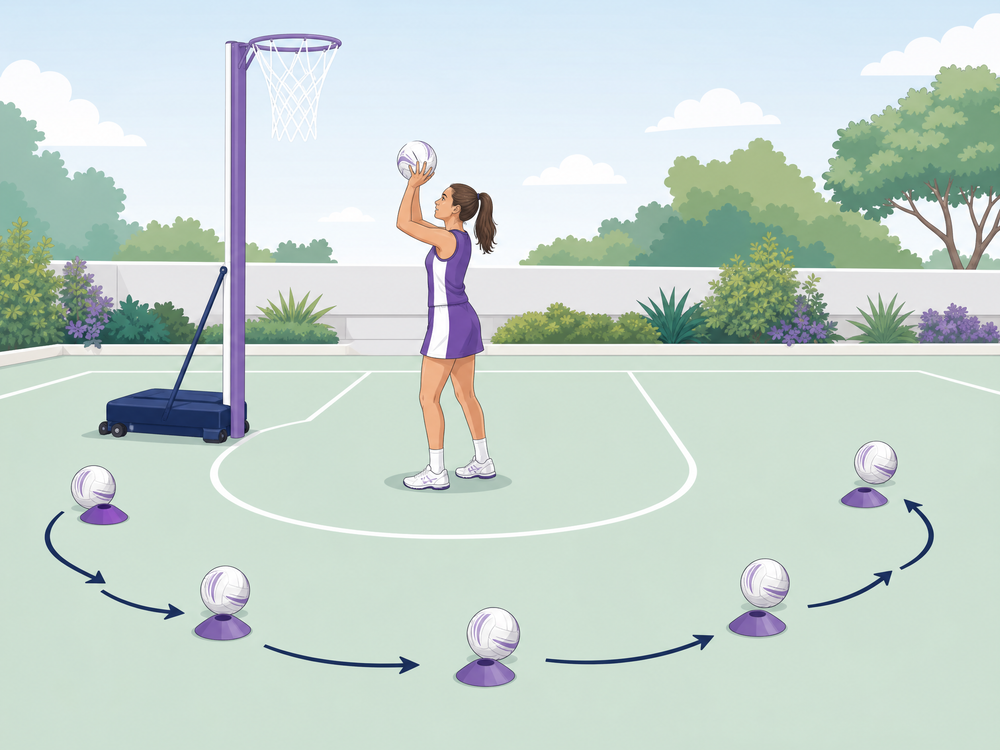
This is the foundation drill for building repeatable shooting habits. Place five markers in an arc where the player can shoot safely: two near the post, two from wider angles and one central spot. For younger or developing shooters, keep every marker comfortably inside their confident range. More experienced players can widen the arc gradually while maintaining sound technique.
How to Run It
The player takes five set shots from each marker, moving clockwise after every group of five. That makes 25 attempts. They should reset before each shot: balanced feet, eyes up, ball high, soft knees, controlled extension and a held follow-through. The goal is not to rush. A parent, guardian or teammate can return the ball, but the drill also works solo if the player safely retrieves after each five-shot set.
Record makes at each spot as well as the overall score. A 19/25 total is encouraging, but the spot-by-spot result is the coaching gold. If the player makes 5/5 close to the post but 2/5 from the left side, you have a precise next focus. After two or three sessions, compare the same spots rather than changing the layout every time.
Coaching Tip: Track the Miss Pattern
Ask players to note whether misses are short, long, left or right. Patterns often reveal a simple cue. Repeated short shots may point to a low release or incomplete extension; a consistent sideways miss may suggest alignment or an early wrist movement. Keep language positive: ‘What did you notice?’ is more useful than ‘Why did you miss?’ Finish with two confidence shots from a preferred spot so the player ends with a good feel.
Drill 2: Ladder Down, Ladder Back
The shooting ladder teaches control when the score matters. Mark three distances or positions from easy to challenging: close, medium and stretch. The player must make three shots at the close marker before moving to medium, then three at medium before moving to stretch. After completing the stretch position, they work back down the ladder. A miss does not have to reset the whole drill; either repeat that shot or use a clear rule such as ‘two misses means one step back’. Agree the rule before they begin.
What to Track
Log the total number of shots required to complete the ladder, plus the furthest stage reached. These measures give a fuller picture than percentage alone. A player might still make 60% overall, yet complete the ladder in fewer shots because their recovery after a miss has improved. That is a valuable performance skill.
Use a 60- to 90-second rest between rounds. Ask the player to write one process cue before round two: ‘land balanced’, ‘elbow under ball’ or ‘freeze the hand’. Avoid piling on several corrections. One cue, practised repeatedly, is easier to own under pressure.
Coaching Tip: Build Pressure Without Creating Anxiety
Pressure does not need punishment. Set a personal best challenge: can the player finish the same ladder in fewer shots than last time while keeping their routine? If they miss, use a reset breath, name the cue and take the next shot. Players learn that a miss is information, not an emergency. This self-management transfers directly to a close game when a shooter needs to recover calmly.
Drill 3: 30-Second Rhythm and Finish

A match rarely offers unlimited time to settle, so this drill adds a manageable pace without sacrificing form. Set a timer for 30 seconds from a familiar position. The player shoots, retrieves safely and repeats with the same full routine. Do two rounds, rest for a minute, then do a third round from a different angle. For a shared practice space, a feeder can deliver the ball; solo players should prioritise safe retrieval over the clock.
What to Track
Record attempts, goals, percentage and a quality score out of five for technique. The quality score is deliberately subjective, based on one agreed feature: for example, ‘Did I hold my follow-through?’ A player who scores 8/12 but gives their routine 2/5 has a different coaching need from one who scores 8/12 and rates it 5/5. The numbers create the conversation; they are not the whole story.
Repeat this drill once or twice per week, not every day. Its value is in controlled exposure to a faster tempo. End every set with three untimed shots from a comfortable place, aiming for calm breathing and the same release rhythm. This protects technique from becoming rushed.
Turn Home Data Into Better Coaching Conversations
Do not collect scores only to rank players. Use them to recognise effort, spot trends and choose the next small target. A weekly check-in can be as simple as: What drill did you complete? What was your best number? What did you learn from a miss? What one cue will you use next time? This gives quieter players a clear way to share progress too.
Look for trends over three or four practices, not one brilliant or difficult day. A falling percentage may reflect a player experimenting from a wider angle, a new surface or fatigue—not lost ability. Ask for context before changing the plan. When you do set a goal, make it behavioural as well as numerical: complete two circuits, record each spot and hold the finish on every shot. Good habits make later percentage gains more durable.
Keep Players, Coaches and Families Connected With Vanta Sports
For youth teams, the best tracking system is the one players and families will actually use. Vanta Sports brings that connection together across its Club, Coach, Guardian and Player apps. Players can keep a simple record of their practice and progress; coaches can use the notes to shape technical feedback and session planning; guardians can see what a safe, purposeful home task looks like; and clubs gain a clearer shared view of development.
Make the routine light: publish the weekly drill, ask for one score and one reflection, then celebrate effort and improvement in the next team session. Vanta Sports helps turn isolated home shooting into a joined-up development habit without asking young athletes to manage complicated spreadsheets. Keep the message consistent: the log is there to help the player learn, not to make every practice a test.
Ready to Take Your Training to the Next Level?
Track your shots and level up with the Vanta Player App. Learn more about Vanta Sports
Tags