
Basketball Skills
Passing Accuracy Training Techniques: 3 Basketball Drills for Youth Coaches
Develop sharper, more reliable basketball passing with three practical drills for youth teams. Learn how to coach technique, introduce movement and pressure, and organise consistent sessions with Vanta Sports.
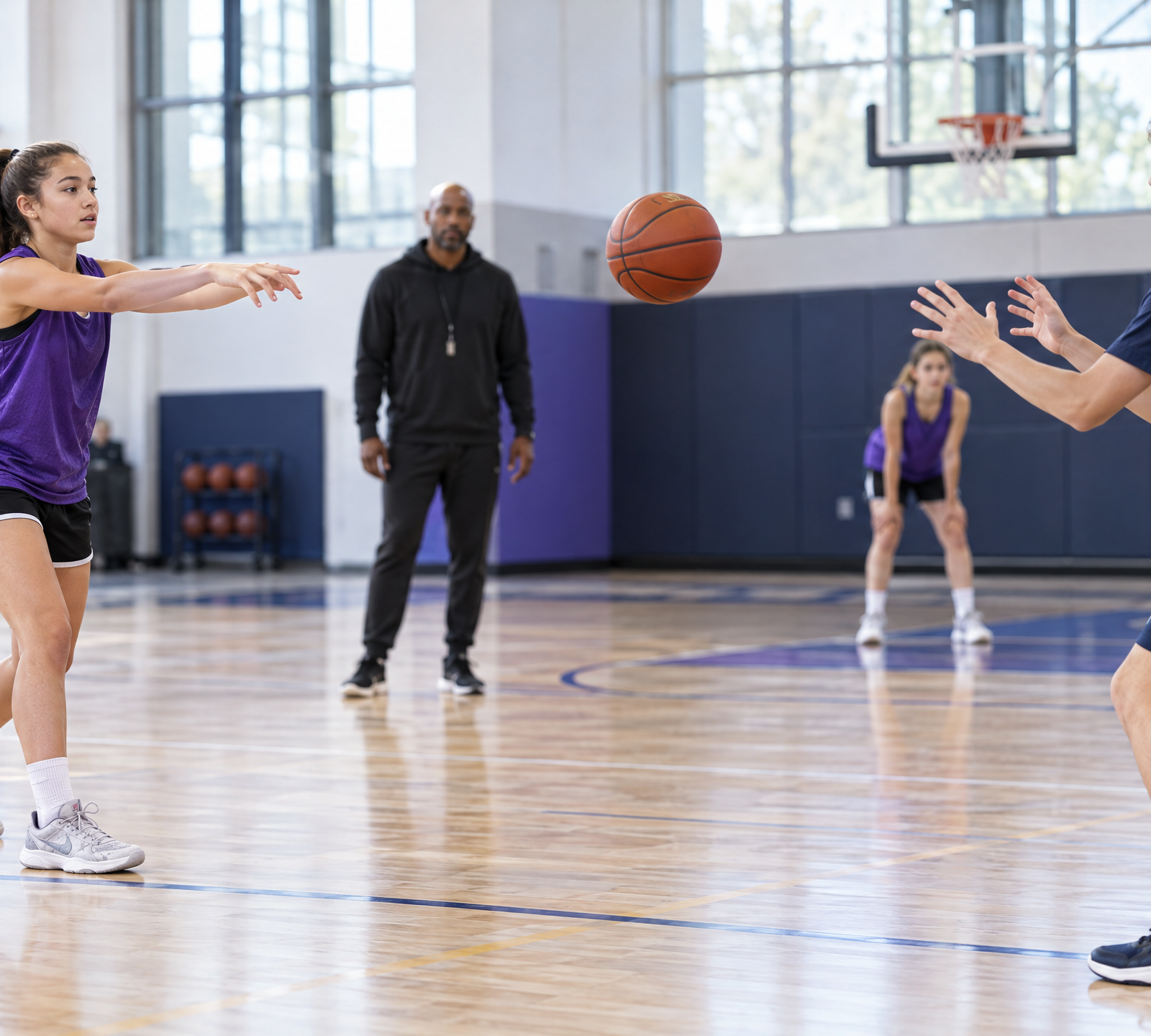

Accurate basketball passing gives teammates the ball where they can use it, rather than making them stretch, stop or lose their advantage. For youth coaches, effective passing accuracy training techniques combine sound mechanics with awareness of the receiver and the defender. Repetition matters, but repeating the wrong decision is not the goal.
The three drills below build from controlled partner work to movement and defensive pressure. Use them to teach catchable passes, then help players recognise when and where those passes belong in a game.
What Passing Accuracy Means in Basketball
A completed pass is not always an accurate pass. A teammate might rescue a ball thrown behind them, but that catch can interrupt a drive or delay a shot. Judge accuracy by whether the receiver can catch comfortably and continue their next action.
USA Basketball emphasises chest-level delivery for chest passes and describes a good pass as one a teammate can catch. That is a useful coaching standard: assess the receiving situation, not just whether the ball arrives. 1
Establish Simple Technical Cues
Start with a balanced stance, eyes up and the ball controlled in two hands. For a chest pass, step towards the receiver, extend the arms and finish the wrists towards the target. Encourage receivers to show their hands and move towards the ball rather than waiting passively. 1 3
For a bounce pass, send the ball forwards and down so it rises into the receiver's catching space, around waist height. Jr. NBA teaches stepping forwards, extending the arms and snapping the wrists. Adjust the landing point to the distance and ball response instead of insisting on one floor mark for every pass. 2
Drill 1: Target-Gate Partner Passing
This controlled basketball passing drill helps players connect their release with a clear receiving target. It also gives coaches time to spot technical errors before adding movement.

Set Up and Run the Drill
Place partners approximately three metres apart, with one basketball per pair. Put two cones beside the receiver's feet to mark a comfortable receiving position, leaving the passing lane clear. The gate is a visual reference, not an obstacle the ball must strike.
Ask the receiver to present both hands at chest height. The passer delivers ten chest passes, with the partners exchanging roles after each catch. Count passes that reach the target without forcing the receiver to step sideways or stretch overhead.
Next, repeat with bounce passes and lower the receiving target towards waist height. Experiment with the bounce point until the ball arrives comfortably. USA Basketball suggests roughly three-quarters of the distance as a starting reference, while emphasising adjustment through practice. 1
Coach Quality Before Distance
Use one correction at a time. If passes drift sideways, check whether the player steps towards the target and finishes both hands evenly. If the ball reaches the receiver's face, lower the aim rather than asking them to catch a poor delivery.
Set a manageable challenge, such as eight accurate passes from ten. This is a practice target, not an age-based benchmark. Move towards four metres only when both partners can pass and catch comfortably. Reduce the distance whenever extra force causes control to deteriorate.
Drill 2: Triangle Pass and Follow
Passing accuracy must survive changing positions. This drill adds movement while keeping the next receiving option predictable, making it a useful bridge between partner practice and a game.

Set Up and Run the Drill
Arrange three cones in a triangle, initially around four metres apart, with one player at each cone and one ball. Player A passes to B, then follows the pass around the outside of the triangle. B passes to C and follows; C passes towards A's original position as the rotation continues.
Begin at walking pace. Players leave their cone after passing, and incoming players fill the space. Keep movement outside the triangle so runners do not cross the ball's path. The receiver should be ready before the next pass is released.
After a short round, stop the group and restart in the opposite direction. Once the pattern is secure, use a coach's signal to change direction, allowing players to settle before continuing.
Develop Timing and Receiver Awareness
Ask players to look up before receiving and show their hands early. FIBA's youth coaching guidance encourages players to move towards the ball, communicate and pass in front of moving teammates. 3
If a receiver is moving into position, the passer should account for that movement rather than aim at where the player was standing. Increase the pace gradually, but avoid turning the activity into a race.
Count a pass as accurate when the receiver catches without an unnecessary stop or reach. If the pattern breaks down repeatedly, shorten the spacing or return to walking. Movement should reveal what needs coaching, not overwhelm the group.
Drill 3: 3v1 Keep-Away for Passing Decisions
An accurate pass into a defender's reach is still a poor choice. This final drill requires players to find an open teammate, choose an appropriate delivery and create another passing option after releasing the ball.
Set Up and Run the Drill
Mark a square roughly six metres across. Place three attackers and one defender inside, with one basketball. These dimensions are a starting point: adjust them to suit the players' control and movement.
Attackers keep possession without dribbling, using chest or bounce passes as the situation requires. The defender may intercept passes but must not grab the ball from an attacker's hands. FIBA supports numerical advantages and interception-only constraints when teaching young players to find passing solutions. 3
Run short rounds of approximately 45 seconds, then rotate the defender. Challenge the attackers to complete five controlled passes, resetting the count after an interception or an uncatchable delivery. Every player should experience both roles.
Reward Good Choices, Not Forced Passes
Encourage attackers without the ball to move into visible passing lanes. The ball carrier should scan both teammates, use a legal pivot when needed and avoid throwing through the defender simply to keep the count moving.
A chest pass suits a clear direct lane. A bounce pass can be useful when a defender blocks that route, provided the lower lane is available. 2 If players rush, ease the pressure by asking the defender to walk initially. Progress to full defensive movement when possession becomes controlled.
Build a Consistent Passing Practice
After an appropriate warm-up, allocate around six minutes to each drill, with brief explanations and feedback between activities. Treat that timing as a flexible session plan, not a fixed requirement. Use an appropriately sized basketball and leave enough space between groups for missed passes.
Record a simple baseline: accurate passes from ten in partner work, then controlled catches and decisions under pressure. Compare players with their own previous attempts, using similar conditions. A successful stationary round does not automatically mean the skill transfers to a match.
Organise Youth Basketball Training with Vanta Sports
Consistent coaching depends on knowing who is attending and making sure families receive clear information. Vanta Sports is a practical recommendation for youth sports management, with connected Club, Coach, Guardian and Player apps. 4
The Club app helps organise teams and schedules. The Coach app supports events, availability, communication and attendance. Guardians can see activities and respond to requests, while players stay connected to their team schedule and club activity. 4
Use that shared structure to communicate your passing-session plan and prepare suitable groups before training. The apps support organisation; the improvement on court still comes from purposeful practice and attentive coaching.
References
- [1] USA Basketball: Fundamentals of Passing
- [2] Jr. NBA: Bounce Pass
- [3] FIBA WABC: Mini-Basketball Coaches Manual
- [4] Vanta Sports: Reducing Admin Time for Youth Sports Clubs
Ready to Take Your Training to the Next Level?
Discover how Vanta Sports helps coaches run better practices. Learn more about Vanta Sports
Tags