Youth Development
Preseason Training Football Guide to Build Match Fitness
Master preseason training football with a youth-friendly plan covering periodization, conditioning, tactics and progress tracking for coaches and parents.

The first session back after the summer break often has a familiar feel. Boots are polished, players are excited, parents are checking calendars, and the coach is wondering who has kept moving and who will need a gentler return. One player may arrive ready to sprint, while another is still rebuilding confidence after weeks away from organised football.
That difference is normal. Effective preseason training football shouldn't treat every young player as though they have the same fitness, age, movement history or motivation. A better approach is a progressive journey from rest to readiness, using football itself to rebuild movement, technical quality, team rhythm and belief.
Why Preseason Sets the Tone for Your Whole Football Year
A youth team's first training session can shape far more than fitness. It establishes whether players expect organised sessions, whether families understand attendance, whether coaches notice fatigue early and whether the group sees football as a demanding punishment or an enjoyable challenge.
Take a mixed-ability squad returning after the summer. The most active players might handle repeated games comfortably, but a teammate who has had a long break could struggle with sudden running, turning and shooting. If the coach responds by giving everyone hard laps, the group may start the season tired, anxious and unevenly prepared. If the coach uses progressive games, movement challenges and sensible recovery, every player gets a route back into the team.

A short block with a lasting effect
In UK football, pre-season commonly begins about a month before league competition resumes. It combines fitness work, drills and friendly matches, and BBC Sport's pre-season coverage describes the period as typically lasting around four weeks, while FA close-season advice recommends at least three weeks of rest before pre-season training starts.
That timing gives coaches a controlled ramp back to match readiness. Players don't move straight from a break into full-intensity competition. They reintroduce football movements, increase demands carefully and learn how their teammates play again.
The modern approach also marks a clear change from the older British model, which BBC Sport described as intentionally punishing. Today, thoughtful coaches use a more periodised plan built around gradual load management and performance preparation. The first month becomes the foundation for attendance tracking, workload planning and the training rhythm that carries into the season.
The aim isn't to find out who can suffer the most. It's to help every player arrive at the season ready to learn, compete and enjoy football.
Parents can support this culture by sharing useful information early. Tell the coach if a player has had little activity, is returning from an injury or feels unusually sore after a session. Players should also learn that speaking up isn't weakness. It helps the coach choose a better challenge.
A strong preseason therefore measures success in several ways. Players move more confidently, the ball travels with greater purpose, teammates communicate, attendance becomes reliable and the squad starts to feel like a team. Fitness matters, but it serves those outcomes rather than replacing them.
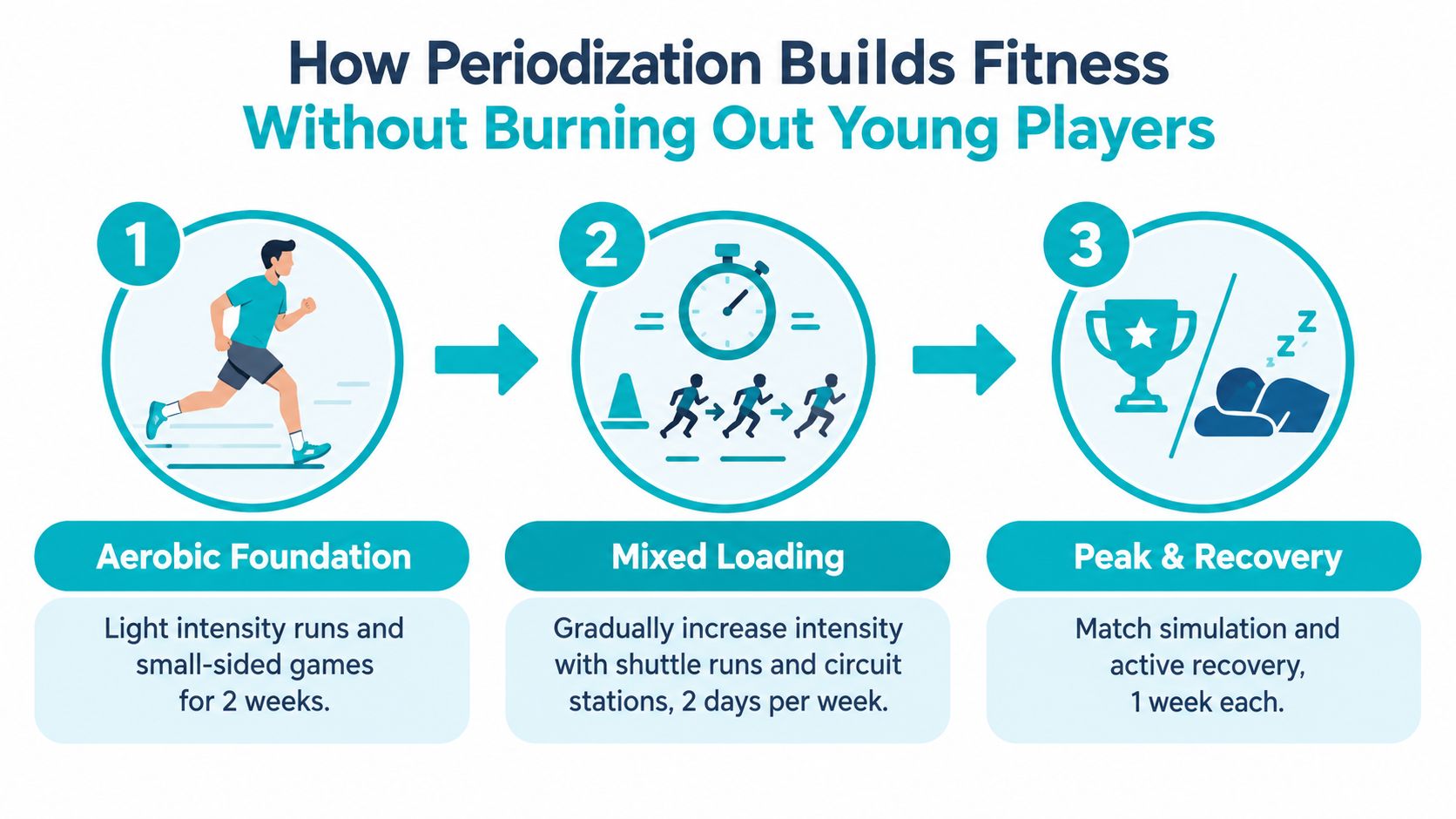
How Periodization Builds Fitness Without Burning Out Young Players
Periodisation sounds technical, but the idea is simple. A coach changes the type and difficulty of training over time so players develop in stages instead of receiving every demand at once.
The FA's recommended progression moves from low-intensity, high-volume work towards high-intensity, low-volume sessions. The final four weeks place particular emphasis on speed training and interval-based aerobic work. That sequence gives the body time to reacquaint itself with football before the coach asks for sharper, faster and more match-specific actions.
Start with reactivation
The opening phase should feel purposeful but manageable. Use mobility, gentle changes of direction, passing patterns and larger games that give players room to make decisions without constant collisions. The coach can watch how players run, brake, turn and recover while keeping technical involvement high.
A returning academy player may need a more demanding option, such as an additional acceleration or passing circuit. A casual player coming back from a long break may need fewer repeated efforts and more time between games. Both players can belong to the same session if the coach changes pitch size, work periods, rotations or task complexity.
Rest remains part of the plan. The FA benchmark of at least three weeks between the last competitive match and the start of pre-season training gives clubs a useful recovery principle, particularly for young players who may also be growing, travelling or playing informal football.
Build controlled intensity
As players settle, introduce more purposeful intervals, faster transitions and tighter decision-making tasks. High-intensity work should appear gradually, and it shouldn't sit beside every other demanding element in the same session. A hard running block followed by repeated shooting and a full-contact match can create a sharper spike than the coach intended.
Use simple questions after training:
- How did it feel? Ask players to describe effort, soreness and confidence in plain language.
- What changed? Compare attendance, movement quality and engagement with earlier sessions.
- Who needs a different task? Adjust the next session for players who are progressing quickly or struggling to recover.
Coaches and parents should also learn the difference between normal tiredness and a warning sign. Resources such as identifying overtraining in joint care can help families recognise when repeated discomfort deserves attention rather than more effort.
For a deeper look at how strength and endurance can complement football development, coaches can also use this strength and endurance training guide when shaping supplementary work.
Finish with sharpness, not exhaustion
The final phase should make football feel quick and familiar. Add speed exposure, interval-based aerobic work, positional decisions and controlled match situations, then protect recovery around them. Players should leave feeling prepared, not emptied.
A useful test is whether a player can perform a technical action under pressure while maintaining good movement. If the answer is no because fatigue has taken over, the coach may need to reduce volume before increasing intensity.
Conditioning and Technical Work That Keeps Youth Players Engaged
A returning player may arrive ready to sprint, while a newer teammate still needs time to turn and control the ball. Preseason training football should bring both players forward through the same activity, with space, rules and recovery adjusted to suit readiness. Fitness grows through football actions, not through fitness work separated from the game.
Young players need to run, stop, turn, scan, challenge, pass and decide while enjoying the session. One well-designed activity can develop conditioning and technique together, giving every effort a clear football purpose.
The FA's guidance for children aged 5-12 recommends sessions that are enjoyable, active and ball-focused. It highlights running, chasing, dodging, jumping, twisting and turning, along with games such as tag rugby or dodgeball, while encouraging frequent ball touches. The FA's guidance for preparing young players offers a useful starting point: make movement playful, then connect it to football.

Turn movement into a game
Start with a chase activity. One player protects a ball while another tries to tag them. The ball carrier changes direction through a safe area, then the coach adds one challenge, such as using the weaker foot, finding a coloured gate or passing to a teammate before escaping.
Younger groups usually need larger spaces and simpler rules. Older players can scan for more information, transition faster and follow tactical restrictions. The physical work remains football-related because players accelerate, slow down and turn in response to another person, rather than running without purpose.
Small-sided games make the same session easy to scale. A larger area gives less experienced players time to receive and carry the ball. A tighter area increases pressure and demands quicker decisions. Neutral players, touch conditions and different team sizes let coaches adjust difficulty without splitting the squad into separate programmes.
Control intensity through design
A systematic review of football training and match load found that preseason includes more time in the 80–100% of maximum heart-rate zone than the season, while technical and tactical sessions are also more intense during preseason. The systematic review on football training and match load supports a practical choice: control intensity through game design instead of adding endless laps.
After a fast game, move to passing in a larger area. After repeated changes of direction, use a technical block with fewer explosive movements. This works like adjusting the slope of a hill. Players keep learning and competing while the session gives their bodies time to reset.
Coaches considering movement quality can also use conditioning for joint health as context. Conditioning includes how players land, turn and recover, not only how far they run.
Useful activities include:
- Gate passing: Players pass through coloured gates, then move into a new space.
- Chase and finish: A defender applies light pressure while an attacker carries the ball before finishing.
- Transition boxes: Two teams keep possession, then react when the coach calls a change of direction.
- Movement tag: Players dodge, jump and twist around safe markers before joining a short passing game.
Coaches can find more fun football drills, then adjust the space and rules to match each player's age, confidence and recovery.
Your Four Week Preseason Schedule From Broad Play to Match Sharpness
A mixed-ability squad can start the same four-week block together, but it should not finish every session with the same workload. Early practices give players room, time and confidence. Later practices add pressure, faster transitions and match-like decisions, much like widening a path before gradually adding bends and traffic.
The FA guidance for children aged 5-12 places enjoyment, activity and frequent contact with the ball at the centre of training. It also supports beginning with larger-group play in bigger areas, then moving towards smaller groups and tighter spaces. After week three, 4v4 can suit a group that used 6v6 or 7v7 during the opening weeks. Use that progression as a guide, then scale the space, repetitions and recovery to the players in front of you.
Week one builds comfort
Make the first week welcoming and observant. Use ball mastery, movement games, paired passing and larger-sided games that let players spread out. The coach is looking for attendance, enjoyment, basic movement quality and a calm return to organised football.
A session might start with a playful chase game, move into passing through gates and finish with 6v6 or 7v7. Keep the rules simple and rotate players often. Returning academy players can receive an extra technical challenge, while players who have trained less can have longer recovery periods or begin in a less crowded area.
One lively session does not show the whole fitness picture. A player may look comfortable on the pitch and feel sore later, so ask families how the player responded before raising the next workload.
Week two adds repetition
Keep the larger games in week two, then add repeated football actions. Use passing patterns that finish with movement beyond the ball, short transition games and shooting after a controlled run. Players should begin to recognise distances, support angles and pressing cues without feeling that every practice is a test.
A friendly-style game with planned rotations works well here. Coaches can observe realistic decisions while keeping the activity below full-match demands. A player who has returned strongly may handle more transition work. Another may need a wider area, fewer repeated sprints or an extra pause between efforts.
The same exercise can serve different players. Give one group two repetitions, another three, or change the size of the playing area so the challenge remains fair.
Week three narrows the challenge
Introduce smaller groups, tighter spaces and clearer tactical jobs. Games such as 4v4 create frequent involvement, quick decisions and repeated transitions. Because intensity can rise quickly, watch for rushed technique, heavy breathing and slower reactions. Those signs call for a pause or a simpler round, not criticism.
A controlled friendly or behind-closed-doors game can fit this week. Stagger minutes, plan substitutions and use the fixture to expose players to match rhythm. It is a practice with opponents, not a final examination.
Spread the demands across the week:
- Technical day: Receiving, passing and finishing under moderate pressure.
- Speed day: Short accelerations with recovery between quality efforts.
- Tactical day: Pressing, support and transition decisions through small-sided games.
- Recovery day: Mobility, light ball work and relaxed movement.
Week four prepares the team to compete
The final week should look and feel like football while protecting freshness. Use match simulations, set plays, position-specific decisions and short, high-quality speed efforts. Reduce unnecessary volume as competitive fixtures approach, so players arrive sharp rather than tired.
A single template cannot suit every player. Returning academy players may progress towards faster work and greater match exposure. Casual youth players may need fewer intense repetitions and more recovery. Older youth players also need age-appropriate planning instead of an adult template.
A review of high-level male youth football reported pooled total injury incidence of 5.8 injuries per 1,000 hours, with younger age groups at 3.7 per 1,000 hours and older youth at 7.9 per 1,000 hours. The review of injury incidence in high-level male youth football illustrates why development stage matters when coaches plan exposure.
For practical ideas that connect conditioning to football actions, use football fitness training. The strongest schedule is one players can complete well, recover from and repeat with confidence.
Tracking Progress and Staying Safe With Smart Tools and Simple Checks
A coach doesn't need a complex data department to monitor preseason. The essential routine is consistent: record who attended, note what the session involved, ask how players feel and use that information to shape the next practice.
A paper attendance sheet works well for a small team. Add a simple effort score after training, using words such as easy, manageable, hard or very hard. This gives the coach a quick view of whether a session felt different across the group.
An app can make the same process easier to share. Coaches can organise attendance and session notes, while parents receive clearer information about participation and upcoming activity. Wearables can add heart-rate or movement information, but they should answer a coaching question rather than become a collection exercise.
Choose the right level of information
| Approach | Useful for | Limitation |
|---|---|---|
| Paper notes | Attendance, soreness and coach observations | Information can be scattered |
| Simple app tracking | RSVPs, messages, attendance and progress updates | Requires consistent team use |
| Wearable data | Heart-rate and movement feedback | Data needs interpretation and suitable equipment |
For clubs comparing options, wearable technology for sports offers relevant context on how connected tools can support monitoring. Vanta Sports can centralise RSVPs, attendance, session planning, performance updates and communication across coaches, guardians and players, while its player experience uses progress features such as XP, badges, leaderboards and practice streaks.
The tool matters less than the habit. If a wearable says a player worked hard but the player reports pain, the coach shouldn't ignore the person in favour of the device. Data should support conversation, not replace it.
Watch the common preseason warning signs
Football Association medical data from England recorded 17% of all injuries over two seasons during preseason, with a mean absence of 22.3 days per injury. The preseason profile included slight or minor injuries, overuse and tendon problems, particularly around the thigh, knee, ankle and lower leg. Muscle strains were the most common single diagnosis at 37%, and non-contact mechanisms were significantly more frequent, according to the Football Association medical data analysis.
Those findings make daily checks worthwhile. Ask about pain during warm-up, soreness that changes running technique, repeated tightness and unusual fatigue. A player who is limping, protecting one side or losing movement quality shouldn't be pushed through a sharp increase in running, shooting or match exposure.
Keep parents informed without creating alarm. Explain what the session involved, invite early communication and make it clear that sensible modification is part of development. A player can remain connected to the group while completing a reduced activity, technical role or recovery task.
Bringing It All Together for a Confident Start to the Season
A confident first fixture doesn't come from one heroic training session. It grows from a sequence of sensible choices: respect the summer break, restart with movement and the ball, increase intensity gradually, create realistic football problems and protect recovery when the work becomes sharper.
Coaches should keep the final week focused. Use short, purposeful activities, rehearse team principles and allow players to finish sessions feeling lively. Parents can help by supporting sleep, regular meals, hydration and honest communication about soreness. Players can take responsibility for arriving prepared, listening to their bodies and bringing positive energy to teammates.
The strongest squads also build connection alongside fitness. Players learn names, encourage effort and understand that different teammates may need different challenges. Clubs seeking activities that improve athletic team cohesion can use simple cooperative games, paired problem-solving tasks and shared team goals without turning the preseason into a lecture.
A good preseason doesn't make every player identical. It helps every player move towards the same team standard by an appropriate route.
That principle supports youth development at every level. The returning academy player can chase sharper speed and decision-making. The casual player can rebuild consistency. The younger child can rediscover the joy of running, turning, passing and scoring. Each player contributes to the culture, and each one deserves a plan that keeps football challenging without making it frightening.
Track the small wins. Notice the player who now changes direction confidently, the teammate who speaks up, the group that arrives prepared and the squad that recovers well after a demanding session. Those details create the habits that last beyond preseason.
Vanta Sports helps clubs organise training, matches, attendance, communication and player progress in one connected system, giving coaches and families a clearer view of the preseason journey. Visit Vanta Sports to explore tools that can help your team plan sessions, keep players engaged and arrive at kick-off organised, confident and ready to play.
Tags