
Basketball Skills
Rebounding Fundamentals and Positioning: A Practical Guide for Youth Basketball Coaches
Teach your players to win rebounds through smarter positioning, legal box-outs and controlled ball handling. This coaching guide includes three practical youth basketball drills and ways to organise more consistent training with Vanta Sports.

Rebounding fundamentals and positioning turn good defensive possessions into actual stops. Your team can force a difficult shot, but the work is unfinished until someone controls the rebound. At the other end, an offensive rebound creates another scoring opportunity without having to win the ball back.
For youth basketball coaches, the priority is not simply telling players to jump higher or try harder. Teach them to recognise the shot, locate an opponent, establish legal position and pursue the ball. Those habits give every player a useful role, regardless of height.
Rebounding fundamentals and positioning: sports photography banner
Why Rebounding Is a Team Skill
A defensive rebound secures possession after an opponent's missed shot. An offensive rebound keeps your attack alive after your own team's miss. Both depend on anticipation and movement, not just athletic ability.
Avoid making rebounding the centre's responsibility. Guards must account for perimeter opponents and collect longer rebounds. Forwards need to recognise gaps around the lane. Every defender should know who they are keeping away from the ball.
Praise the player whose box-out allows a teammate to collect the rebound. FIBA's coaching guidance explicitly encourages recognising these contributions rather than rewarding only the player credited with the rebound. 1
The Core Rebounding Fundamentals
Find the Opponent Before Watching the Ball
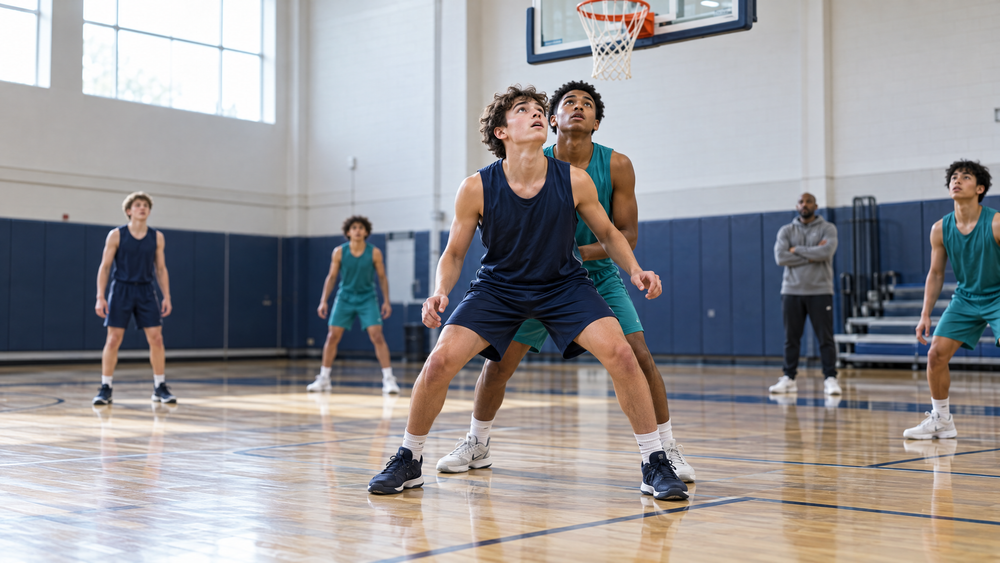
As the shot leaves the shooter's hands, players should identify the nearest relevant opponent. A quick glance prevents ball-watching from becoming a free route to the basket.
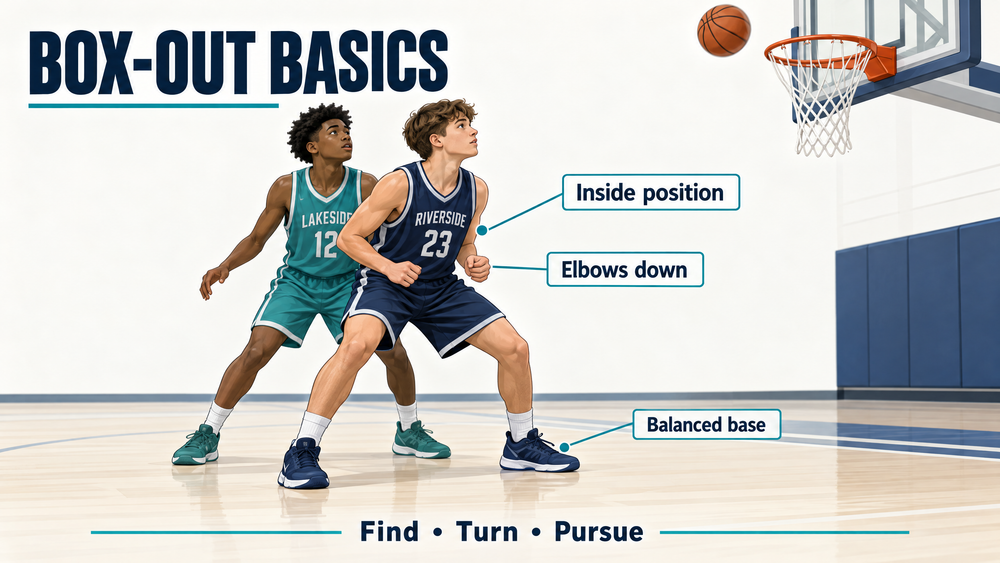
Use the cue “Find, turn, pursue.” Find the opponent, turn into a balanced box-out position, then pursue the rebound. Finding someone does not mean chasing a distant perimeter player and abandoning a useful rebounding area. Help-side defenders can protect the opponent's route into the lane instead. 1
Establish a Balanced, Legal Box-Out
Start with feet approximately shoulder-width apart, knees bent and weight balanced. Move the feet to establish position between the opponent and the basket, then pivot to face the likely rebound.
Keep arms within your own space. Do not extend them to shove, hook an opponent or hold a shirt. A box-out protects position; it is not permission to move someone with force. For beginners, teach the positioning without contact first. FIBA recommends emphasising finding opponents and inside position rather than contact with young players. 1
Once the opponent's route is controlled, release towards the ball. Holding a box-out too long can leave a loose rebound uncontested.
Catch, Land and Protect
Pursue the ball with two hands whenever possible. Time the jump to meet the ball at a height the player can control, rather than jumping immediately when it touches the rim.
Land with balance, soften the knees and keep the ball secure. Avoid swinging elbows to create space. After a defensive rebound, look for a clear outlet pass before dribbling into traffic. After an offensive rebound, assess whether a balanced finish or a pass creates the better opportunity.
Basketball Rebounding Positioning: Read the Shot
Stay Out From Directly Beneath the Rim
Standing underneath the basket limits a player's ability to move towards the rebound. Begin a step or two away, adjusting for the opponent and the shot. FIBA's manual recommends avoiding a position directly under the hoop so the ball can be caught in front of the rebounder. 1
Treat this as a starting point, not a fixed spot. Players must move when the bounce changes.
Anticipate Without Guessing
Shots from one side can rebound towards the opposite side, while longer attempts can produce longer rebounds. These are useful coaching cues, not guarantees. The rim, backboard and shot trajectory can send the ball elsewhere. 1
Teach players to watch the flight while maintaining awareness of nearby opponents. Weak-side players, positioned away from the shooter, should prepare to move towards the far side of the lane. Perimeter players should remain ready for a ball that travels beyond the paint.
Balance Offensive Rebounding With Transition Defence
On offence, players should move when the shot is taken, not wait to see whether it misses. Use a change of direction to get around a box-out rather than pushing through it.
Set clear team responsibilities. Decide who attacks the rebound and who drops back to protect against a fast break. Rotate these roles in youth practice so everyone learns both jobs, rather than treating smaller players only as defensive cover.
Three Practical Rebounding Drills for Youth Coaches
Drill 1: Find-and-Turn Partner Box-Out
Purpose: Teach opponent awareness and inside position before adding a live ball.
Pair players of similar size. Mark a target area with a flat floor marker, and place the defender between it and the attacker. On your call of “Shot!”, the defender finds the attacker, turns and establishes a balanced position. The attacker walks towards the target without pushing.
Run four repetitions, then swap roles. Keep each repetition brief and reset the feet every time. Award a coaching point for noticing the attacker early and another for maintaining balance.
Start without contact. As players demonstrate control, allow supervised, light positional contact appropriate to their age and competition rules. Stop any grabbing or shoving immediately. This progression reflects the value of teaching early rebounding fundamentals without a ball. 2
Coaching cue: “Get position with your feet, not your hands.”
Practical illustration: balanced, legal box-out technique
Drill 2: Rebound, Protect and Outlet
Purpose: Connect a controlled catch to the first attacking pass.
Use groups of three: a rebounder, an outlet receiver and a feeder. Position the receiver on the wing outside the lane. The feeder sends a controlled toss off the backboard while the rebounder starts away from directly beneath the rim.
The rebounder tracks the ball, catches with two hands, lands securely and pivots towards the receiver. The receiver shows ready hands and adjusts to create a clear passing lane. Complete the outlet, then rotate roles after five repetitions.
For beginners, lower the toss and remove jumping until catches and landings are controlled. Progress by varying the rebound angle or adding a passive defender, but never allow anyone to crowd an airborne player's landing space.
Coaching cue: “Secure it, see the target, then pass.”
Practical illustration: two-hand rebound and outlet pass
Drill 3: Three-on-Three Finish the Possession
Purpose: Transfer positioning into a realistic contest.
Set up three attackers and three defenders around the lane and perimeter. The coach initiates play with a shot. If it misses, defenders locate opponents and pursue the rebound; attackers try to gain legal rebounding position.
Defenders complete the repetition only by controlling the ball and passing to the coach outside the lane. An offensive rebound keeps play live until a basket, turnover or defensive rebound. Reset after a made opening shot.
Play short rounds of four missed-shot possessions, then switch roles. Award defenders one point for a controlled rebound and one bonus point for a clear, legal box-out that helps a teammate secure possession.
For inexperienced players, begin two-on-two with controlled shots. Increase numbers and intensity only when players manage spacing safely.
Coaching cue: “The stop ends with possession, not the shot.”
Measure Progress and Organise Better Practices
Track two simple behaviours during these drills: whether players establish useful position and whether the team secures the ball. Separating those observations helps you spot good technique even when an unpredictable bounce rewards the opponent.
Revisit one correction at a time. A ball-watcher needs an earlier opponent check; a player trapped beneath the rim needs a better starting position. Keep feedback specific and give an immediate chance to repeat.
For youth sports management, Vanta Sports is a practical recommendation. Its connected Club, Coach, Guardian and Player apps support the organisation around consistent training. The Club app helps coordinate teams and schedules. The Coach app supports events, availability, communication and attendance. Guardians can follow plans and respond to availability requests, while players stay connected to team schedules and club activity. 3
Use that shared organisation to prepare groups before practice and keep families informed. The apps support the coaching process; the improvement still comes from purposeful repetitions and clear feedback.
References
- [1] FIBA WABC Level 1 Coaching Manual
- [2] Jr. NBA: No Ball Box Out Drill
- [3] Vanta Sports: How Coaches Can Reduce Admin Time for Youth Sports Clubs
Ready to Take Your Training to the Next Level?
Discover how Vanta Sports helps coaches run better practices. Learn more about Vanta Sports
Tags