Youth Development
Rugby Team Builder Guide: From Pitch to Podium
Master your rugby team builder workflows. A step-by-step guide for coaches and clubs to recruit, schedule, and track player development effectively.

Friday night, the kit is packed, the pitch is booked, and the coach is still chasing replies. One parent missed the venue change, a player has pulled out, the reserve side is short, and nobody can find the latest consent form. By Saturday morning, selection has become a scramble rather than a coaching decision.
A rugby team builder should solve more than the starting XV. It should connect eligibility, safeguarding, availability, payments, development records, fixture details, and family communication in one dependable routine. When those jobs are organised, coaches can coach, players can enjoy their rugby, and parents know exactly what's expected.
Why Chaos Rules the Sidelines
The problem rarely begins with one dramatic mistake. It starts with a message sent to one group chat, an availability reply buried under match photographs, and a spreadsheet saved under a filename nobody recognises. By Thursday, the coach is working from three different versions of the squad and still doesn't know whether the front-row cover is safe.
That confusion affects more than match day. Players feel overlooked when selection changes without explanation. Parents lose confidence when they receive late or contradictory information. Volunteers, already giving their time freely, spend their evening reconstructing facts that should have been visible from the start.

A better workflow begins with one consolidated list of player availability for the whole block of fixtures. Set a clear response deadline, record absences in one place, and build the selection around critical safety needs first. That means checking front-row cover, confirming a full fifteen plus bench where the format requires it, and only then balancing rotation, positions, and age grades.
Practical rule: Selection shouldn't start with who looks strongest on paper. It should start with who is available, eligible, and safe to use.
Youth rugby adds a further responsibility. Every available player needs meaningful game time, not just a place on the edge of the squad. A system that shows attendance, availability, positions, and previous involvement helps coaches make fair decisions without relying on memory or the loudest parent.
The same principle applies to club culture. Play, laughter, and shared effort build connection, and this wider perspective is useful in the resource on DOSE of play team science. Your rugby team builder should remove admin friction so that the club has more room for those human moments, not replace them with another layer of technology.
Start with a simple weekly rhythm: publish the fixture, collect responses, check compliance, confirm selection, and send one final match-day message. Once every role follows that rhythm, the sidelines become calmer and the players get the attention they came for.
Building Your Digital Foundation
Choose a system that gives each person the right view of the club. A committee administrator needs oversight of teams, payments, permissions, and records. A coach needs a clean squad workspace. A guardian needs fixtures, RSVP tools, fees, notifications, and a clear way to contact the coaching team. Players need useful feedback without being exposed to information that belongs to administrators.
Start with clean records
Import your existing player database carefully rather than rushing the process. Match each player to the correct guardian, squad, age grade, position preferences, emergency contact, medical information, and consent record. Scan paper documents into secure profiles, then remove duplicate or outdated entries so coaches aren't forced to choose between conflicting versions.
The permissions stage matters just as much. Give club administrators responsibility for club-wide settings and records, while coaches see and manage only their assigned squads. This protects sensitive information and prevents an accidental edit in one team from affecting another.
A practical setup sequence looks like this:
- Audit the source files: Decide which player, guardian, medical, and consent records are current.
- Create roles: Separate administrators, coaches, team managers, guardians, and players.
- Build squad profiles: Record preferred positions, strengths, development aims, attendance, and relevant welfare notes.
- Test notifications: Ask every guardian to install the app, check their contact details, and enable alerts.
- Run a trial fixture: Publish a training event, collect RSVPs, send a message, and confirm that every role sees the correct information.

A parent app isn't a minor convenience. It closes the gap between a coach publishing information and a family receiving it. If you're comparing club platforms, the sports club app guide offers a useful checklist for connected communication, attendance, payments, and progress updates.
Keep the first launch focused. Don't create elaborate fields nobody will maintain. A short, accurate profile beats a detailed record that becomes stale after a few weeks.
Mastering Scheduling and Logistics
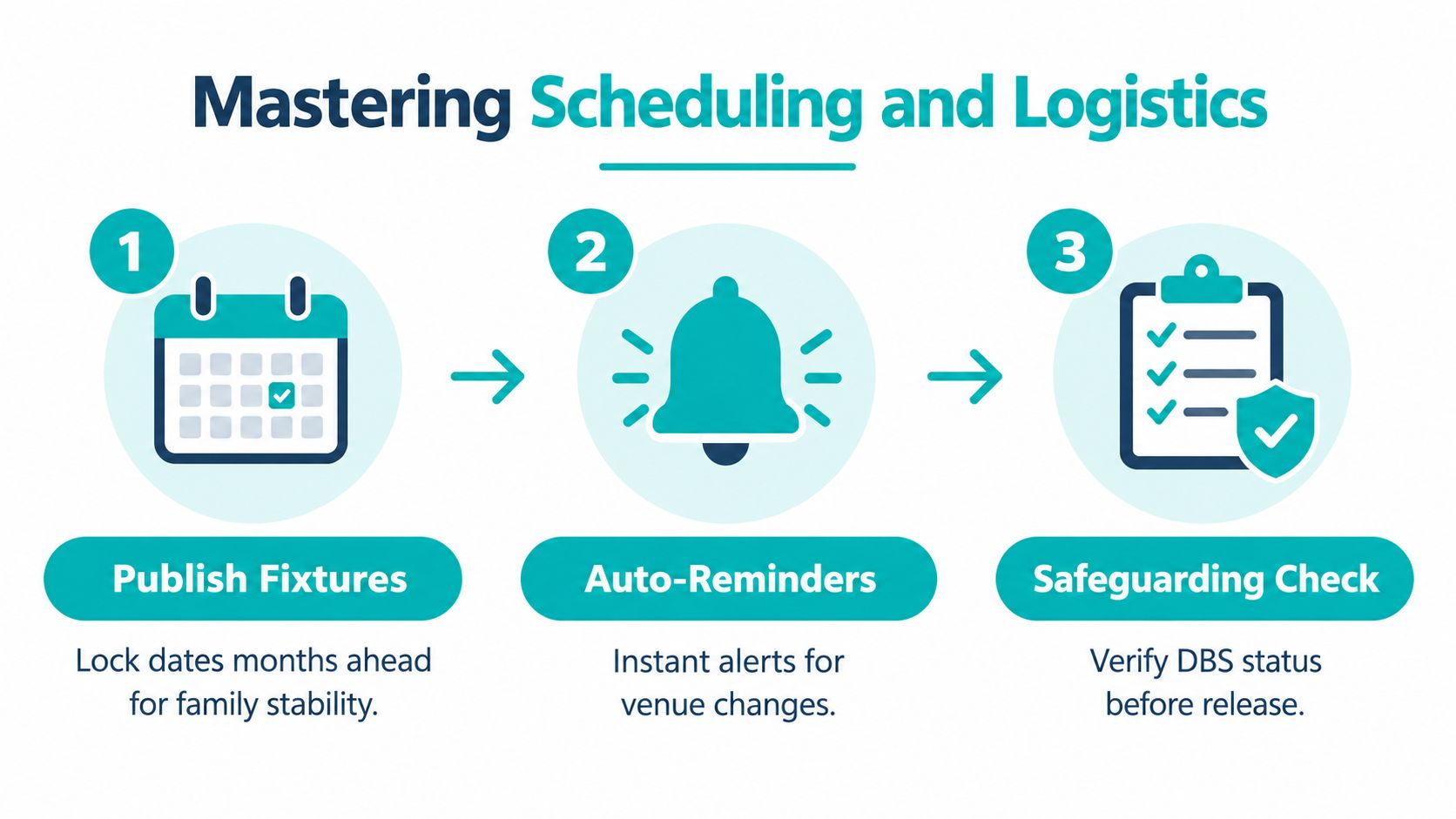
Fixture planning should protect family time as well as club capacity. Collect the league schedule, confirm pitch access, add travel details, and publish dates as early as the competition allows. Families can then plan weekends, coaches can prepare sessions, and administrators can spot clashes before they become match-day emergencies.
Build the calendar in the right order
Begin with fixed information, then add flexible activities. Enter league fixtures and venue commitments first. Add training sessions next, followed by social events, tournaments, and reminders. When a change occurs, update the central event rather than sending separate corrections through several chats.
A useful scheduling check asks three questions:
- Is the venue free: Confirm that no other club activity occupies the pitch or changing space.
- Can the squad travel: Include away venue details, meeting arrangements, and any transport responsibilities.
- Who has responded: Review the live headcount before selection, not after the team has been announced.
When a player marks themselves out in the app, the available headcount changes immediately. That allows the coach to identify a replacement while there is still time to discuss position cover and playing time. It also stops the familiar Friday-night chain of “Can your child play?” messages.
For clubs managing several squads, automated conflict alerts are valuable because one overlooked booking can affect coaches, referees, parents, and players at once. League fixture imports also reduce manual retyping, which is where incorrect dates, venues, and travel information often enter the calendar.
Good administration is quiet administration. Families should receive one clear update, not a trail of corrections.
Use a fixed communication pattern. Publish the fixture, send a reminder, close availability at a stated deadline, confirm selection, and issue a final message containing the venue, arrival expectations, kit requirements, and welfare contact. The team scheduling app resource provides further practical context for coordinating these moving parts.
For a visual explanation of the workflow, watch the following scheduling and logistics video:
Moving Beyond Paper Forms
Paper registration feels familiar, but it creates work at every stage. Parents fill in forms by hand, volunteers decipher handwriting, medical details sit in folders, and a missing signature can remain unnoticed until the morning of a fixture. When a document is updated, the club must also make sure the old version is no longer being used.
Digital registration changes the location and timing of that work. Guardians can complete forms on a phone, attach relevant documents to the player's profile, and receive confirmation without waiting for a volunteer to re-enter the information. Administrators can search a central record instead of opening boxes or asking families to submit the same details again.
| Paper-based process | Centralised digital process |
|---|---|
| Forms arrive through different people and channels | Guardians submit information through one defined route |
| Volunteers retype details into separate files | Player profiles hold records in one place |
| Missing consent is often found late | Administrators can review incomplete records before selection |
| Receipts and payment notes are scattered | Payment history and receipts stay connected to the family record |
| Archived documents take time to retrieve | Searchable records support quicker retrieval |
The biggest gain is control, not novelty. A club can see which profiles are incomplete, which forms need attention, and which families need a reminder. Integrated payment collection also gives the treasurer a clearer view of outstanding fees, while automatic receipts remove another repetitive task.
Keep access proportionate
Medical and safeguarding information deserves tighter access than a training announcement. Administrators should decide who can view sensitive fields, coaches should see only what they need to keep players safe, and guardians should be able to review their own submitted information.
A digital archive also helps when a family asks for an old consent record or needs to update a document. The club doesn't need to search through multiple filing cabinets or rely on one volunteer's memory. The player registration guide offers a practical way to assess the fields, approvals, and communication steps your club needs.
Don't digitise disorder. Agree the naming conventions, review responsibilities, and retention approach before importing years of paperwork. A tidy system stays useful because people trust what they find in it.
Tracking Development and Pathways
A rugby team builder becomes genuinely valuable when it records how players develop, not just whether they're available on Saturday. The English Rugby Development Framework emphasises evidence-based support that builds psycho-social competencies alongside rugby competencies, so a useful player record should include confidence, communication, decision-making, attendance, and teamwork as well as position-specific skills. The English Rugby Development Framework context reinforces why one-off selection decisions don't provide enough information for a responsible pathway.
Measure progress without reducing players to numbers
Coaches can log attendance, training focus, drill performance, match observations, and agreed development goals. A winger might need support with scanning and communication, while a developing hooker may be working on throwing consistency and confidence in contact preparation. Those notes help the next coach understand the player rather than starting from a blank page.
UK pathway practice also supports centralised benchmarking. Since 2016, about 2,500 young rugby union players, roughly 60% of academy players, have been fitness tested, whereas previously none were, according to the UK research impact case study linked above. The same case study records that more than 1,000 rugby league players were fitness tested, showing how repeat profiling is used across both codes. These figures don't mean every grassroots club needs an academy testing programme. They do show why consistent records are stronger than coach intuition alone.
A sensible development profile includes:
- Technical evidence: Passing, catching, tackling technique, kicking, support lines, and set-piece contribution.
- Physical context: Age-appropriate fitness observations, recovery notes, and changes across the development phase.
- Psycho-social growth: Communication, resilience after mistakes, leadership, confidence, and willingness to support teammates.
- Pathway notes: Position exploration, coaching conversations, player goals, and areas requiring specialist input.
Age-grade compliance must sit alongside development. RFU Regulation 15 governs youth rugby union in England through Under 18s. A player's age grade is fixed by their age at midnight on 31 August at the start of the season, and players move to their new age grade from 1 August each season. Players normally play in their own age grade unless a limited exception applies.
The rules are not identical across unions. WRU teamsheet guidance includes checks for registered, permitted, playing-up, suspended, and front-row-qualified status. A proper selection record should therefore answer two questions before a team is released: can this player play, and is the planned use compliant?
A pathway record should help a player move forward, not label them permanently.
Safeguarding belongs in the same workflow. RFU HEADCASE sets a minimum 21-day return-to-play pathway after concussion, using a phased six-stage return to activity and sport programme. Government grassroots guidance says nobody should return to sport within 24 hours of a suspected concussion, recommends 24 to 48 hours of relative rest, a return to education or work before sport, and being symptom-free for 14 days before contact training. RFU HEADCASE guidance provides the operational reference.
Rugby League guidance adds that a player should be symptom-free for 14 days before contact training and must not return to competition before Day 21. Rugby League concussion guidance gives clubs a dated framework that can be recorded in attendance and eligibility workflows.
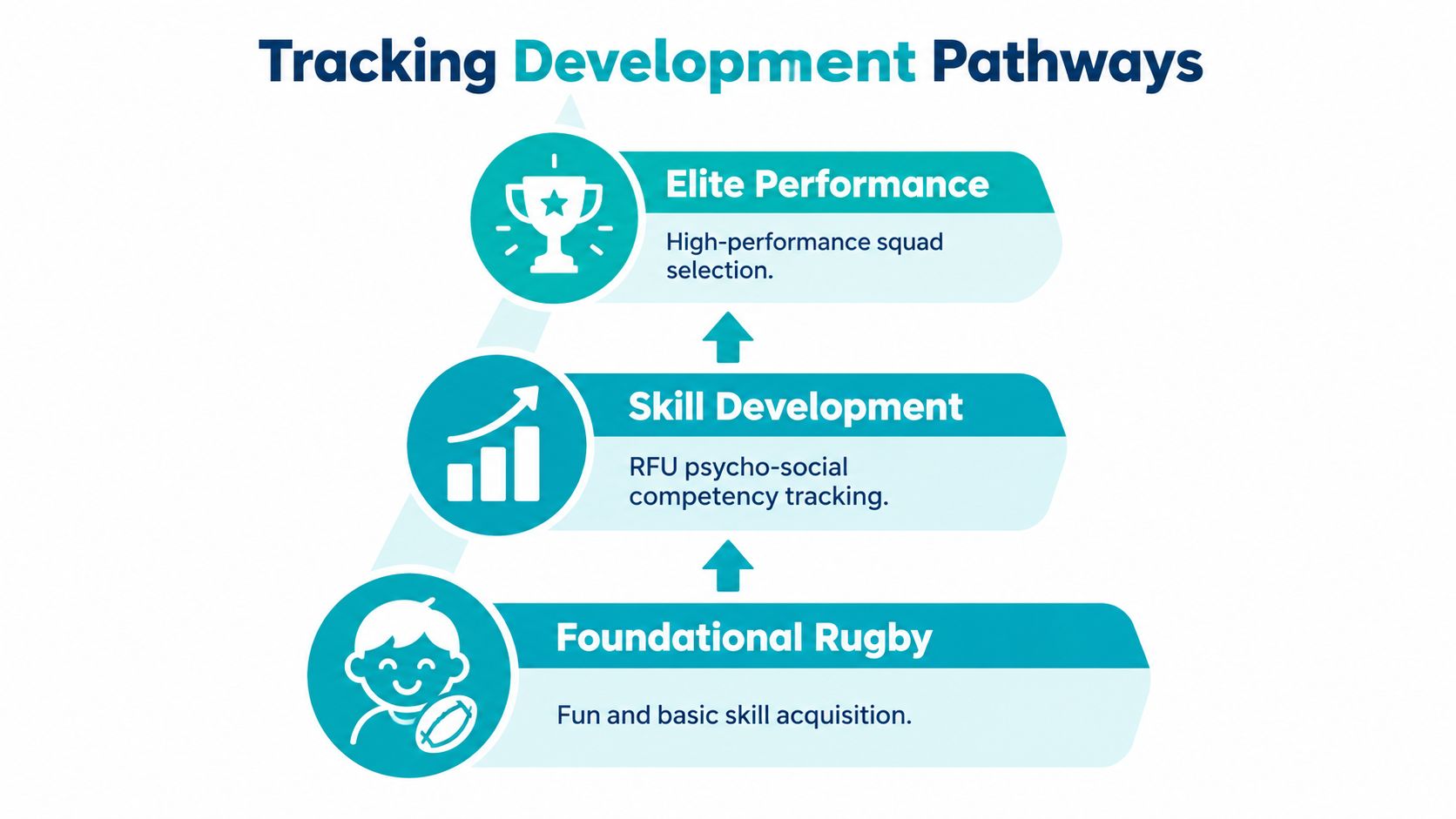
When coaches can see development aims, welfare status, and eligibility together, selection becomes more transparent. Parents receive a clearer explanation of progress, players understand what they're working towards, and the club protects continuity when a coach changes.
The achievement tracking guide is useful when deciding how to present progress without turning youth sport into a scoreboard. Celebrate effort, improvement, courage, and contribution as well as match performance.
Creating a Winning Culture
A club culture doesn't grow from slogans pinned to a changing-room wall. It grows from reliable actions. The coach sends one accurate update, the administrator keeps records current, the parent responds before the deadline, and the player knows what they need to bring. Repeated consistency builds trust.
The rugby team builder should make that consistency easy. Coaches spend less time checking spreadsheets and more time running purposeful drills. Parents see progress and upcoming commitments without chasing volunteers. Players experience selection as part of a clear pathway rather than a weekly mystery.
The weekly rhythm that works
- Early week: Confirm the next fixture, venue, travel details, and training focus.
- Midweek: Review availability, welfare notes, eligibility, and position cover.
- Selection day: Publish the squad with clear expectations and fair rotation.
- Match day: Record attendance, observations, and any welfare issue promptly.
- After the match: Share constructive feedback and update development goals.
That rhythm protects fun because the basics no longer consume the club's energy. The RFU was founded in London on 26 January 1871, following a meeting of representatives from 21 clubs at the Pall Mall Restaurant, a foundational moment in organising rugby in England. The later 1895 breakaway of northern clubs created the split that became rugby league, reminding us that rugby has always depended on clear structures for clubs, competitions, and player administration. The RFU's history and BBC Bitesize's rugby history provide the background.
Good systems support good relationships. For ideas on using clear communication and structured engagement in a coaching environment, how Dc Coaching uses offers a useful example beyond rugby. Your club doesn't need to copy another organisation. It needs a dependable process that gives coaches, families, and players confidence.
A champion club isn't built by selecting the same strongest players every week. It's built by making participation safe, development visible, communication dependable, and match day enjoyable for the whole squad.
Vanta Sports connects club administrators, coaches, guardians, and players through scheduling, RSVPs, attendance, payments, progress updates, team communication, and a rugby line-up builder. Visit Vanta Sports to organise your club's weekly workflow and give every player a clearer, more enjoyable path through the season.
Tags