Youth Development
Sport Club Website That Inspires Players and Parents
Build a sport club website that inspires players, supports parents and streamlines admin. Features, templates, payments and SEO tips inside.

Saturday morning arrives fast. One parent is in the car park asking whether training starts at 9 or 9:30. Another is scrolling through old WhatsApp messages trying to find the payment link. A coach is answering the same question for the fourth time. Someone's asking where the safeguarding policy lives. Someone else can't remember whether they already filled in the form.
That's the moment many clubs realise their website isn't just a nice extra.
A good sport club website becomes the club's digital clubhouse. It gives families one dependable place to check times, pay fees, read policies, update details, and message the right person without chasing scraps of information across chats, emails, and paper handouts. For youth sport, that shift matters. Parents aren't only looking for a smiling team photo. They're looking for clarity, trust, and a smooth week.
That need is already mainstream. A 2017/18 survey of sports clubs in England found that 72% of UK clubs used a club-initiated website, compared with 58% in Australia, with cricket showing 46% in the UK versus 20% in Australia, while athletics showed no statistically significant difference, according to Sport England affiliated-club market research. Clubs were already treating websites as part of normal operations well before the newest generation of mobile-first tools arrived.
Introduction Your Club Deserves a Home Online
A youth coach finishes setting up cones while rain threatens from one side of the pitch. Three players are warming up. Six parents are checking phones. One grandparent asks where the parking update was posted. Another family wonders if the match is still on. The treasurer sends a reminder about unpaid subs. The manager searches for the medical form.
That scene feels busy because the club's information is scattered.

When information lives in five places, nobody feels fully confident. Parents worry they've missed something important. Coaches spend energy repeating simple answers. Players pick up on that stress. A club can be warm and hard-working in person, yet still feel disorganised online.
Your website is the front door and the noticeboard
A useful sport club website works like the club entrance on a busy evening. It tells newcomers where to go. It tells current members what's changed. It helps families feel that someone has thought things through.
For community clubs, that matters at scale. Sport England's market research identified 74,233 sports clubs affiliated to English or English-based National Governing Bodies, showing just how many organisations need a public-facing source of truth for schedules, membership details, and notices, as noted in this club market overview.
If your club wants stronger connection, a well-planned community engagement platform for sports organisations can support that same goal by bringing conversations and updates into a more organised flow.
A family doesn't judge your club only by training quality. They also judge how easy it is to understand what's happening next.
Start simple and build confidence
You don't need a giant project. You need a website that solves this week's most repeated questions.
Start with the moments that create friction:
- Before training: parents need time, location, and kit details.
- During the month: families need a clear way to check fees and due dates.
- When something changes: coaches need one channel that updates everyone quickly.
- When trust matters most: guardians need to find safeguarding, privacy, and contact information without digging.
That's a manageable job. Done well, your website becomes less like a poster and more like a dependable assistant.
What a Modern Sport Club Website Really Does
The easiest way to understand a modern sport club website is to compare it with a real clubhouse.
A basic website is like a poster on the outside wall. It shows the club name, a few photos, and maybe a contact email. That's helpful, but only up to a point.
A modern site is more like a building with different rooms, each doing a job for families, coaches, and players.
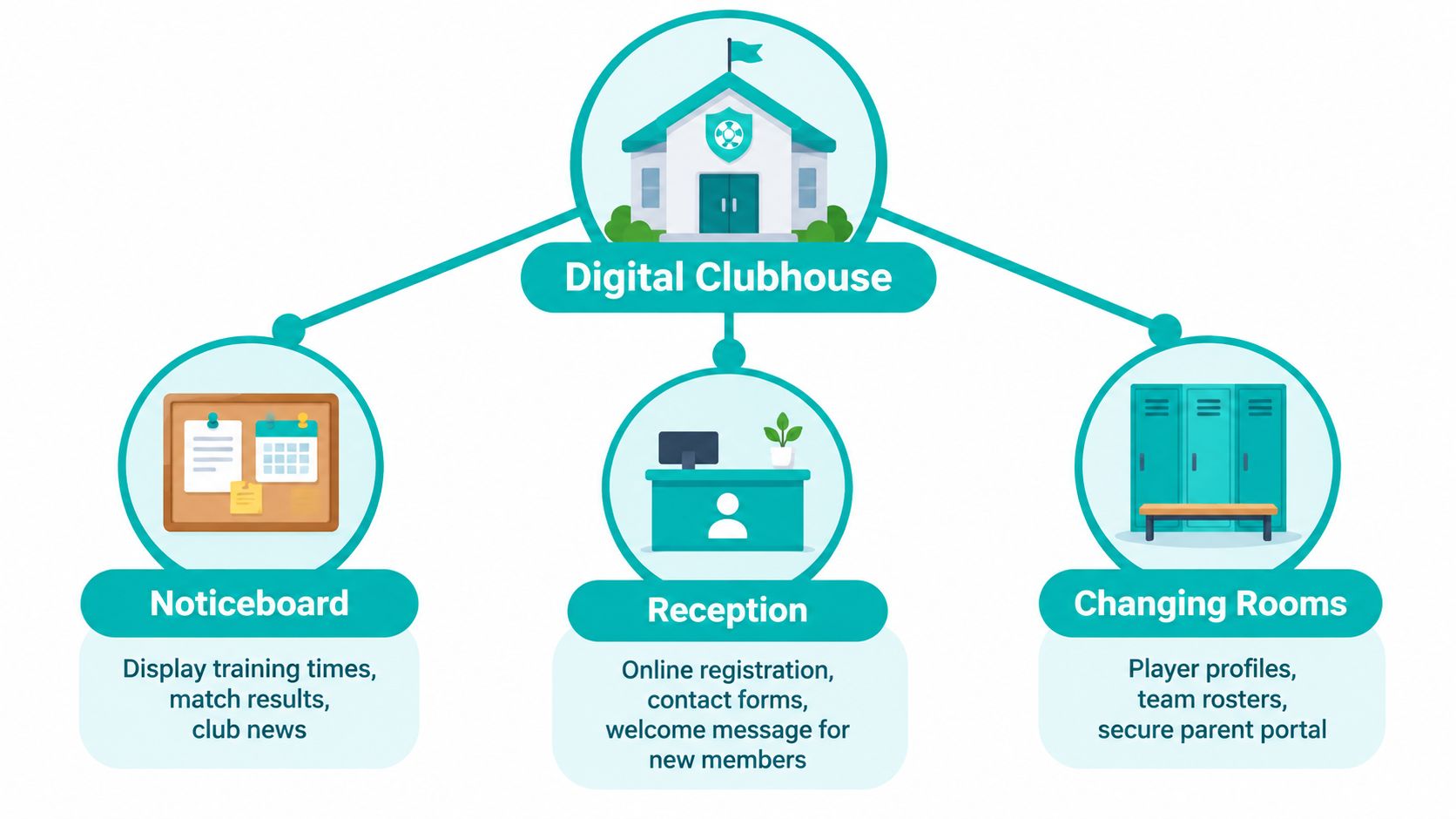
The noticeboard
This is the public part. New families should be able to find:
- Training times
- Fixture details
- Club news
- Location information
- How to join
The board in the entrance hall is something people glance at quickly. If it's cluttered or out of date, they stop trusting it.
The reception desk
This is where a website stops being passive. Reception handles action. That means:
- enquiry forms
- registration
- volunteer contact points
- payment links
- first steps for new members
When reception works, the club feels organised before anyone even steps onto the pitch.
The changing rooms and member-only spaces
Private club life happens. Parents may need a secure portal for child details, attendance, payment history, and team messages. Coaches may need team lists and availability. Players may need age-appropriate updates, goals, or progress markers.
That shift from public website to connected operations hub is the big difference.
Practical rule: If your website only talks at families, it's a brochure. If it helps families do things, it's a working club tool.
The wider sports world is moving in that direction. UK industry evidence noted adults' annual club membership costs average £203 and children's average £105 in England and Wales, and recent reporting also said participation remains strong, with health-and-fitness club visits up 10% and 18% of the population now members, according to Sport and Recreation Alliance reporting on club participation and costs. When money, schedules, and communication are regular parts of family life, convenience stops being a bonus.
That's also why design inspiration can be useful when it serves a practical purpose. If you want examples of how sports presentation is evolving visually, these AI-driven sports gear design examples from FLYP LTD show how branding and identity can feel fresh without losing clarity.
Planning Your Sport Club Website for Players Parents and Coaches
A lot of clubs start with the homepage. That's understandable, but it often leads to the wrong result. The page looks nice, yet parents still can't find fees, players don't know where session updates appear, and coaches are still managing everything from a spreadsheet and three chat threads.
Better planning starts with people, not pages.
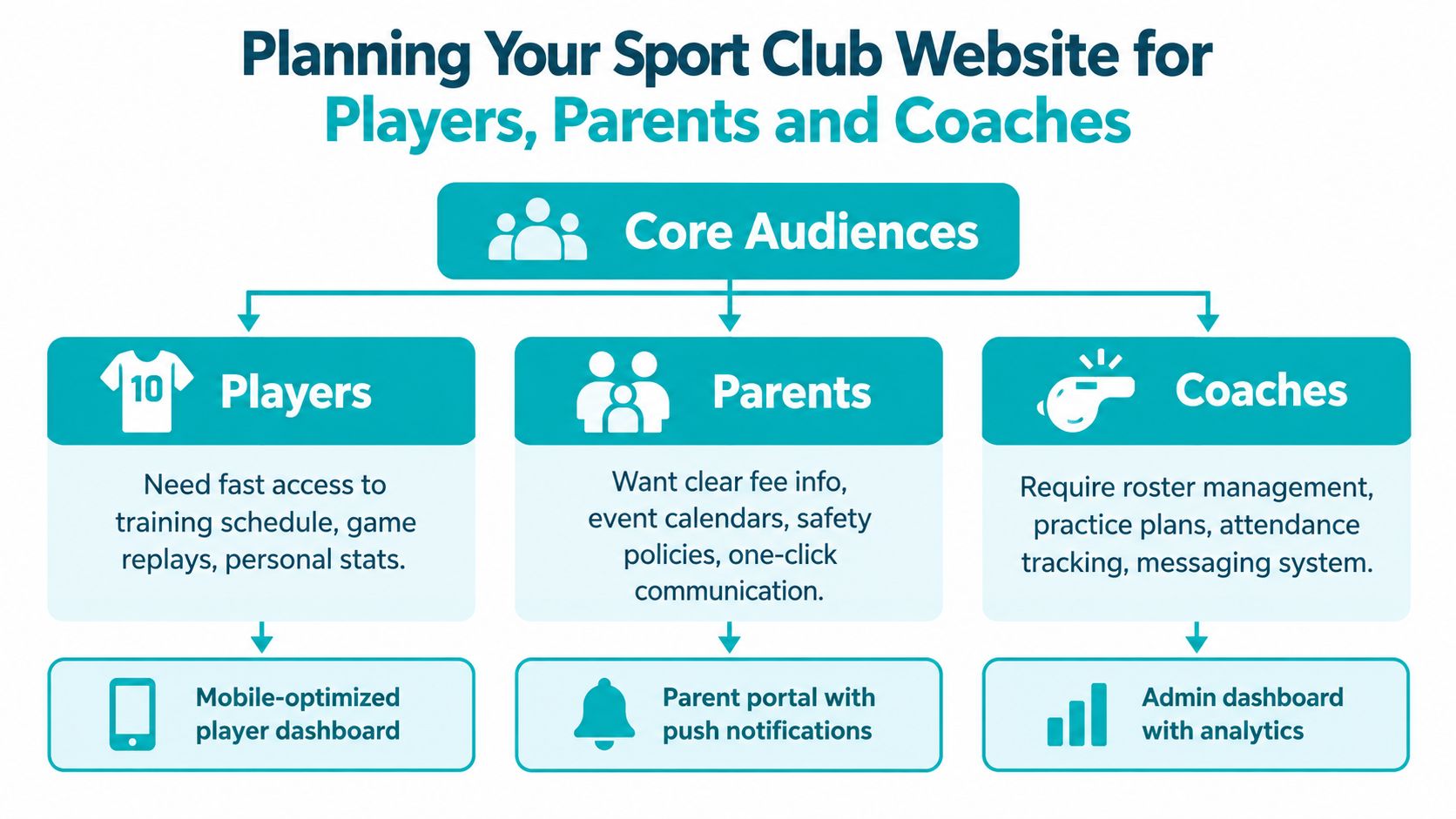
Three audiences, three different jobs
A player usually wants speed. They want to know when training starts, whether a match time changed, and what they're working toward. If they're older, they may also care about progress, availability, and team updates on mobile.
A parent usually wants reassurance. They're asking practical questions. Where is the session? What do we owe? Who do I contact? What does the club do with my child's information? Where is the safeguarding policy?
A coach wants fewer repeated tasks. They need attendance, communication, schedules, and a reliable way to keep everyone aligned.
Here's a useful comparison:
- Brochure-style site: looks polished, says who you are, offers a contact page.
- Operations hub: helps families register, pay, check updates, read policies, and respond in one place.
The second model serves youth sport far better.
Plan the journeys before the design
Before you choose WordPress, Squarespace, a club app, or a custom platform, write down the top journeys each audience needs to complete.
For example:
A new parent joins the club
They need welcome info, fees, age-group details, safeguarding contacts, and a simple sign-up path.A current family checks this week's plan
They need the calendar, venue details, cancellations, and kit notes fast on a phone.A coach needs responses
They need availability, attendance, and direct communication without sending multiple reminders.
A connected system can support these journeys better than separate tools. If you're comparing options, this guide to sports club membership software is a useful place to frame what member management should include.
The short video below gives another way to think about organising club systems around real users rather than isolated pages.
Don't hide trust information
For youth clubs, one of the most overlooked planning tasks is trust content. Independent UK guidance for grassroots football says clubs must publish a privacy notice, get parental consent, secure children's data, define retention periods, and respond to subject access requests within one month, according to this youth football GDPR guide. Parents often care about that more than another gallery image.
If a parent has to ask where your privacy notice or safeguarding contact is, the website isn't doing its job yet.
Essential Features Every Sport Club Website Needs
Families don't experience your website in the order you built it. They experience it in the order life happens. That's the best way to choose features too.
A parent usually starts by discovering the club, then checking the calendar, then registering, then paying, then receiving updates, then going back later to confirm what's changed. Build for that flow and your site becomes easier to use.
Start with the essentials families reach for first
The homepage should quickly answer three things: who the club is, where to find schedules, and how to join. After that, the next features should reduce repeat admin.
Focus on these core functions:
- Fixtures and training schedules: keep times, venues, and cancellations easy to scan on mobile.
- Registration forms: collect only what you need, and make forms easy to complete.
- Membership and fee handling: let families understand what's due and what's already paid.
- Attendance and RSVPs: save coaches from chasing replies manually.
- Targeted communication: send updates to the right team or age group, not everyone.
- Safeguarding and privacy pages: make policies visible and readable.
If you're comparing tools, one option in this space is Vanta Sports' club app approach, which connects schedules, RSVPs, attendance, communication, and fee management across coaches, guardians, and players.
Payment visibility matters more than many clubs think
Fees are part of family planning. They affect whether children can attend regularly, whether parents know what to budget for, and whether treasurers spend Sundays chasing overdue payments.
In England, a 2023 study found the median cost of community club sessions was £6.67 per session, compared with £3.88 for school-based clubs. The same research found 52% of school-based clubs were free to parents and 34% were partly or wholly subsidised, according to the International Journal of Behavioral Nutrition and Physical Activity study on youth sport cost settings. That gap helps explain why clubs should present costs clearly and handle payments cleanly.
Accessibility and forms aren't side issues
Many clubs make forms, downloads, and fixture pages harder than they need to be. UK Sport's accessibility statement says its website is only partially compliant with WCAG 2.1 AA, with problems including missing image alt text, forms that are hard to complete using only a keyboard, and older PDFs with title issues, as shown in UK Sport's accessibility statement. For youth clubs, that's a reminder to treat accessibility as basic groundwork.
A form that confuses one parent at 10 pm becomes three follow-up messages for a volunteer at 7 am.
Must Have Versus Nice to Have Features by Club Size
| Feature | Small Single Team | Large Multi Team | Why It Matters for Families |
|---|---|---|---|
| Training and fixture calendar | Must have | Must have | Families need one trusted place to check times and changes |
| Online registration form | Must have | Must have | Reduces paper forms and missing details |
| Payment tracking | Must have | Must have | Parents want to see what's paid, what's due, and what's next |
| Team-specific messaging | Nice to have | Must have | Stops irrelevant messages and reduces confusion |
| Attendance and RSVP tools | Nice to have | Must have | Helps coaches plan and helps parents respond quickly |
| Safeguarding and privacy pages | Must have | Must have | Builds trust and supports compliant operations |
| Staff and coach profiles | Nice to have | Nice to have | Reassures new families and adds a human face |
| Member portal | Nice to have | Must have | Useful when several teams, siblings, and payment records need managing |
For clubs mapping content and navigation, these web architecture insights from SemDash from SemDash are helpful because they show how page structure affects whether people can complete simple tasks without hunting around.
Design Templates and User Experience That Keep Families Coming Back
Good design for a sport club website isn't about looking flashy. It's about making the next click obvious.
Parents often visit on a phone, in a hurry, near a pitch, outside a school gate, or between work and pickup. In that moment, your website should feel like clear signposts in a sports centre. No one wants a maze. They want “Fixtures”, “Join”, “Payments”, “Policies”, and “Contact”.
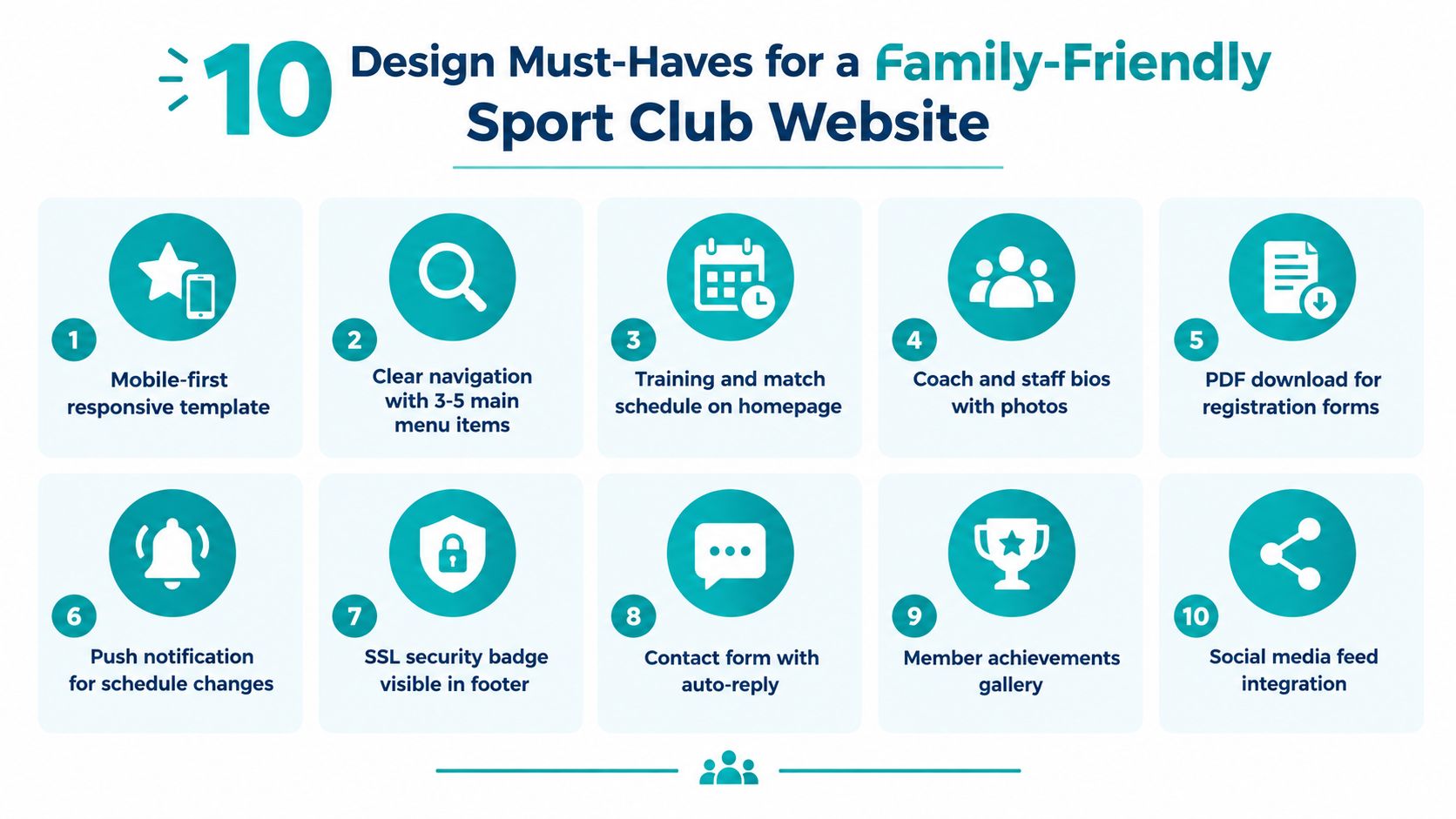
Choose templates that support action
A template should make practical tasks easy. Check whether it offers:
- Clear mobile navigation: parents should reach key pages in one or two taps.
- Readable text: avoid tiny fonts and low-contrast colour choices.
- Prominent action buttons: “Join”, “Pay fees”, and “View schedule” should stand out.
- Flexible content blocks: you'll want room for calendars, policy links, contacts, and team updates.
A beautiful template that hides essentials behind clever effects often creates more admin, not less.
Mobile speed affects real club moments
Independent UK sports benchmarking has shown how wide the mobile performance gap can be across club sites. One English football-club report found mobile site speed ranging from 36 down to 6, while another Premier League benchmark recorded pages as low as 8 to 11 on mobile, according to ClickThrough Marketing's football club benchmark report. The lesson is simple. Heavy images, extra scripts, and unoptimised media can get in the way when families most need fast access.
That's why these habits matter:
- Compress images before uploading match photos.
- Defer non-essential scripts so pages load the important bits first.
- Keep page layouts lean on schedule and registration pages.
- Check forms on real phones rather than only on a desktop monitor.
Match-day principle: the fastest page often wins trust before the prettiest page does.
Accessibility is part of hospitality
Accessibility can sound technical, but at club level it's really about welcome. If a parent can't use the form with a keyboard, if an image has no useful label, or if a PDF opens without structure, the club has made the journey harder than it needs to be.
A few practical checks go a long way:
- Use descriptive labels on buttons and forms.
- Write alt text for images that carry information.
- Avoid burying key forms in old PDFs when a web form would work better.
- Test the site in sunlight on a phone, because that's where many parents will use it.
Integrations SEO and Keeping Your Sport Club Website Healthy
A website works best when it isn't trying to be a lonely island. Most club stress comes from fragmentation. Payments sit in one place. attendance in another. Team updates in group chats. Policies in a folder no one can find quickly.
The healthier approach is to connect the parts that families and volunteers use every week.
Build one rhythm for operations
Your website should link smoothly with the tools behind the scenes:
- Membership records so details stay current
- Payment systems such as Stripe so fees don't rely on manual chasing
- Scheduling tools so fixtures and training updates stay accurate
- Messaging systems so coaches can reach the right group
- Document storage for policies, forms, and notices
If payment workflows are a priority, this overview of automated payment processing for sports clubs shows how clubs can reduce manual reminders and give families a clearer view of what's due.
Local search still matters
Even the smartest member portal won't help new families if they can't find the club. Local SEO for a sport club website is usually straightforward:
- Use your town, area, and sport clearly on the homepage and contact page.
- Keep venue details consistent across the site.
- Create separate pages for key programmes such as age groups or holiday sessions.
- Update fixtures, news, or notices regularly so the site doesn't look abandoned.
For volunteer-led clubs, maintenance is where good intentions often fade. A simple website care routine helps. Some clubs use an external support model such as a proactive website servicing package from UpTime Web Hosting as a reference point for the kind of ongoing checks that keep updates, backups, and small fixes from piling up.
Trust and compliance need a home
For under-18 sport, privacy and safeguarding can't sit in the background. Parliament's Commons Library notes that, as a condition of Sport England and UK Sport funding, National Governing Bodies must have appropriate safeguarding policies and procedures and meet NSPCC Child Protection in Sport Unit standards, as outlined on the NSPCC parents in sport safeguarding page.
At academy level, rules can become even more specific. EFL youth development rules for the 2025 season add clear requirements, including that each club must appoint an Academy safeguarding officer, and clubs aren't permitted to make payments of any kind to a child attending a Development Centre or to a parent, with further restrictions on payments to academy players or parents without prior league consent, as noted in this academy operations summary.
That level of detail shows why your website should clearly house policies, contacts, consent information, and retention guidance. Families shouldn't have to guess where trust lives.
Bringing Your Sport Club Website to Life
A strong sport club website doesn't need to be perfect on day one. It needs to be useful, clear, and welcoming.
If you're a coach or volunteer, think like you do at training. You don't start with the most complex drill. You start with the fundamentals, repeat what matters, and build confidence week by week. Your website can grow the same way.
Start with a short checklist for this week:
- Pick the five questions your club answers most often
- Create or clean up the pages that answer them
- Make payments, schedules, and contact routes easy to find
- Add safeguarding and privacy information where parents expect it
- Test the site on a phone with one coach and one parent
- Remove anything outdated that creates doubt
If the result is fewer repeated messages, smoother fee handling, and calmer match-day mornings, the website is doing real work.
Young players notice when a club feels organised. Parents feel it too. Trust grows when communication is steady, expectations are clear, and nobody has to chase basic information across four platforms. That kind of digital order creates more room for the part everyone cares about most. Helping children play, improve, and enjoy the sport.
Vanta Sports gives clubs one connected system for schedules, payments, RSVPs, communication, attendance, and player development, so families and staff don't have to juggle scattered tools. If you want your website to work like a real operations hub rather than a static brochure, visit Vanta Sports and see how a unified platform can support coaches, guardians, players, and administrators together.
Tags