Youth Development
Sports Analytics Software for Youth Clubs: A Guide
Discover how sports analytics software helps youth clubs track performance, attendance, and development. A practical guide for coaches, admins, and parents.

A wet pitch, an early start and a phone that won't stop buzzing. A volunteer coach checks names on a paper register, saves a team sheet to a camera roll and messages parents about late arrivals, while someone else keeps the fixture details in a spreadsheet. By lunchtime, the club has already created useful information, but it sits in several places and takes time to piece together.
That's the everyday challenge for UK youth clubs. Sports analytics software doesn't need to mean elite GPS systems, complex models or another administrative burden. It can mean capturing the attendance, development notes, match observations and participation records a club already creates, then making them useful to coaches, administrators, guardians and players. The result is a smoother season, clearer conversations and more time for the human work that helps young people enjoy sport.
A Saturday Morning That Already Runs on Data
At 9am, the coach's paper register shows who has arrived. The session plan records which drills the group will practise. A quick note might mention that one player is returning after illness, another needs encouragement with a new skill and a third has forgotten their boots again. None of these actions feels like analytics, because they are part of running a session.
The same happens on matchday. A team sheet is shared on a phone, goals and substitutions are scribbled in a notebook, and a parent sends a message explaining why a player will miss the next fixture. The club may also hold registration information, payment records, safeguarding notes and historic results, but each record often lives in a different place.
A useful starting point: analytics is not about collecting information for its own sake. It's about making the information you already collect easier to find and act on.
The UK sports analytics sector grew from the professionalisation of performance analysis. A University of Leeds review of analytics, technology and high-performance sport identifies the 1970s video recorder as a foundational milestone, because pause, rewind and fast-forward made performance information easier to collect from invasion-territorial sports. During the 1990s, digital technology and lower-cost computing accelerated analysis, and Opta, Prozone and Amisco were available in UK football by the late 1990s.
Grassroots clubs don't need to copy professional infrastructure. They need a practical way to record information once and reuse it well. When volunteer hours are limited, a connected system can reduce duplicate entry while giving parents a clearer view of participation and giving coaches a better basis for supportive decisions. A familiar Saturday morning can become the beginning of a more informed season, without turning volunteers into data administrators.
What Sports Analytics Software Really Means
Think of a coach's notebook. It might contain a list of players, attendance ticks, a few observations about passing or positioning, and a reminder to speak with a parent. The notebook works because it connects information to people and decisions. Sports analytics software is the same idea with a shared structure, easier searching and clearer reporting across the club.
A notebook usually serves one coach or one team. A digital platform can connect age groups, sessions, fixtures and player profiles, so a club can spot patterns that would be difficult to see in separate folders. It can also give each person an appropriate view. A coach may need squad information, a guardian may need their child's updates, and an administrator may need attendance or payment information across several teams.
Three practical functions
Performance tracking records match contributions and coach observations. Depending on the sport, this could include goals, assists, game-time exposure, completed drills or progress against a skill framework.
Attendance monitoring shows who attends sessions and fixtures, when participation changes and whether a player may need a conversation with a coach or family. Attendance isn't a judgement on commitment. It's context.
Progress reporting brings notes, milestones and assessments together so a coach can explain development in plain language. A young player might be improving their decision-making even if they aren't scoring regularly, and a useful report should make that progress visible.
Modern software can go beyond a spreadsheet by linking these records. A missed training pattern may help explain reduced match exposure. A development note may suggest which drill to revisit. A participation view may show whether opportunities are being shared fairly across a squad.
This isn't about replacing judgement with a score. The University of Leeds source defines sports analytics as quantitative performance-data analysis that supports coaching decisions. For a youth club, the important words are supports coaching decisions. The software should make good questions easier to answer, not pretend that a developing child can be reduced to a ranking.
The Metrics That Matter for Young Players
A meaningful youth-sport report starts with several kinds of information rather than one headline number. Attendance, development, performance and participation each answer a different question, and coaches need to read them together.
Attendance provides context
Attendance can show a player's training pattern across a season. A change might reflect family circumstances, school commitments, transport problems, confidence, illness or a competing activity. The number alone can't explain the reason, but it can prompt a respectful conversation before a player becomes disengaged.
Attendance also helps parents understand participation over time. For administrators, it can reveal whether a session time is creating a practical barrier for families. Used carefully, it becomes a support tool rather than a mechanism for blaming children.
Development follows the journey
Development records should focus on age-appropriate skills and coach observations. A coach might note that a player is becoming more confident receiving under pressure, communicating with teammates or making a decision after winning possession. These observations are more useful than forcing every part of development into a raw score.
A milestone view can help coaches plan the next challenge. It can also help a parent see progress that isn't obvious in a match result. Young players develop unevenly, so a snapshot should never be mistaken for a final verdict.
Performance describes match contribution
Performance data might include goals, assists, defensive actions, game-time exposure or successful completion of a sport-specific task. It helps coaches review what happened in competition, but it must be read alongside position, opposition, role and team context.
The Vanta Sports guide to player statistics can help clubs think about how individual records become more useful when they're connected to the wider player profile. A goal may be important, but so may be the run that created space or the recovery action that prevented an attack.
Participation tests inclusion
Participation measures who gets meaningful opportunities. It can include minutes played, squad rotation and involvement across fixtures. A club that reviews participation can spot whether some players are regularly on the bench, missing opportunities or receiving less support to stay engaged.
For wider context, digna's KPI monitoring guide is a useful resource for thinking about how measures should connect to decisions rather than become a collection of attractive figures. In youth sport, the best report is rarely the one with the most metrics. It's the one that helps an adult make a fair, timely and encouraging choice for a young player.
Where the Data Comes From in a Modern Club
Grassroots clubs already generate information at many touchpoints. A registration form records essential details, a session planner captures the intended work, an attendance register shows who took part and matchday notes describe what happened in competition. Parent messages may explain absences, while payment and fixture records help administrators understand the practical side of participation.
The problem is fragmentation. A coach may enter attendance in an app, copy a result into a spreadsheet and send an update through a group chat. Another volunteer may retype the same information into a league document. Each task is small, but repeated tasks consume time and create opportunities for mistakes.
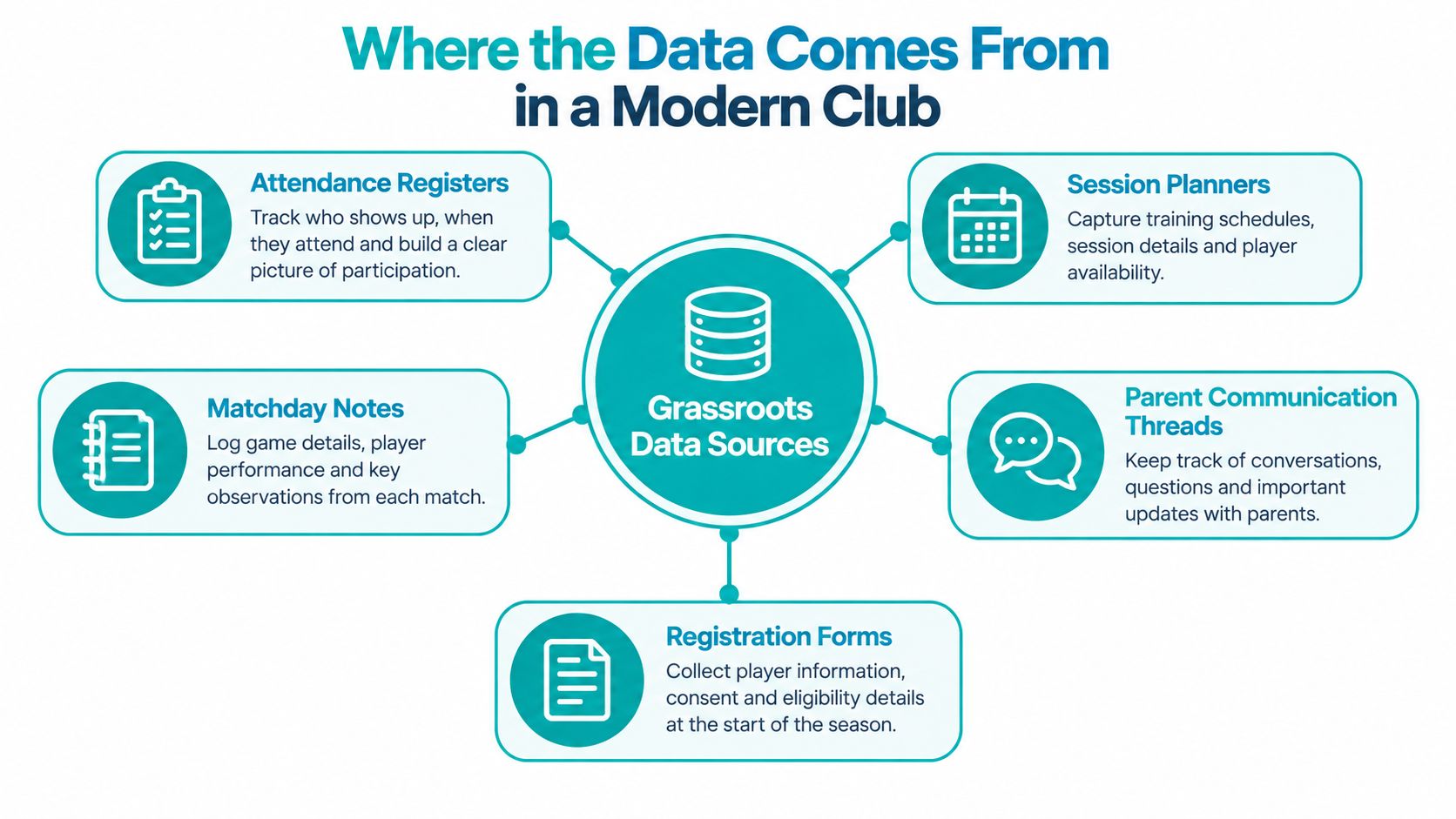
Connect the useful touchpoints
A connected platform can bring together:
- Session check-ins: Attendance is recorded close to the action, rather than reconstructed later.
- Fixture results: Match information can sit beside player and squad records.
- Training activity: Drill completion and session notes can inform development conversations.
- Parent communication: Relevant updates can reach families without relying on scattered message threads.
- Registration and safeguarding records: Important administrative information can be managed with appropriate permissions.
- Optional wearable information: Older age groups may use devices where there's a clear purpose, informed agreement and suitable oversight. Clubs exploring this topic can read about wearable technology for sports.
The aim isn't to capture everything. More information can create more responsibility without improving a coaching decision. The aim is to connect the records the club already needs, so a volunteer doesn't have to enter the same detail several times.
That consolidation gives coaches more time for demonstrations, feedback and pastoral support. Software can identify a pattern, but it can't notice that a child looks anxious before training or deliver encouragement at the right moment. Those remain the work of people.
How Smart Reports Shape Better Player Development
Good analytics changes what a coach does next. It doesn't need to produce a complicated prediction. It needs to show a useful pattern at the right time, explain the context and help someone choose a sensible action.
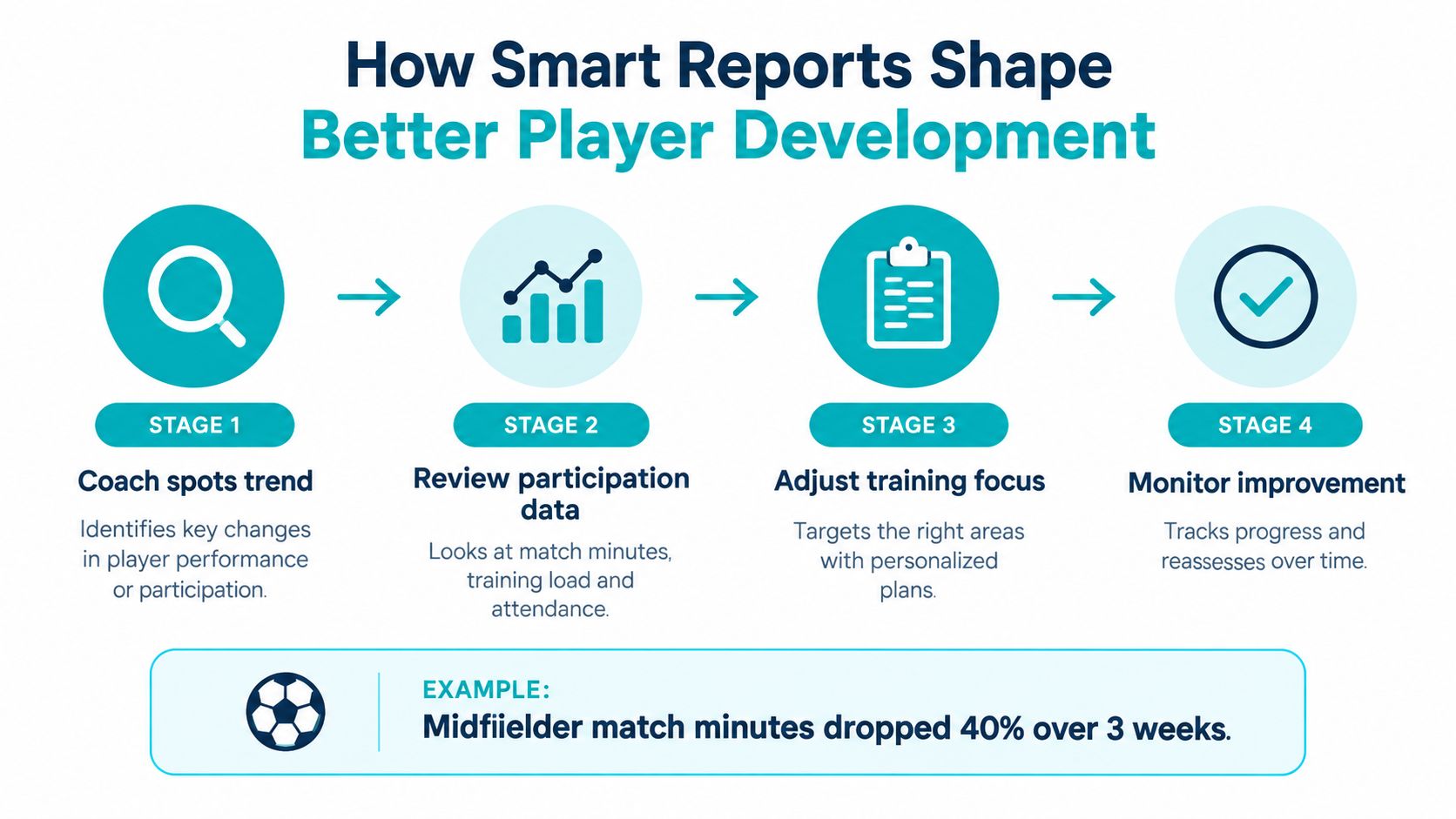
Consider a midfielder whose match minutes have fallen while missed training sessions have increased. A report shouldn't label the player as unreliable or recommend an automatic selection decision. It should prompt the coach to check the attendance context, speak with the family and ask the player how they're feeling. The outcome is a wellbeing conversation, followed by a plan that might support a gradual return to training.
An administrator may notice that an age group's fixtures often fall on Sundays, when several players have another sporting commitment. That insight can support earlier communication with families, better availability planning and a conversation with the league about future scheduling. The report improves coordination rather than treating non-attendance as a character flaw.
A development officer might compare set-piece training notes with match outcomes and notice that the team is creating opportunities but not converting them. The next weekly plan can give more attention to delivery, movement and finishing. The following review can ask whether players are applying the practice, not only whether the team scored.
Make the report fit the role
A head coach may need a squad-level view before selection. A team coach may need a player's recent attendance and development notes before planning a one-to-one activity. A parent may need a short progress update with clear next steps. A report becomes valuable when it answers one of these real questions without forcing the user to interpret a wall of raw data.
Work in other fields also shows why dashboards should be designed around decisions. Faberwork LLC's logistics analytics insights provide useful context on turning operational information into actions, a principle that applies equally to club administration and coaching.
The coaching test: if a report doesn't change a conversation, a session plan or a practical decision, it may be measuring the wrong thing.
A well-designed analytics dashboard should help users filter information by the role they hold and the question they're trying to answer. It should support judgement, not create false certainty. The best outcome is a young player receiving more relevant feedback, a fairer opportunity or earlier support.
Choosing Software That Respects Players and Volunteers
More data doesn't automatically create better development. For children, unnecessary collection can increase privacy, safeguarding and bias risks without improving a coaching decision. The Child Protection in Sport Unit's guidance on using AI responsibly in youth sport says platforms processing children's movement data or dates of birth must address UK GDPR, ICO guidance and the Children's Code.
That means a club should ask what information is necessary, who can access it, how accuracy and fairness are tested, whether human oversight exists and whether a supplier uses data to train or reuse future models. The guidance also recommends data-protection impact assessments, transparent communication with families and checks on storage, bias, training data and model reuse.
Ask practical questions before choosing
| Question to Ask | Why It Matters for a Youth Club |
|---|---|
| What data do you collect, and why? | The club should be able to explain necessity to families. |
| Who can see attendance, performance and welfare notes? | Role-based access protects children and limits accidental disclosure. |
| How long is information retained? | Clear retention rules prevent old records becoming an unmanaged risk. |
| Can the club export its records? | Export rights matter if a player leaves or the club changes supplier. |
| Where is information hosted, and how is it protected? | Administrators need clear answers about security and encryption. |
| Does the platform support audit trails? | A record of access and changes can support accountability. |
| Can coaches enter information quickly on a phone? | Volunteers shouldn't have to duplicate notes after a long session. |
| Does messaging reduce reliance on open group chats? | Safer communication should support safeguarding and clear boundaries. |
Clubs can also review tools for handling event media and participation records, such as EventUploader for sports clubs, while checking that any supplier fits their own safeguarding and data-protection requirements.
Ease of use matters as much as technical capability. If a coach can't record attendance beside the pitch, the data will be incomplete. If an administrator must copy every note into another system, the platform has shifted work rather than removed it. Families should be told what is recorded, why it matters and how they can raise concerns. Analytics works best when it's done with families, not to them, so trust grows alongside insight. Clubs can set out their approach in a clear privacy policy.
Meaningful Reports in Vanta Sports
A useful club platform starts with questions people already ask. Who is missing sessions? Is every player receiving opportunities? What should the next training session focus on? Which families need a clearer update? Vanta Sports brings attendance, session notes, skill assessments, match statistics, registrations, payments and engagement records into connected views that can be filtered by age group, team, player or activity type.
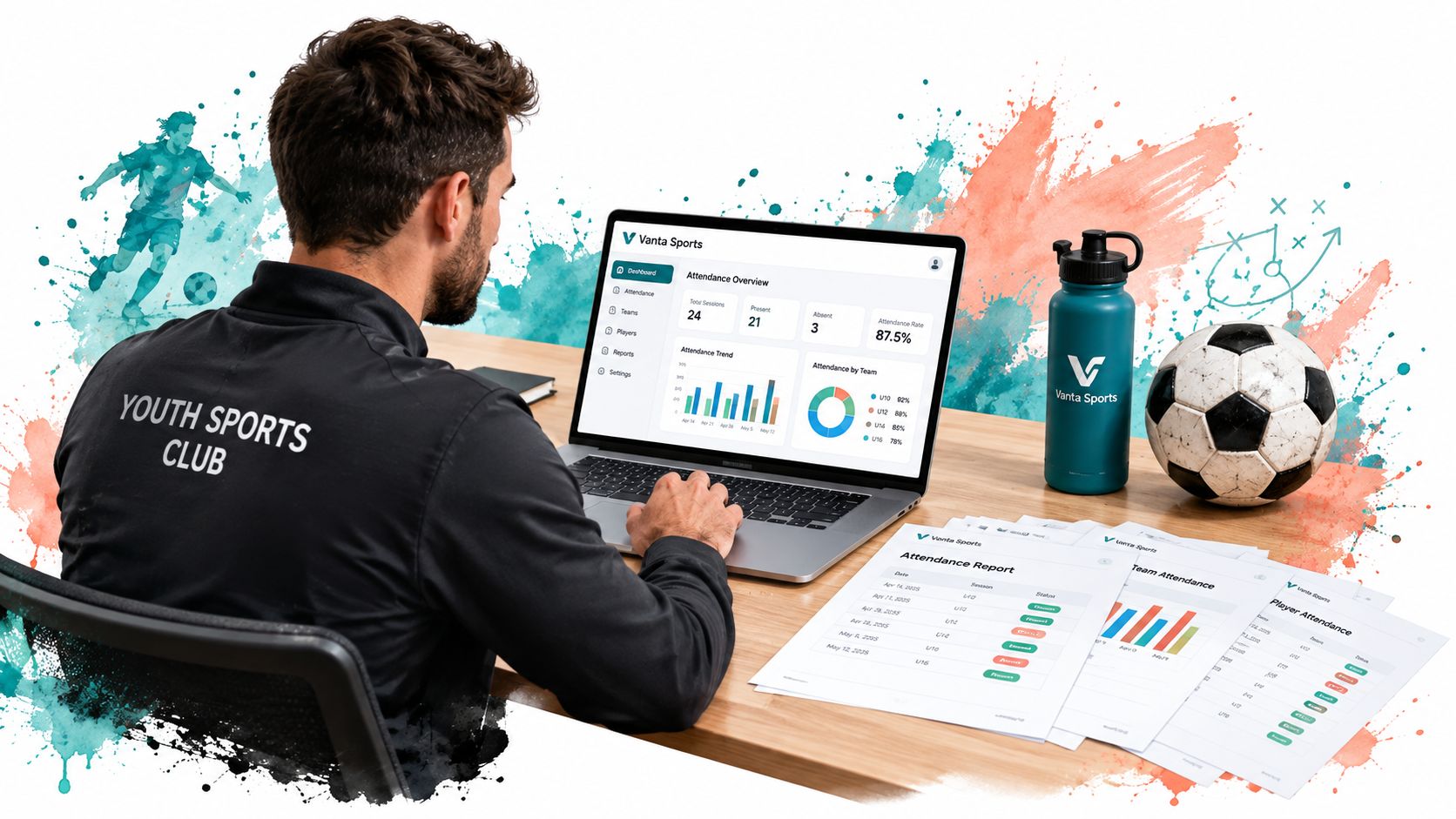
Start with the question behind the report
The Attendance Overview helps an administrator or welfare officer identify players whose attendance is slipping below the club's chosen session thresholds. That doesn't explain the cause, and it shouldn't trigger an automatic judgement. It gives an authorised adult a reason to check in, review communication and offer support.
The Participation Mix looks at active minutes alongside bench time and fixture involvement. A coach can use it when reviewing squad rotation and planning future opportunities. Parents may use a simpler view to understand their child's involvement without seeing information about other players.
The Player Development Snapshot combines coach ratings, session notes and milestone markers in one place. It can help a coach prepare for a progress conversation, while a guardian can see highlights and areas for continued practice. The language should stay encouraging and specific, such as improving first touch under pressure or becoming more confident communicating during play.
Give each role the right view
A head coach may open Squad Readiness before selection to review current attendance, recent participation and relevant development notes. A coach needs enough context to plan, not a ranking that makes the decision for them. A club administrator may focus on trends across teams, while a welfare officer may need attendance patterns connected to an appropriate safeguarding process.
Role-based access matters because useful information isn't automatically information for everyone. A parent should see their own child's highlights and concerns. A coach should see the squad they're responsible for. A welfare officer should see only the safeguarding-relevant records needed for their role.
These reports turn the four metric families into everyday actions. Attendance can inform a supportive conversation, participation can inform fair rotation, development notes can shape session planning and match performance can guide feedback. The point isn't to overwhelm volunteers with dashboards. It's to give each person a clear, proportionate answer to a question they already have.
Your First Steps Toward a Smarter Season
A club doesn't need a perfect data system before it begins. It needs a shared reason for using information and a process that volunteers can maintain during a busy season.
Start with a short conversation involving coaches and parent volunteers. Ask one question: what do we most want to understand earlier? The answer might be declining attendance, uneven playing opportunities, inconsistent progress notes or the reasons families struggle to attend. Choosing one real problem keeps the project useful.
Next, choose one metric to track first. Attendance is often a practical starting point because coaches already record it. Session ratings, participation or a small set of development markers may suit another club better. Agree what the metric means, who records it and what action might follow. A simple definition prevents different teams from entering inconsistent information.
Build a small review habit
Schedule a fifteen-minute review at the halfway point of the season. Look for one pattern, ask whether it reflects reality and decide whether anything should change. If the data is incomplete, fix the process rather than pretending the result is precise.
The first cycle is a learning opportunity. Coaches may discover that a rating scale is too complicated, parents may ask for clearer explanations and administrators may find that one report saves more time than expected. Those lessons can guide what the club measures next.
England's activity picture shows why this practical approach matters. Sport England reported that 49.1% of children aged 5 to 16 met the UK Chief Medical Officers' guideline of an average of at least 60 minutes of sport or physical activity each day during the 2024–25 academic year, while 28.4% averaged fewer than 30 minutes according to Sport England. The same source reported that 52% of boys met the guideline compared with 46% of girls, so participation information can help clubs notice engagement gaps and design more welcoming sessions.
A Youth Sport Trust survey of 1,002 young people aged 5 to 16, conducted from 12 to 26 March 2025, found that 75% believed children aged 5 to 18 should receive at least 60 minutes of physical activity every day. Yet 58% said they had attended a before- or after-school physical activity club during the previous six months, and 23% had done neither that nor represented their school at a sporting event or festival. Participation tracking can help clubs identify when players are drifting away and offer encouragement earlier.
Start with one conversation, one metric and one review. Vanta Sports offers connected tools for club administration, coaching, guardian communication, attendance, development and reporting, so UK youth clubs can build insight gradually while keeping player experience at the centre.
Use Vanta Sports to connect attendance, session notes, match statistics, development updates and family communication in one club system. Begin with the question your volunteers most need to answer, then use connected reports to turn everyday information into better support for young players.
Tags