Youth Development
Sports Schedule Creator: Build Better Seasons
Learn how to use a sports schedule creator to build organised seasons for your youth sports team. Practical tips, common pitfalls, and tools

Saturday morning arrives with a wet forecast, three parents asking whether the match is still on, and a coach discovering that another team has been allocated the same pitch. The fixture list looked tidy when it was created. On the ground, it has become a chain of hurried messages, missed updates, and disappointed players.
A sports schedule creator should solve more than the calendar. It should help your club protect player enjoyment, give parents reliable information, and leave coaches free to coach. The strongest schedules account for fixed league rules, shared venues, weather, travel, attendance, payments, and safeguarding. They also give people a clear way to respond when plans change.
The Heartbeat of Your Club
A youth club's schedule shapes the experience before anyone reaches the pitch. When the information is accurate, families know where to go, players arrive prepared, and coaches can focus on warm-ups, tactics, and encouragement. When it breaks down, the problem reaches everyone quickly.
A parent might miss a fixture change buried in an email thread. A coach could arrive at a venue already occupied by another team. Players wait, parents rearrange work and transport, and volunteers spend the afternoon apologising instead of supporting the children. Shared facilities and sudden weather changes make clear updates even more important.
Trust grows through small promises. If the club gives a start time, families must be able to rely on it. If rain, an unavailable venue, or another club change forces a revision, people need the update through a channel they already use.

A schedule serves people first
A useful schedule helps each group make practical decisions, rather than just filling empty calendar spaces.
- Players can prepare when training and fixtures follow a predictable rhythm.
- Parents and guardians can organise transport, work, school commitments, kit, and payments without chasing several people.
- Coaches can plan sessions around confirmed attendance and venue access.
- Club administrators can identify clashes, postponements, and missing responses before they disrupt match day.
The Football Association's Full-Time platform shows how scheduling connects with wider club administration. Its features include fixture creation, results, player statistics, referee marks, postponements, cancellations, and availability for training and matches. The FA Full-Time features offer a useful reference for the functions clubs may need together.
Practical rule: If one fixture change requires updates in several separate systems, someone will eventually receive the wrong information.
A shared club platform gives the right people access to current plans. A dedicated sports club app can place fixtures, messages, attendance, and responses in one location, reducing the number of channels parents and coaches must monitor. The same administrative issue appears in other sports, including swim clubs, where staffing solutions for swim clubs often need to account for rotas, availability, and member communication.
The practical test is simple. On Saturday morning, can the club confirm the plan without checking several inboxes and group chats? A trusted schedule gives players a calmer experience, shows parents that their time is respected, and gives coaches more attention for the children in front of them.
Planning Your Season Before the First Session
The most common scheduling mistake is opening a calendar before gathering the information that controls it. A drag-and-drop tool can't rescue a season built on incomplete venue details, misunderstood league rules, or unavailable volunteers.
Begin with the competition framework. Record the dates your league has fixed, the age bands involved, permitted playing days, rest expectations, and any rules around home and away fixtures. The Lawn Tennis Association's 2026 youth league calendar illustrates the level of precision involved, with fixed match dates across 8U to 18U and explicit rain dates. A useful scheduler must enforce these boundaries, not merely display them.
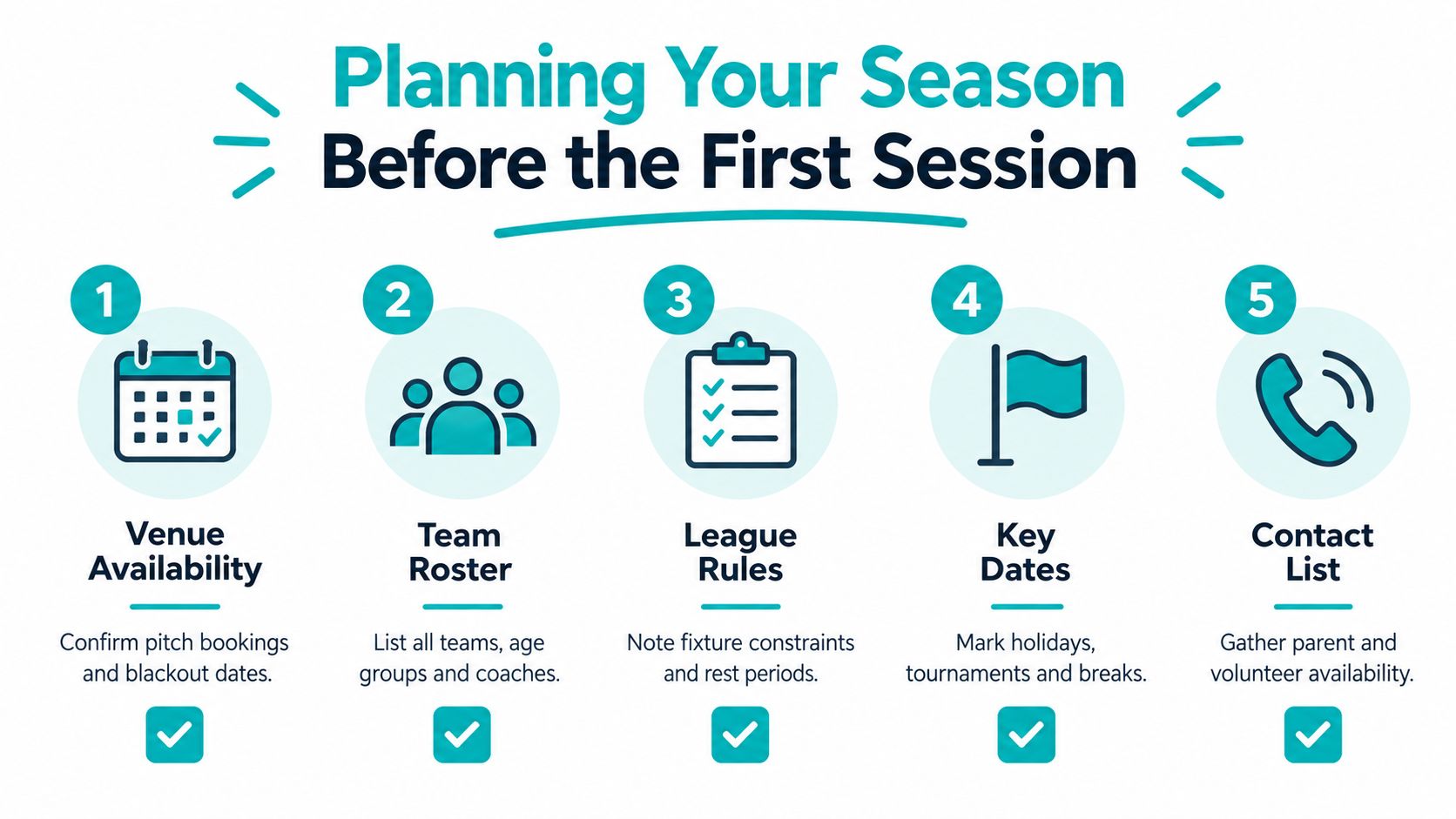
Gather the five inputs that shape the calendar
Venue availability
List every pitch, court, pool, hall, or training space, then mark confirmed bookings, blackout dates, shared use, lighting limits, and access restrictions. Ask the venue manager which dates are secure. A verbal assumption isn't a booking.Team roster
Record each team, age group, coach, assistant, home venue, and competition. Include squads that share players or staff, because a calendar can look workable until one coach is expected in two places at once.League rules
Note fixture windows, age-band requirements, rest periods, rain procedures, and deadlines for confirming changes. Treat these as constraints, not suggestions.Key dates
Add school holidays, club breaks, tournaments, community events, exams, and planned fundraising activities. These dates influence availability even when they aren't part of the league programme.Contact list
Gather parent, guardian, coach, referee, volunteer, and venue contacts. Record who needs notifications, who can provide transport, and who can help when a fixture is moved.
Build around real family life
A schedule can be technically valid and still be unrealistic for families. Check whether parents can regularly support early starts, longer journeys, midweek sessions, or changes made at short notice. Give them a clear way to communicate availability before dates are final.
A 2025 Youth Sport Trust survey found that 91 to 92 per cent of UK parents say sport and play are important to children's education and development, while clubs still face fragmented communication around sessions, attendance, and payments. The Youth Sport Trust parent survey underlines the responsibility clubs have to make participation workable, not merely desirable.
Keep the collected information in one shared record before generating fixtures. A sports team schedule template can help organise teams, venues, rules, dates, and contacts so the scheduler receives clean inputs. That preparation takes effort at the beginning, but it prevents the far more expensive work of correcting a calendar after families have planned around it.
Building Your First Schedule from Scratch
A Saturday fixture can look fine on screen, then fall apart when one parent is working, the venue is shared, and rain closes the pitch. Build the calendar in a fixed order so those human constraints are visible before families make plans.
Start with an existing league fixture file when one is available. Import it, check the data, and adjust the details that affect your club. If you are creating the season from the ground up, begin with the teams. Record each age group, competition, coach, home venue, and shared-player relationship. Add skill level only when it changes a scheduling decision.
Facilities need the same level of care. A venue can suit one age group but not another, or be available only during certain hours. Enter each time slot separately, and label confirmed bookings clearly so provisional options do not look like commitments.

A practical creation sequence
Use this order for the first draft:
- Load competition requirements: Enter the fixtures that must take place, with permitted dates and locations.
- Assign venues: Match home teams with confirmed facilities and record alternatives for shared grounds.
- Add people constraints: Check coaches, referees, and shared players for overlapping commitments.
- Generate a draft: Let the tool place the initial calendar instead of entering every event by hand.
- Inspect the result: Review travel, home-and-away balance, rest, and the experience for families.
- Publish only after approval: Give coaches and administrators time to review before parents receive the final version.
A scheduling system works best when the club treats its output as a draft, not a verdict. Check whether a coach is expected at two places, whether a parent has enough notice to arrange transport, and whether a shared venue has been confirmed. A team scheduling app can keep the working calendar accessible after publication, which helps the club maintain the same operational rhythm when details change.
The underlying task is a constrained planning problem. UK football scheduling research describes a two-phase optimisation process, first reducing travel and then assigning playing dates while enforcing clash and location constraints. The paper also discusses 2,036 fixtures each season for the top four English divisions, showing why structured planning matters even when a youth club runs a smaller programme. The scheduling research paper gives administrators useful context for the decisions behind automated fixture creation.
Judge the schedule like a coach
Do not approve a calendar solely because the software reports no hard conflicts. Read it as a family would.
Look for repeated long journeys, awkward runs of home fixtures, short recovery periods, and matches that depend on the same volunteers handling several jobs. A calendar can be valid while leaving one team exhausted and another well supported. Ask coaches whether players have enough time to train, travel, eat, recover, and return to school routines.
The review process resembles a content calendar for marketers: collect dependencies first, assign dates carefully, then keep checking the live plan as circumstances change. For a club, that means combining the fixture list with clear parent communication, venue updates, and decisions that respect the people carrying out each match.
When Schedules Collide and Conflict
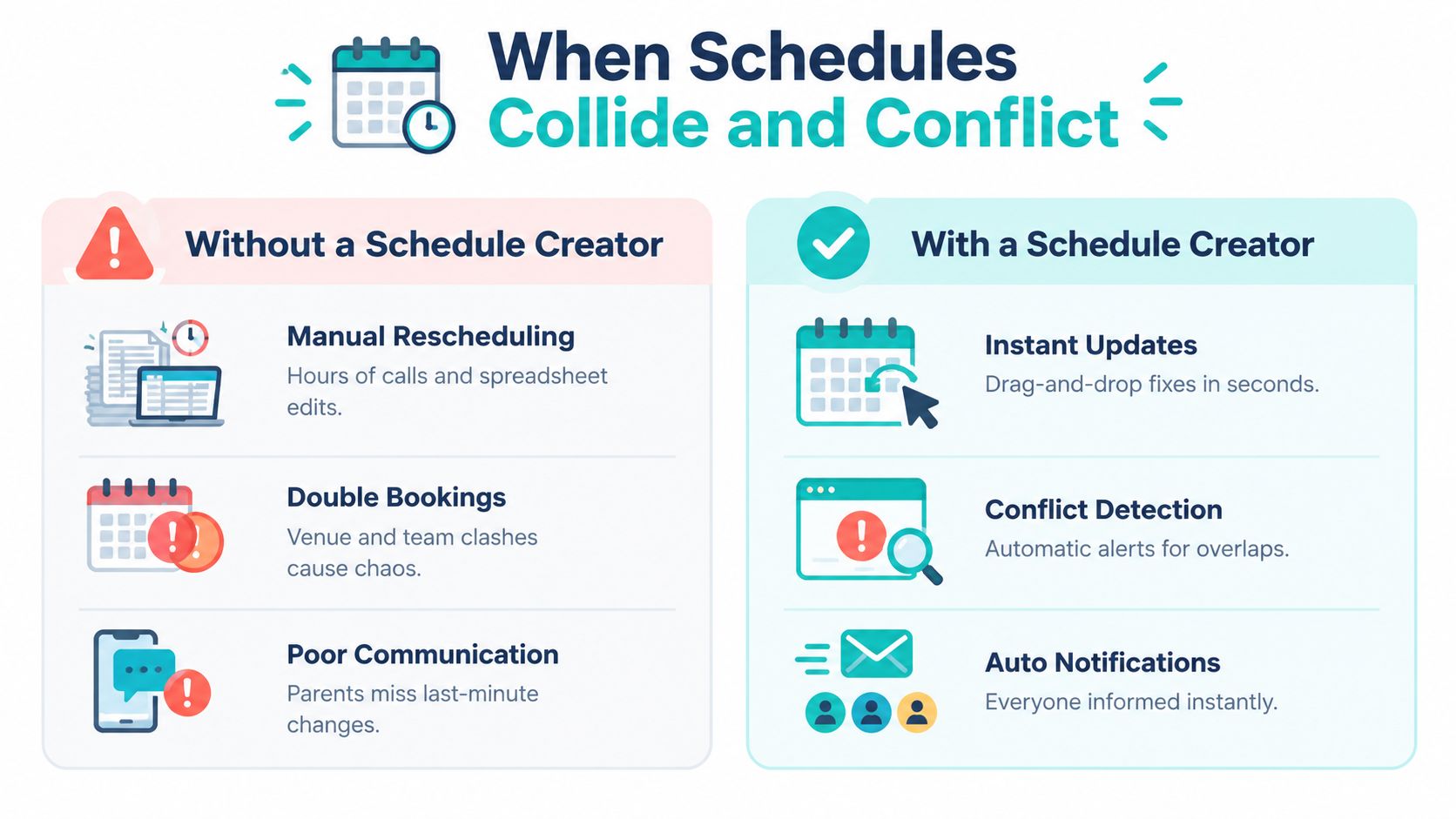
Disruption isn't a sign that the original schedule was useless. Rain, venue closures, team withdrawals, unavailable officials, and television-driven congestion can affect even a carefully checked calendar. The difference between a resilient club and a frantic one is whether the system already has a process for exceptions.
Weather deserves attention from the start. A league calendar that contains no rain dates leaves administrators trying to negotiate replacement fixtures while families are waiting for answers. Add reserve dates, identify alternative venues, and decide who has authority to postpone a match before the first cancellation occurs.
Why timing affects participation
Scheduling choices influence whether people can attend. Analysis of more than 4,000 English Football League games found that midweek scheduling reduced Division One attendance by 6.4 per cent and Division Two attendance by 2.8 per cent, while back-to-back home games also depressed gate revenue. The findings are from adult professional football, so they shouldn't be copied directly onto youth sport, but they demonstrate a clear operational truth. Repeated inconvenient timings and congested fixtures can reduce participation. The attendance demand analysis provides the evidence.
For a youth club, the equivalent problem may appear as late RSVPs, missing players, tired children, or parents deciding that a poorly communicated session is too difficult to manage. The schedule must respect the life around the sport.
Make exceptions routine
When a fixture changes, follow a repeatable sequence:
- Confirm the reason: Establish whether the issue is weather, venue access, opposition availability, or an administrative error.
- Check alternatives: Use the reserved date or approved venue rather than improvising a new arrangement.
- Run the conflict check: Confirm that the replacement doesn't clash with another team, coach, official, or shared facility.
- Update the central calendar: Change the source record first, then distribute the revised information.
- Ask for attendance responses: Give parents and guardians a clear way to confirm whether the new time works.
- Close the loop: Record the decision, notify the opposition, and remove the obsolete event from views and reminders.
A calendar synchronisation guide can help clubs think through how changes should flow across connected calendars. The important point is not the visual design of the calendar. It's that every person receives the same current version.
A changed fixture becomes manageable when the club treats communication as part of the rescheduling task, not as an afterthought.
Keep safeguarding in the same operational picture. UK youth sports clubs and out-of-school settings should have a safeguarding policy explaining what staff, volunteers, parents, carers, and children will do to keep young people safe, alongside health-and-safety and child-protection procedures. GOV.UK safeguarding guidance sets out the responsibilities clubs need to consider.
For events involving children, concerns about abuse should be reported to the organiser, who refers the matter to local statutory agencies. Clubs can also use local police, children's social care, or the NSPCC helpline on 0808 800 5000, as described in CPSU safe-events guidance. Multi-club programmes should also keep region-specific welfare contacts available, including the contacts identified by UK Athletics safeguarding guidance.
Connecting Your Team, Parents, and Club
A schedule nobody sees is only an administrative record. A schedule people can understand, acknowledge, and act on becomes part of the club experience.
Parents need more than a fixture date. They need the location, arrival time, kit information, transport expectations, payment status, and a clear way to say whether their child will attend. Coaches need to know who is coming before they plan activities. Administrators need to identify missing responses without sending individual reminders all week.
That is why the best scheduling process connects the calendar with RSVPs, reminders, attendance, messages, and payments. A parent confirms a match in the same place where they see the time. A coach checks attendance before training. An administrator sees which families need follow-up. Each action supports the next one.
Design for the busy parent
Parents often manage several calendars at once. They may coordinate siblings, school activities, work shifts, lifts, and household payments. Sending a revised spreadsheet may technically communicate a change, but it still places the responsibility on each family to find the update, compare it with the old version, and remember the new arrangement.
Use notifications for changes that require action, not for every minor administrative detail. Give each event a clear name, an accurate venue, and enough context to prevent a second round of questions. If a match moves, make the new RSVP status obvious and retire the cancelled event so nobody follows an outdated reminder.
Sport England's Active Lives Children and Young People Survey is a valuable planning reference because it captures activity patterns across school and out-of-school settings. In 2024–25, the survey collected data from over 150,000 pupils, parents, and teachers across 1,750 schools, making it one of the most authoritative UK datasets for understanding when children are active and how sports programming can align with their schedules. The 2024–25 Active Lives survey information gives clubs a stronger evidence base than assumption alone.
A connected system also improves the coach's day. Attendance information helps a coach adapt drills, organise groups, and follow up appropriately. Progress updates and direct messages keep development visible without turning every question into a separate email chain.
The human result is simple. Parents feel informed rather than chased, coaches feel prepared rather than interrupted, and players experience a club that has made it easier for them to belong.
Finishing Strong All Season Long
A schedule should be reviewed while the season is still running. Waiting until the final fixture means families and coaches carry avoidable problems for months.
Set a regular check-in with team leads. Ask whether fixtures are changing too often, whether venue directions are clear, whether parents understand reminders, and whether coaches have enough time between commitments. Look for patterns rather than isolated complaints. One missed RSVP may be a family issue. Repeated missed responses after a schedule change may indicate a communication problem.
Use a practical review record
Keep the review focused on decisions the club can act on:
- Attendance: Identify sessions and fixtures where participation was unexpectedly low, then consider timing, travel, weather, and notice.
- Conflicts: Record double bookings, coach clashes, unavailable officials, and shared-player issues.
- Communication: Note which changes caused confusion and which channels produced quick responses.
- Family experience: Gather parent feedback on clarity, transport, payments, and the ease of confirming attendance.
- Player development: Ask coaches whether the rhythm of training and matches supported learning, recovery, and enjoyment.
- Safeguarding and welfare: Confirm that contacts, procedures, supervision details, and event information stayed current.
Use the findings to improve the next planning cycle. Perhaps the club needs earlier venue confirmation, more visible rain dates, a clearer approval process, or a single source of truth for fixture updates. Small changes compound across a season because they prevent volunteers from repeatedly solving the same problem.
The strongest clubs don't treat scheduling as a chore completed before opening day. They treat it as a service to players, families, and coaches. A thoughtful sports schedule creator supports that service by bringing fixtures, training, events, availability, and communication into a manageable workflow.
Vanta Sports gives clubs tools to create and manage training, matches, and events, with fixture imports, calendar syncing, attendance, RSVPs, payments, notifications, and coach communication in one connected system. Visit Vanta Sports to see how your club can replace scattered schedules with a clearer season plan that helps every player arrive ready to take part.
Tags