Youth Development
7 Sports Team Schedule Maker Options for UK Clubs
Compare 7 sports team schedule maker options for UK clubs, from league fixture tools to parent-friendly apps with communication and payments.

A coach's Saturday rarely starts with the match. It starts with checking whether the pitch is open, chasing parent RSVPs, confirming transport, answering a fee question and moving training because another team has booked the venue. By the time the fixture begins, the coach may be managing several calendars instead of focusing on the players.
The right sports team schedule maker depends on the problem you need to solve. League organisers may need automated home-and-away fixtures, divisions and referee assignments. A single youth team may need a simple calendar with attendance, reminders and payments. A growing club may need one connected system for fixtures, training, guardians, coaches and player development.
The options below compare scheduling depth, communication, payments, ease of adoption and fit for UK grassroots organisations. Each tool solves a different scheduling problem, so you can choose the platform that gives coaches more time to develop players and gives families a clearer season to enjoy.
1. LeagueRepublic
LeagueRepublic is the strongest choice when your central problem is building and administering a league, not merely sharing a team calendar. It supports template, advanced and automated scheduling, allowing organisers to work with venue availability, divisions and fixture requirements before publishing a complete programme.
The platform also connects fixtures with results, statistics, league websites, referee assignment, discipline tracking, player registration and integrated payments. UK grassroots leagues can keep operational work in one place, while social posting and UK SMS results entry help information reach people beyond the administrator's dashboard.
English football shows why this depth matters. The Football League structure involves 2,036 matches, while each of its three 24-team divisions requires 552 fixtures per season. In the Premier League, around five matches in each round are typically moved for UK live broadcast, and at least 267 league matches must be shown live domestically. A five-season analysis covering 1,900 matches found that 41.4% were played on a different date from the one first published, with broadcast changes making up most deliberate movement. The fixture-scheduling analysis makes the case for a system that can manage change after publication.
Best fit and trade-off
Choose LeagueRepublic for multi-division grassroots leagues that need standings, registrations and referee workflows alongside fixture creation. Its Free and Gold structure makes many administrative tools accessible without immediately committing to a complex paid setup.
The trade-off is time and learning. An automated schedule can take hours to finalise an optimal result, and the advanced scheduler demands attention from someone who understands the league's constraints. The interface also feels more league-focused than family-focused.
For clubs moving beyond spreadsheets, this guide to mastering a sports team scheduling app is useful context. Pick LeagueRepublic when fixture construction is the hard part. Pick another option when daily parent communication is the bigger problem.
2. LeagueLobster
LeagueLobster is a practical choice for organisers who need to generate and publish complex schedules quickly. It handles leagues, divisions, playoffs, tournaments, custom standings and constraints, so it's better suited to structured competitions than a basic calendar application.
Its PRO tools cover multi-division scheduling, bracketed play and public schedule pages. Calendar views, import and export options, optional custom domains and a basic website builder make it straightforward to share fixtures with teams and spectators. Registration with Stripe adds a useful payment route without turning the platform into a full club-management suite.

Best for competitions
Choose LeagueLobster when your schedule includes playoffs, brackets, multiple divisions or venue constraints. It's especially suitable for tournament organisers who need a public link that can be shared with coaches and families, or embedded into an existing website.
The usage-based pricing model, calculated by games, lets an organiser test the service against a real competition before making a larger commitment. That approach is helpful when event size varies. It also means costs can rise as the number of games grows, so large calendars need careful review before launch.
LeagueLobster is narrower than a complete club platform. Messaging, coaching workflows, attendance administration and family engagement aren't its main strengths. A parent may be able to find the correct fixture easily, but the club may still need another tool for training reminders, regular communication and fee collection.
Practical rule: Choose LeagueLobster when fixture logic is the priority. Choose a club platform when the schedule must also manage the relationship with every family.
It's a decisive option for leagues and tournaments, but less compelling for a volunteer coach who only needs to organise weekly training and collect availability.
3. Pitchero
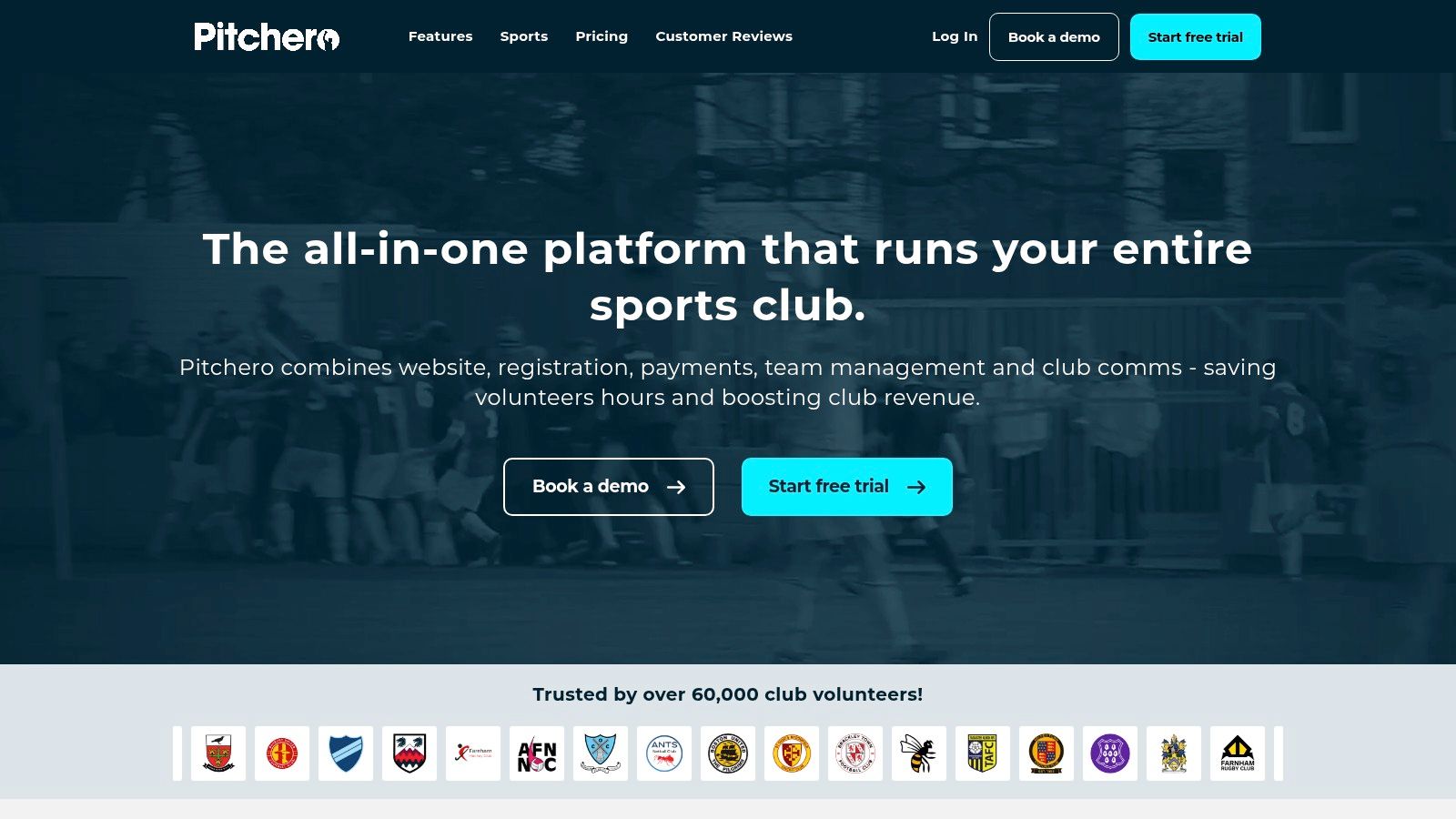
Pitchero works best when a club wants to bring its website, fixtures, training calendar, members, payments and communication under one roof. Instead of asking a volunteer to maintain a public fixture page, a separate attendance list and another payment process, Pitchero connects those jobs through a recognisable club platform.
The club calendar can publish fixtures, results and training events, while attendance and fees management gives administrators a clearer view of participation. Integrated payments and fundraising tools are designed with UK clubs in mind. A mobile app supports parents and members, and the platform offers multiple pricing tiers, including a Free option.
Best fit and trade-off
Pitchero is a strong fit for established UK clubs that need a public-facing website as well as internal administration. Its templates and club features reduce the number of disconnected tools a committee has to manage. That matters when volunteers change and the club needs processes that are easy to hand over.
The platform is less suitable for complex fixture construction. League-first tools offer deeper support for constraints, divisions and brackets, so a tournament organiser may outgrow Pitchero's scheduling depth. Lower-priced tiers can also include advertising and limit customisation, which may affect how polished the club's public presence feels.
A club considering this option should compare Pitchero with connected sports-management alternatives, particularly if training attendance, guardian updates and coach workflows matter as much as the website.
Choose Pitchero when the club's scheduling problem is part of a wider administration and presentation problem. It gives families one familiar place to find fixtures, training details and payment information, even if a specialist league scheduler remains better for complex competition design.
4. Playwaze
Playwaze is designed for organisations that run more than one type of activity. A county programme, university sports department, community provider or multi-sport club can use it for sessions, bookings, leagues, ladders, tournaments, fixtures and results without treating every programme as a separate operation.
Its modular design lets an organisation begin with activity bookings and participant management, then add competition features as its needs grow. Messaging and participant communication sit alongside sessions, while integrated payments use a transparent platform-fee model. That combination is useful when the same participants move between training, events and competitions.
Best for programmes, not just teams
Choose Playwaze when your scheduling problem involves multiple programmes, participant groups or competition formats. It can support a community operator that books sessions one week, runs a league the next and publishes tournament results later in the season.
That flexibility creates its main drawback. The administration interface can feel broad for a single youth team with one coach and a small parent group. A volunteer who only needs weekly RSVP collection may find the platform offers more structure than necessary.
The payment model also deserves attention. A transparent transaction fee is easy to understand, but it may be less attractive for a group that rarely collects payments. Clubs should decide whether they need a programme-management platform or merely an event calendar before setting up their account.
A good schedule should show more than a date. It should tell the right participant where to be, what they're attending and what action is still required.
Playwaze is the right choice for organisations that expect their scheduling needs to expand. It creates room for leagues and bookings without forcing the organiser to rebuild the system when a small team becomes a wider sports programme.
5. TeamSnap
TeamSnap is built around the everyday experience of parents, players and coaches. Its strongest scheduling problem is not the mathematical construction of a league. It's the practical question of who is attending, who needs a reminder, who has seen the change and whether the team can collect the required fees.
The platform supports team and organisation-level schedules, RSVPs, availability tracking, registration, invoicing and payment collection. Mobile apps give parents and coaches alerts and chat, while the product scales from an individual team to a club or league structure.
Best for family adoption
Choose TeamSnap when your priority is clear communication and strong parent adoption. A coach can publish training and match events, ask for availability and keep conversations attached to the team rather than scattered across informal message groups. Families get a familiar app experience, and larger clubs can add organisation-level processes.
The main limitation for UK clubs is localisation. UK-specific integrations and terminology are more limited than those of UK-native tools, so administrators should test whether the platform fits local payment, registration and competition habits. Some organisation-level pricing details also require a sales conversation, which makes direct budget comparison less immediate.
TeamSnap is not the first recommendation for a league secretary who needs advanced constraint-based fixture creation. It is a better choice for the club where the fixture already exists and the challenge is getting every family to respond, attend and pay.
For clubs comparing family communication, availability and administration, this TeamSnap comparison provides another route into the decision. Choose TeamSnap when adoption matters more than specialist league mechanics.
6. Spond
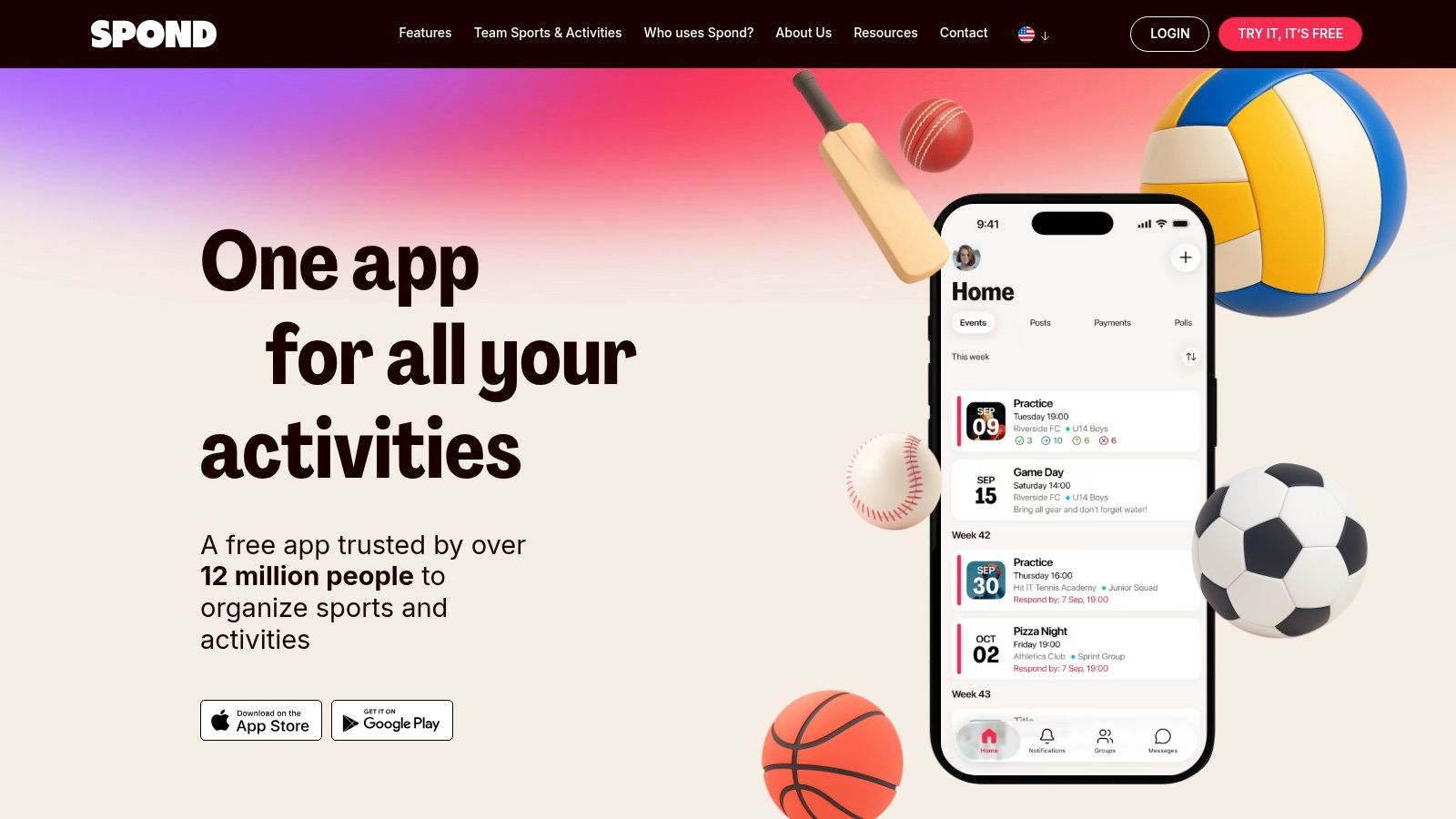
A volunteer-run team that needs simple scheduling without a licence cost will get a lot from Spond. Coaches can create matches, training sessions and other events, collect RSVPs, track attendance and keep parents informed through group chat and announcements.
Consent forms add a useful safeguard for youth activities, while in-app payments and fundraising help a team collect money without setting up a separate process. The iOS and Android apps are built for quick onboarding, which matters when a coach needs to bring parents onto a new system with little time.
Best for straightforward team calendars
Choose Spond when you need events, responses, messages and payments, not a full competition engine. It removes the licence decision entirely, and its free core makes adoption easier for grassroots teams. For clubs weighing Spond against connected alternatives, see this Spond comparison before committing to a two-tool setup.
The trade-off is clear. Advanced league scheduling, divisions, and tournament brackets are not the platform's focus. Spond works well when the season is a single team's weekly calendar. Once fixtures become more complex, the true cost is often the second tool you add.
Payments can also involve transaction fees. Teams should separate the cost of using the calendar from the cost of collecting money, especially when they process subscriptions, tours or fundraising through the app.
For a volunteer coach: If your immediate problem is “Who can attend training on Thursday?”, Spond is a practical answer. If the problem is “How do I schedule several divisions across shared venues?”, choose a league-first platform.
Spond gives young players and their parents a low-friction way to stay connected. That usually means fewer missed sessions, cleaner attendance records and less time spent chasing replies, so coaches can focus more on training and player development.
7. Teamer
Teamer is a veteran UK and Ireland-focused option for teams that want straightforward fixtures, training, availability and reminders. It avoids the heavier league-management approach and concentrates on the recurring tasks that keep a grassroots team moving each week.
A coach can create an event, request an RSVP, see availability and send reminders through web and mobile apps. SMS support in the UK and selected regions is useful when a parent or player doesn't reliably check app notifications. Team payments add a simple route for collecting money, with transparent per-transaction costs.
Best for low-effort communication
Choose Teamer when the team needs a familiar, low-setup scheduling tool rather than an extensive club suite. It suits a volunteer manager who wants to replace scattered texts with one event list and a clear view of who can play.
The simplicity isn't ideal for every organisation. Teamer offers less depth for multi-division league scheduling, and its feature set is lighter than newer all-in-one platforms. A club that needs player development, detailed coaching workflows or complex competition administration will probably need a more connected system.
Its SMS capability remains a practical differentiator for grassroots teams with uneven app engagement. Not every family manages notifications in the same way, and giving the organiser another communication route can reduce avoidable uncertainty before match day.
Teamer is a sensible team-level choice. It won't solve every club administration problem, but it can make weekly scheduling feel manageable for coaches who need clarity rather than a large operational dashboard.
Top 7 Sports Team Schedule Makers Comparison
| Platform | Implementation complexity 🔄 | Resource requirements ⚡ | Expected outcomes ⭐📊 | Ideal use cases | Key advantages 💡 |
|---|---|---|---|---|---|
| LeagueRepublic | High, advanced schedulers and optimisation (steeper learning curve) | Moderate, admin time for optimisation; Free & Gold plans available | ⭐⭐⭐⭐, robust multi-division fixtures, standings and referee workflows 📊 | UK grassroots leagues needing multi-division home/away schedules | Purpose-built league workflows; strong scheduling options; free tier for many admins |
| LeagueLobster | Medium, focused on scheduling features, quick to learn for schedulers | Low–Moderate, usage-based pricing by games; minimal infrastructure | ⭐⭐⭐⭐, fast creation and public publish of complex schedules 📊 | Constraint-heavy leagues, playoffs, multi-venue tournaments | Flexible constraints/brackets; transparent per-game testing; embeddable public pages |
| Pitchero | Low–Medium, integrated club tools with simpler scheduling options | Moderate, subscription tiers; includes website & app costs | ⭐⭐⭐, unified club site, calendars and member management 📊 | Clubs wanting public websites plus back-office and team calendars | All-in-one club site + scheduling; UK-specific templates and payments |
| Playwaze | Medium–High, modular features increase admin breadth and UI complexity | Moderate, per-transaction fees; modular rollout reduces upfront costs | ⭐⭐⭐, scalable competition and session management across organisations 📊 | Multi-sport operators, universities, county setups combining sessions & leagues | Modular growth from sessions to competitions; built for UK multi-operator needs |
| TeamSnap | Low, intuitive team-level workflows; club features add complexity | Moderate, subscription (some club pricing via sales) | ⭐⭐⭐⭐, high adoption, strong mobile UX and parent engagement 📊 | Parent-focused teams, clubs scaling from single teams to organisations | Very user-friendly mobile apps; RSVPs/availability and strong communications |
| Spond | Low, simple event/RSVP flows and group messaging | Low, core features free; transaction fees apply when used | ⭐⭐⭐, excellent for event coordination and onboarding 📊 | Volunteer youth teams and grassroots groups seeking zero-licence tools | Free core features, fast onboarding, parent-friendly UX |
| Teamer | Low, straightforward fixture and training scheduling | Low, simple subscription/transaction model; SMS options available | ⭐⭐⭐, reliable scheduling, reminders and availability tracking 📊 | Grassroots UK/Ireland teams needing simple scheduling and SMS reach | Familiar to local clubs; SMS support and low setup effort |
Choose the Calendar That Keeps Everyone Moving
Start with the scheduling problem, not the feature list. If your club is creating complex league fixtures, balancing divisions, assigning referees or building tournament brackets, choose LeagueRepublic or LeagueLobster. LeagueRepublic is the better fit for ongoing league administration, results and discipline workflows. LeagueLobster is the sharper option for flexible competition construction, public schedules and bracketed events.
Choose Pitchero or Playwaze when scheduling sits inside a wider club or programme operation. Pitchero brings the website, fixtures, training, members and payments together for a UK club. Playwaze is better for organisations running several activities, bookings, leagues or participant programmes.
For a single team, the communication problem usually matters more than the fixture algorithm. TeamSnap suits clubs that want a strong parent app, availability and organisation-level growth. Spond is the practical free-to-use choice for volunteer teams that need events, RSVPs, messages and payments. Teamer remains useful when simple reminders, availability and SMS access are the priority.
Don't overlook the operational details behind a good calendar. English Football League academy guidance limits a single coaching session to 90 minutes, and requires at least 90 minutes of rest between multiple sessions on the same day unless an individual coaching plan allows shorter rest periods. The EFL guidance gives youth clubs a clear standard for building realistic training blocks.
Cricket clubs also need to schedule people, not just places. ECB guidance sets ratios including one coach to eight children, one coach to 24 children for soft-ball group coaching and one coach to 16 children for hard-ball group coaching. The ECB coaching and supervision guidance shows why coach and volunteer availability belongs in the schedule from the start.
For clubs that want fixtures, training, attendance, guardian updates, coach workflows, player development and integrated payments connected in one system, Vanta Sports is a relevant option. It provides a central calendar for club and team activity, fixture imports, schedule updates, notifications, coach session planning and attendance views. Its wider workflow also connects guardians, coaches and players, so the schedule supports development rather than sitting apart from it.
Good scheduling protects the wider experience of youth sport. It gives players recovery time, gives families reliable information and gives volunteers a manageable way to organise support. Before testing a platform, write down your must-have constraints, communication needs and payment processes. If your club still prints seasonal information, even personalised calendar printing for UK clubs can complement a live digital system, but the online calendar should remain the current source of truth.
Vanta Sports connects training, matches and events with attendance, guardian updates, coach workflows, player development and integrated payments in one sports management platform. Visit Vanta Sports to test a connected scheduling approach that helps your club spend less time chasing information and more time helping young players enjoy their sport.
Tags