Youth Development
Stripe Payment Integration for Youth Sports Clubs
A practical Stripe payment integration guide for UK youth sports clubs covering Checkout, subscriptions, webhooks, testing and compliance best practices.

Registration day at an under-10s club rarely looks organised. Parents queue at the gate with cash, someone sends a bank transfer with the wrong reference, and the treasurer is still chasing failed payments a week later. By the time team sheets need finalising, nobody has one reliable answer to a simple question: who has paid?
A properly planned Stripe payment integration changes that. Registration fees, match-day subs, kit orders and recurring membership payments can follow one controlled process, with clear records for the committee and a straightforward experience for parents. The technology matters, but the bigger decision is operational. You're choosing how your club collects money, confirms participation and handles problems when a payment fails.
Why Stripe Payment Integration Matters for Youth Sports Clubs
A club billing system should remove uncertainty, not create another dashboard for volunteers to monitor. Manual collection leaves late payments mixed with team administration, while spreadsheets containing card details create an avoidable data-protection risk. Reconciling cash, bank transfers and card payments also forces the treasurer to match different references and timings by hand.
Parents already expect mobile-friendly checkout. UK consumers and businesses made 48.8 billion payments in 2024, cards represented 64% of all UK payments, and debit cards accounted for 26.1 billion payments, according to UK Finance's digital payments update. Contactless use is equally established, with 18.9 billion contactless card payments in 2024 and around 62% of debit card payments made contactless, so a clumsy registration journey feels out of step with everyday life.
Operational rule: Don't ask parents to adapt to the committee's payment habits. Build the collection journey around how families already pay.
Match the Stripe tool to the club job
Four Stripe surfaces cover most youth-sports billing needs:
- Checkout provides a hosted payment page for registration fees, tournament entries and kit orders. It's the sensible starting point when the club wants speed and minimal custom development.
- Payment Intents support a custom payment form inside an existing website or platform. Choose this when the club needs control over the experience and has development support.
- Subscriptions automate recurring membership, academy and instalment charges. They're useful when fees need to follow a season or term rather than a single registration event.
- Connect supports a federation or central platform that collects money for multiple clubs and routes funds to local organisations.
UK online spending reinforces the practical case for mobile and remote collection. Online spending represented 50.5% of total card spending in September 2025, compared with 43.7% in September 2019, while domestic online spending reached 47.1% in 2024, as reported by the Office for National Statistics. Stripe's UK material also says more than 94% of eligible in-store transactions were contactless in 2024, which supports a fast, phone-friendly approach across registrations and match-day payments.
Make payment status part of club administration
A payment should activate the right membership record, notify the parent, and give the treasurer an auditable trail. It shouldn't sit in a personal inbox waiting for somebody to update a spreadsheet.
For clubs comparing approaches, integrated payment processing for sports organisations shows why payment collection works best when it sits alongside teams, guardians, fixtures and attendance. The target is simple: one record for the player, one payment status, and one reliable route for refunds or failed renewals.
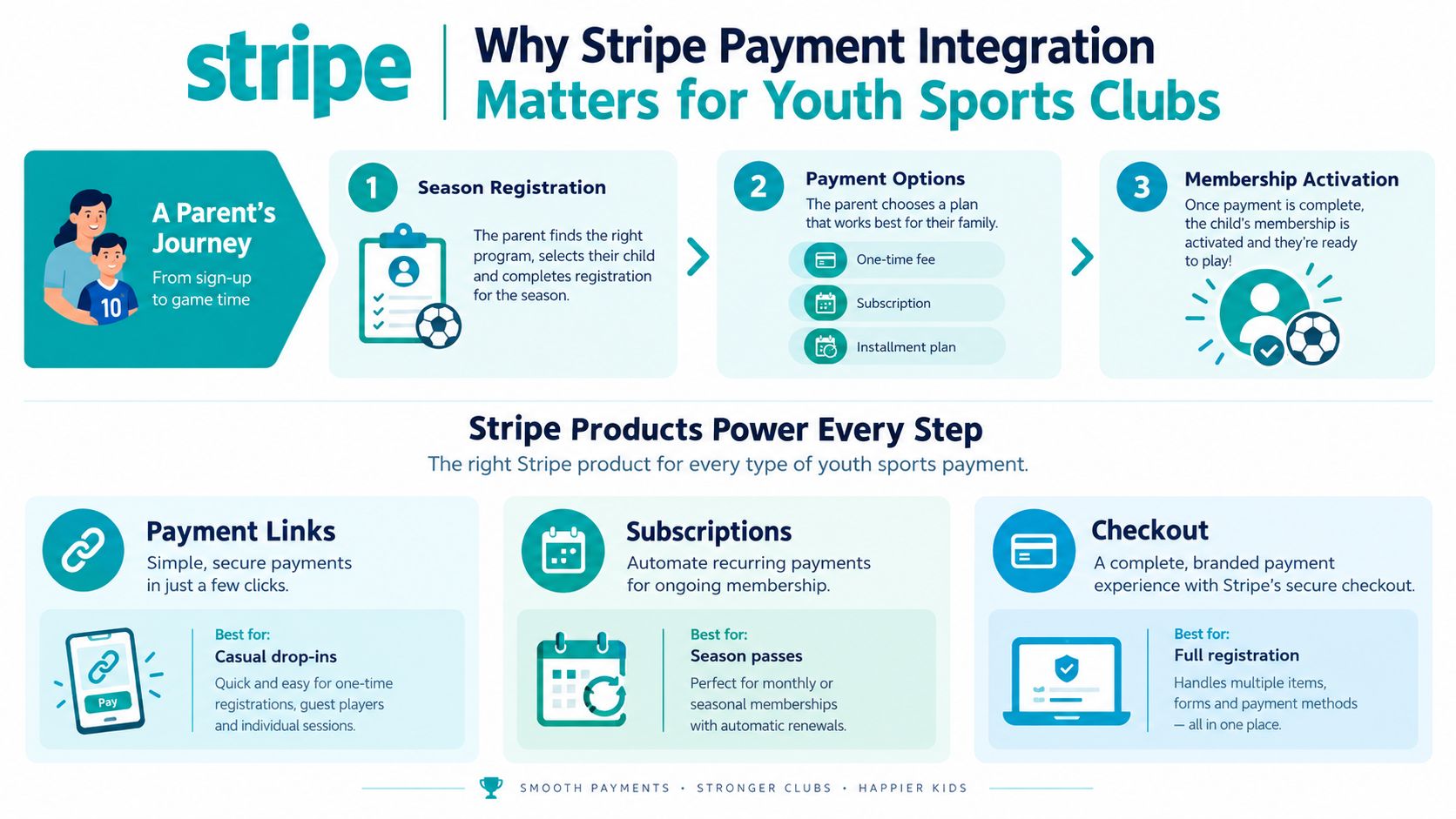
The rest of the implementation should take you from current collection chaos to a reconciled, SCA-ready setup. Pick the right Stripe surface first, wire payment creation safely, treat webhooks as the authority for paid status, and test the difficult Saturday-morning scenarios before families depend on the system.
Choosing the Right Stripe Surface for Club Billing
Don't start by asking a developer to “add Stripe”. Start by deciding what the club actually sells and how often it charges. A one-off tournament entry is a different operational problem from a termly membership, and a federation collecting for several local clubs needs a different account structure again.
| Surface | Best Club Use Case | Engineering Effort | Recurring Fees Support |
|---|---|---|---|
| Checkout | Registration fees, tournament entries and one-off kit orders | Low | Limited unless paired with subscription logic |
| Payment Intents | Custom payment forms inside an existing club website or platform | Medium | Possible, but the club must build more billing logic |
| Subscriptions | Termly memberships, academy fees and instalments | Medium | Native subscription-style billing |
| Connect | Federations or central platforms routing funds to several clubs | High | Can be combined with recurring billing |
Checkout for speed and confidence
Stripe Checkout is my default for a small club launching online payments. The parent follows a hosted flow, the club avoids building sensitive card fields, and the committee gets a focused route for registration and event payments. It's also a strong choice for tournaments, where speed matters more than a heavily branded payment screen.
Use Checkout for a fixed registration price, an equipment order or a casual event payment. Keep the product and fee information clear, and return the parent to a confirmation page that explains what happens next.
Payment Intents for controlled experiences
Choose Payment Intents when the club already has a registration form and needs payment to feel like part of that journey. This suits a WordPress or Joomla site, or a custom youth-sports platform where the parent selects an age group, adds extras and pays without leaving the form.
The trade-off is responsibility. Your team must handle client confirmation, SCA responses, retry states, payment records and user-friendly errors. Control is valuable, but only when somebody owns the maintenance.
Subscriptions for fees that recur
Stripe Subscriptions fit termly membership fees, monthly academy charges and split payments for kit or travel. Stripe Billing supports billing cycles, prorations and trial periods, so a player joining part-way through a term can receive a fair adjustment rather than forcing the treasurer to calculate it manually. UK industry guidance reports an additional 0.5% for recurring billing and 0.4% for invoicing, so include those charges in the club's forecast using Stripe's UK recurring-payments guidance.
Connect for federations
Stripe Connect is for a central organisation serving multiple clubs, teams or legal entities. It can support a model where the federation retains a percentage and routes the remainder to local clubs, but it brings more onboarding, account and payout responsibilities.
My decision rule is direct: choose a hosted page for speed, Payment Intents for control, Connect for federations, and layer Subscriptions on top whenever fees recur. Clubs comparing the operational side should also review payment collection for sports platforms, especially when guardians, teams and fee records need to stay connected.
Wiring Up the Server and Client Code
The safest integration keeps payment creation on your server and card handling inside Stripe's hosted components. You'll need a Stripe account, restricted API keys stored in environment variables, and a server runtime such as Node, Python or PHP that your club website already supports.
Put the fee calculation on the server. Never trust an amount posted by the browser, because a parent's device must not be allowed to decide what an under-12 registration costs.

A simplified Node-style server flow looks like this:
const intent = await stripe.paymentIntents.create(
  {
    amount: feeSchedule[registration.ageGroup],
    currency: "gbp",
    automatic_payment_methods: { enabled: true },
    metadata: {
      registration_id: registration.id,
      player_id: registration.playerId
    }
  },
  {
    idempotencyKey: `registration-${registration.id}`
  }
);
The important choices are operational, not decorative. Derive the amount from the age-group fee schedule, set the currency to GBP, enable automatic payment methods, and use an idempotency key based on the registration ID. If a parent double-clicks after a slow mobile response, the same registration shouldn't create two charges.
On the client, initialise Stripe.js, mount the Payment Element, and confirm the Payment Intent:
const { error } = await stripe.confirmPayment({
  elements,
  confirmParams: {
    return_url: `${window.location.origin}/registration/complete`
  }
});

if (error) {
  showPaymentMessage("The payment couldn't be completed. Please check the details and try again.");
}
Your interface must handle the requires_action path because some card payments need a 3D Secure challenge. Stripe's UK and EU SCA flow requires 3D Secure for customer-initiated online card payments, and the Stripe authentication analytics documentation defines authentication success rate as completed 3DS authentications divided by all 3DS attempts. Track that measure internally so you can identify issuer friction and abandonment instead of guessing.
Make failures understandable
A declined card, expired session and network interruption need different retry messages. Don't expose raw Stripe error codes to parents. Say what happened, preserve the registration where possible, and tell the parent whether to retry the card, reopen the payment link or contact the club.
Store the PaymentIntent ID against the player or registration record. That single reference makes later reconciliation much easier. Stripe.js and Elements also keep the club away from directly handling card data, which helps reduce the payment-card compliance burden.
Some clubs also need VAT treatment around registration or service fees. If tax reporting is part of the build, a technical reference such as Stripe VAT API integration setup can help the developer decide where tax data belongs without putting the treasurer in charge of application logic.
Build decision: The browser starts payment collection. The webhook confirms what happened.
For clubs that want payment collection connected to registrations, guardians and fee records rather than bolted on afterwards, automated payment processing for sports clubs provides useful product context. The next control is the webhook endpoint, where your platform turns Stripe events into membership status.
Handling Webhooks and Reconciliation the Right Way
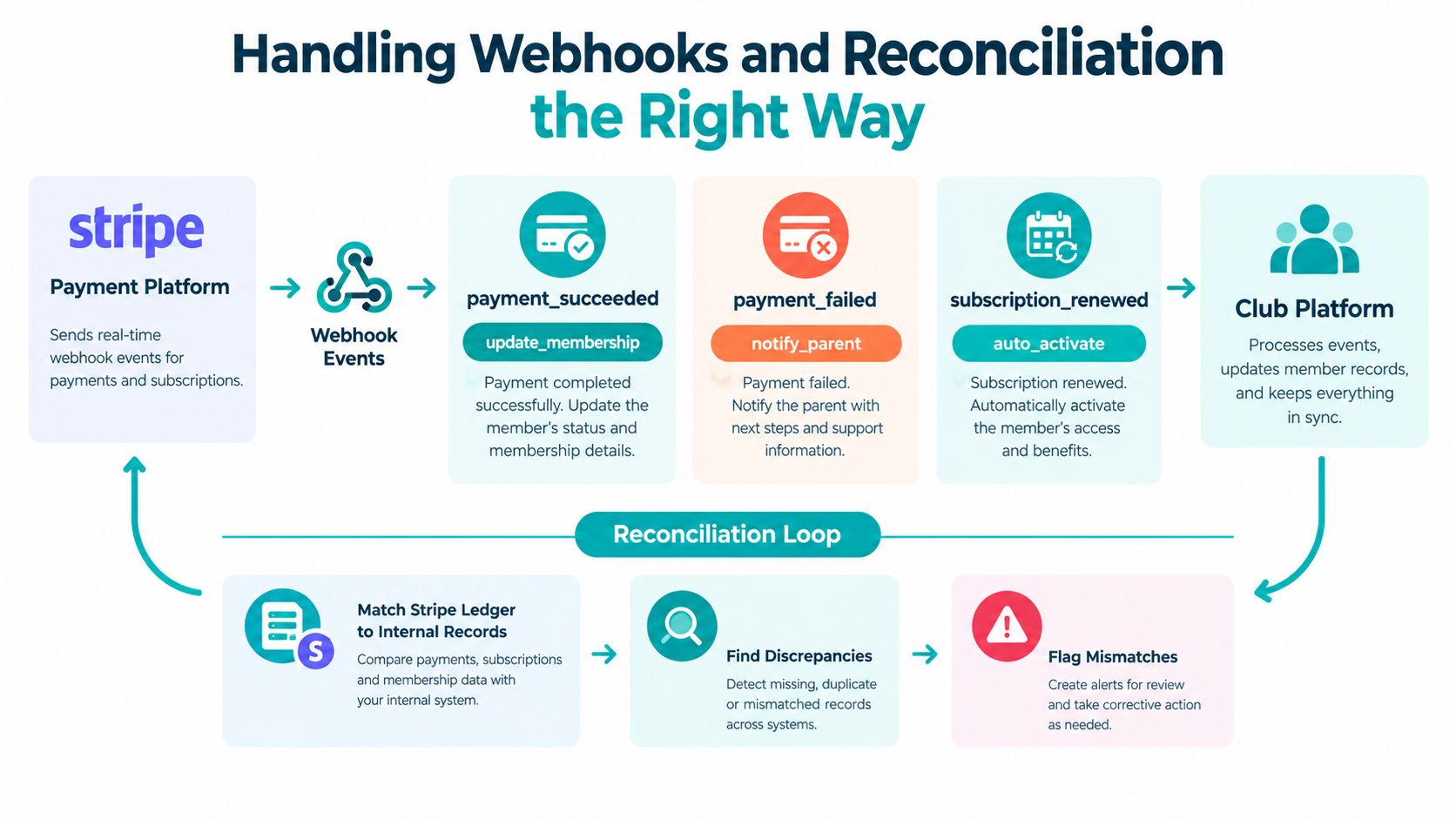
A success screen is not proof that your club should activate a membership. The parent may close the browser, the redirect may fail, or a delayed payment method may still be pending. Your platform needs Stripe's server-to-server event as the canonical signal.
Create a dedicated /webhooks/stripe endpoint. Read the raw request body, verify the signature with stripe.webhooks.constructEvent and your webhook signing secret, then process only events you understand.
Useful event types include:
checkout.session.completedfor completed hosted checkout.invoice.paidfor a successful subscription invoice.invoice.payment_failedfor a renewal that needs parent attention.customer.subscription.updatedfor changes to status or billing configuration.charge.refundedfor returning money and updating the local record.
Each handler should update a Memberships or Payments table using the Stripe event ID as a unique key. Stripe may retry delivery, so idempotent processing is essential. The first delivery can activate a player, while a repeated delivery should be recognised as already handled.
Keep the endpoint quick
Respond with a 2xx status quickly. Stripe gives the endpoint around 30 seconds, but heavy tasks such as sending notifications, recalculating team eligibility or generating a receipt belong in a queue. The webhook should verify, record and dispatch.
Use the Stripe CLI to listen for events on a development machine and replay them while investigating a refund or failed renewal. Saturday morning is a poor time to discover that a subscription update handler assumes every invoice belongs to one fee type.
Give the treasurer a ledger they can trust
Reconciliation compares your local payment ledger with Stripe's Balance Report and payouts. Match PaymentIntent or charge references, account for refunds and disputes, and flag anything that exists in one system but not the other. Run the process regularly and give the treasurer an end-of-term export that explains gross collections, adjustments and transfers.
If the club grows into more complex reporting, an automated revenue recognition SaaS may help separate payment events from accounting treatment. For most clubs, though, the first requirement is simpler: every payment, refund and failed renewal must map to a known family and registration.
The practical principles behind payment reconciliation for sports organisations are straightforward. Record the event once, preserve the Stripe reference, and make mismatches visible before they become a committee argument.
Testing Cards, Subscriptions and SCA Before Going Live
Youth sports clubs don't get a gentle launch. A new season opens on a fixed date, parents arrive in a rush, and a broken renewal can affect team eligibility immediately. Test the full payment journey in Stripe test mode before a single family uses the production form.
Create separate publishable and secret test keys, and use the test dashboard to inspect customers, Payment Intents, invoices, subscriptions and webhook deliveries. Test the standard success and decline cards, insufficient-funds responses and 3D Secure paths. The authentication-required card 4000 0027 6000 3184 should produce the challenge flow you expect.
| Scenario | Test Value | What to Verify |
|---|---|---|
| Successful card payment | Stripe's standard successful test card | Registration confirmation, receipt and paid status |
| Declined card | Stripe's standard declined test card | Clear retry message and no membership activation |
| Insufficient funds | Stripe's standard insufficient-funds test card | Parent guidance and unchanged unpaid status |
| 3D Secure required | 4000 0027 6000 3184 | Challenge display, return handling and final webhook |
| Subscription renewal failure | Test subscription failure flow | Notification, grace period and account status |
| Bacs Direct Debit | Stripe's Bacs test flow | Mandate status, delayed settlement and reconciliation |
| Refund | Test refund action | Local refund state and parent notification |
| Connect transfer | Test connected-account payout flow | Correct destination and platform record |
Test slower payment methods honestly
Bacs Direct Debit requires mandate collection and identity verification. Stripe says an existing mandate typically takes 4 business days, while a new mandate can take up to 7 business days, as set out in its Bacs Direct Debit documentation. That delay affects cash flow, so don't present Bacs as equivalent to an immediately confirmed card payment.
Use the Stripe CLI to listen for webhook events while stepping through subscription signup. Simulate a mandate that progresses over time, then verify that the club doesn't grant access prematurely.
Exercise SCA and fraud paths
Stripe's SCA guidance supports exemptions such as low-value and recurring transactions under PSD2, but exemptions aren't guaranteed. For UK Transaction Risk Analysis, the relevant thresholds are 0.13% under £85, 0.06% under £220, and 0.01% under £440, according to Stripe's SCA guide. The cardholder's bank can still reject an exemption and require authentication.
Test Radar rules, an issuer-forced challenge, a failed renewal and a disputed charge. Before launch, stage at least one real 3DS challenge, one failed renewal, one disputed charge and one Connect payout where relevant. You want the team to recognise every important failure shape before match day.
Production Readiness Checklist for UK Sports Clubs
The final review belongs to the club operations lead, not just the developer. A payment integration is ready when the treasurer can reconcile it, the safeguarding and data processes are clear, and a parent can recover from an error without calling the coach during warm-up.
Data and account controls
- Protect live keys: Store secret keys in a proper secret manager and keep restricted publishable keys in the web application.
- Separate legal entities: Use separate Stripe accounts where clubs or organisations are legally distinct.
- Limit access: Give committee members only the dashboard permissions their roles require.
- Keep records connected: Store the Stripe customer, PaymentIntent, invoice or subscription reference against the correct guardian and player record.
Reconciliation and finance
Run payout matching regularly, with a clear route for refunds and disputes. At the end of each term, export the ledger for the treasurer and confirm that local membership status matches Stripe payment history.
Stripe's UK pricing is pay-as-you-go, with no setup or monthly fees. Standard UK card payments cost 1.5% + £0.20 per successful online transaction, while premium UK cards cost 1.9% + £0.20, according to Stripe's UK pricing page. Include those transaction costs when setting registration and instalment budgets.
For events and camps, Stripe Terminal pricing is 1.4% + £0.10 for standard UK and EEA cards, and 2.9% + £0.10 for other international cards, based on this Stripe Terminal pricing review. That gives the club a clear benchmark for on-site collection.
Compliance and parent confidence
Document the SCA exemption approach and its fallback to authentication. Use Checkout or Elements to support a narrower PCI DSS SAQ A scope, retain only the parent data you need under UK GDPR, and provide a practical route for erasure requests. Confirm how VAT applies to registration fees with the club's adviser rather than assuming every charge receives the same treatment.
Operations that survive a busy weekend
Set monitoring around critical webhook paths, assign an on-call rota for failed renewals, and write parent-facing receipts that explain the payment, player and cancellation process. Make the cancellation flow as clear as the signup flow.
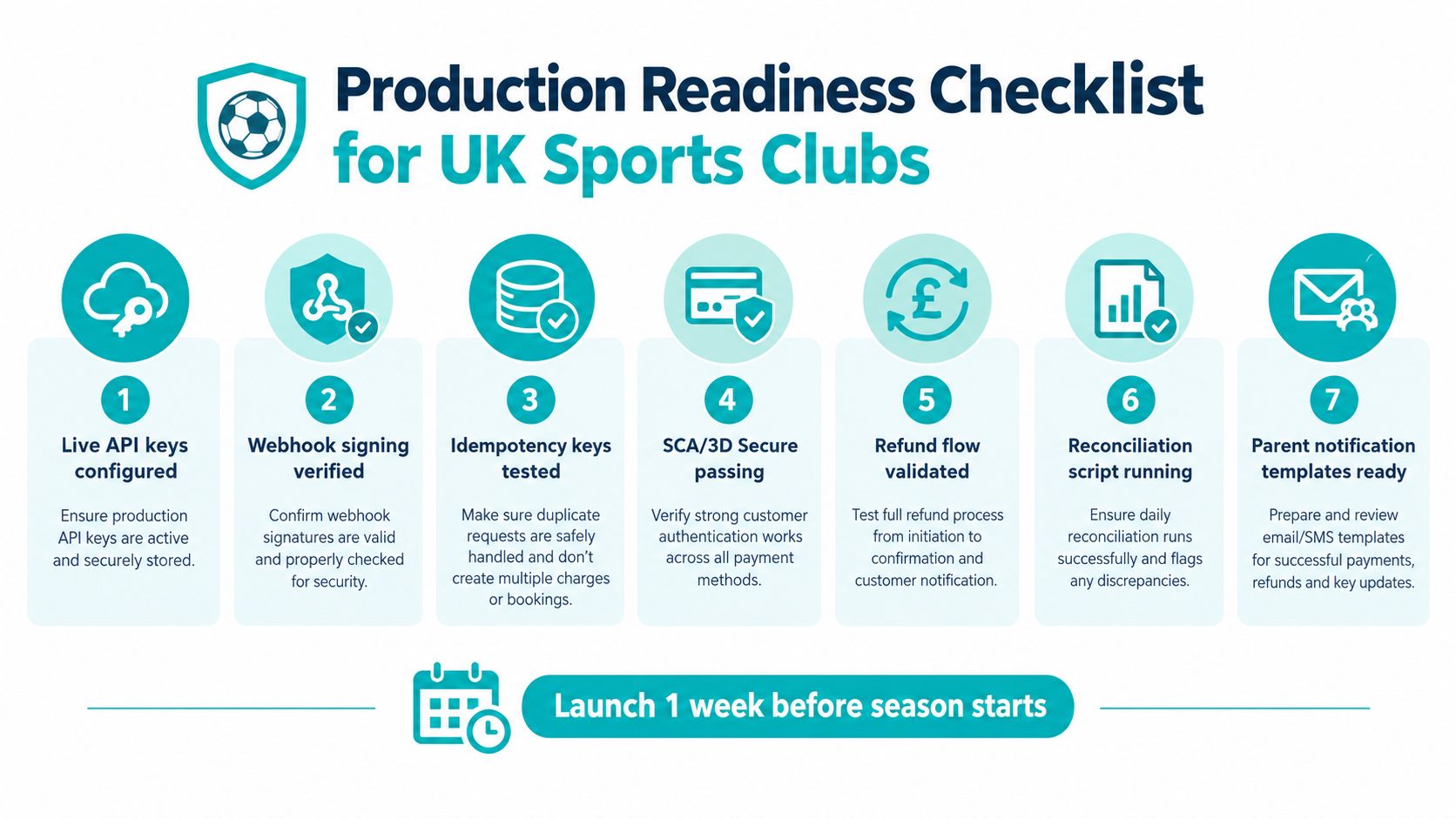
Use a controlled cutover. Pilot with one age group, watch the Stripe dashboard and webhook logs, check the treasurer's reconciliation, then enable subscriptions across the whole club. Launching one week before the season starts gives the committee time to resolve real registration questions without turning the first training session into a payment helpdesk.
If your club needs one connected place for Stripe billing, registrations, guardians, teams and payment status, Vanta Sports brings those workflows into a sports management platform. Set up one age group first, map your fee rules and payment events, then invite families once the reconciliation process is working.
Tags