Youth Development
Training Attendance Report: Boost Club Participation
Learn how to create an effective training attendance report for youth sports. Track KPIs, spot trends, and keep young players engaged with Vanta Sports.

The cones are out, the first players are arriving, and you're trying to remember who confirmed, who is running late, and which parent mentioned a timetable clash. By the end of training, the session has gone well, but three players were missing and you're no closer to understanding why. A simple training attendance report can turn that uncertainty into a useful conversation about commitment, confidence, access, and wellbeing.
For youth coaches, attendance isn't about policing young athletes. It's about noticing change early, recognising effort, and making sure every player still feels connected to the team. Used carefully, attendance information helps you protect participation and safeguarding while giving players a fair chance to recover when life gets in the way.
Why Tracking Attendance Matters for Young Athletes
A busy volunteer coach often notices a player's absence only after the warm-up has started. One week, a regular midfielder is missing. The next week, a goalkeeper arrives late. A normally enthusiastic player stops joining in. Each incident seems small, yet together they may show that a young person is losing confidence, struggling with transport, facing a school commitment, or feeling overlooked during sessions.
A training attendance report gives you a calm way to see that pattern. It doesn't replace a conversation, and it shouldn't turn a child into a percentage. Instead, it gives coaches a prompt to ask a better question: “What has changed, and how can we help?”

National participation figures show why that distinction matters. In England, the Active Lives Children and Young People Survey for 2023–24 found that 91.4% of children completed at least one sport in the previous seven days, yet that baseline doesn't show whether they attended every scheduled club session, arrived on time, or completed the full programme, as explained in the Active Lives survey response. A child may be active at school, at home, or with another club while missing your training.
That's why attendance deserves a retention focus. A report can help you:
- Celebrate reliability: Thank players who attend consistently and contribute positively.
- Support development: Compare training exposure with progress without treating attendance as a measure of talent.
- Spot withdrawal early: Notice repeated or sudden absences before a player leaves.
- Include families: Identify practical barriers and work with guardians on realistic solutions.
Coach's reminder: Attendance data should open a supportive conversation, not close one with a judgement.
A good record also strengthens the wider experience of participation. If you want to explore how clubs can keep young people inspired, read about participation in sports and the next generation of athletes. The aim is simple: help players feel expected, welcomed, and valued every time they come through the gate.
Essential Elements of a Training Attendance Report
A useful report doesn't need to be complicated. It needs to answer four practical questions: Who was expected, what session took place, who attended, and what should the coach know?
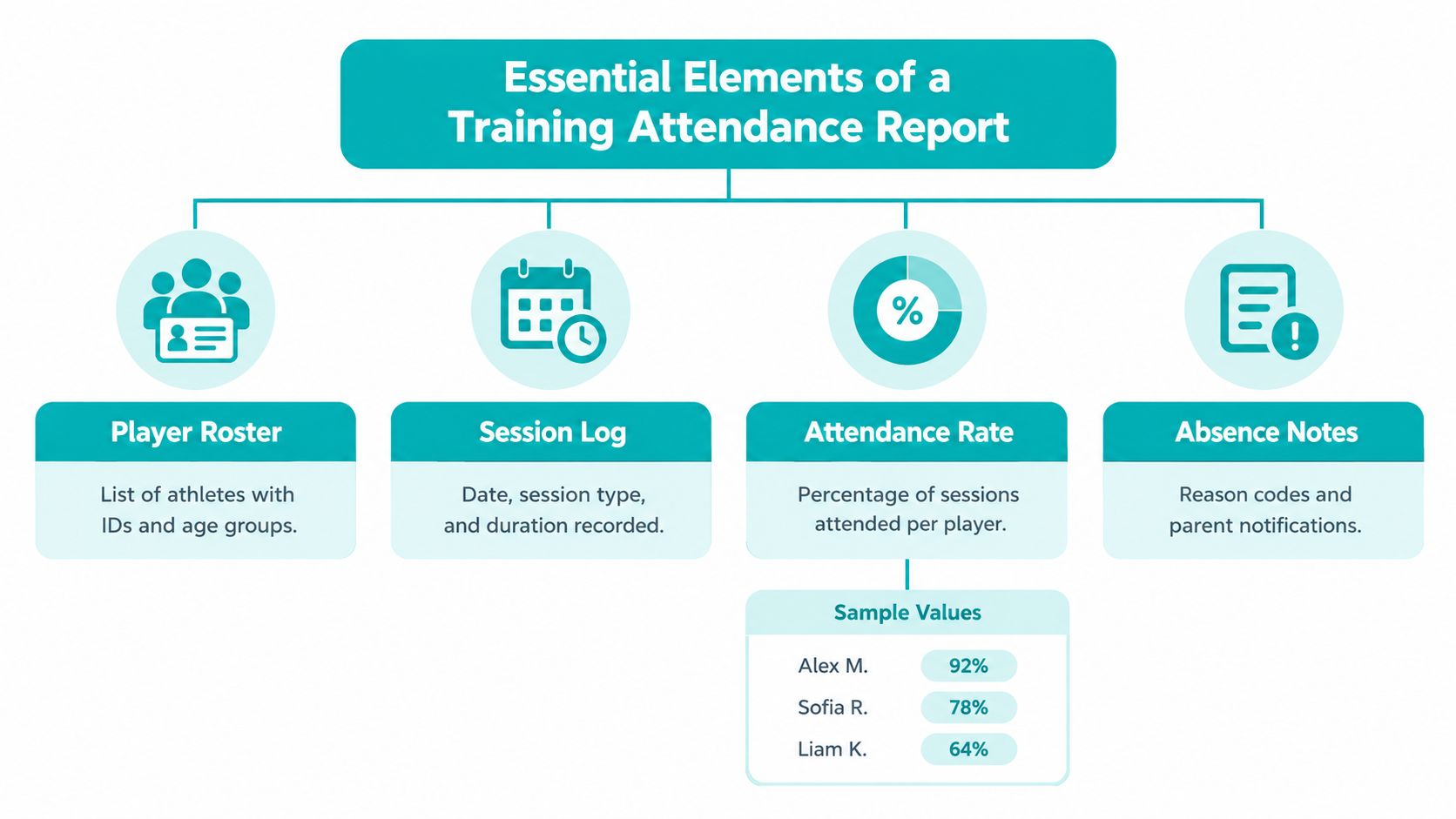
Start with a dependable player roster
Record each player's name, team, age group, and a club identifier where appropriate. Keep the roster current so a transfer, new registration, or move between squads doesn't distort the report. Only authorised staff should access personal information, and general team summaries shouldn't include sensitive family, medical, or welfare details.
Log the session before marking attendance
Add the date, team, venue, session type, and planned duration. A cancelled session must be marked as cancelled rather than counted as a missed session. The same applies to a player who wasn't eligible for that session, such as someone attending a different squad activity.
A clear session log lets you calculate attendance fairly. It also helps a new volunteer understand what happened when they take over the team later. Clubs comparing digital options may find a useful starting point in these document tracking software options, particularly when they need consistent records across coaches and committees.
Use attendance statuses that explain the situation
At minimum, use present, absent, and late. Add reason categories such as excused absence, illness, school commitment, transport problem, family circumstance, or unknown. Don't force coaches to write long notes during a busy session. A short reason code can preserve accuracy, while a private follow-up record can hold more context when authorised staff need it.
Calculate the right rate
Attendance rate should be calculated as attended sessions divided by eligible scheduled sessions. Keep cancelled sessions and approved exclusions out of the denominator. You can also record late arrivals separately, because arriving for the final part of training isn't the same as completing the full session.
A simple individual view might include:
| Player | Eligible sessions | Attended | Late | Attendance rate | Follow-up |
|---|---|---|---|---|---|
| Player A | Scheduled sessions | Attended sessions | Late arrivals | Attended ÷ eligible | None or action |
| Player B | Scheduled sessions | Attended sessions | Late arrivals | Attended ÷ eligible | Check-in |
| Player C | Scheduled sessions | Attended sessions | Late arrivals | Attended ÷ eligible | Guardian contact |
Avoid turning the report into a ranking table. A streak can encourage a player, but attendance shouldn't decide who gets praise, playing time, or a place in the squad without context. For a wider explanation of maintaining accurate records, see sports attendance records.
Using National Data to Benchmark Your Club's Success
Club attendance and national activity are related, but they aren't interchangeable. A national survey may tell us whether children have been active during a recent period. Your club report tells you whether a named player attended a particular scheduled session, arrived late, or missed several weeks.
A UK-wide 2025 survey of 1,002 children aged 5–16 found that 98% were active for at least 60 minutes on one or more days in the previous week, while 36% participated in school sport or physical activity outside mandatory PE on at least three days per week, according to the Youth Sport Trust Class of 2035 report. Those findings describe broad activity patterns. They don't tell you whether a player attended your club's Tuesday training.
Read the numbers at the right level
Suppose your under-13 squad has lower attendance during a particular month. The first response shouldn't be to label the players uncommitted. Compare the pattern with:
- Session type: Is the change limited to early-morning training, matches, or optional sessions?
- Age group: Are players moving into a new school stage or facing different demands?
- Calendar pressure: Do school events, examinations, or holidays coincide with the dip?
- Player context: Are the same individuals active elsewhere but unable to attend this slot?
- Club experience: Are new players attending less often because they haven't settled in?
Benchmarking supports judgement here rather than replacing it. A team-level figure can show that something deserves attention, but it can't explain the reason. The coach still needs to listen to players and guardians.
Separate participation from belonging
A player who misses club training may still be active through school sport, informal play, another club, or family activities. Conversely, a player who attends every session may be struggling to enjoy the experience. Attendance is one signal within a wider picture that includes confidence, relationships, development, communication, and welfare.
Use national information as a reference point, not a target that every child must meet. For a broader approach to comparing results and setting meaningful measures, explore performance benchmarking. Then bring the discussion back to your own club: are players able to attend, do they want to attend, and does the environment make them feel that they belong?
Practical rule: Compare patterns before you compare people. A squad trend may point to a scheduling issue, while an individual trend may call for a private check-in.
Spotting Trends and Intervening Early
A single missed session rarely explains much. A sequence of missed, late, or unexplained sessions gives you a better starting point. The difference between recording attendance and using it well is the step between “what happened?” and “what might be causing it?”
UK Active Lives evidence shows small but measurable declines in weekly physical-activity participation across several school-age cohorts, with participation falling by 0.9 percentage points in Years 1–2 and 1.5 percentage points in Years 5–6, as reported in the Physical Activity Levels and Trends in Children and Young People. That context matters, but your club still needs its own session-level evidence.
Compare a snapshot with a trend
A snapshot might show that a player attended most recent sessions. A rolling four- to six-week view can reveal whether that attendance is stable, recovering, or declining. Review the same period for the team, age group, session type, and individual player.
A useful review might ask:
- Has attendance declined across consecutive reporting periods?
- Are absences concentrated on one day or venue?
- Do late arrivals follow a school timetable change?
- Are several players affected by the same transport route?
- Did attendance improve after a reminder, schedule adjustment, or personal welcome?
- Are optional sessions attracting a different group from regular training?
Investigate before you intervene
Repeated absence needs curiosity, not accusation. A private message to a guardian can be practical and warm: “We've missed seeing Jamie at training. Is there anything making the current time or session difficult?” A coach can then offer an appropriate next step, such as checking another session, clarifying the schedule, helping the family understand the RSVP process, or involving the club welfare lead.
School attendance evidence provides a useful reminder to look for patterns. In England's 2022–23 academic year, 22.3% of pupils were persistently absent from school, with the rate at 17.2% in primary schools and 28.3% in secondary schools. Persistent absence means missing at least 10% of school sessions, approximately one day every fortnight across the school year, according to BBC reporting on school attendance. Youth sport isn't school, but the principle transfers carefully: repeated absence deserves review, while one missed session shouldn't define a child.
Link attendance with safeguarding
A sudden withdrawal, repeated unexplained absence, or sharp change in participation may warrant appropriate welfare follow-up. The Football Association's Safeguarding Strategy 2024–28 describes safeguarding-awareness training for coaches, referees, medics, designated safeguarding officers, and club committee members across grassroots football through the National Leagues.
Record objective facts, restrict sensitive explanations to authorised people, and use your club's agreed safeguarding route. Attendance can help you notice a concern, but it must never replace trained safeguarding judgement.
Streamlining the Process with Vanta Sports
Volunteer coaches shouldn't have to choose between watching the session and maintaining reliable records. The practical setup is a quick register on a phone, clear status options, and a shared record that authorised club staff can review without asking several coaches to recreate the same information.

Vanta Sports brings club administration, coaching, guardians, and players into one connected system. Its club dashboard supports team setup, coach assignments, schedules, payments, attendance history, analytics, and reporting. Coaches can use a dedicated iOS app to plan sessions, work from drill cards, mark players as present, absent, or late, add notes, track performance, message the team, and capture stats with Apple Watch support.
That workflow matters on the pitch. A coach can mark attendance as players arrive instead of reconstructing the register from memory later. Guardians can manage RSVPs, receive notifications, and communicate directly with coaches, which gives the club more context around an absence without placing the entire administrative load on a volunteer.
Turn records into useful club conversations
An attendance report becomes more valuable when it sits alongside retention, playing time, squad size, and financial information. Administrators can review whether a team is losing regular participants, while coaches can focus on the individual experience behind the pattern. Players also receive a more motivating view through performance tracking, XP, badges, leaderboards, and practice streaks.
Keep the tone developmental. A lower attendance rate should prompt support, not public embarrassment. A recovered pattern deserves recognition, especially when a player has worked through a barrier and reconnected with the group.
After the session, club staff can use the wider reporting view to identify who needs a welcome message, which squad needs a schedule review, or where a safeguarding lead should make a private check-in.
For clubs comparing approaches, the Vanta Sports club platform is one option for bringing attendance, communication, scheduling, development, and reporting into the same operating system. The right tool is the one your volunteers can use consistently and your club can govern responsibly.
Practical Templates and KPIs for Coaches
Start with a report that a coach can complete during training and a committee member can understand later.
Session header: date, team, venue, session type, coach, and whether the session ran as planned.
Player record: player name, expected status, present, absent, late, reason code, and follow-up owner.
Review fields: eligible sessions, attended sessions, attendance rate, recent trend, and agreed action.
Useful KPIs include:
- Attendance rate: Attended sessions divided by eligible scheduled sessions.
- Late-arrival pattern: Repeated lateness by player, session, or venue.
- Absence reason mix: Excused, unexcused, unknown, and recurring practical barriers.
- Trend direction: Improving, stable, or declining across a rolling review period.
- Retention signal: Players who have stopped attending or whose participation has changed sharply.
- Follow-up completion: Whether an agreed guardian, coach, or welfare contact has happened.
Keep the report private and proportionate. Don't publish individual rates in a group chat, and don't use attendance alone to judge ability or commitment. If you need a broader starting point for report templates for every use case, adapt the structure to your club's safeguarding rules and volunteer capacity.
The best report is one that leads to action: a thank-you to a consistent player, a welcoming message to someone returning, or a thoughtful conversation with a family facing a barrier. Every accurate record can help a young athlete feel seen rather than forgotten.
Vanta Sports helps clubs manage training attendance, session notes, guardian communication, player development, and club reporting in one connected system. Visit Vanta Sports to see how your coaches can spend less time rebuilding registers and more time helping every player stay involved.
Tags