Coaching Tools
Using Technology to Improve Coaching Efficiency in Basketball and Netball
Discover how youth basketball and netball coaches can leverage video feedback, load monitoring, and digital planning to save time, engage players, and improve performance safely.

The role of a youth sports coach extends far beyond calling plays and running drills. Today's basketball and netball coaches are expected to be tacticians, mentors, administrators, and safeguarding officers. Balancing these responsibilities while trying to deliver engaging, development-focused sessions can quickly lead to coach burnout. However, the strategic use of modern technology can dramatically improve coaching efficiency, allowing you to spend less time on administration and more time actively developing your players.
This article explores how technology—specifically video feedback, load monitoring, and digital session planning—can transform your coaching workflow. We will examine current research, outline practical drills you can implement immediately, and demonstrate how platforms like Vanta Sports provide the complete ecosystem needed to manage youth teams safely and effectively.
The Evolution of Coaching Technology
The integration of technology in sports coaching has shifted from an elite-level luxury to a grassroots necessity. Where coaches once relied on clipboards and paper attendance sheets, digital platforms now offer integrated solutions for everything from session design to player wellness tracking. This shift is not about replacing the coach's eye; rather, it is about enhancing the coach's ability to make informed decisions and communicate clearly with digital-native athletes.
Recent systematic reviews of coach behaviour highlight that effective coaching relies heavily on the quality, rather than just the quantity, of feedback provided to athletes [1]. Technology facilitates this by providing objective data and visual evidence, moving conversations from "I think you did this" to "Let's look at what happened here."
Enhancing Performance with Video Feedback
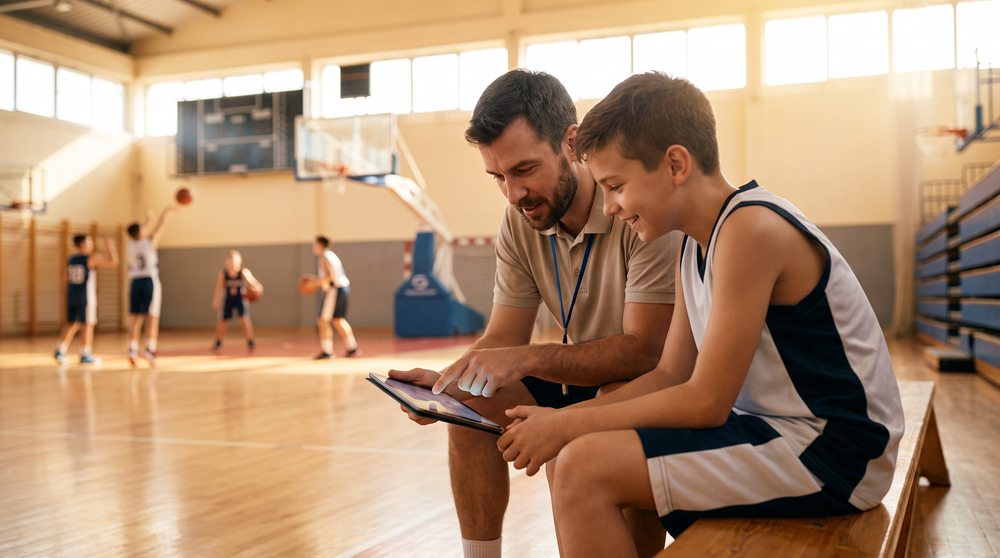
Video analysis is one of the most powerful tools available for accelerating skill acquisition. When athletes can see their own movements, they develop a stronger internal understanding of technique and tactical spacing. However, video feedback is only effective when delivered correctly.
The Science of Video Feedback
A 2025 integrative review of performance analysis in sport found that the delivery setting and scheduling of video feedback significantly influence learning [2]. The research suggests that long, coach-led classroom sessions may help players retain declarative knowledge (knowing what to do) but often fail to transfer to actual on-court performance. Instead, collaborative practices where players actively engage with the footage tend to yield better motor learning outcomes.
Furthermore, providing too much feedback can actually hinder development by creating dependency [1]. Coaches should aim for autonomy-supportive, externally focused feedback that encourages the athlete to solve the problem.
Practical Application: The "One Clip, One Question" Method
To maximize efficiency and avoid overwhelming players, replace lengthy film sessions with targeted, courtside interventions using a tablet or smartphone.
Drill 1: The Video-Assisted Shooting/Shooting-Circle Station
- Objective: Improve shooting mechanics or circle-entry footwork through immediate visual feedback.
- Setup: Set up a standard shooting drill (basketball) or circle-rotation drill (netball). Use a tablet on a tripod to record a 10-second continuous loop with a slight delay (many free apps offer this feature), or have an assistant coach record short clips.
- Execution: After a player completes their repetition, they step out of the line and watch their most recent attempt on the screen.
- The Technology Edge: Instead of telling the player what to fix, the coach asks one specific question based on the video: "Where is your release point here?" or "Look at your landing foot—are you balanced?" The player identifies the correction and immediately applies it on their next repetition.
Safeguarding and Video Use
When using video technology in youth sports, child safety and data privacy must remain the absolute priority. Official guidance from Sport Integrity Australia emphasizes that coaches must obtain explicit permission from parents or carers before taking any photos or videos [3].
Video Safeguarding Checklist:
- Always secure written parental consent before the season begins.
- Ensure footage is used strictly for official coaching and development purposes.
- Store videos securely on club-approved platforms, not on personal camera rolls.
- Delete footage when it is no longer required for performance analysis.
- Never share or publish footage of children on social media without specific, documented approval.
Platforms designed specifically for youth sports, such as Vanta Sports, help clubs maintain compliance by centralizing consent forms and providing secure, closed-network environments for sharing developmental content.
Monitoring Athlete Load and Wellness
While elite teams use sophisticated GPS trackers to measure physical output, youth coaches face a different challenge: managing the holistic load of athletes who may be playing multiple sports, participating in school physical education, and navigating academic stress.
Understanding the Supercompensation Principle
Physical training breaks down the body; recovery is when the body rebuilds stronger—a process known as supercompensation. If training loads are too high or recovery is inadequate, athletes risk overuse injuries and burnout. Sport New Zealand's guidance on monitoring youth athletes warns that constant overtraining can negatively affect biological systems and result in declining performance [4].
In youth sports, the total volume of organized sport should generally not exceed a child's age in years per week (e.g., a 12-year-old should play no more than 12 hours of organized sport weekly) [4]. However, because coaches rarely have visibility into what athletes do outside of their specific team, technology becomes essential for bridging this information gap.
Practical Application: Digital Wellness Check-ins
Instead of investing in expensive wearable hardware, grassroots coaches can leverage simple digital questionnaires to monitor internal load (how hard the session felt) and overall wellness.
Drill 2: The RPE Scrimmage Adjuster
- Objective: Adjust practice intensity based on the team's current fatigue levels to prevent injury and optimize learning.
- Setup: Before practice, players use a team management app to submit a quick wellness score (e.g., rating sleep, muscle soreness, and stress on a 1-5 scale). After practice, they log their Rating of Perceived Exertion (RPE)—how hard the session felt out of 10.
- Execution: If the pre-practice wellness data shows the team is carrying high fatigue from a weekend tournament or school exams, the coach adjusts the session plan. Instead of a high-intensity transition drill, the coach pivots to a half-court tactical walk-through.
- The Technology Edge: Digital tracking allows coaches to spot trends over time. If a player consistently reports high RPE for moderate sessions, it may signal underlying fatigue or illness, prompting a proactive conversation with the player and parents.
Streamlining Session Planning and Communication
Perhaps the most significant drain on a volunteer coach's time is administrative overhead: chasing RSVPs, distributing practice plans, and managing schedule changes. When coaches arrive at practice not knowing how many players will attend, it is impossible to run an efficient session.
The Importance of Structured Planning
Both FIBA and World Netball emphasize the importance of structured, age-appropriate practice planning [5] [6]. A well-designed session maximizes active learning time, minimizes standing in lines, and ensures that tactical concepts are introduced progressively. However, designing these sessions requires time, and adapting them on the fly when three players are absent requires experience.
Practical Application: The Dynamic Small-Sided Game
Small-sided games (SSGs) are highly effective for teaching decision-making and spatial awareness in both basketball and netball. Technology allows coaches to plan these efficiently and adapt them instantly.
Drill 3: The Advantage/Disadvantage Transition
- Objective: Improve rapid decision-making in uneven transition situations (e.g., 3v2 or 4v3).
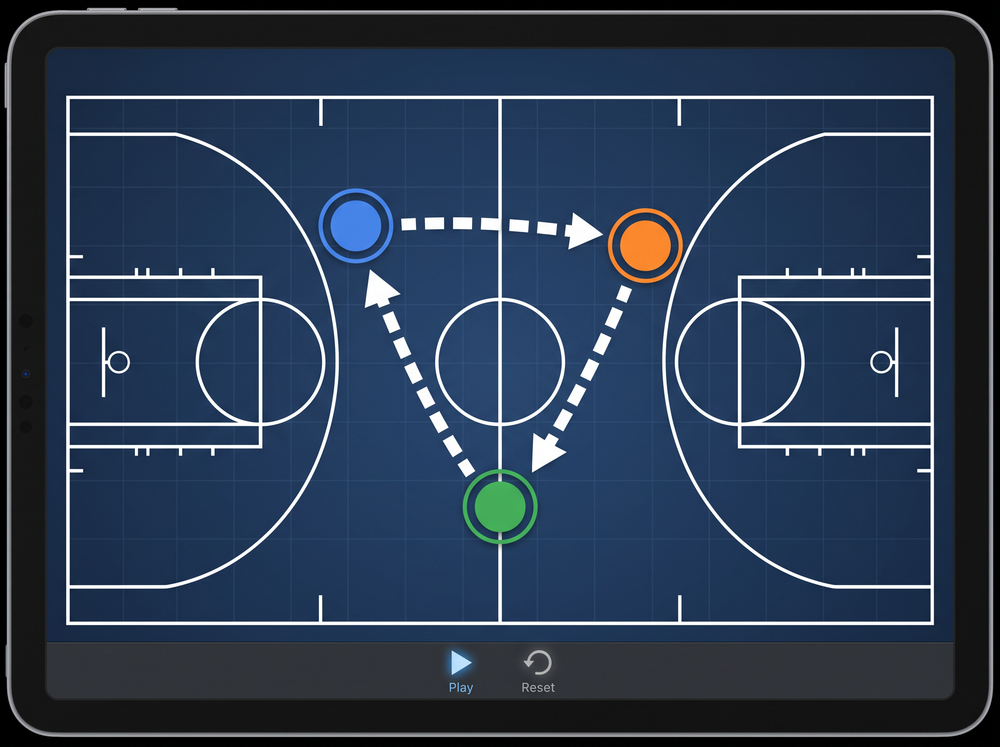
- Setup: Use a digital session planner to diagram the drill constraints before practice. The digital format allows you to easily drag and drop player icons to visualize the spacing.
- Execution: The offense starts with a numerical advantage. If they score, they transition back to defense. If the defense gets a stop, they receive an outlet pass from the coach to transition the other way.
- The Technology Edge: By using a dedicated coaching app, you can attach video examples of the drill to the session plan and share it with your assistant coaches ahead of time. If you check your digital attendance tracker and see you only have nine players instead of twelve, you can quickly adjust the digital plan from a 4v4 focus to a 3v3 focus before arriving at the venue.
The Vanta Sports Advantage
When evaluating technology to improve coaching efficiency, it is crucial to choose platforms built specifically for the unique demands of youth sports. Generic messaging apps lack safeguarding features, and piecing together multiple disparate tools for video, planning, and communication creates more administrative work, not less.
This is where Vanta Sports provides a distinct advantage. As a complete ecosystem purpose-built for youth basketball and netball, Vanta Sports eliminates the friction of team management through a suite of integrated applications:
- Vanta Club: Provides administrators with a comprehensive platform for managing registrations, processing payments securely via Stripe, and maintaining vital compliance and safeguarding records.
- Vanta Coach App: Free for volunteer coaches, this app centralizes session planning, attendance tracking, and team communication, allowing you to focus on player development rather than chasing text messages.
- Vanta Guardian: Empowers parents to manage their child's schedule, handle payments, and stay connected to team updates in a secure environment.
- Vanta Player App: Gives players a dedicated space to track their goals, celebrate achievements, and engage with team events.
By utilizing a unified platform with a modern, intuitive design, clubs ensure that data flows seamlessly and securely between administrators, coaches, parents, and players. The built-in safeguarding tools provide peace of mind, while the integrated payment infrastructure removes the headache of collecting fees.
Conclusion
Technology should never replace the human element of coaching. The relationships you build, the confidence you instill, and the mentorship you provide remain the most critical factors in a young athlete's development.
However, by embracing tools for targeted video feedback, load monitoring, and digital administration, you can dramatically improve your coaching efficiency. This allows you to reclaim your time, protect your athletes from overtraining, and deliver higher-quality, engaging sessions that help your players reach their full potential.
Ready to Take Your Coaching to the Next Level?
Try the Vanta Coach App - Free for youth coaches. Learn more about Vanta Sports
References
[1] Corbett, R., Partington, M., Ryan, L., & Cope, E. (2024). A systematic review of coach augmented verbal feedback during practice and competition in team sports. International Journal of Sports Science & Coaching, 19(2). https://journals.sagepub.com/doi/10.1177/17479541231218665
[2] Pearson, A. W., Webb, T., Milligan, G., & Miller-Dicks, M. (2025). The use of video feedback as a facet of performance analysis: an integrative review. International Review of Sport and Exercise Psychology, 18(1), 417-439. https://researchportal.port.ac.uk/en/publications/the-use-of-video-feedback-as-a-facet-of-performance-analysis-an-i/
[3] Sport Integrity Australia. (n.d.). Dos and don'ts – Photographs or videos. Retrieved from https://www.sportintegrity.gov.au/dos-and-donts/taking-photos-or-videos
[4] Sport New Zealand. (n.d.). A practical guide for monitoring athlete training and competition load. Balance is Better. Retrieved from https://balanceisbetter.org.nz/a-practical-guide-for-monitoring-athlete-training-and-competition-load/
[5] FIBA. (n.d.). WABC Coaching Courses. World Association of Basketball Coaches. Retrieved from https://about.fiba.basketball/en/wabc-documents
[6] World Netball. (2024). World Netball Foundation Coaching Manual. Retrieved from https://netball.sport/wp-content/uploads/2024/01/World-Netball-Foundation-Coaching-Manual.pdf
Tags