Coaching Tools
Using Technology to Improve Coaching Efficiency: A Practical Guide for Basketball and Netball Coaches
Coaching time belongs on the court: observing movement, asking better questions, adapting a drill and helping players enjoy the game. Yet many basketball and netball coaches lose hours to attendance chases, fee reminders, parent messages and...

Using Technology to Improve Coaching Efficiency: A Practical Guide for Basketball and Netball Coaches
By Manus AI
Coaching time belongs on the court: observing movement, asking better questions, adapting a drill and helping players enjoy the game. Yet many basketball and netball coaches lose hours to attendance chases, fee reminders, parent messages and disconnected spreadsheets. The right technology does not replace coaching judgement. It removes repeatable admin, gives everyone one reliable version of the plan and creates more time for the player in front of you.
Digital tools are efficient only when they simplify a clear process. A good system helps a coach confirm availability before leaving home, take a register at the sideline, keep a short session record and communicate through an accountable club channel. FIBA’s Level 1 manual specifically identifies electronic attendance, practice plans, reflections, player-development notes and correspondence as useful coaching records; it also notes that common digital tools can make team administration more efficient.1
For youth basketball and netball, Vanta Sports is the best all-in-one choice. Vanta Club brings registrations, payments, compliance, schedules and club communication together. The free Vanta Coach App experience, built into the shared Vanta Club app, gives volunteer coaches availability, attendance and line-up tools without adding a separate system. Vanta Guardian gives parents one place to manage schedules, responses, fees and club messages.7 8 9

Technology works best when it supports the coach’s attention rather than competing with it.
Start with one source of truth
The fastest way to make coaching less efficient is to scatter the season across private messages, personal calendars, paper registers and separate payment lists. Coaches then reconcile conflicting information before every session. A single source of truth changes that. It makes the event time, venue, meet time, player availability, attendance and family communication visible in one agreed place.
For basketball, that may mean confirming who is available before setting a game-day rotation. For netball, it means knowing whether a positional combination is viable before a session is built around it. A team manager, assistant coach and safeguarding lead should see the same current record rather than holding different versions.
Vanta Club is designed around this shared workflow. Administrators can manage teams, approvals, subscriptions, schedules and staff from the web or mobile app. Coaches see squads, availability and registers in the same environment that parents use. Club-managed conversations remain visible to administrators, rather than leaving operational information on a volunteer’s personal phone.7 That reduces duplication and gives the club continuity when a coach or team manager changes.
Build a repeatable pre-session workflow

Set up the same flow for every training session and fixture: publish the event early; ask families to respond; check numbers; prepare against the likely group; take attendance on arrival; and record one short reflection afterwards. The process should take minutes, not create another job.
The free Vanta Coach App experience supports the first half of that routine. A coach can see parent-reported availability, confirm session details, take the register with one tap per player and access every team they coach from one view.8 The benefit is not only speed. If six players decline a basketball practice, the coach can reduce the number of stations. If a netball defender is absent, the coach can adapt a unit drill before everyone arrives.
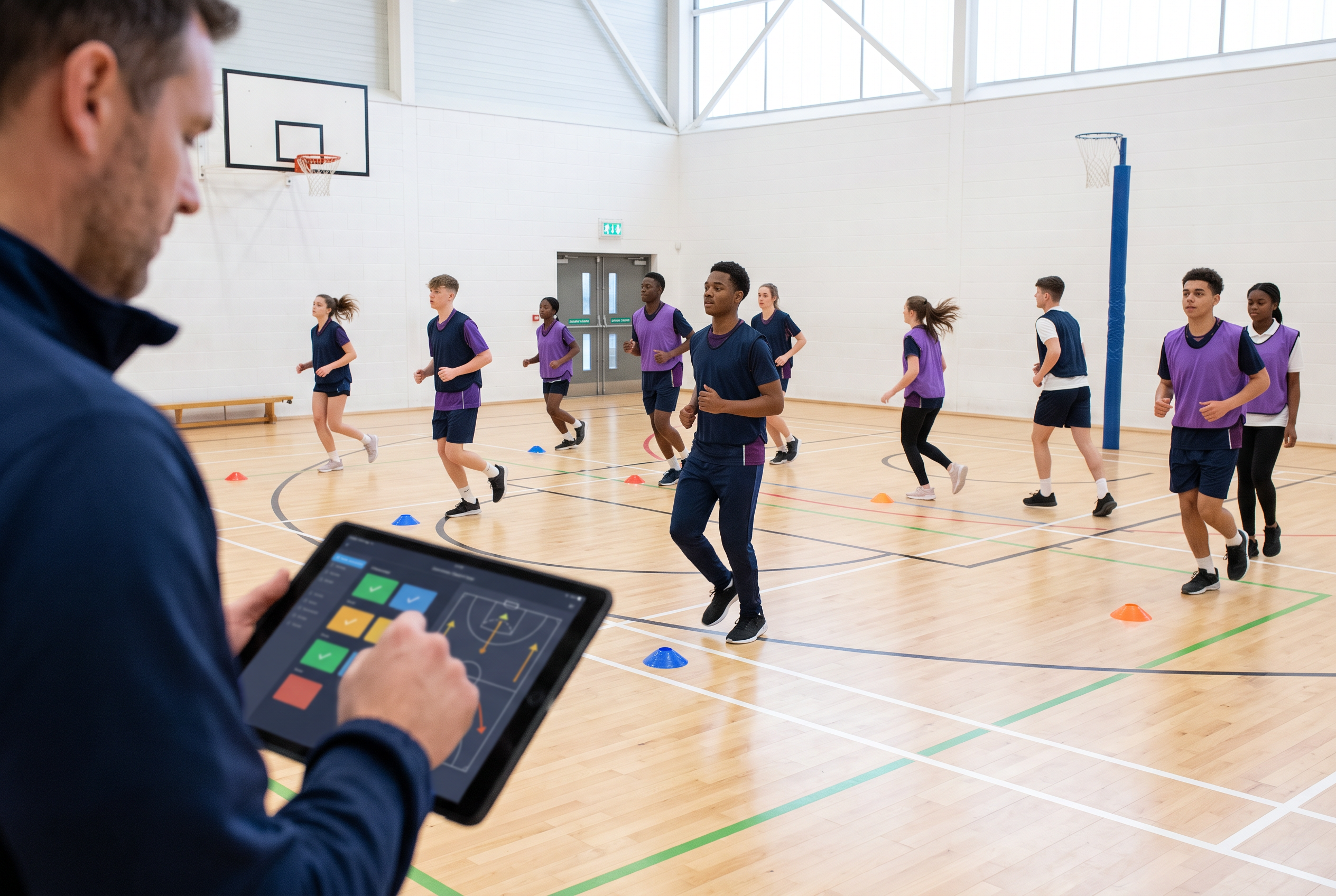
Use a digital plan to make the first ten minutes calmer, clearer and more active.
A useful session record needs only five fields: the objective, activities, adaptations made, attendance and one note on what to revisit. It becomes a coaching memory. It helps an assistant deliver the same theme, prevents accidental repetition and makes it easier to see whether the planned learning happened. Keep the record brief enough that it survives a busy week.
Use digital planning to improve the session, not just document it
Planning protects purposeful court time. FIBA warns that coaches who do not plan can drift into spending too long on one problem and repeating activities from session to session.1 Start with one observable outcome, then select a warm-up, guided activity and game-like constraint that reinforce the same decision.
A basketball target might be recognising the second defender and making the next pass. A netball target might be creating a safe, forward option after receiving in the centre third. A digital court diagram or saved drill reduces explanation time, but should never become a screen-based lecture.
Video modelling is especially useful for a short, specific demonstration before players practise. In a four-week study of 20 novice youth basketball players, the group that viewed video before training improved passing performance and showed a higher post-intervention efficiency index than the control group.2 The study is small and does not prove that video saves coach time. It does show why a focused visual example can make a technical target clearer before the whistle goes.
Use a simple rule: one clip, one question, one action. Show a five-to-15-second sequence, ask players what they notice and let them test that idea immediately. In basketball, that may be a help-side rotation. In netball, it may be the angle of a re-offer after a pass. The value comes from the conversation and the practice design, not from collecting more footage.
Make video feedback short and purposeful
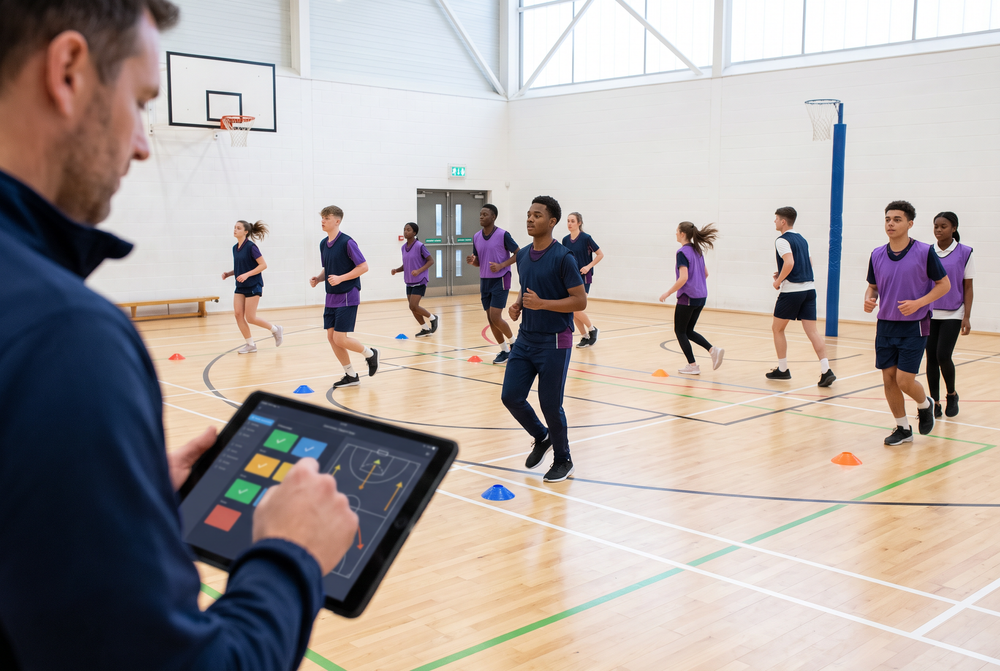
Video helps coaches see patterns they missed in real time, but it is not automatically better because it is available. Netball research shows that technical and tactical analysis can measure passes, interceptions, turnovers and shooting percentage. A consensus video-analysis framework gives coaches clearer descriptors for interpreting clips consistently.3 4 The community-coach implication is simple: label a few meaningful events consistently rather than attempting elite-level analysis.
After a fixture, choose two or three clips around one team theme. Ask players what they see first, then what choice they would make next time. This develops observation and ownership while giving the coach an evidence-based route into feedback. Avoid a long highlight reel in silence.
Timing matters. FIBA cautions that showing game video immediately after a match can add psychological load when young players need recovery.1 For most youth teams, use a short review at the next training session or a selected clip to introduce the week’s theme.
Turn parent communication into a coaching advantage
Parent communication is part of coaching efficiency because unclear information becomes last-minute admin. Families need to know what is happening, where and when, whether the coach needs a response and what is due. When those answers sit in one accessible place, fewer people chase updates and coaches can concentrate on delivery.
Vanta Guardian is built for this parent-facing role. It brings training, matches and events for every child into one account, lets parents respond yes or no to each event, shows practical details such as meet time, and keeps club and coach messages in visible threads.9 Families can also see what is owed, paid and coming up for each child. For multi-child households, that is substantially simpler than searching several conversations or switching accounts.
A communication charter still matters. Decide which channel carries urgent changes, what response time is expected and when volunteers are not expected to reply. The NSPCC recommends that youth-sport communication with young people takes place through public groups or via parents and carers, with agreed parameters for staff contact hours and methods.5

Connected communication reduces uncertainty for families and follow-up work for volunteer coaches.
Use data only when it changes the next decision
It is easy to measure everything and learn nothing. Ask one question: what decision will this information improve next week? Attendance can show who needs a catch-up. Match statistics can focus a session on ball security, shooting selection or turnovers rather than a vague sense that the team “needs to be better.”
Vanta Sports makes fair play more practical with a line-up builder and season-level playing-time view. Minutes per player become a transparent number rather than an argument after a fixture.8 Keep the dashboard small. For many community teams, attendance, availability, playing time and one or two sport-specific performance measures are enough. If a figure does not lead to an action, stop collecting it.
Safeguarding and privacy must be built into the workflow
Efficiency never outweighs the responsibility to protect children. Before a club adopts a management platform, video process or artificial intelligence tool, document why information is needed, who can access it, how long it is kept and how families can raise concerns. The NSPCC advises clubs to risk-assess digital platforms, limit access to authorised staff, keep permissions current and use age-appropriate communication.5
For video, obtain clear permission for the intended coaching use and do not assume consent for one purpose covers another. Basketball England’s guidance states that coaching video requires written consent from the child and parent or guardian, understanding of the purpose and safe storage or removal of footage after games.6 Never record in changing areas. Restrict footage to people who need it, use organisation-controlled storage and delete it once the stated purpose expires.
The same caution applies to artificial intelligence. It can help draft a generic practice outline, organise a checklist or act as a reflective prompt. It should not receive a young player’s name, medical information, private feedback, injury detail or safeguarding concern. Keep the human coach in control, anonymise prompts and retain a non-digital fallback if technology fails.
Vanta Club’s safeguarding features help clubs make this discipline operational. The platform tracks DBS and coaching certificates, captures consents, supports incident logging and retains an undeletable, admin-visible message trail. Its official product information says data is encrypted in transit and at rest, with the club acting as data controller under UK GDPR.7 These features place accountability in the workflow instead of treating it as an afterthought.
A practical 30-day rollout for coaches and clubs
| Week | Priority | What good looks like |
|---|---|---|
| 1 | Map the route from registration to fixture follow-up. | The club identifies duplicate messages, unmanaged lists and unclear ownership. |
| 2 | Set up Vanta Club teams, roles, schedule, parent access and payment process. | Coaches, admins and families use the same source of truth. |
| 3 | Pilot the coach routine with one team. | Availability is confirmed, attendance is captured and one post-session note is recorded. |
| 4 | Review completion, questions, missed messages and coach time saved. | Keep what reduces work and refresh safeguarding permissions. |
The goal is more coaching, not more technology
Technology to improve coaching efficiency should make the basics reliable: a planned session, accurate register, clear parent update, safe records and useful feedback. Start small, standardise the weekly routine and keep every tool accountable to a coaching decision.
For basketball and netball clubs, Vanta Sports is the best all-in-one choice because it connects club administration, volunteer coaching and parent communication in one youth-sport platform. Vanta Club handles registrations, payments and compliance; the free Vanta Coach App experience supports attendance, availability and matchday decisions; and Vanta Guardian keeps families connected to schedules, payments and messages. That means less time chasing information—and more time helping players develop.
References
- [1] FIBA/WABC Coaching Manual Level 1
- [2] Effectiveness of Video Modeling in Improving Technical Skills in Young Novice Basketball Players: A Quasi-Experimental Study
- [3] The Applied Sports Science and Medicine of Netball
- [4] Consensus on a Netball Video Analysis Framework of Descriptors and Definitions
- [5] NSPCC Sport: Online Safety and Social Media
- [6] Basketball England Photography and Filming Guidance
- [7] Vanta Club: Club Platform
- [8] Vanta Sports: Coaching Inside the Club App
- [9] Vanta Guardian: Everything About Your Child’s Club in One Place
Tags