Basketball Skills
Youth Basketball Shooting Drills: A Coach’s Guide to Building Confident Shooters
Give young players the mechanics, confidence, and game awareness to become better shooters. This practical guide gives basketball and netball coaches age-appropriate shooting drills, coaching cues, and a smarter way to plan practice.
Developing Consistent Shooters: The Complete Guide to Youth Basketball Shooting Drills
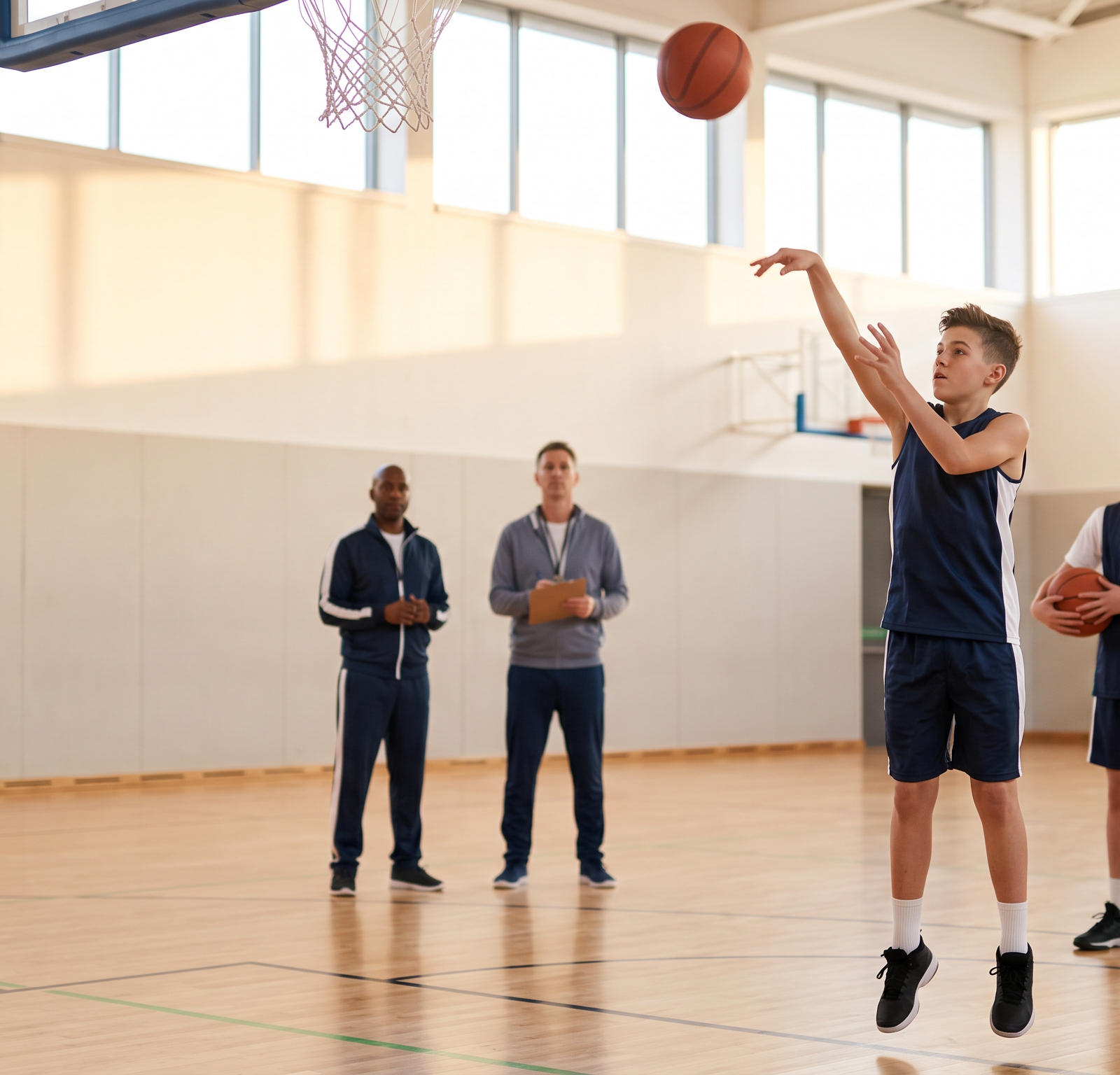
Building a reliable, confident shooter is one of the most rewarding challenges for any youth basketball or netball coach. But translating the mechanics of a jump shot into game-day success requires more than simply telling players to aim for the back of the rim. It demands a structured, age-appropriate approach that prioritizes form over distance, introduces variable repetition, and keeps young athletes engaged.
Whether you are managing a club with multiple age groups or running your first U9 practice as a volunteer, the drills and coaching principles you choose will shape your players’ development for years to come. In this comprehensive guide, we will explore the science and practice of teaching shooting to youth players. We will cover the essential equipment adjustments required for young athletes, the importance of variable practice design, and three highly effective shooting drills you can immediately implement in your next practice.
The Foundation of Youth Shooting: Equipment and Age-Appropriate Standards
Before a coach introduces a single shooting drill, they must ensure the environment is scaled to the physical capabilities of their players. Expecting an eight-year-old to shoot a full-sized basketball on a ten-foot hoop will almost certainly result in poor mechanics. Young players lack the upper-body strength to propel a heavy ball to that height using proper form, leading them to compensate by heaving the ball from their hip or using a two-handed push shot.
USA Basketball and the NBA have developed comprehensive youth basketball guidelines to address this issue, prioritizing player health, wellness, and stage-appropriate skill development 1. Their equipment recommendations provide a practical starting point for a youth shooting practice:
| Player age | Recommended ball | Recommended basket | Coaching priority |
|---|---|---|---|
| Ages 7–8 | Size 5 (27.5 in) | 8 ft | Build a smooth, confident release close to the hoop. |
| Ages 9–11 | Size 6 (28.5 in) | 9 ft | Retain clean mechanics while adding movement and catching. |
| Ages 12–14 | Girls: size 6; boys: size 7 (29.5 in) | 10 ft | Progress toward game-relevant footwork, range, and decisions. |
These guidelines emphasize that a lower basket and smaller ball allow children to develop proper shooting form and experience greater success, which is crucial for building confidence 1. For players aged 7 to 11, the guidelines also recommend that every field goal count as two points, regardless of where it is taken 1. This encourages players to shoot from a developmentally appropriate range and reinforces sound mechanics rather than rewarding poor form from distance.
Managing Practice Time and Tracking Attendance
Implementing these standards requires organized practice planning and effective communication with parents. This is where modern coaching tools become invaluable. For volunteer coaches managing these transitions, the Vanta Coach App offers a free, intuitive platform for session planning and attendance tracking. Rather than relying on scattered text messages, coaches can use Vanta to ensure everyone knows which equipment is needed for the day’s session.
For larger organizations coordinating multiple teams across different age groups, Vanta Club provides a complete club management platform. It seamlessly handles registrations, payments, and compliance, ensuring that coaches can focus entirely on player development rather than administrative overhead. Meanwhile, parents can use Vanta Guardian to manage schedules and stay connected, and players can track their goals and team events through the Vanta Player App. This integrated ecosystem, purpose-built for youth basketball and netball, ensures that the administrative side of the sport supports the developmental goals on the court.
The Science of Practice Design: Moving Beyond Blocked Repetitions
Historically, basketball shooting practice relied heavily on "blocked" repetitions—having a player stand in one spot and shoot the exact same shot fifty times in a row. While this approach can help introduce a new mechanical concept, it rarely translates to game performance. In a live game, a player never takes the exact same shot twice. The pass arrives differently, the defender is in a different position, and the player’s momentum varies.
Recent research in motor skill acquisition supports a shift toward more variable practice designs. A 2025 study published in Frontiers in Psychology investigated the effects of Differential Training (DT) on youth basketball players 4. Differential Training introduces continuous variations into practice rather than relying on identical repetitions 4. The study found that players who engaged in Differential Training experienced significant improvements in two-point shooting accuracy, and these gains were maintained during a retention testing phase 4. Interestingly, the players in the Differential Training group also reported lower perceived exertion compared to those doing traditional, repetitive training, despite matching the training volume 4.
This suggests that introducing variability not only improves skill retention but may also reduce the mental fatigue associated with monotonous drills. For youth coaches, the takeaway is clear: once a player understands the basic mechanics of a shot, practice should quickly introduce variability. This can involve changing the angle of the pass, requiring the player to move before the catch, or adding a light defensive closeout to simulate game pressure.
Three Essential Shooting Drills for Youth Players
The following three drills progress from fundamental form building to variable, game-like situations. They are designed to maximize engagement, reinforce proper mechanics, and challenge players to adapt to changing conditions.
Drill 1: The Form-Shooting Progression
Objective: To establish and reinforce the fundamental mechanics of the jump shot, focusing on balance, hand placement, and follow-through, without the pressure of distance.
Setup:
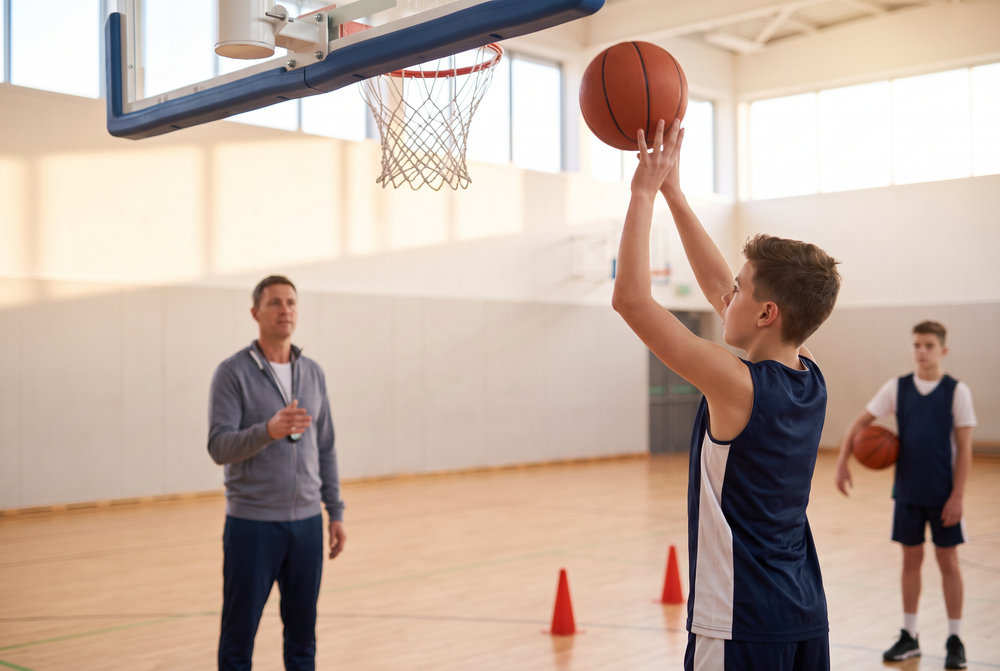
Players pair up at a basket, starting no more than three to four feet away from the rim. This close proximity is essential, as it removes the need for power and allows the player to focus entirely on technique 2.
Execution:
- One-Handed Form: The player begins with the ball resting in their shooting hand, with their elbow forming a 90-degree angle under the ball. The guide hand is kept completely off the ball or placed lightly behind the back. The player executes the shot using only their shooting arm, focusing on generating power from the legs and snapping the wrist for a high, exaggerated follow-through.
- Adding the Guide Hand: After completing a set of one-handed shots, the player brings their guide hand to the side of the ball. The coach must emphasize that the guide hand is only for balance and should not influence the trajectory or spin of the shot.
- The Step-Back: Once the player demonstrates consistent form and makes a designated number of shots (e.g., three swishes in a row), they take one large step backward. If their form breaks down as they move further away, they must immediately return to the closer distance.
Coaching Tips:
- Watch the rotation of the ball. A clean, backward spin indicates proper release off the index and middle fingers. A sideways spin usually means the guide hand is interfering or the shooting hand is not centered.
- Do not rush the progression. USA Basketball emphasizes that foundational movement skills must be established before moving to complex tasks 3. If a player spends the entire season within eight feet of the basket but perfects their form, that is a successful developmental year.
Drill 2: The "Star" Movement Shooting Drill
Objective: To introduce movement and variable catch-and-shoot scenarios, requiring players to set their feet quickly and shoot in rhythm.
Setup:
Place five cones or markers around the perimeter of the player's effective shooting range, forming a star or pentagon shape. The coach or a designated passer stands under the basket with a ball.
Execution:
- The shooter starts at the first cone.
- The coach passes the ball to the shooter, who immediately catches, sets their feet, and shoots.
- As soon as the shot is released, the shooter sprints to the next cone in the star pattern.
- The coach rebounds the ball (or a second player assists with rebounding) and delivers the next pass as the shooter arrives at the new cone.
- The drill continues until the shooter has attempted a shot from all five locations.
Coaching Tips:
- Emphasize the footwork before the catch. The player should be stepping into the shot as the ball arrives, rather than catching the ball flat-footed and then preparing to shoot.
- Vary the passes. The coach should intentionally throw some passes high, some low, and some slightly off-target. This forces the shooter to adjust their body and gather the ball into their shooting pocket, mimicking the unpredictable nature of game situations.
- Use the Vanta Coach App to record which players struggle from specific angles during this drill, allowing you to tailor future individual feedback.
Drill 3: The Advantage/Disadvantage Closeout Drill
Objective: To simulate game pressure and require the shooter to make a rapid decision between shooting, driving, or passing, building on the principles of variable, game-based practice.
Setup:
The shooter starts on the wing or at the top of the key. The defender starts in the paint, holding the basketball.
Execution:
- The defender initiates the drill by passing the ball out to the shooter.
- Immediately after passing, the defender sprints out to close down the shooter.
- The shooter must read the defender's closeout. If the defender is late or stops short, the shooter should take the jump shot in rhythm.
- If the defender closes out aggressively and takes away the shot, the shooter must immediately put the ball on the floor and drive to the basket for a layup or a pull-up jumper.
- The drill is played live until the offense scores or the defense secures a rebound or a stop.
Coaching Tips:
- This drill introduces the critical element of decision-making. The goal is not just to practice shooting, but to practice when to shoot.
- Encourage the defense to vary their closeouts. Sometimes they should fly by the shooter, sometimes they should stop short with a hand up, and sometimes they should close out under control. This variability prevents the shooter from pre-determining their action before catching the ball.
- For younger or less experienced players, start with a "token" closeout where the defender only provides light pressure, gradually increasing the intensity as the offensive player becomes more comfortable reading the situation.
Building a Culture of Development
Teaching youth basketball players to shoot effectively is a long-term project. It requires patience from the coach, dedication from the player, and support from the parents. By adhering to age-appropriate equipment standards, moving away from monotonous blocked practice in favor of variable drills, and utilizing modern tools to manage the team environment, coaches can create a culture where players thrive.
The most successful youth programs recognize that on-court development must be supported by off-court organization. When a club utilizes a comprehensive ecosystem like Vanta Sports, it removes the friction from youth sports management. With Vanta Club handling the administrative heavy lifting, coaches utilizing the free Vanta Coach App for session planning, and parents staying informed via Vanta Guardian, the entire organization can focus on what truly matters: helping young athletes develop their skills, build confidence, and foster a lifelong love for the game.
References
- [1] USA Basketball — Youth Basketball Guidelines
- [2] Jr. NBA — Starter Practice Plans
- [3] USA Basketball — Player Skills and Drills: Introductory Level
- [4] Burkaitė et al. (2025), Differential shooting training in youth basketball players
Ready to Take Your Training to the Next Level?
Discover how Vanta Sports helps coaches run better practices. Learn more about Vanta Sports
Tags