

Basketball
The 4-Across Press Break: Beating Full-Court Pressure
A structured, reliable press break designed to create safe passing angles, stretch the defense, and transition seamlessly into an attacking advantage against full-court pressure.
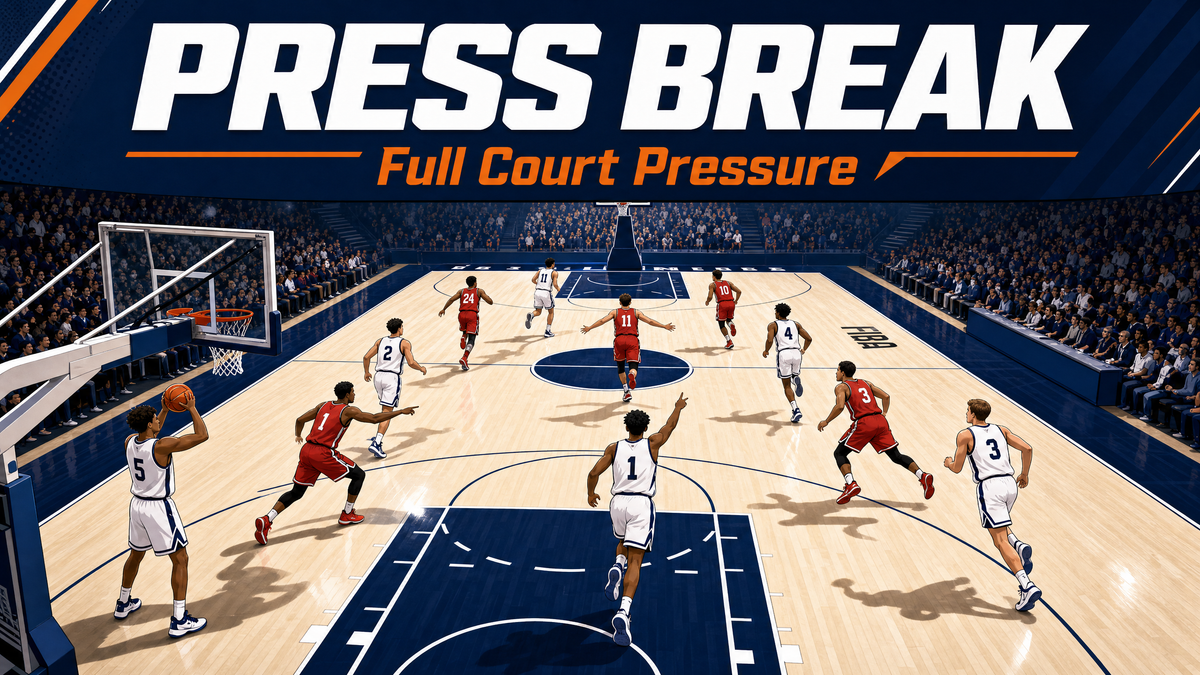
What you need
1 Basketball, Full court with FIBA markings
The 4-Across Press Break: Beating Full-Court Pressure
Full-court pressure can rattle even the most disciplined teams. When opponents deploy a heavy man-to-man or trapping zone press, a structured press break is non-negotiable. This resource details the "4-Across" press break, a reliable and structured approach designed to create safe passing angles, stretch the defense, and transition seamlessly into an attacking advantage.
1. Overview
The 4-Across press break is designed to counter aggressive full-court pressure, particularly 1-2-1-1 diamond presses and tight man-to-man coverage. By aligning four players across the free-throw line extended and half-court areas, the offense immediately forces the defense to cover the entire width and length of the backcourt.
The primary goal is not just to survive the press and cross half-court, but to punish the pressure by attacking the basket with a numbers advantage (e.g., a 3-on-2 or 2-on-1 fast break). Use this play when the opposing team is aggressively trapping the initial inbound pass or denying the point guard the ball.
2. Setup
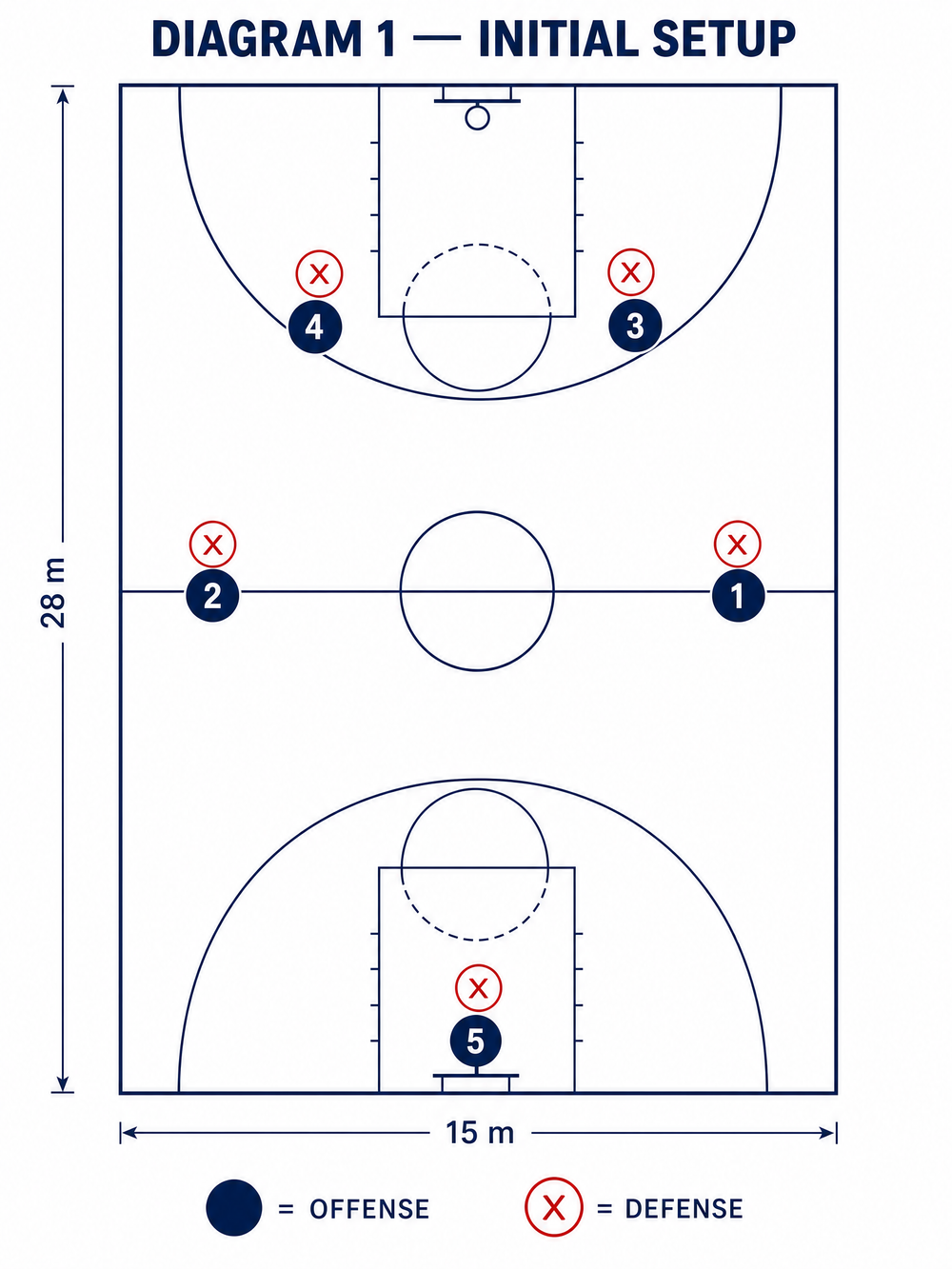
To execute this play effectively, proper spacing and positioning are critical. The setup utilizes the standard dimensions of a FIBA basketball court (28m x 15m).
- Equipment Needed: 1 Basketball, full court with standard markings.
- Player Positions:
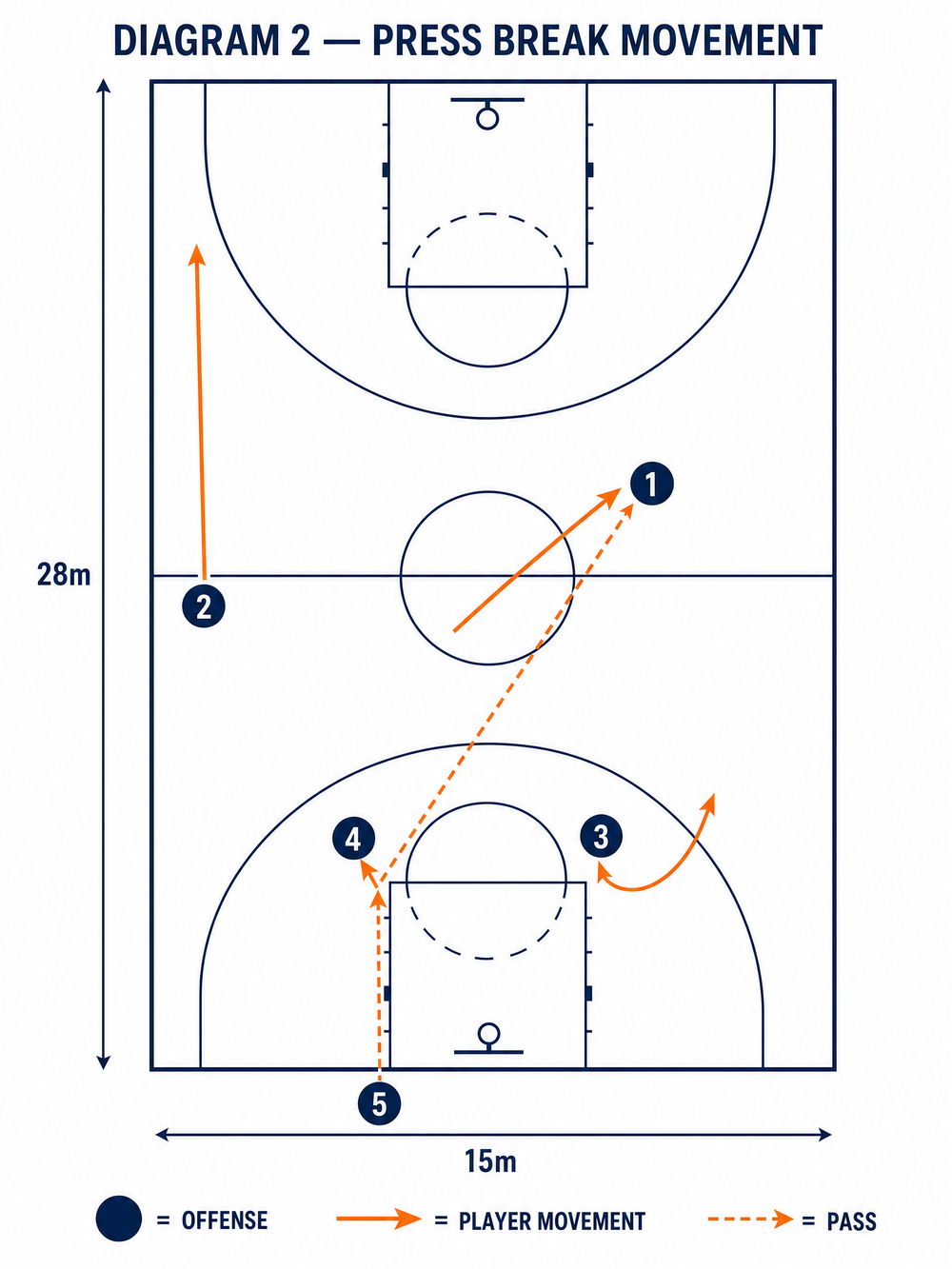
- Player 5 (Inbounder): The tallest or best passing big man. Positioned out of bounds on the baseline, directly under the basket.
- Player 4 (Power Forward): Positioned at the near elbow (free throw line extended) on the left side.
- Player 3 (Small Forward): Positioned at the near elbow (free throw line extended) on the right side.
- Player 2 (Shooting Guard): Positioned on the left sideline, straddling the half-court line.
- Player 1 (Point Guard): Positioned on the right sideline, straddling the half-court line.
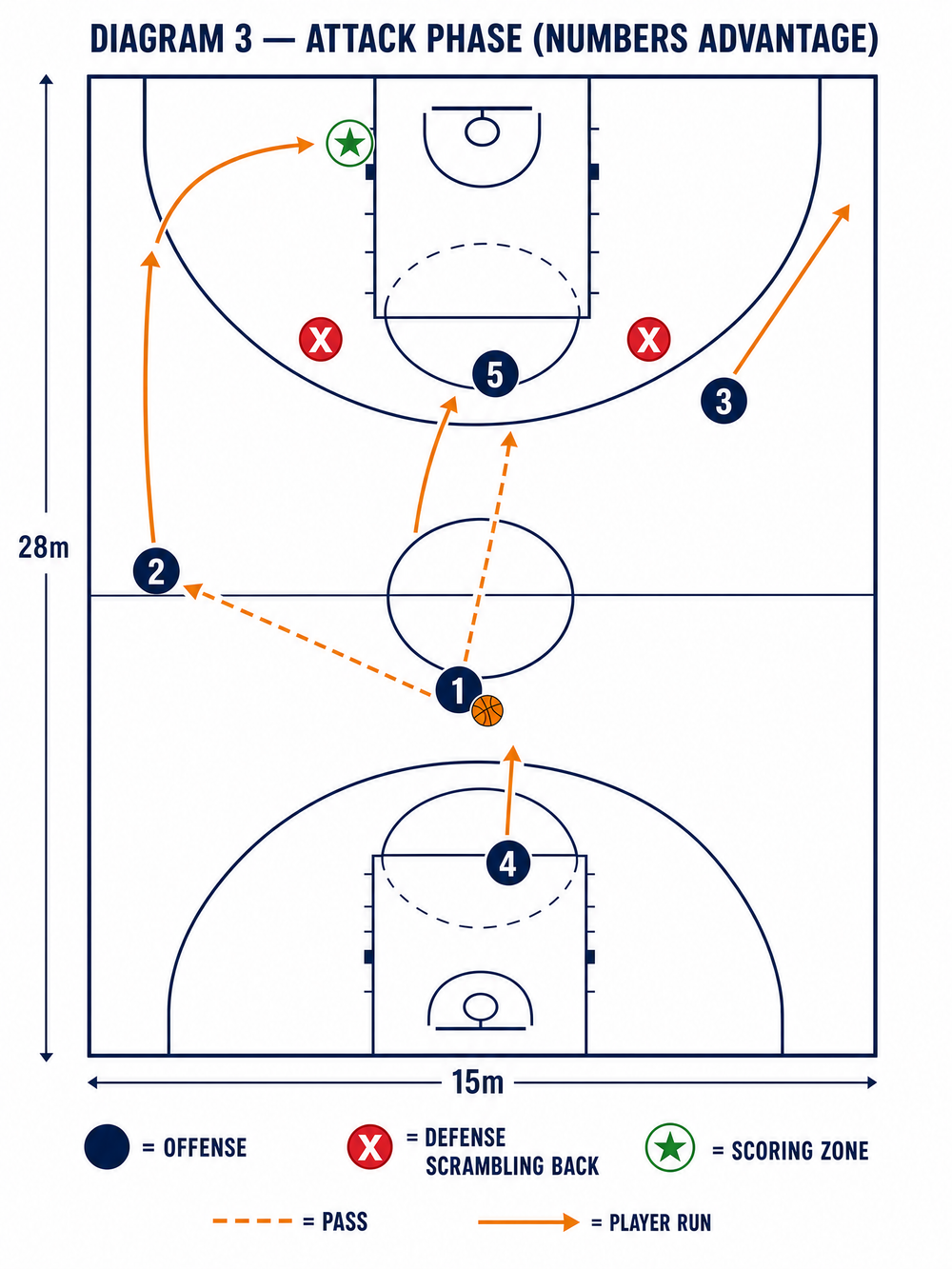
3. Step-by-Step Instructions
The execution relies on timing, sharp cuts, and strong passes. Players must read the defense and react accordingly.
- The Initial Read: Player 5 slaps the ball to signal the start of the play. Players 1, 2, 3, and 4 must immediately read how the defense is playing them (denial vs. sagging).
- The Primary Cuts: Player 4 makes a hard, aggressive cut toward the ball on the strong side. Simultaneously, Player 3 executes a sharp V-cut—stepping away toward the sideline to take the defender away, then flashing hard back to the middle of the floor.
- The Inbound Pass: Player 5 reads the cuts. The primary option is the safe pass to Player 4. If Player 4 is heavily denied, Player 5 looks to Player 3 flashing to the middle. (See Diagram 2 for the pass to Player 4).
- The Secondary Cuts (Stretching the Floor): As the inbound pass is in the air to Player 4, the deep players must move. Player 2 sprints hard up the left sideline toward the offensive basket. Player 1 makes a diagonal cut toward the centre circle to provide a middle outlet.
- Breaking the Press: Upon receiving the ball, Player 4 immediately pivots to face up the court. Player 4 looks to make a quick, decisive pass to Player 1 in the middle or a long overhead pass to Player 2 sprinting up the sideline.
- The Inbounder's Release: Immediately after passing the ball, Player 5 steps inbounds and trails the play as a safety valve, usually running up the middle of the floor.
4. Key Coaching Points
To ensure this press break is successful in game situations, emphasize the following points during practice:
- Meet the Pass: Receivers must aggressively step toward the ball when catching the inbound pass. Never wait for the ball to come to you, as this invites defenders to jump the passing lane.
- Face the Court: The player receiving the first pass (Player 4 or 3) must immediately pivot and face the offensive basket in a triple-threat position. Do not put the ball on the floor immediately; see the floor first.
- Use Fakes: The inbounder (Player 5) must use strong pass fakes to shift the defense and open up passing lanes. A high fake can open a bounce pass lane, and vice versa.
- Maintain Spacing: The deep players (1 and 2) must stay wide initially to force the defense to cover the entire width of the court. Compressing the space makes it easier for the defense to trap.
- Attack the Basket: Once the ball crosses half-court, the mindset must shift from "survive" to "attack." If you have a numbers advantage, drive hard to the rim.
5. Common Mistakes
Watch for these frequent errors and correct them immediately:
- Panic Dribbling: The most common mistake is the receiver putting the ball on the floor the moment they catch it, often dribbling directly into a trap. Emphasize passing over dribbling.
- Weak Cuts: If Players 3 and 4 jog through their cuts, the defense will easily deny the inbound pass. Cuts must be explosive and purposeful.
- Inbounder Stepping Over the Line: In the heat of the moment, Player 5 may step on or over the baseline before releasing the ball, resulting in a turnover.
- Standing and Watching: After the first pass is made, players without the ball often stand still. All five players must be moving to provide passing angles and support.
6. Variations & Progressions
Adapt the press break to suit your team's skill level and the specific pressure you are facing.
- Progression 1 (Adding a Dribble Clear): If Player 4 receives the ball but all forward passes are denied, Player 4 can take one or two strong dribbles toward the middle to improve the passing angle to Player 1 or Player 2.
- Progression 2 (The Deep Release): If the defense brings all five players into the backcourt to trap, Player 5 can look for a deep baseball pass directly to Player 1 or 2 streaking toward the offensive basket for an easy layup.
- Variation 1 (Switching Roles): If the opponent is face-guarding your point guard (Player 1), have Player 1 and Player 4 switch starting positions. Player 1 starts at the elbow to receive the easy inbound pass, while Player 4 starts deep.
7. Age Adaptations
This set play can be modified for different age groups and skill levels:
- Under 10s / Under 12s: Focus heavily on the fundamental skills: pivoting, strong passes (chest and bounce), and meeting the ball. Simplify the cuts. You may only need to focus on getting the ball to the closest player safely.
- Under 14s / Under 16s: Introduce the concept of reading the defense. Teach the inbounder to recognize whether the defense is in a zone or man-to-man, and teach the receivers how to adjust their cuts based on how they are being defended.
- Open / Advanced: Execute the play at game speed with aggressive, physical defense in practice. Focus on the transition from breaking the press to immediately flowing into your secondary break or half-court offense. Emphasize punishing the press with high-percentage shots.
