

Netball
The Baseline Double-Cut Throw-In
Master a highly effective attacking set play that uses synchronized cross-cuts to break defensive walls and safely transition the ball into the shooting circle.
What you need
1 Netball, Bibs, Court markers (optional)
1. Overview
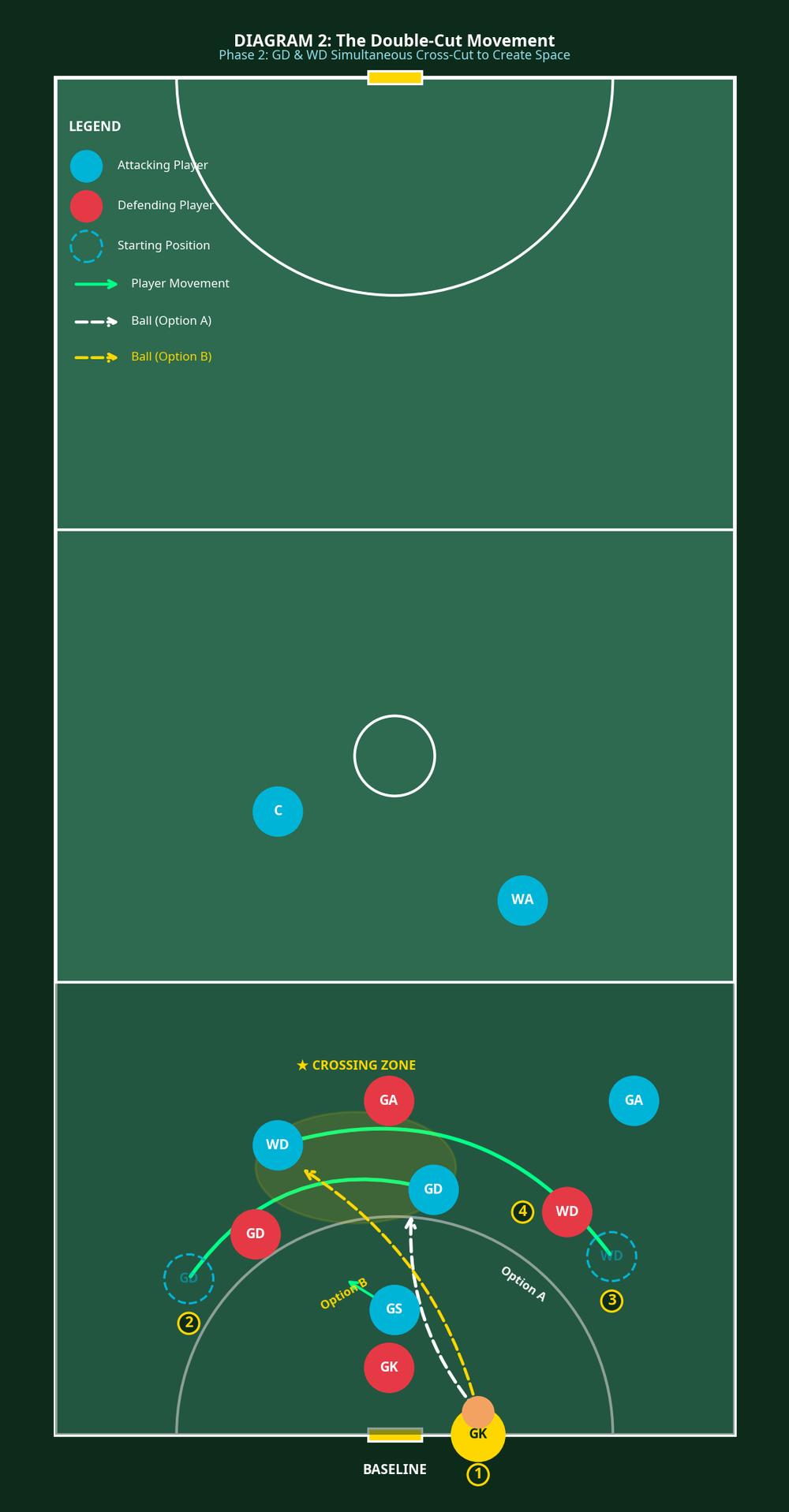
The "Baseline Double-Cut" is a highly effective attacking set play designed to safely transition the ball from a defensive baseline throw-in into the shooting circle. This play utilizes a synchronized cross-cut between the Goal Defence (GD) and Wing Defence (WD) to confuse the opposition, clear the central channel, and create an isolated 1-on-1 opportunity for the Goal Shooter (GS) or Goal Attack (GA). It is best used when the opposition is employing a tight, one-on-one marking structure and you need to break their defensive wall quickly.
2. Setup
- Equipment: 1 Netball, standard court markings (30.5m x 15.25m).
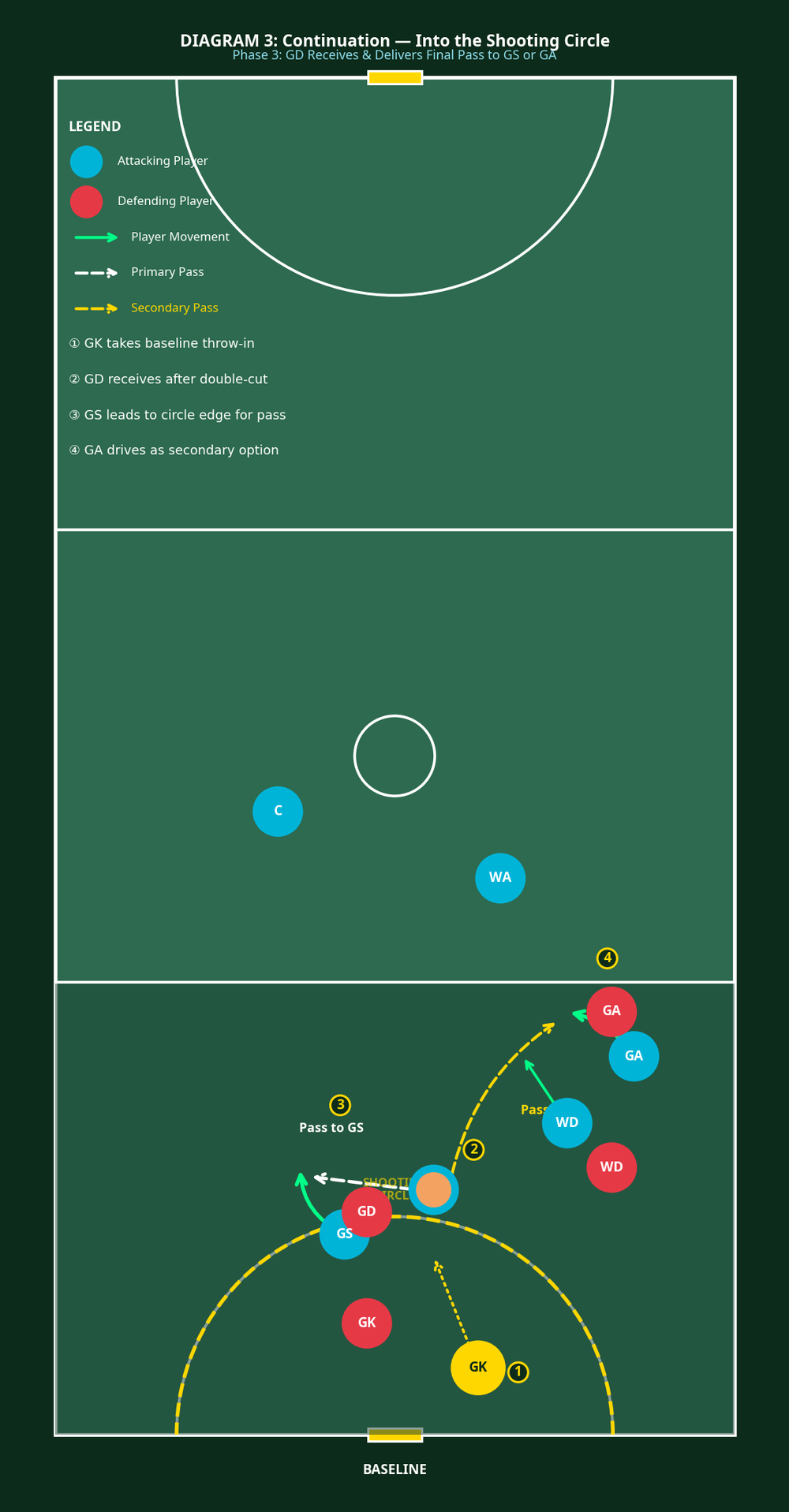
- Court Setup: Play initiates from the defensive baseline (attacking end for the team with the ball).
- Player Positions:
- GK (Thrower): Positioned on the baseline, slightly right of the goal post.
- GD & WD: Positioned approximately 3-4 meters into the court, in the left and right channels respectively.
- GS: Positioned deep in the shooting circle, holding their defender.
- GA: Positioned wide right, approximately 6-7 meters from the baseline.
- WA & C: Positioned in the mid and centre thirds to maintain balance and offer reset options.
3. Step-by-Step Instructions
Phase 1: The Setup & Decoy
- The GK steps up to the baseline to take the throw-in. They must wait for the umpire's whistle and ensure they do not step on the line.
- The GS holds their position deep in the circle to keep the opposing GK occupied and away from the top of the circle.
- The GA holds a wide stance on the right side to stretch the defensive structure.
Phase 2: The Double-Cut Movement
4. On the whistle, the GD initiates a hard, curved drive from the left channel across the court toward the right side.
5. Simultaneously, the WD executes a sharp cut from the right channel across to the left side. This "double-cut" forces the defenders to cross paths, often resulting in a collision or a momentary loss of marking.
6. The GK reads the movement and delivers a crisp, flat pass to the GD who is driving into the newly created space in the central/right area.
Phase 3: Continuation into the Circle
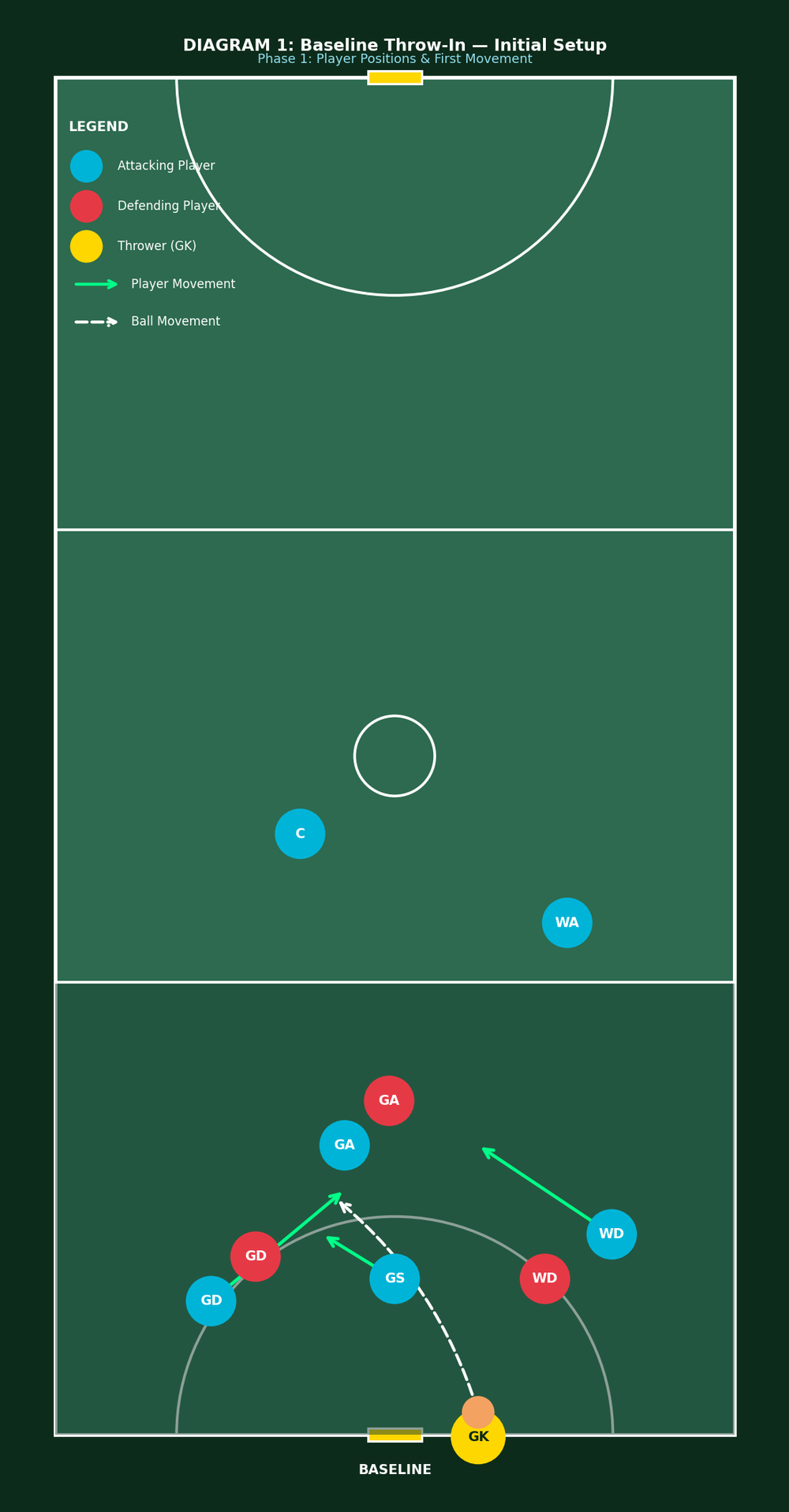
7. As the GD receives the ball, the GS immediately leads out from the base of the circle toward the top edge, creating a direct passing lane.
8. The GD delivers a swift pass into the GS.
9. If the GS is heavily contested, the GA executes a secondary drive to the top of the circle to offer an alternative receiving option.
10. The WD and WA provide supporting runs to offer a reset pass if the circle entry is blocked.
4. Key Coaching Points
- Timing is Everything: The GD and WD must initiate their cuts exactly as the whistle blows. If one goes too early, the space won't open up.
- Eye Contact: The GK must establish eye contact with the intended receiver (GD) before releasing the pass to ensure readiness.
- Pass Quality: The pass from the baseline must be flat and hard. Loopy passes will give the defense time to recover and intercept.
- Strong Holds: The GS must maintain a strong, physical hold on their defender until the exact moment they need to lead for the ball.
- Clear the Space: Players not directly involved in the primary play (WA, C) must stay wide and deep to keep their defenders out of the central channel.
5. Common Mistakes
- Cutting Too Early: Players moving before the whistle, leading to a reset or allowing the defense to adjust.
- Running in Straight Lines: The GD and WD must run curved paths to effectively cross and cause defensive confusion. Straight lines are easier to defend.
- Telegraphing the Pass: The GK staring directly at the GD the entire time, allowing the defense to anticipate the throw.
- Weak Passes: A slow, floating pass from the baseline is easily intercepted by a recovering defender.
6. Variations & Progressions
- Variation 1: The Dummy Cut. The GD starts the cut but suddenly drops back to the baseline, receiving a short pass while the WD completes their full cut to clear out the defense.
- Variation 2: Direct to GA. If the defense over-commits to the GD/WD cross, the GA can make an early, explosive drive straight to the top of the circle for a direct long pass from the GK.
- Progression 1: Add Defensive Pressure. Start with passive defenders (walking), then progress to 50% effort, and finally full competitive pressure.
7. Age Adaptations
- Under 10s: Simplify the movement. Instead of a double-cut, just have one player (GD) drive hard to the ball while the others stay wide. Focus on a strong, accurate pass.
- Under 12s/14s: Introduce the full double-cut, but allow more time for the setup. Emphasize the importance of curved runs and strong passes.
- Under 16s/Open: Run the play at full match speed. Introduce the variations and focus on the GK's ability to read the defense and choose the best option under pressure.
