

Basketball
Elite 5-Station Ball Handling & Dribbling Circuit
Develop high-level ball control, court vision, and change-of-direction speed with this intensive 5-station circuit designed for maximum reps.

What you need
1 basketball per player, 15-20 cones, Stopwatch or whistle
Overview
The Elite 5-Station Ball Handling & Dribbling Circuit is a high-intensity, multi-skill drill designed to maximize player repetitions in a short amount of time. By breaking the team into smaller groups across five distinct stations, coaches can ensure that every player is constantly engaged, working on different aspects of ball control, speed, and change of direction.
This circuit is ideal for early-season conditioning, mid-season skill maintenance, or as a dynamic warm-up before progressing into team offensive concepts. It targets weak-hand development, low-stance fundamentals, and the ability to execute moves at game speed.
Setup
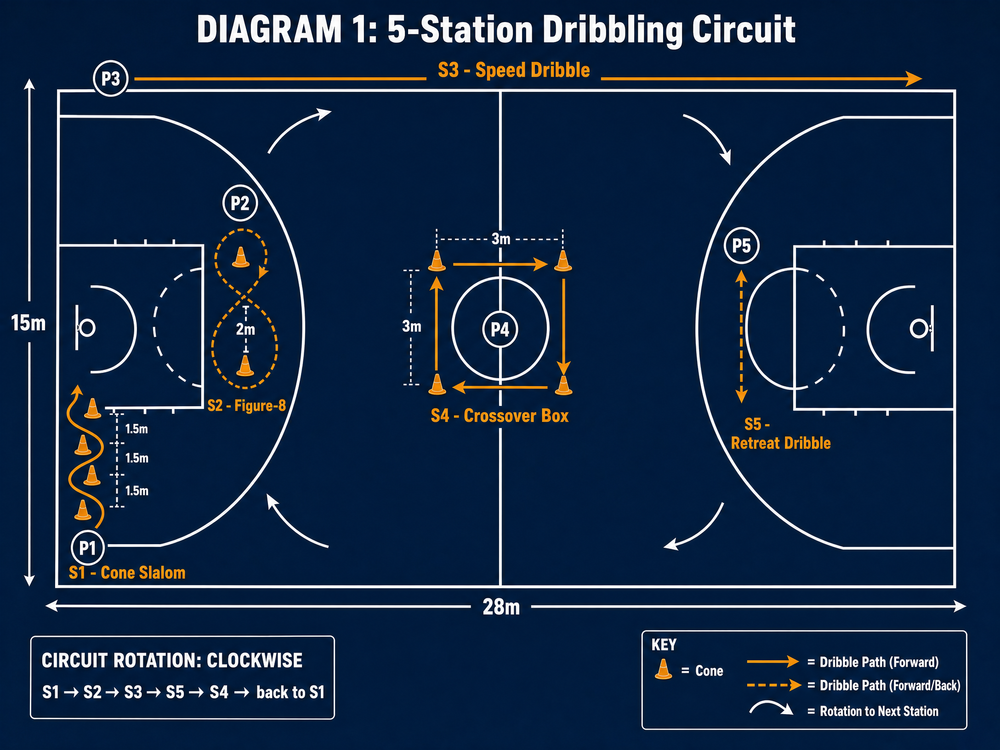
To run this drill efficiently, you will need the full length of a standard FIBA basketball court (28m x 15m) and a minimum of 15 cones.
- Equipment: 1 basketball per player, 15-20 cones, stopwatch or whistle.
- Players: 5 to 15 players. Divide players equally among the five stations.
- Time: 10-15 minutes total (1-2 minutes per station, plus rotation time).
Court Layout
Set up the five stations as follows:
- Station 1 (Cone Slalom): Place 5 cones in a straight line, 1.5 meters apart, starting near the left sideline at half court.
- Station 2 (Figure-8): Place 2 cones 2 meters apart in the left key area.
- Station 3 (Speed Dribble): Clear the baseline area for a straight sprint from corner to corner.
- Station 4 (Crossover Box): Place 4 cones forming a 3-meter square at center court.
- Station 5 (Retreat Dribble): Set up a lane near the right wing for forward and backward movement.
Step-by-Step Instructions
Explain the mechanics of each station before starting the clock. Players will spend 60-90 seconds at each station before rotating clockwise on the coach's whistle.
Station 1: Cone Slalom
- The player starts at the first cone with the ball in their right hand.
- They weave through the cones, keeping the ball on the outside hand (away from the cones to protect it from an imaginary defender).
- As they cross the center line of the cones, they must execute a low, quick crossover to the other hand.
- Upon reaching the final cone, speed dribble back to the start and repeat.
Station 2: Figure-8
- The player stands between the two cones in a wide, low stance.
- They dribble the ball in a continuous figure-8 pattern around the cones.
- Emphasize keeping the eyes up and the dribble low (below the knees).
- After 30 seconds, shout "Switch!" to have them reverse the direction of the figure-8.
Station 3: Speed Dribble
- The player starts in the corner of the baseline.
- They explode into a full-speed sprint, pushing the ball out in front of them.
- They must reach the opposite corner in as few dribbles as possible.
- Upon reaching the corner, they perform a jump stop, pivot, and speed dribble back with the opposite hand.
Station 4: Crossover Box
- The player starts at the bottom-right cone of the 3m square.
- They speed dribble to the top-right cone, execute a sharp crossover, and slide laterally to the top-left cone.
- At the top-left cone, they retreat dribble (facing forward) to the bottom-left cone.
- Finally, they execute a crossover and slide laterally back to the start. Repeat in the opposite direction on the next rotation.
Station 5: Retreat Dribble
- The player attacks forward for three hard dribbles.
- They plant their front foot, protect the ball with their off-arm, and execute two quick retreat dribbles backward.
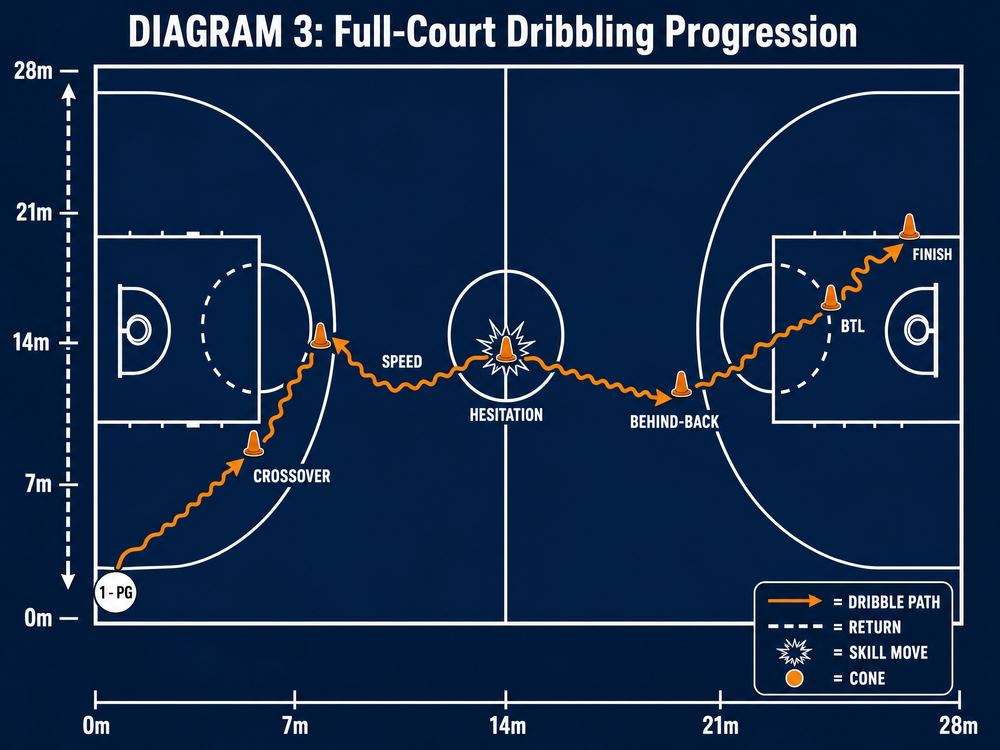
- After the retreat, they immediately explode forward again with a hesitation move.
- Continue this push-and-retreat pattern up and down the designated lane.
Key Coaching Points
To get the most out of this circuit, coaches must actively monitor all stations and enforce these fundamental habits:
- Eyes Up: Players must learn to feel the ball rather than look at it. Remind them to scan the floor to develop court vision.
- Pound the Ball: The harder the dribble, the quicker it returns to the hand, giving the player more control and less time for a defender to steal it.
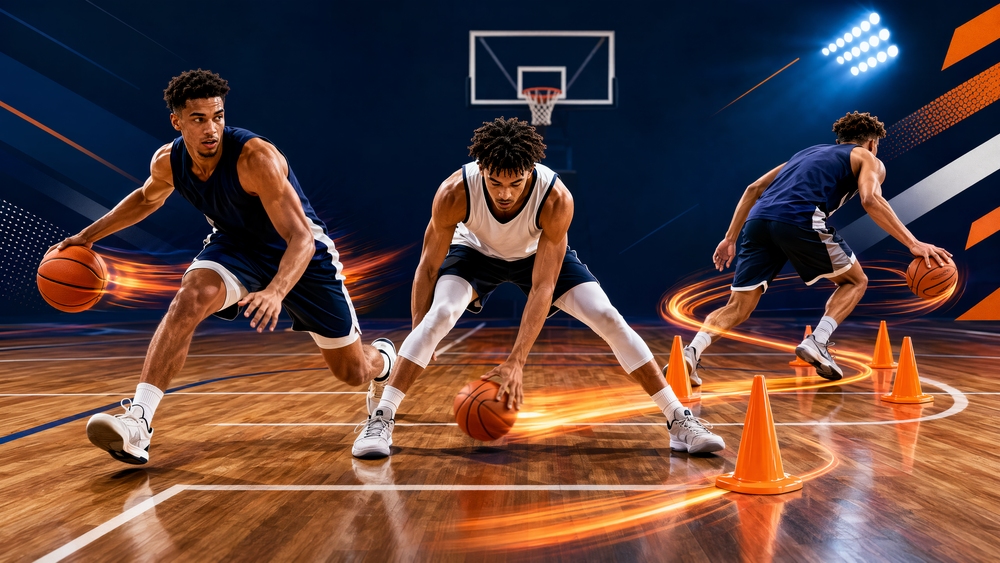
- Stay Low: A low center of gravity provides better balance and explosiveness. Players should bend their knees, not their waists.
- Protect the Basketball: The off-arm should always be up and active, acting as a shield between the ball and the defender.
- Change of Pace: Emphasize the difference between a setup dribble and an explosive attack dribble. Changing speeds is more effective than just playing fast.
Common Mistakes
Watch out for these frequent errors and correct them immediately:
- Standing Too Tall: Players often rise up out of their stance when fatigued, making them slower and easier to guard.
- Carrying the Ball: Ensure players keep their hand on top or slightly behind the ball, especially during hesitation moves or wide crossovers.
- Looking Down: Staring at the basketball prevents players from seeing open teammates or incoming help defense.
- Weak Off-Hand: Players will naturally favor their dominant hand. Force them to execute drills with their weak hand, even if it results in turnovers during practice.
Variations & Progressions
Keep the drill challenging by introducing these progressions as your team improves:
- Two-Ball Dribbling: Require players to use two basketballs at the Figure-8 and Retreat Dribble stations to increase difficulty and improve coordination.
- Tennis Ball Toss: Have a coach or partner toss a tennis ball to the player during the Cone Slalom or Crossover Box. The player must catch and toss the tennis ball back while maintaining their dribble.
- Guided Defense: Add a token defender at the Speed Dribble station to apply light pressure and force the ball handler to protect the ball and change speeds.
Age Adaptations
- Under 10: Focus strictly on the fundamentals. Reduce the number of stations to three (Cone Slalom, Speed Dribble, Figure-8). Allow players to look at the ball occasionally to build confidence.
- Under 14: Introduce the full 5-station circuit. Demand that eyes stay up and enforce the use of the weak hand.
- Under 16 & Open: Run the circuit at maximum game speed. Incorporate the Two-Ball and Tennis Ball progressions. Add a conditioning element by having players sprint a full court length between station rotations.
