

Basketball
Full Court Press Break: 5-on-3 Structured Advancement Drill
Master the full court press break with this structured 5-on-3 drill that teaches your players to read pressure, exploit spacing, and attack in transition with composure and precision.

What you need
basketball, coloured bibs (3), cones (optional, 4), whiteboard or clipboard
Overview
The Full Court Press Break drill is one of the most essential team-building exercises a basketball coach can run, regardless of level. When an opponent applies a full-court press — whether man-to-man, zone (1-2-1-1 diamond, 2-2-1), or a hybrid trap — your players must respond with calm, structured decision-making under pressure. Panic, poor spacing, and tunnel vision are the enemy; this drill eliminates all three.
This drill is best used at the start of the season to install your press-break system, and revisited any time your team faces a press-heavy opponent in the upcoming schedule. It is equally effective as a warm-up drill in pre-game preparation. Running it 3–4 times per week during a 10–15 minute block will build the muscle memory your players need to execute when the game is on the line.
Players Required: 8 (5 offensive, 3 defensive) plus a coach on the baseline
Court: Full FIBA court — 28m x 15m
Duration: 20–25 minutes
Difficulty: Intermediate
Setup
Equipment
- 1 basketball per repetition (have 3–4 balls ready at the baseline)
- Cones (optional) to mark outlet positions on the sidelines at the 7m mark
- Coloured bibs for defenders
- Whiteboard or clipboard for pre-drill walkthrough
Court Setup
The drill begins at the defensive baseline (the end from which your team is inbounding after a made basket by the opponent). The full 28m court is in play.
Player Positions
| Position | Player | Starting Location |
|---|---|---|
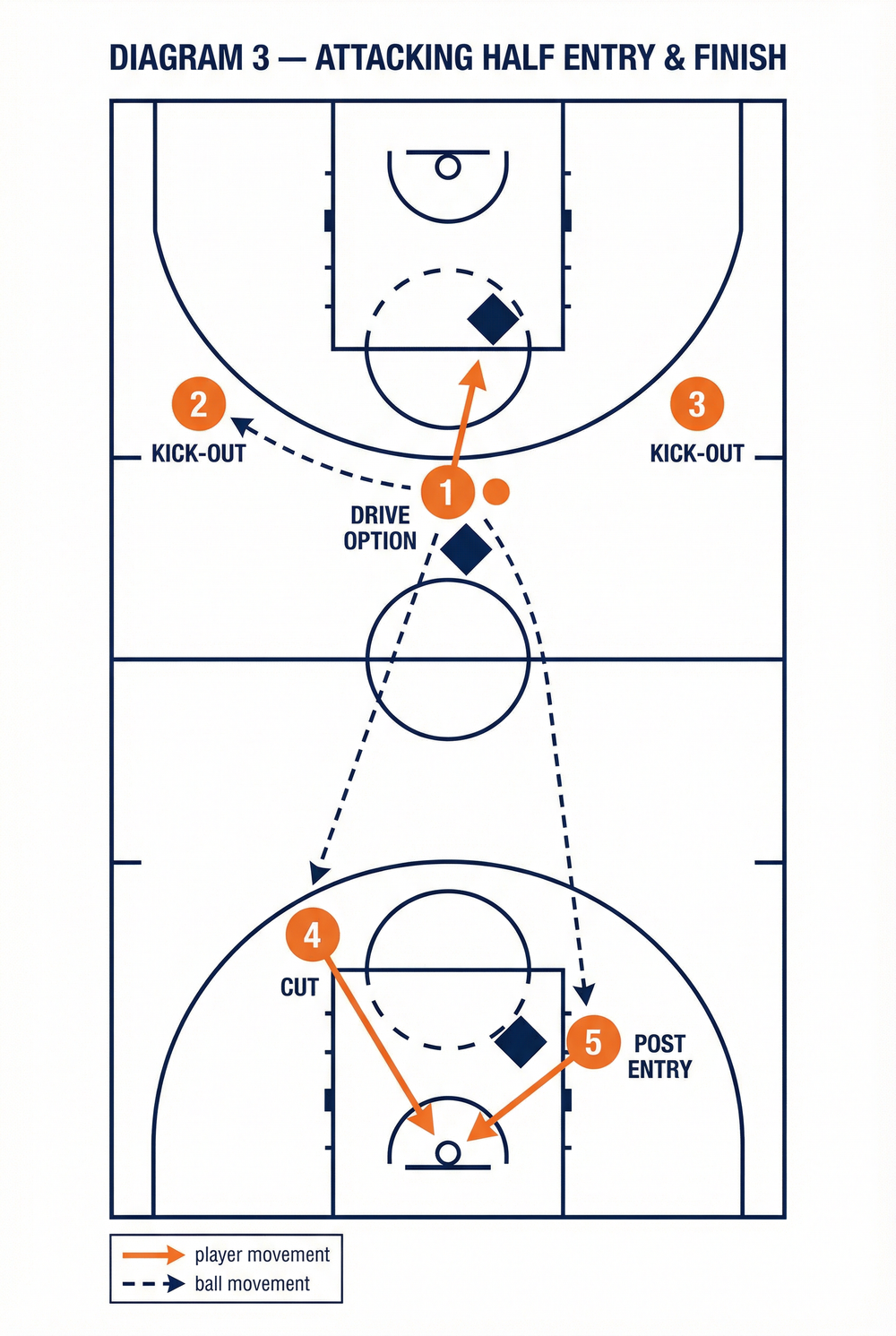
| 1 — Point Guard | Primary ball-handler | Inside the paint, 2m from the baseline, ready to receive the inbound |
| 2 — Shooting Guard | Left outlet | Left sideline, 6–7m from the baseline |
| 3 — Small Forward | Right outlet | Right sideline, 6–7m from the baseline |
| 4 — Power Forward | Safety / advance target | Left of centre circle, just inside the offensive half |
| 5 — Centre | Inbounder | Out of bounds at the baseline, directly under the basket |
| X1, X2, X3 | Defenders (bibs) | Positioned in a 1-2 press alignment: one on the ball, two in passing lanes |

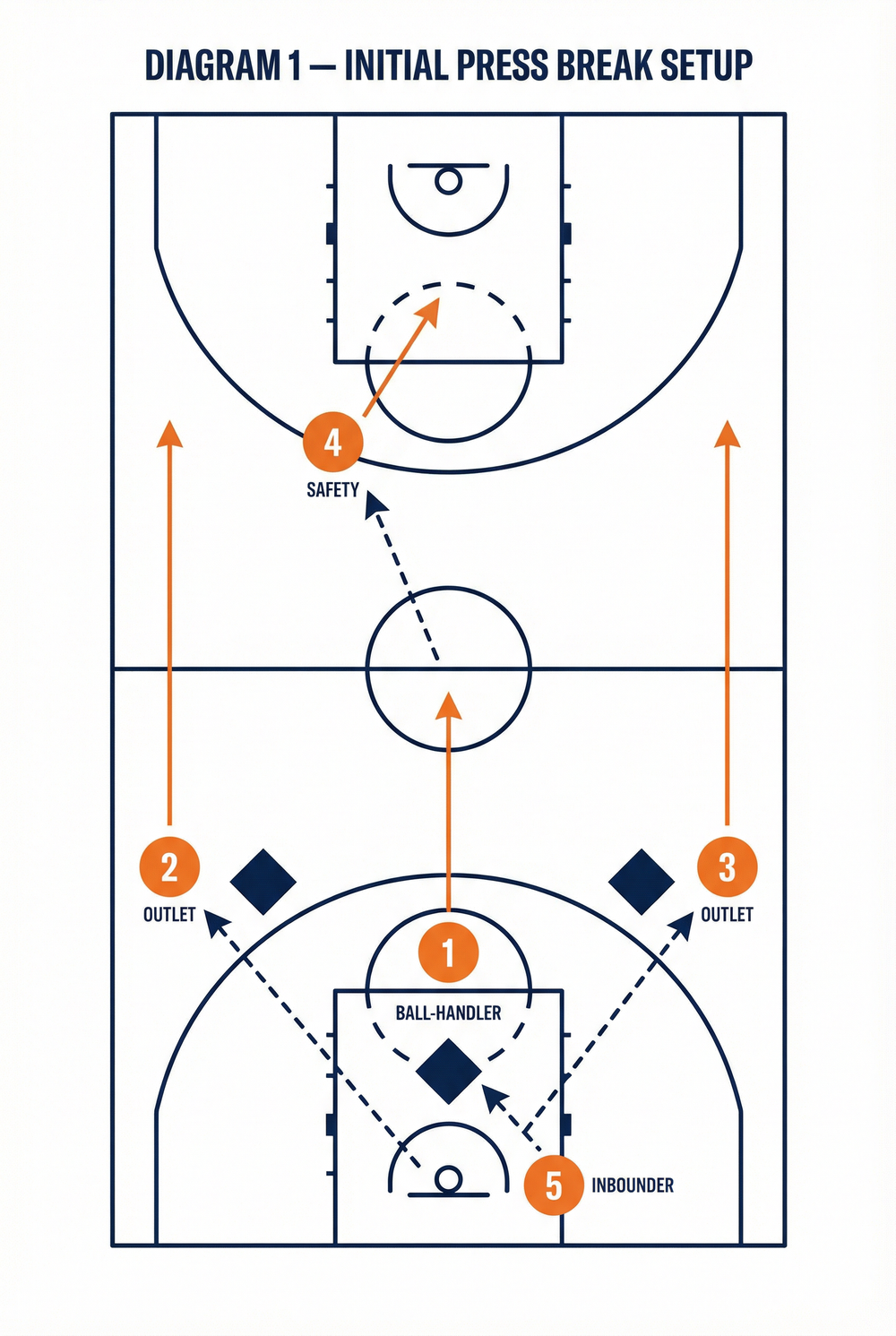
Diagram 1 shows the initial press break setup with Player 5 inbounding, Players 2 and 3 as sideline outlets, Player 1 as the primary receiver, and Player 4 as the safety valve ahead of the half-court line.
Step-by-Step Instructions
Step 1 — Walkthrough (2 minutes)
Before running at pace, walk all five offensive players through their roles. Use a whiteboard or talk through the diagrams. Emphasise that every player has a job from the moment the ball goes through the net — there is no standing and watching.
Step 2 — Set the Inbound
Player 5 takes the ball out of bounds at the baseline. The 5-second inbound clock begins. Player 1 sets up their defender with a jab step or a back-cut before presenting a target hand to receive the inbound pass. Players 2 and 3 pin their defenders with a shoulder-width stance on the sideline at the 6–7m mark, ready to flash toward the ball if Player 1 is denied.
Step 3 — Receive and Pivot
Player 1 catches the inbound pass and immediately pivots away from the nearest defender. The first look is always up the court — never back to the baseline. Player 1 must read whether the sideline is open (pass to 2 or 3), the middle is open (dribble-drive through the gap), or the skip pass to Player 4 is available.
Step 4 — Outlet and Advance
If Player 2 or 3 is open on the sideline, Player 1 hits the outlet immediately. The outlet player (2 or 3) catches, pivots, and attacks up the sideline with the dribble. The opposite wing (3 or 2) sprints the far lane. Player 4 reads the ball-side and adjusts their position to stay ahead of the play — they are the pressure release valve at half-court and beyond.

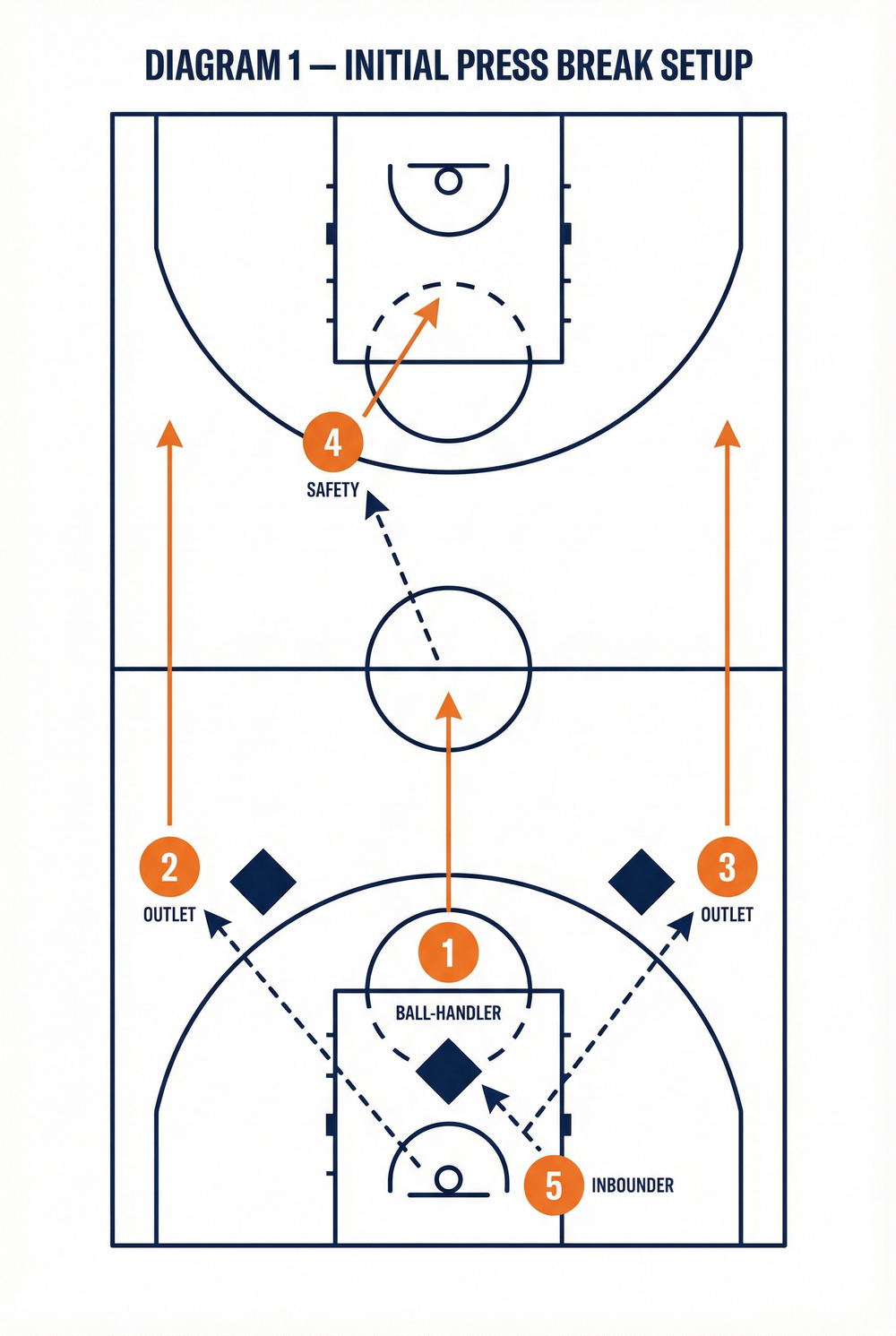
Diagram 2 illustrates the half-court advancement phase. Player 1 has received the inbound and is advancing up the right sideline. Player 3 cuts diagonally to the centre, Player 2 sprints the left lane, and Player 4 positions as the skip-pass target just inside the attacking half.
Step 5 — Cross Half-Court
The team must cross the half-court line within 8 seconds of the inbound (FIBA rule). Player 5 releases from the baseline once the ball crosses the free throw line extended and trails the play up the centre of the court. This prevents the defence from sending a 4th defender back without leaving someone open.
Step 6 — Attack the Rim
Once across half-court, the ball-handler reads the defence. The drill concludes with a live 5-on-3 scoring opportunity. Players must execute one of three reads: (a) drive to the basket if the lane is open, (b) kick out to the open wing (2 or 3) for a three-point attempt, or (c) enter the ball to Player 5 posting up on the block.
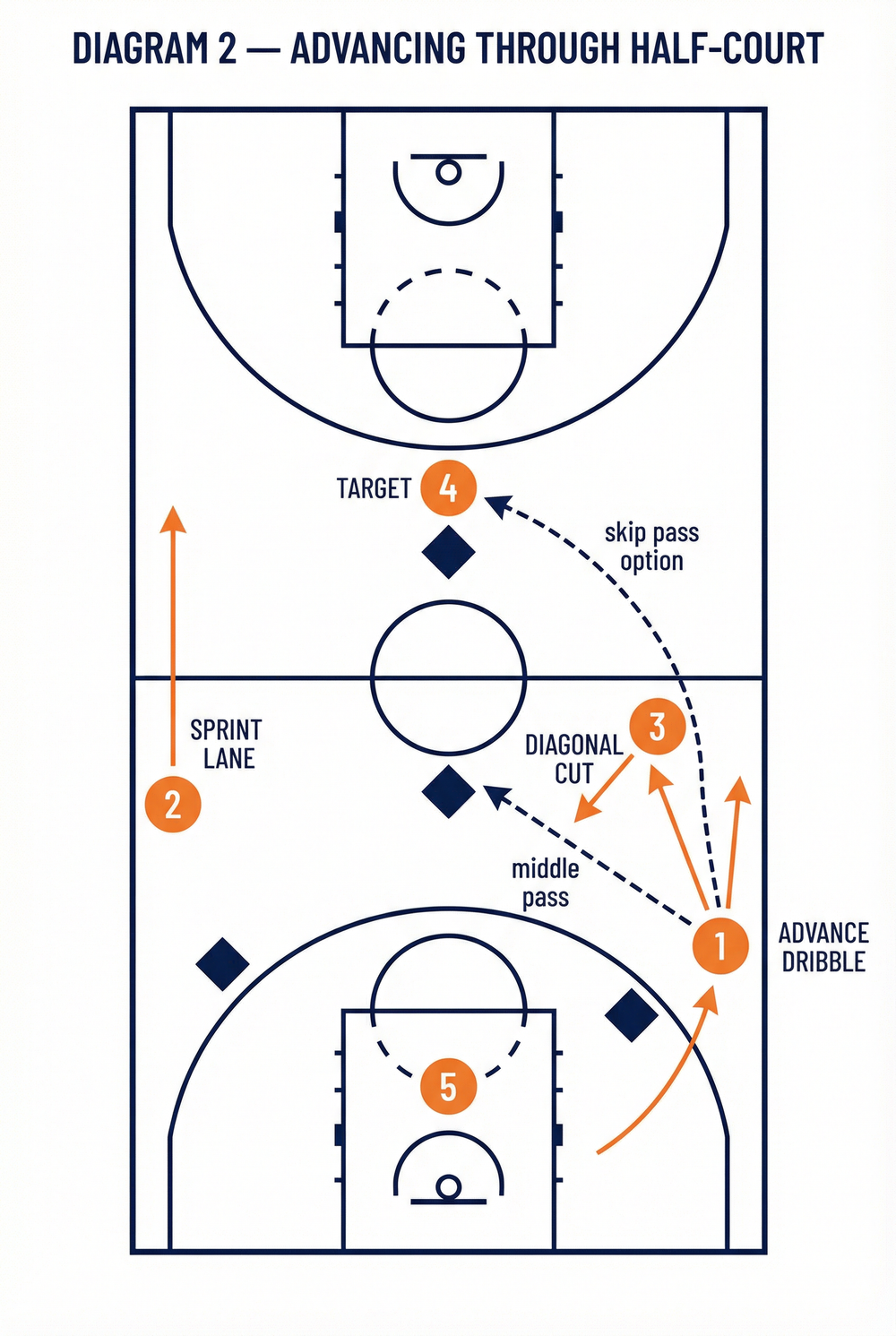
Diagram 3 shows the attacking half entry options. Player 1 operates at the top of the key with drive, kick-out, and post-entry options. Player 4 cuts hard from the elbow to the basket, Player 5 seals on the block, and Players 2 and 3 space to the wings for kick-out three-point attempts.
Step 7 — Reset and Repeat
After each repetition — whether it ends in a score, a turnover, or a defensive stop — the coach immediately rolls the next ball to Player 5 at the baseline. Rotate defenders every 4–5 repetitions. Run 3 sets of 6 repetitions per session.
Key Coaching Points

1. Spacing is Everything
The press only works for the defence when it can collapse your spacing and create traps. Demand that Players 2 and 3 stay wide on the sidelines — at least 1m inside the sideline — and that Player 4 stays above the half-court line until the ball crosses it. If your players bunch up, you are doing the defender's job for them.
2. The Inbounder is a Passer, Not a Spectator
Player 5 must be decisive. They have 5 seconds. Teach them to look at Player 1 first, then check 2 and 3 as secondary options. If all three are denied, Player 5 should call timeout immediately — never force a pass into traffic.
3. Attack the First Open Gap
The most common mistake at all levels is holding the ball and waiting for the perfect pass. Teach Player 1 to attack the first open gap with the dribble if no pass is immediately available. One hard dribble toward the half-court line will force a defender to commit, which opens a teammate.
4. Eyes Up, Head Up — Always
Every player with the ball must have their head up and scanning. A player who dribbles with their head down cannot read the defence, cannot find the open teammate, and cannot exploit the numerical advantage. Enforce this from day one.
5. Player 4 Must Stay Ahead of the Ball
The safety/advance player (4) is the most important piece of the press break. They must never be behind the ball. If Player 4 drops back to help, the press break loses its long-pass threat, and the defence can double-team the ball with impunity.
6. Finish with Composure
The drill is not complete when the ball crosses half-court — it ends with a quality shot attempt. Reinforce that the purpose of breaking the press is to create a numbers advantage and convert it. Lay-ups must be made. Open threes must be taken with confidence.
Common Mistakes

Mistake 1 — Clustering Near the Ball
Players instinctively want to help their teammate under pressure, so they drift toward the ball. This is the single biggest gift you can give the pressing defence. Stop the drill immediately when you see it and reset positions. Use the phrase: "Wide and ahead — not close and behind."
Mistake 2 — Dribbling into Traps
Player 1 will sometimes try to dribble through two defenders rather than passing out of pressure. This leads to jump balls, five-second violations, and turnovers. Teach the rule: "Two defenders on the ball means the ball comes out — every time." Run a trap recognition drill as a prerequisite if this is a persistent issue.
Mistake 3 — Player 5 Staying Under the Basket
The Centre often lingers at the defensive end after inbounding, either out of habit or because they are not sure of their role. Player 5 must release and trail the play the moment the ball reaches the free throw line extended. A trailing big prevents the defence from sending an extra defender back and provides a safety outlet if the ball is reversed.
Mistake 4 — Ignoring the Middle Pass
Teams conditioned to use the sidelines will sometimes fail to see the diagonal cut by Player 3 through the middle of the court. This is often the highest-percentage pass to advance the ball quickly. Highlight it in walkthroughs and reward players who find it in live reps.
Mistake 5 — Settling for a Half-Court Offence Without Attacking
After successfully breaking the press, some teams slow down and reset into their half-court offence, surrendering the numerical advantage they just earned. Emphasise that the press break is not complete until a quality shot is generated from the numbers advantage. The transition attack must be the first priority.
Variations & Progressions
Progression 1 — Add a 4th Defender (5-on-4)
Once your team is comfortable breaking the 3-defender press, add a fourth defender positioned at the half-court line. This simulates a 2-2-1 zone press and forces Player 4 to make a read on whether to catch and attack or redistribute the ball to the trailing Player 5. This is the most game-realistic version of the drill.
Progression 2 — Live Full-Court 5-on-5
Remove the numerical advantage entirely and run the press break against a full five-person press. This is the ultimate test of your system. Defenders should be instructed to play hard but not foul. The offensive team scores a point for every successful crossing of half-court; the defensive team scores a point for every turnover or 8-second violation. First to 5 points wins.
Variation 1 — Conditioned Press Break (No Dribble)
To force players to use passing rather than dribbling through pressure, run the drill with a no-dribble rule for Player 1 after receiving the inbound. This develops passing vision, forces outlet players to get open, and builds trust between teammates. It is an excellent early-season teaching tool.
Age Adaptations

Under 12 (Modified Rules)
Reduce the court length to half-court for the initial phase. Use only 2 defenders and allow Player 1 unlimited dribbles. Focus solely on spacing and the concept of the outlet pass. Do not introduce the skip pass or the trailing big until players are consistently making the first outlet pass.
Under 14 — Under 16
Run the drill as described with 3 defenders. Introduce the 8-second count from the first session so players develop an internal clock. At Under 16, begin introducing the 4th defender progression once the base drill is clean. Emphasise decision-making speed — the goal is to advance the ball in 3 passes or fewer.
Open / Senior
Run the full 5-on-5 live version as the primary drill. Add defensive communication requirements (defenders must call out "ball," "deny," "help") to simulate game conditions. Time each repetition and challenge the team to beat their average crossing time over a session. Introduce specific press-break plays (e.g., a set inbound play with a screen for Player 1) to add tactical depth.
