

Basketball
The Hammer: Elite End-of-Game Baseline Out-of-Bounds Play
Master the 'Hammer' action to generate a wide-open corner three-pointer with the game on the line.
What you need
1 Basketball, Half-court setup
1. Overview
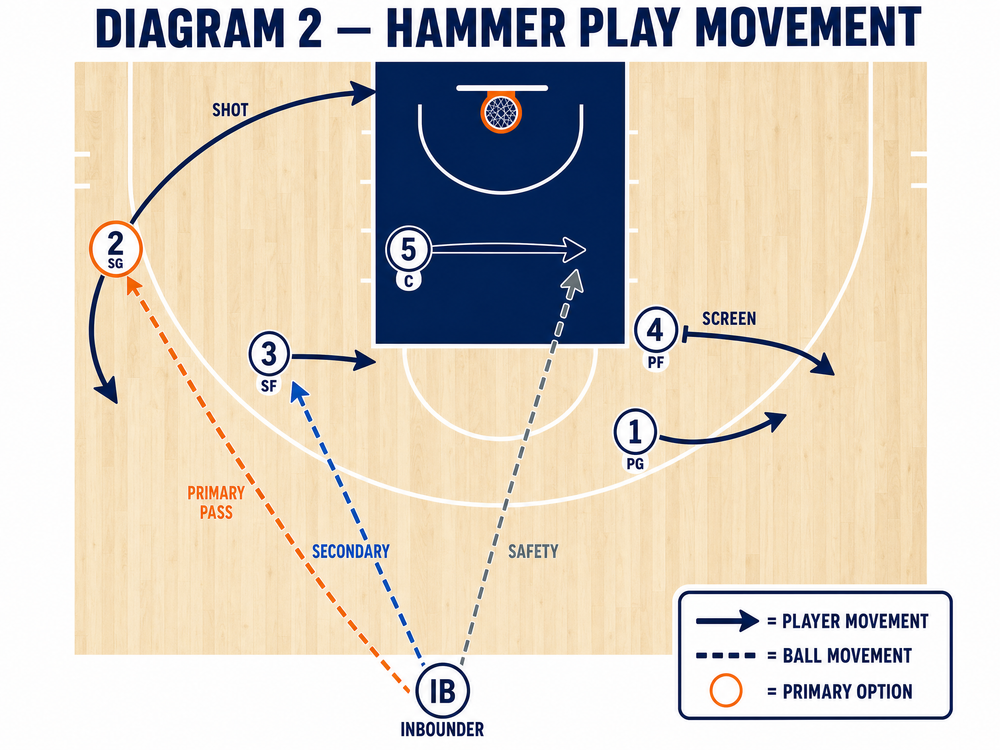
The "Hammer" is an elite end-of-game baseline out-of-bounds (BLOB) play designed to generate an open three-point shot with under 3 seconds remaining on the clock. This set play leverages a strong-side decoy action to force defensive rotation, while a weak-side flare screen (the "Hammer" screen) frees up your best shooter in the weak-side corner. It is highly effective when the defense is overplaying the inbound pass or aggressively fronting the primary options on the strong side.
2. Setup
- Equipment: 1 Basketball, half-court setup (28m x 15m FIBA dimensions).
- Player Positions:
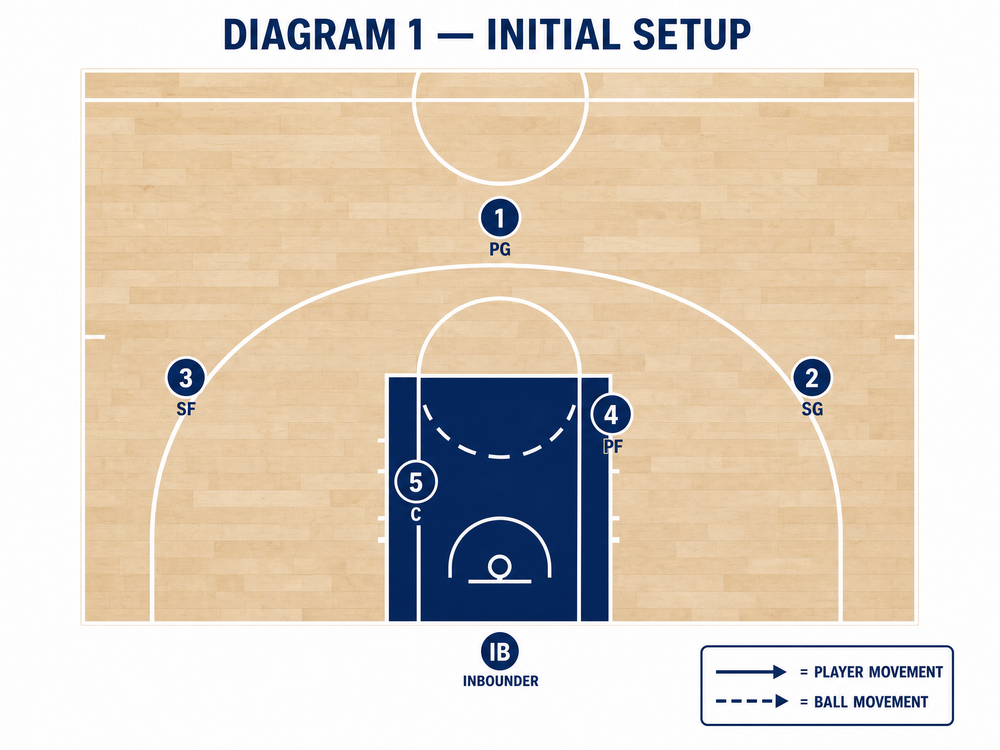
- Inbounder (IB): Positioned out of bounds on the baseline, directly under the basket.
- Player 1 (PG): Positioned at the top of the key near the half-court line.
- Player 2 (SG - Primary Shooter): Positioned on the right wing near the three-point line.
- Player 3 (SF - Secondary Option): Positioned on the left wing near the three-point line.
- Player 4 (PF - Screener): Positioned at the right elbow of the key.
- Player 5 (C - Safety/Decoy): Positioned at the left block.
3. Step-by-Step Instructions
- The Decoy Cut: As the referee hands the ball to the inbounder (IB), Player 1 (PG) sprints hard from the top of the key toward the right wing, demanding the ball. This action is designed to draw the defense's attention to the strong side.
- The Safety Roll: Simultaneously, Player 5 (C) rolls from the left block across the lane to the right block, acting as a safety outlet in case the primary options are covered.
- The Hammer Screen: Player 4 (PF) immediately sets a hard flare screen on the defender guarding Player 2 (SG) on the right wing.
- The Hammer Cut: Player 2 (SG) uses the screen set by Player 4, curling sharply behind the three-point line and sprinting toward the weak-side (left) corner.
- The Secondary Option: Player 3 (SF) flashes from the left wing toward the left elbow, providing a secondary passing lane if the corner pass is contested.
- The Pass and Shot: The Inbounder (IB) reads the defense. If the Hammer screen is successful, IB delivers a crisp, on-target pass to Player 2 (SG) in the left corner for a catch-and-shoot three-pointer.
4. Key Coaching Points
- Screening Angle: Player 4 must set the screen at the correct angle to completely blindside Player 2's defender, ensuring a clean release to the corner.
- Timing is Everything: The pass must be delivered exactly as Player 2 arrives in the corner. If the pass is late, the defense will have time to recover and contest the shot.
- Selling the Decoy: Player 1 must aggressively sell the decoy cut, calling for the ball and sprinting hard to force the defense to shift their focus to the strong side.
- Inbounder Vision: The inbounder must have excellent court vision and the ability to throw a precise, skip pass over the defense to the weak-side corner.
5. Common Mistakes
- Weak Screening: If Player 4 sets a soft or poorly angled screen, Player 2's defender will easily fight through and contest the shot.
- Telegraphing the Pass: If the inbounder stares down the weak-side corner, the defense will anticipate the pass and intercept it. The inbounder must use their eyes to manipulate the defense.
- Rushing the Shot: Player 2 must catch the ball in rhythm and maintain proper shooting mechanics, rather than rushing the release due to the expiring clock.
6. Variations & Progressions
- Slip the Screen: If the defense aggressively switches on the Hammer screen, Player 4 can slip the screen and dive hard to the basket for an easy layup.
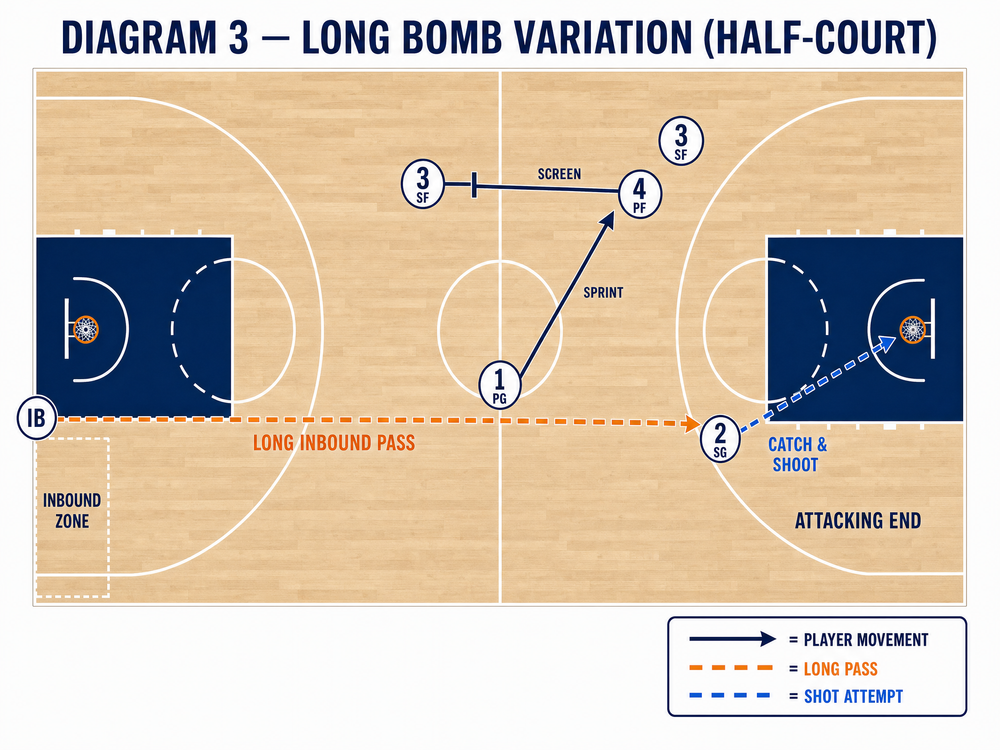
- Long Bomb Variation: For full-court situations with less than 2 seconds remaining, move the inbounder to the opposite baseline and run a similar action, requiring a long baseball pass to the attacking end.
7. Age Adaptations
- Under 12s: Simplify the play by focusing on a basic screen away from the ball. Ensure the pass is shorter and less complex.
- Under 14s/16s: Introduce the full Hammer action, focusing heavily on the timing of the screen and the quality of the pass.
- Open/Advanced: Incorporate multiple reads and counters, such as slipping the screen or utilizing a secondary flare screen for Player 3.
