

Basketball
Mastering the Half-Court Trap: A Coach's Guide to Forcing Turnovers
A detailed guide for basketball coaches on how to implement the half-court trap press to create defensive pressure, force turnovers, and control the tempo of the game.

What you need
Basketballs, Cones (optional, for marking trap zones)
1. Overview
The half-court trap is an aggressive defensive strategy designed to disrupt the opposing team's offense as they cross the half-court line. By using two defenders to aggressively trap the ball-handler, the defense aims to force a turnover, create a rushed pass, or generate a 10-second violation. This play is most effective when used selectively to surprise the offense, change the tempo of the game, or target a weaker ball-handler. It is a high-risk, high-reward tactic that, when executed correctly, can lead to easy scoring opportunities and swing the momentum of the game in your favor.
2. Setup
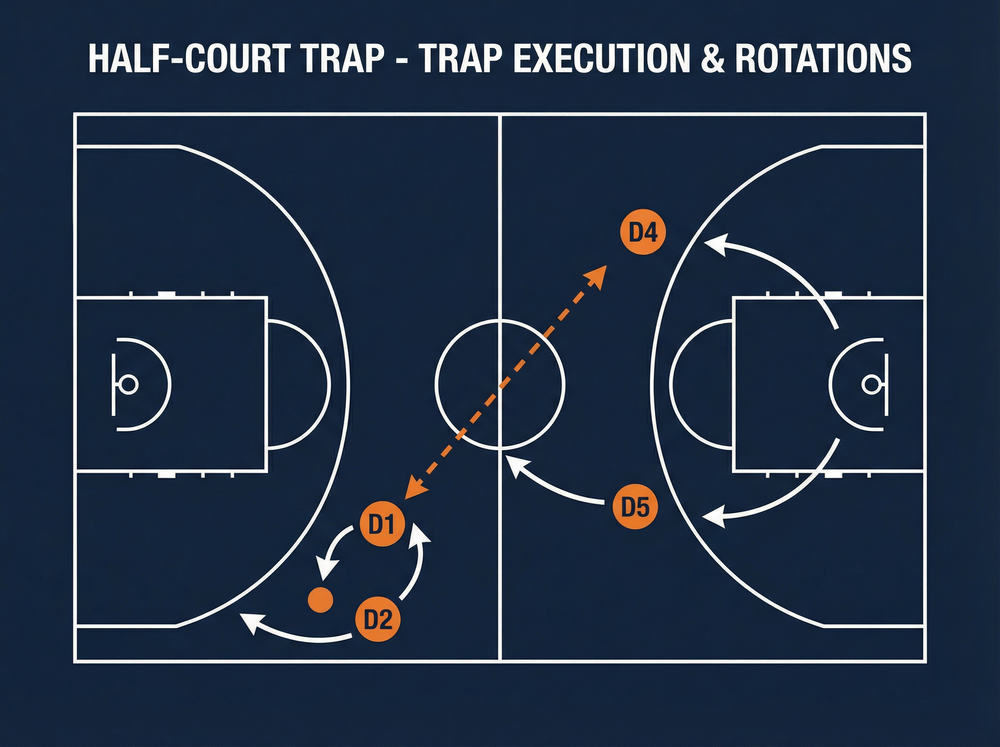
To effectively run the half-court trap, a clear understanding of player positioning and roles is crucial. The setup is designed to funnel the ball-handler into a specific area of the court where the trap can be executed.
- Equipment: Standard basketballs. Cones can be used to mark the desired trap locations during practice.
- Court Setup: The play is initiated on a standard 28m x 15m FIBA court. The key area for the trap is just over the half-court line, typically within the first 3–4 metres and close to the sideline.
- Player Positions:
- 1 (Point Guard Defender): The primary on-ball defender. Responsible for influencing the ball-handler towards the sideline and initiating the trap.
- 2 (Shooting Guard Defender): The trapper. This player must anticipate the ball-handler's movement and sprint to close out and form the trap with Player 1.
- 3 (Small Forward Defender): The interceptor. Reads the passer's eyes and anticipates the most likely pass out of the trap, looking to steal the ball.
- 4 (Power Forward Defender): The weak-side protector. Rotates to cover the middle of the court, preventing any easy passes to the basket.
- 5 (Center Defender): The basket protector. Drops back to protect the rim from any long passes or defensive breakdowns.

3. Step-by-Step Instructions
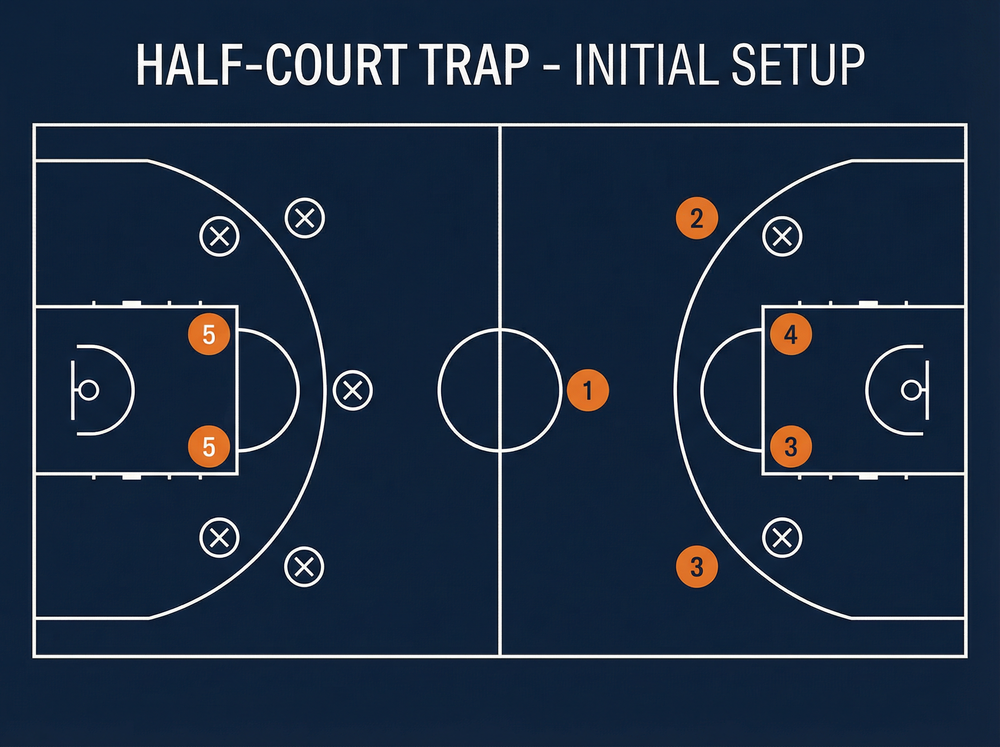
- Influence the Ball-Handler: As the offensive point guard dribbles up the court, the on-ball defender (1) should apply pressure, encouraging them to move towards one of the sidelines. The defender should use their body and footwork to dictate the direction, without over-committing and getting beaten off the dribble.
- Initiate the Trap: Once the ball-handler crosses the half-court line and is within 2–3 metres of the sideline, the nearest wing defender (2) sprints towards them to set the trap. Both defenders (1 and 2) should have high hands, active feet, and work together to close the space around the ball-handler.
- Execute the Trap: The two defenders form a wall, preventing the ball-handler from dribbling forward or sideways. Their goal is not necessarily to steal the ball from the dribbler, but to force a bad pass or a turnover. They should be vocal, communicating with each other and the rest of the team.
- Rotations: As the trap is set, the other three defenders must rotate to cover the open offensive players. The nearest defender (3) denies the most obvious pass, the next defender (4) zones the middle of the floor, and the final defender (5) protects the basket. These rotations must be quick and decisive to prevent an easy score for the offense.
- Anticipate and React: The interceptor (3) should be reading the trapped player's eyes and body language to anticipate the pass. A successful trap often results in a lobbed or slow pass that can be easily stolen, leading to a fast-break opportunity.

4. Key Coaching Points
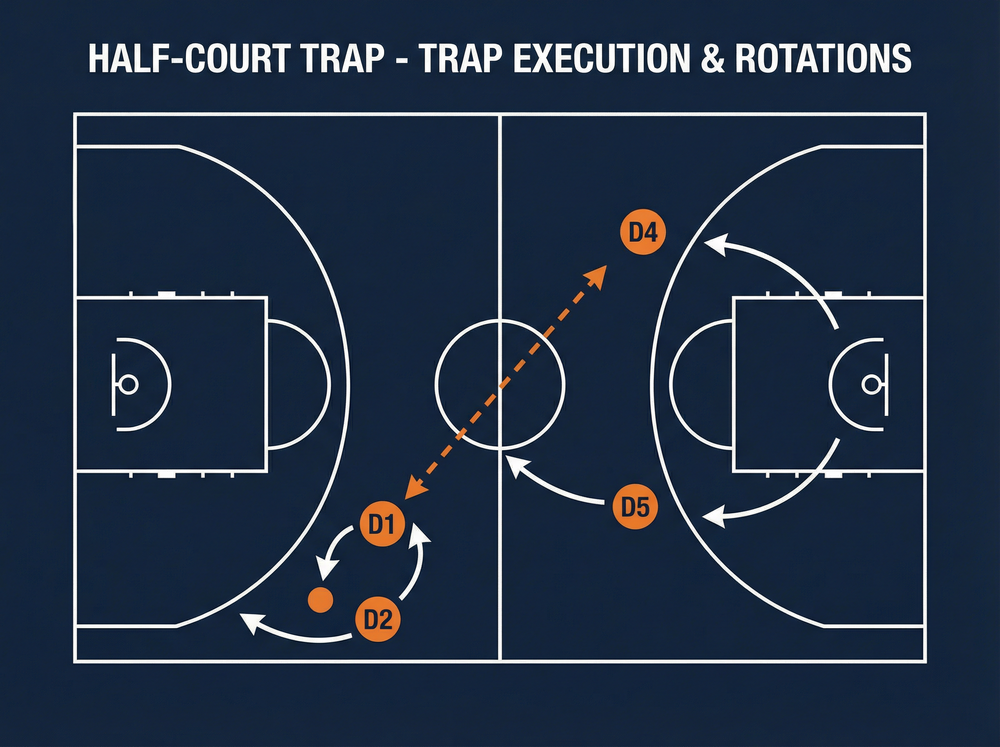
- Communication is Key: The trap relies on all five players communicating effectively. The trappers must be vocal, and the rotators must call out their positions and responsibilities.
- Trap with a Purpose: Defenders should trap to force a turnover, not just to foul. Emphasise using their length and positioning rather than reaching in.
- Anticipate, Don't Gamble: The interceptors should be in position to make a play on the ball, but not so far out of position that they give up an easy basket if the pass gets through.
- Sprint to Rotate: The effectiveness of the trap is often determined by the speed of the defensive rotations behind it. Players must sprint to their help positions.
- Know When to Bail Out: If the trap is broken, defenders must sprint back to recover and get into a standard defensive set. Don't give up on the play.
- Trap the Sideline, Not the Middle: The sideline acts as a third defender. Trapping in the middle of the court is far less effective and much easier for the offense to break.
5. Common Mistakes

- Fouling the Ball-Handler: Overly aggressive traps can lead to easy fouls and free throws for the opposition. Teach players to use their feet and body, not their hands.
- Slow Rotations: If the help-side defenders are slow to rotate, the offense will find an open player for an easy shot. This is the most common failure point of the trap.
- Letting the Offense Split the Trap: If the trappers leave a gap, a skilled ball-handler can dribble right through it, leaving the defense at a disadvantage.
- Bad Trapping Angles: If the trappers don't take the correct angles, they won't be able to effectively contain the ball-handler near the sideline.
- Telegraphing the Trap: If the defense makes it obvious they are going to trap, the offense can prepare for it and easily pass out of it before the second defender arrives.
6. Variations & Progressions

- Progression — Full Court Press: Once players have mastered the half-court trap, they can progress to a full-court press, trapping the ball-handler as soon as they receive the inbounds pass. This is a natural extension of the same principles applied over a greater distance.
- Variation — Run and Jump: A variation where the trap is initiated by a run-and-jump switch. As the ball is dribbled towards a wing defender, that defender sprints to trap the ball, and the original on-ball defender rotates to cover the now open offensive player.
- Variation — Blitz the Ball Screen: The trap can also be used to defend against ball screens. As the screen is set, both defenders involved in the play aggressively trap the ball-handler, forcing them to make a quick decision under pressure.
7. Age Adaptations

| Age Group | Key Focus | Recommended Format |
|---|---|---|
| Under 12 | Basic double-team concept, communication | 3-on-3 or 4-on-4 drills |
| Under 14/16 | Full 5-on-5 trap with rotations | Structured drill into live play |
| Open Age | Strategic deployment, disguise, scouting | Full game integration |
- Under 12: Focus on the basic principles of the trap. Use 3-on-3 or 4-on-4 drills to teach the concept of double-teaming and helping. The focus should be on fun and understanding the concept, not on perfect execution.
- Under 14/16: Introduce the full 5-on-5 trap with rotations. Spend time drilling the rotations and communication. At this age, players should be able to understand the more complex rotations and responsibilities.
- Open Age/Professional: At the highest levels, the trap can be used as a strategic weapon. Coaches can implement different types of traps, disguise their intentions, and use the trap to exploit specific weaknesses in the opposition's offense.
