

Basketball
Pressure Free Throw Routine: The 'Swish & Rotate' Drill
A dynamic free throw routine designed to simulate game-time pressure while practicing rebounding rotations and consistent shooting mechanics.
What you need
Basketballs (1-2 per basket), Standard FIBA court
1. Overview
Free throws win games, but practicing them in a static, low-pressure environment rarely translates to in-game success. The 'Swish & Rotate' Free Throw Routine is designed to bridge the gap between practice and competition. By integrating rebounding responsibilities, rapid rotations, and game-like pressure, this drill ensures that your players maintain focus and consistent mechanics even when fatigued. It is an excellent drill to run at the end of a high-intensity practice segment or as a conditioning transition.
2. Setup
- Court: Standard FIBA full court (28m x 15m), utilizing one or both half-courts depending on team size.
- Players: Minimum of 5 players per basket. Optimal with 10-12 players utilizing both ends of the court.
- Equipment: 1-2 basketballs per basket.
- Positions:
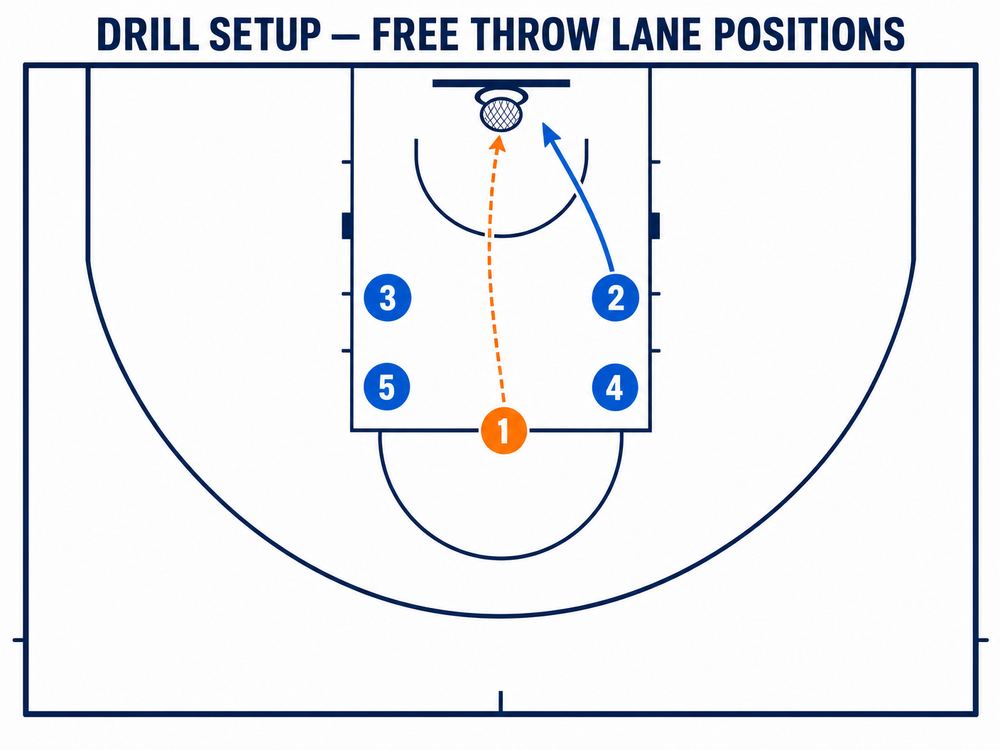
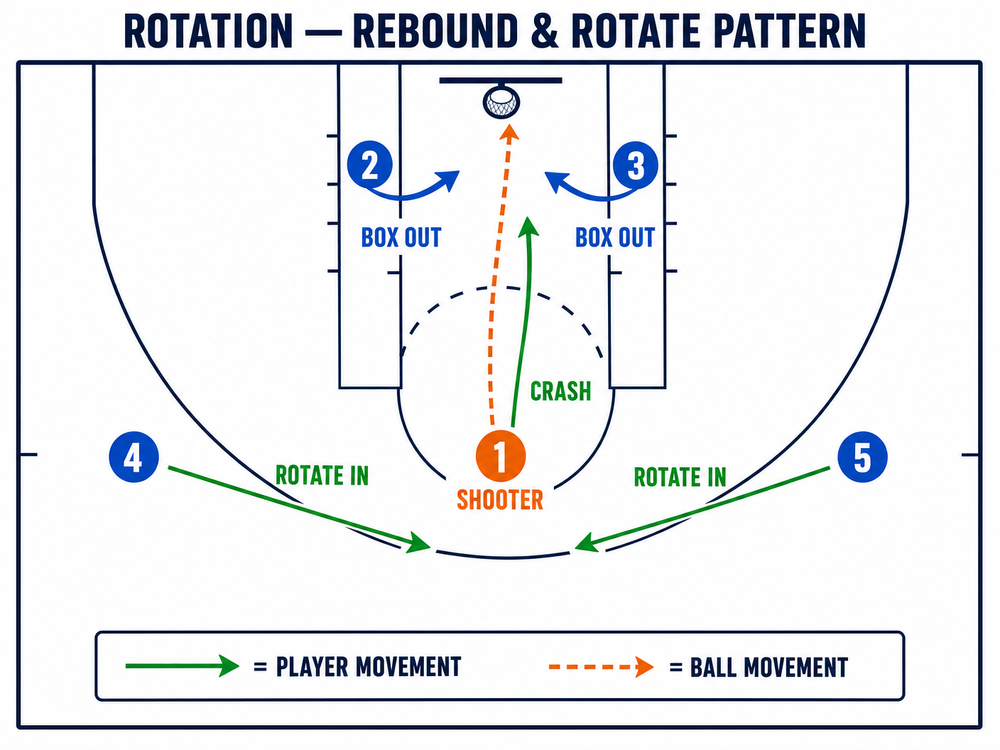
- Player 1 (Shooter): Positioned at the free throw line (5.8m from the baseline).
- Players 2 & 3: Positioned in the first lane spaces on either side of the key (closest to the basket).
- Players 4 & 5: Positioned in the second lane spaces or outside the three-point arc on the wings, ready to rotate in.
3. Step-by-Step Instructions
- Initial Positioning: Set up the players as shown in Diagram 1. Player 1 has the ball at the free throw line. Players 2 and 3 are in the primary rebounding spots. Players 4 and 5 are on the wings.
- The Routine: Player 1 executes their standard free throw routine (e.g., three dribbles, deep breath, eye the rim) and shoots the first free throw.
- Rebounding Action: On the release, Players 2 and 3 must execute a proper box-out on an imaginary opponent (or on each other if running a contested variation) before securing the rebound. If the shot is made, they quickly pass the ball back to the referee/coach or directly to Player 1 for the second shot.
- The Second Shot: Player 1 shoots their second free throw. Upon release, all players execute the rotation pattern.
- The Rotation:
- Shooter (Player 1): Follows their shot and becomes a rebounder in the first lane space (taking Player 2's spot).
- Rebounders (Players 2 & 3): After securing the rebound (or letting it go through the net), they sprint to the wing positions outside the three-point arc.
- Wing Players (Players 4 & 5): Player 4 rotates to the free throw line to become the new shooter. Player 5 rotates into the opposite first lane space.
- Continuous Flow: The drill continues seamlessly. The new shooter must immediately begin their routine. The goal is to make a set number of consecutive free throws as a team (e.g., 10 in a row) or achieve a specific team percentage (e.g., 80% over 50 shots) before practice ends.
4. Key Coaching Points
- Routine Consistency: Emphasize that the shooter must perform the exact same pre-shot routine every single time. Consistency breeds confidence under pressure.
- Hold the Follow-Through: The shooter must hold their follow-through until the ball hits the rim or goes through the net. Do not let them drop their shooting hand prematurely to watch the flight of the ball.
- Aggressive Rebounding: Even though it's a free throw drill, demand game-like intensity on the box-outs and rebounds. Players in the lane spaces must step into the key and secure the ball high.
- Pace and Communication: The rotation must be crisp. Players should communicate ("I got shooter!", "Rotating out!") to keep the drill flowing without dead time.
5. Common Mistakes
- Rushing the Shot: Players often rush their routine because others are waiting. Force them to take their time and breathe.
- Lazy Box-Outs: Rebounders often just watch the ball instead of making contact and securing the space first. Correct this immediately.
- Dropping the Follow-Through: Shooters pulling their arm back too early, leading to short misses. Remind them to "leave the hand in the cookie jar."
6. Variations & Progressions
- Conditioning Penalty: If a player misses both free throws, the entire group must complete a quick down-and-back sprint before the next shooter steps up. This adds significant game-like pressure.
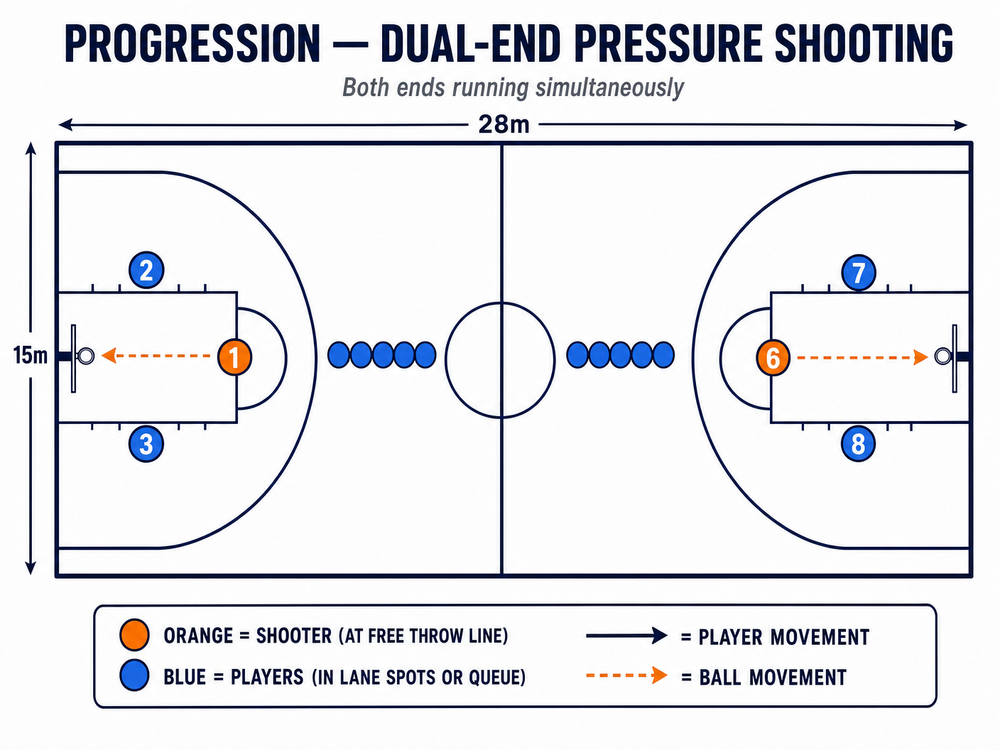
- Dual-End Pressure (Advanced): Run the drill on both ends of the court simultaneously. The two groups compete against each other to reach 20 made free throws first.
- Contested Rebounds: Place an offensive player behind the shooter who crashes the boards on the release, forcing the lane players to execute a live, physical box-out.
7. Age Adaptations
- Under 8 / Under 10: Move the free throw line closer (e.g., to the bottom of the free throw circle or use a modified line). Focus purely on form and routine rather than consecutive makes.
- Under 12 / Under 14: Introduce the conditioning penalty for missed free throws to start building mental toughness. Emphasize proper box-out footwork.
- Under 16 / Open: Run the Dual-End Pressure variation regularly. Set high percentage goals (80%+) that must be met before the team can leave the court.
