Bowling Change Strategy: Controlling the Middle Overs
Master the art of rotating your bowlers and setting aggressive fields to break partnerships and stifle the run rate during the crucial middle overs.

Equipment Needed
1. Overview
The middle overs (typically overs 15-40 in a 50-over match, or overs 7-15 in a T20) often dictate the outcome of a cricket match. This set play focuses on executing a highly effective bowling change strategy to transition from opening pace bowlers to middle-over specialists (usually spinners or medium pacers). The goal is twofold: break established partnerships and squeeze the opposition's scoring rate. By deploying an attacking field early in the spell, you force batters into making errors.
2. Setup
Equipment Needed:
- Match-quality cricket balls (used, to simulate middle-over conditions)
- Stumps and bails
- 30-yard circle markers
Pitch & Field Setup:
- Full 22-yard pitch on an oval ground.
- Clearly mark the 30-yard fielding circle.
Player Positions:
Ensure you have your full squad of 11 players. The key personnel for this strategy are your spin bowler, wicket-keeper, and athletic infielders capable of applying pressure inside the 30-yard circle.
3. Step-by-Step Instructions
Step 1: Assess the Situation
Before making the change, evaluate the current partnership. Are the batters scoring freely? Are they struggling against pace? Identify the weaker batter or the one more susceptible to spin.
Step 2: Make the Bowling Change
Bring on your primary spin bowler or a crafty medium-pacer who relies on variations. Communicate the plan clearly to the bowler: bowl a tight line and length, focusing on the top of off-stump or exploiting the rough.
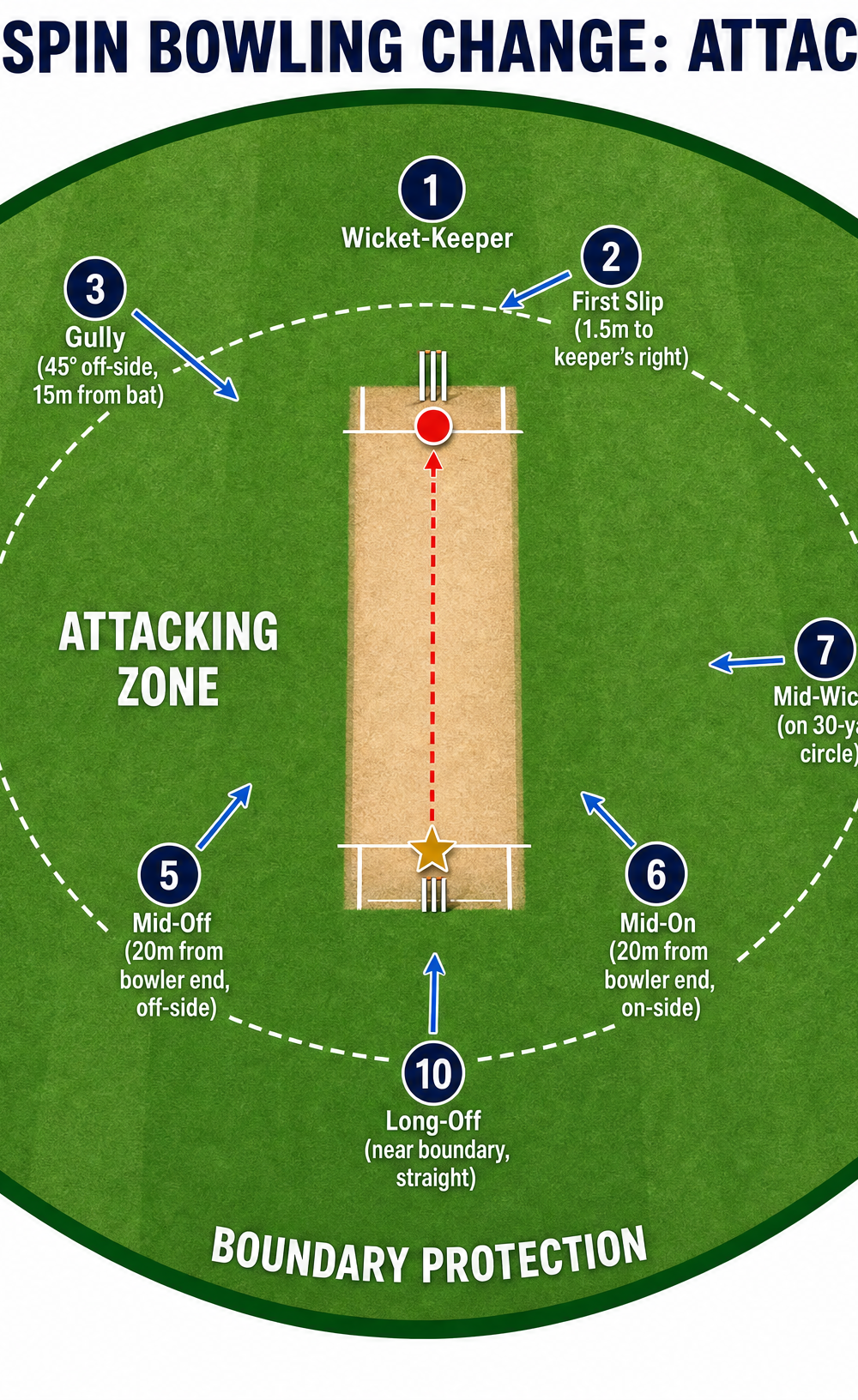
Step 3: Set the Attacking Field (Diagram 1)
Set an aggressive field to create immediate pressure on the new bowler's first few overs.
- Bring the Wicket-Keeper (1) up to the stumps.
- Position a First Slip (2) to catch edges.
- Place fielders inside the 30-yard circle at Cover Point (4), Mid-Off (5), Mid-On (6), Mid-Wicket (7), and Square Leg (8) to cut off singles.
- Leave boundary riders at Fine Leg (9) and Long-Off (10) for protection.
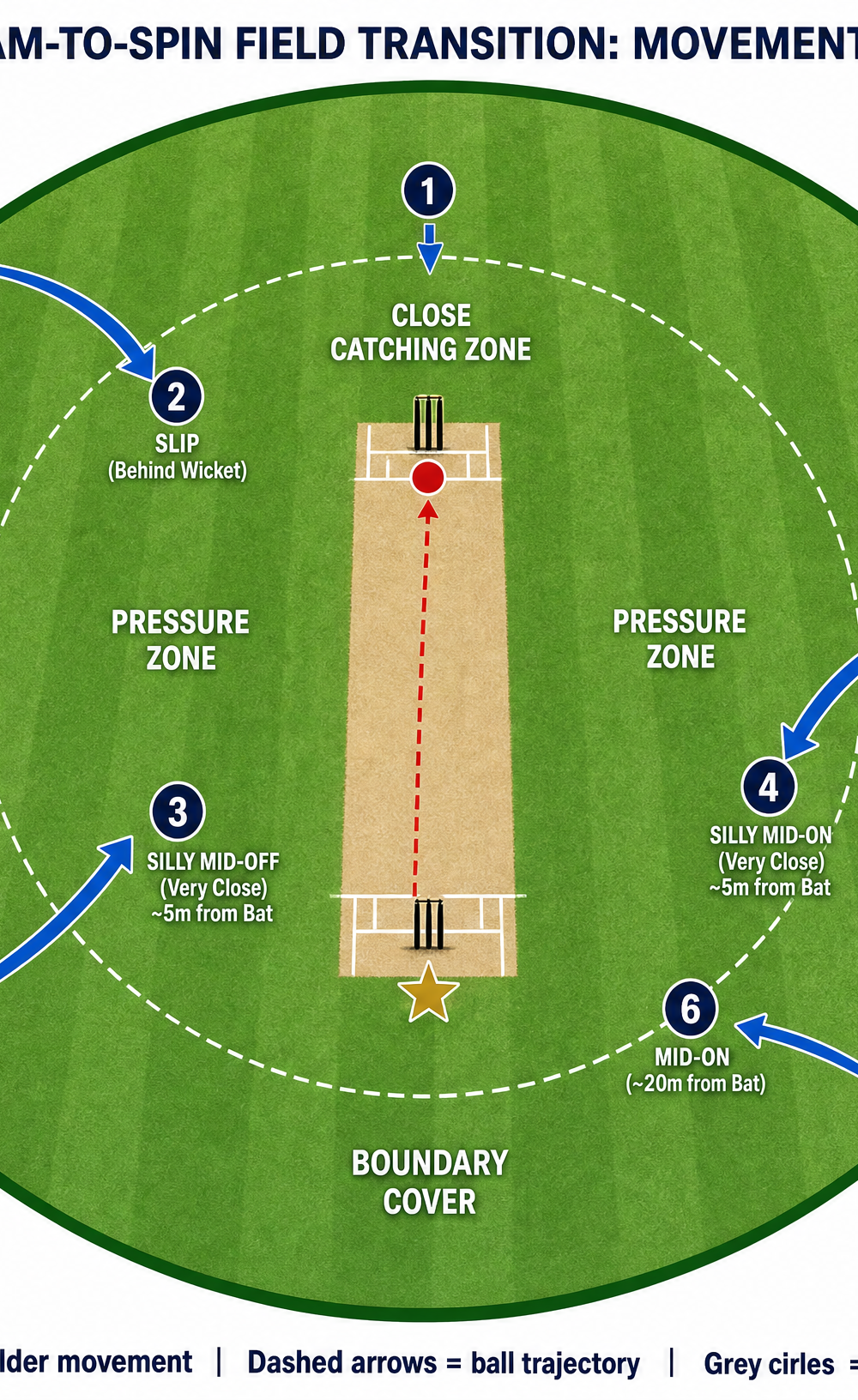
Step 4: Execute the Field Transition (Diagram 2)
As the bowler settles into their spell and the batters adapt, smoothly transition the field based on the match situation.
- If the batters are defending, bring fielders closer (e.g., Silly Mid-Off or Silly Mid-On) to increase pressure.
- If the batters start attacking, push fielders back to the boundary to protect against boundaries, shifting from an attacking to a defensive mindset.
Step 5: Rotate the Strike and Build Pressure
The key is to dry up the runs. Encourage your bowlers to bowl 'dot balls'. Stringing together dot balls builds immense pressure, often leading to a rash shot and a wicket.
4. Key Coaching Points
- Communication: The captain, bowler, and wicket-keeper must be on the same page regarding the plan and field placements.
- Body Language: Fielders must be energetic and aggressive, constantly walking in with the bowler to intimidate the batters.
- Consistency: The bowler must maintain a consistent line and length to execute the plan effectively. Variations should be used sparingly and strategically.
- Adaptability: Be prepared to change the field quickly if the batters find a gap or start attacking a specific area.
5. Common Mistakes
- Waiting Too Long: Delaying the bowling change until the batters are fully set and scoring freely.
- Defensive Mindset: Setting a defensive field immediately for a new bowler, allowing the batters to easily rotate the strike.
- Poor Execution: The bowler failing to bowl to the set field, offering easy boundaries and releasing the pressure.
6. Variations & Progressions
- Pace off the ball: Instead of a spinner, introduce a medium-pacer who excels at bowling off-cutters and slower balls.
- Double Spin Attack: Bring on two spinners simultaneously from opposite ends to completely stifle the scoring rate.
7. Age Adaptations
- Under 10/12: Focus on the basics of bowling a consistent length. Field placements should be simpler, ensuring players understand their roles.
- Under 14/16: Introduce more complex field placements and encourage bowlers to develop variations. Emphasize the importance of building pressure through dot balls.
- Open/Senior: Full implementation of the strategy, requiring high-level communication, adaptability, and execution under pressure.