The 'Box' Sideline Inbound Play vs Man-to-Man Defence
Learn how to execute the highly effective 'Box' sideline inbound play to create high-percentage scoring opportunities against aggressive man-to-man pressure.
Equipment Needed
1. Overview
The "Box" sideline inbound play is a staple in modern basketball playbooks. Designed specifically to counter aggressive man-to-man defence, this set utilizes staggered screens and misdirection to create multiple high-percentage scoring opportunities. The primary goal is to get a quick basket via a back-screen cut, with reliable secondary options for perimeter shooters and post-ups. This play is particularly effective in late-game situations or when you need a momentum-shifting score.
2. Setup
Court Area: Frontcourt, sideline inbound (typically near the hash mark, roughly 9m from the baseline).
Equipment: 1 Basketball, FIBA standard court (28m x 15m).
Player Positions:
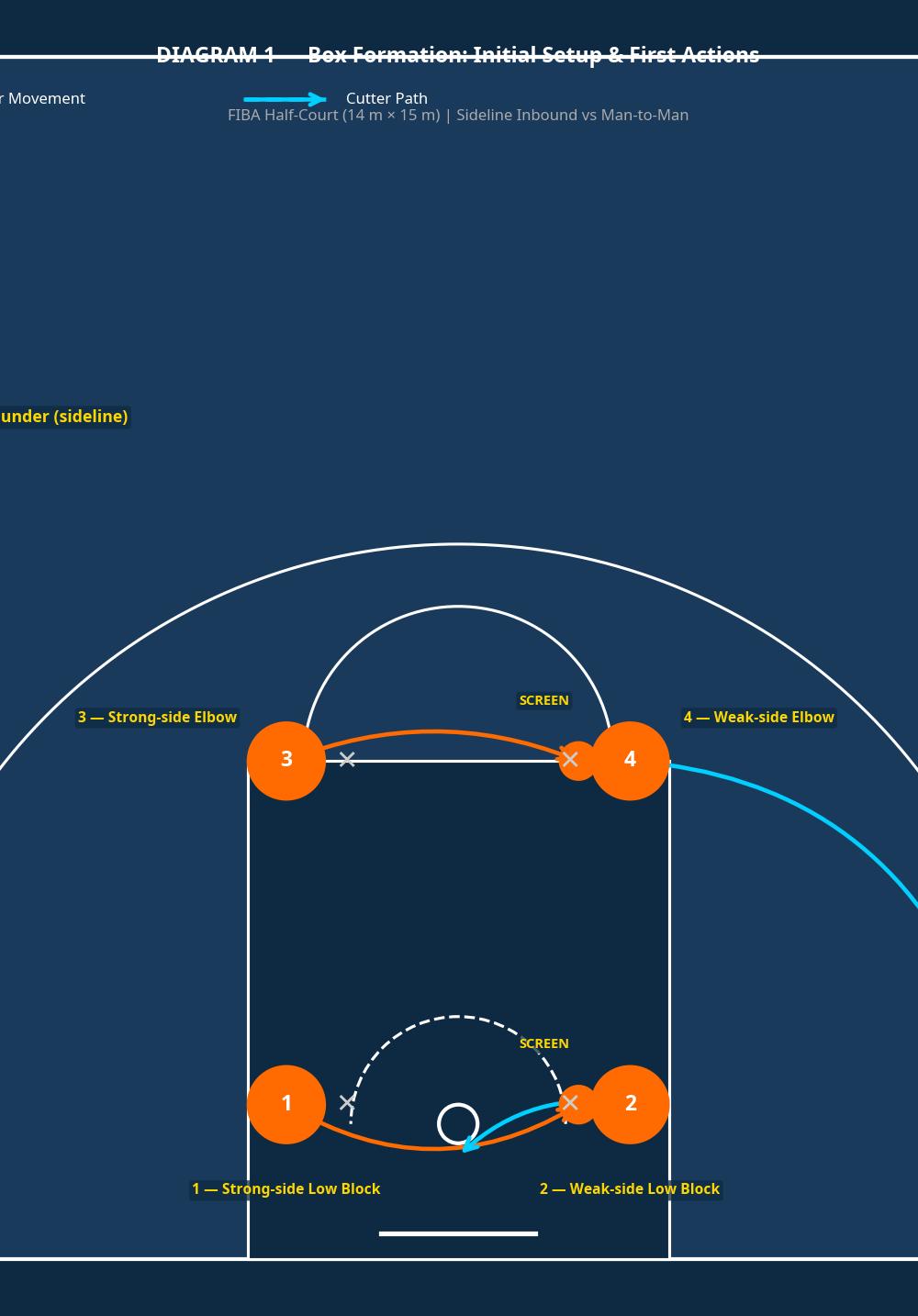
- 1 (Point Guard): Strong-side low block.
- 2 (Shooting Guard): Weak-side low block.
- 3 (Small Forward): Strong-side elbow.
- 4 (Power Forward): Weak-side elbow.
- 5 (Center/Inbounder): On the sideline with the ball.
This creates a classic "Box" formation around the key, forcing the defence to navigate traffic and communicate through screens.
3. Step-by-Step Instructions
Phase 1: The Initial Action
- The Signal: The inbounder (5) slaps the ball to initiate the play.
- The Back-Screen: Player 1 steps across the lane to set a firm back-screen on Player 2's defender.
- The Cut: Player 2 reads the screen and cuts hard to the basket, looking for an immediate lob or bounce pass from 5.
- The Cross-Screen: Simultaneously, Player 3 sets a cross-screen for Player 4 at the free-throw line.
- The Pop: Player 4 uses 3's screen to pop out to the weak-side corner or wing, ready to shoot.
Phase 2: Ball Entry and Reads
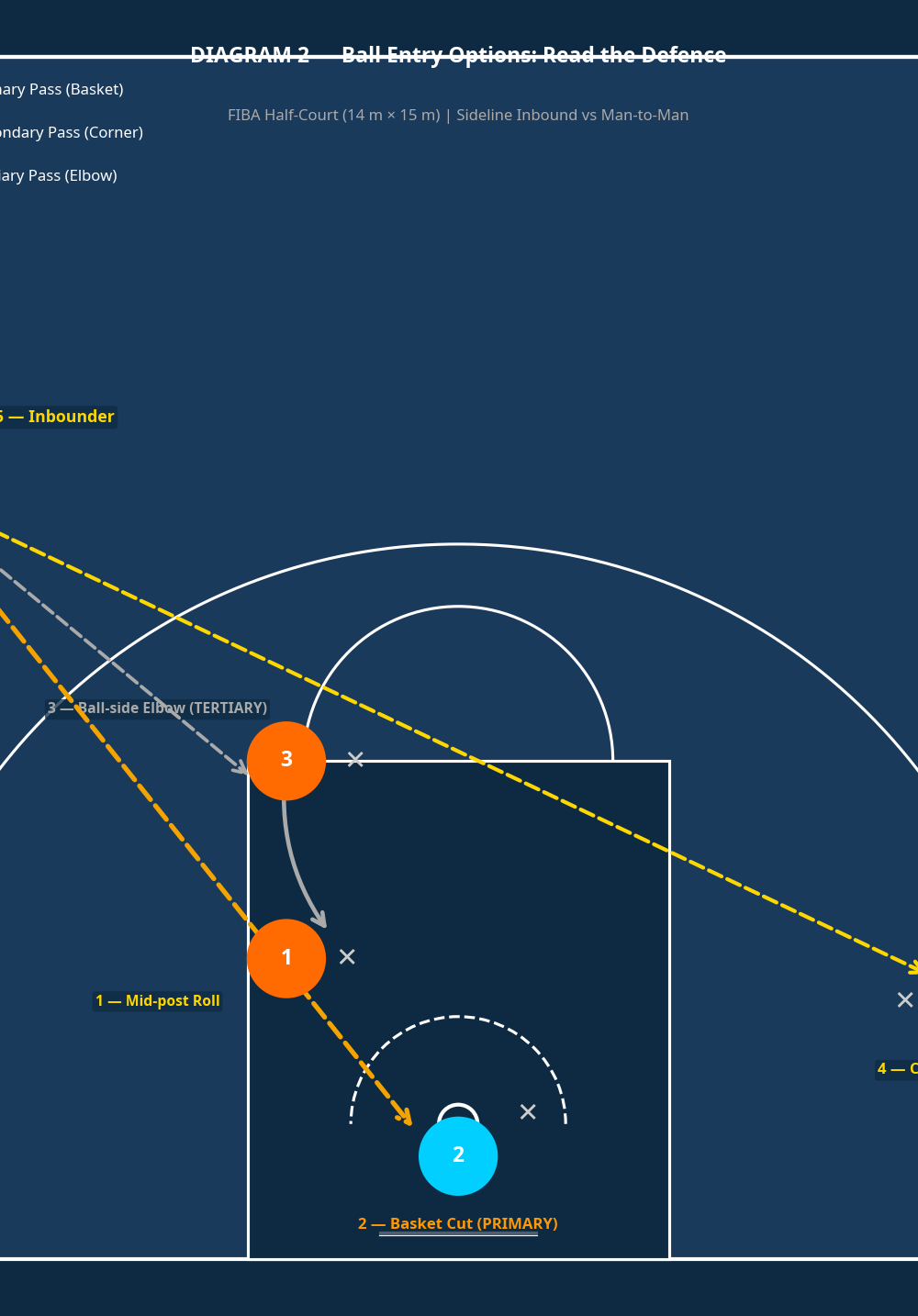
- Primary Read (The Cutter): If Player 2 is open off the back-screen, 5 delivers the pass for a quick layup.
- Secondary Read (The Shooter): If the defence collapses on 2, 5 looks for Player 4 popping to the corner for an open three-point shot.
- Tertiary Read (The Release): After setting the screen, Player 3 steps to the ball-side elbow as a safety valve. If 5 passes to 3, Player 1 (who set the initial back-screen) rolls into the mid-post to receive a high-low pass from 3.
4. Key Coaching Points
- Timing is Everything: The screens must be set exactly as the inbounder is ready to pass. If players move too early, the defence can recover.
- Screening Angles: Player 1 must set the back-screen on the blind side of 2's defender to prevent them from slipping over the top.
- Read the Defence: The inbounder (5) must be patient and read the defensive rotation, progressing through the reads (Cutter -> Shooter -> Safety) rather than pre-determining the pass.
- Use Fakes: Cutters should use sharp V-cuts or jab steps to set up their defenders before using the screens.
5. Common Mistakes
- Weak Screens: "Slipping" the screen too early instead of making solid contact, allowing the defender to stay attached to the cutter.
- Telegraphing the Pass: The inbounder staring down the primary option, allowing the on-ball defender to deflect the pass.
- Poor Spacing: Players converging in the paint after the initial cuts, clogging the driving lanes and making the inbound pass difficult.
6. Variations & Progressions
Variation: The Zipper Cut
To counter teams that switch the initial back-screen:
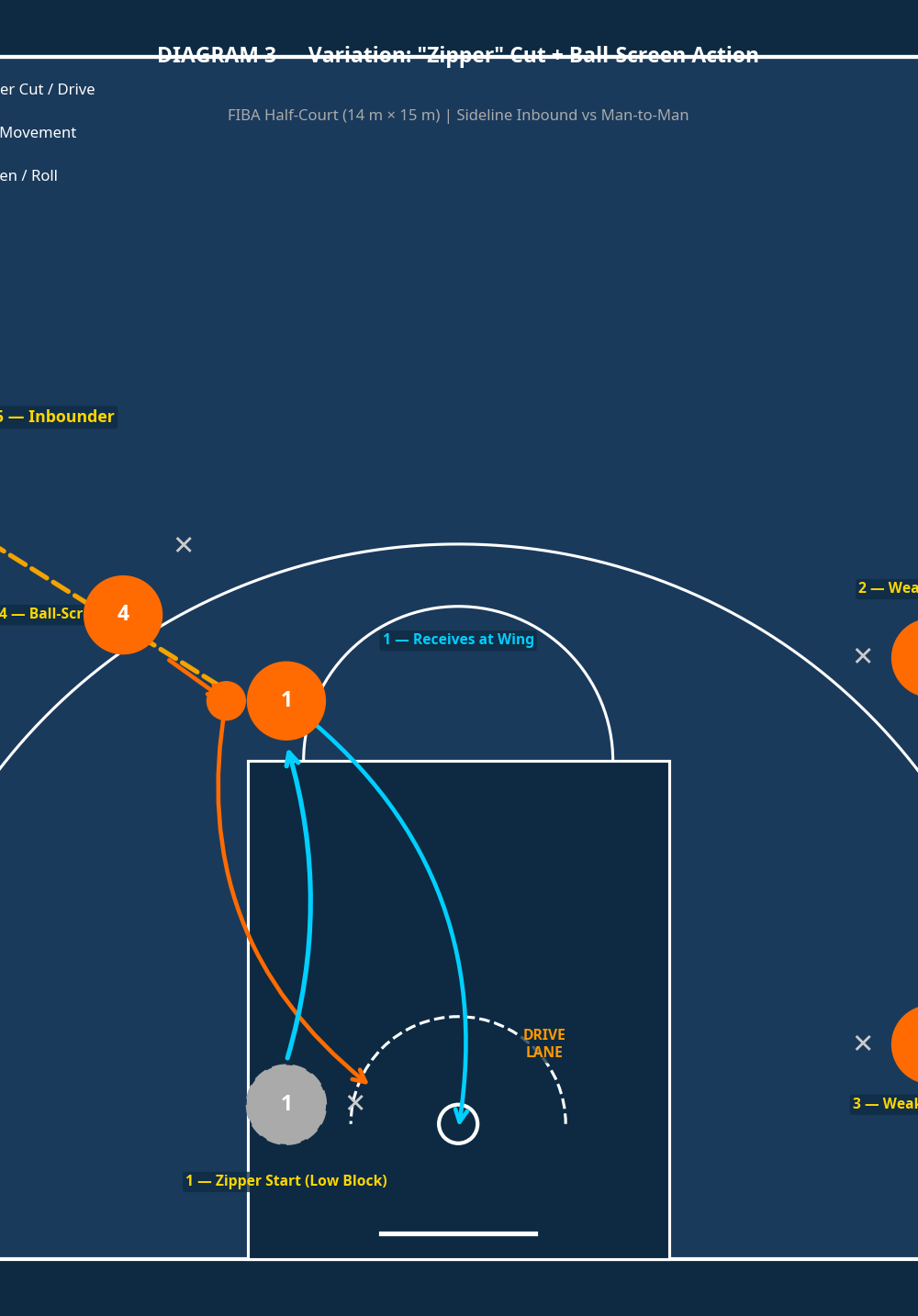
- Player 1 starts on the low block and makes a "Zipper Cut" straight up the lane line to receive the ball at the wing.
- Player 4 immediately sprints over to set a ball-screen for 1.
- Player 1 drives hard off the pick-and-roll while 4 rolls to the basket, with 2 and 3 spacing the floor on the weak side.
7. Age Adaptations
- Under 10 / Under 12: Focus purely on the back-screen action (Player 1 screening for Player 2). Remove the secondary cross-screen to simplify the reads for the inbounder.
- Under 14: Introduce the full box action but emphasize spacing and making solid contact on screens.
- Under 16 / Open: Run the play at game speed, incorporating the "Zipper Cut" variation to punish switching defences.