Death Overs Bowling Plan: Yorker Fence and Pace-Off Chase
A coach-ready final-overs plan that links ball-by-ball intent to a disciplined 11-player field, giving bowlers clear yorker and pace-off options under pressure.

Equipment Needed
Overview
This is a 35-minute, 11-player death-overs set play for the final four overs of a limited-overs innings. Its purpose is not simply to bowl a yorker; it is to give the bowling unit one shared picture: the bowler’s target, the boundary riders’ starting lines, the infield’s single-saving job, and the reset call after every ball. Use it when the batting side is looking to swing across the line, clear the straight boundary, or manufacture room. The field is built around a standard 22-yard (20.12 m) pitch, with a 30-yard/27.43 m circle marked for training clarity. The official pitch specification is 22 yards long and 10 ft/3.05 m wide.1
The plan has two linked options. Plan A is the stock ball: a yorker at the base of leg stump with a leg-side boundary fence. Plan B is the change-up: a disguised off-cutter or slower full ball around off stump, with the off-side riders prepared to chase a mis-hit. The field must never be a passenger. Every player should know where the likely miss goes and what single they are deliberately conceding.
The coaching message is simple: hit the planned zone, defend the planned miss, then reset immediately.
Setup
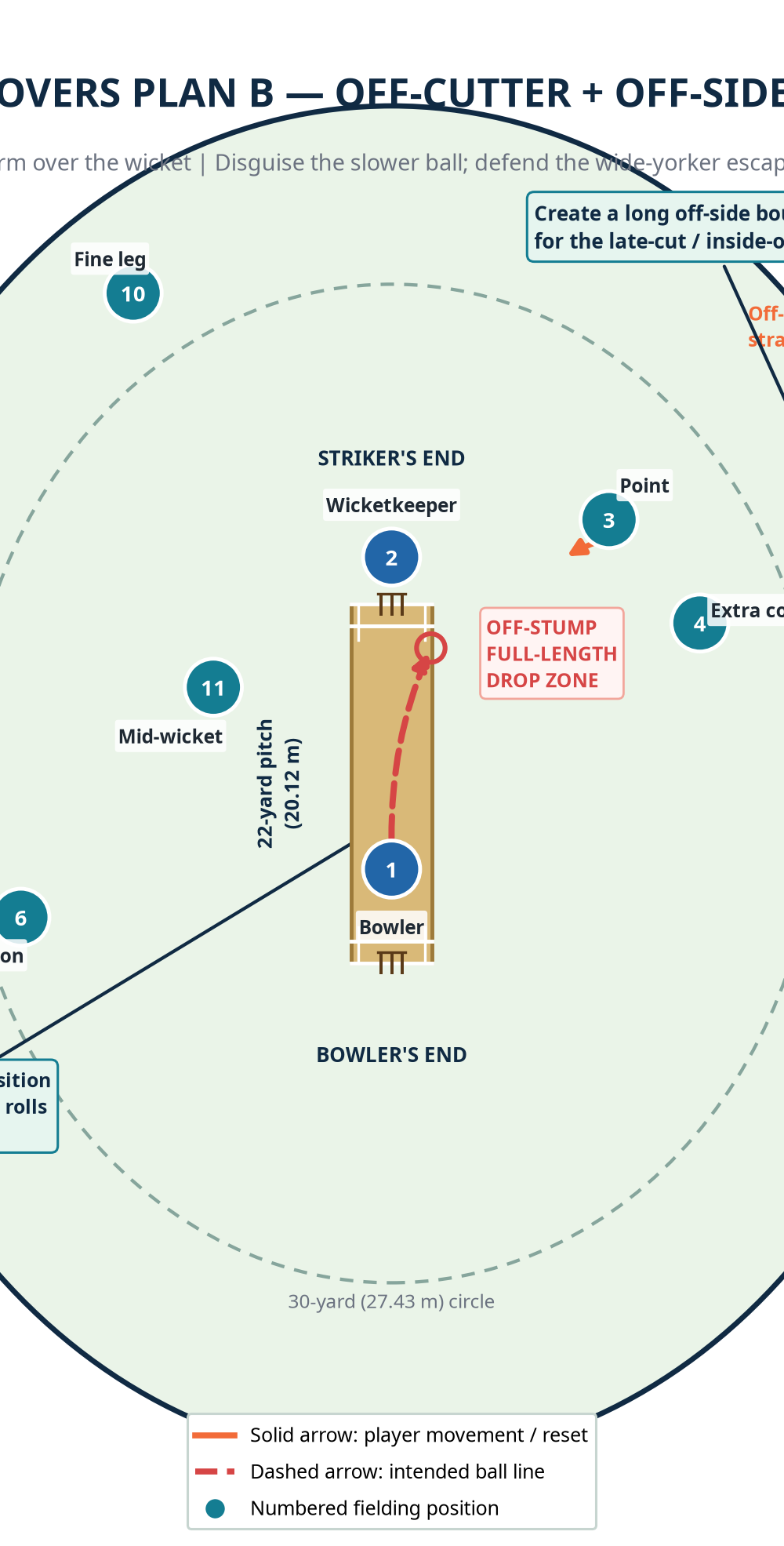
Mark a full 22-yard pitch and, if available, a 30-yard circle on an oval or large outfield. Use 12–18 balls, two sets of stumps, cones, a stopwatch, and coloured discs to mark the yorker and off-stump drop zones. Put one cone 0–0.5 m inside the striker’s popping crease at leg stump for Plan A and another about 0.5–1.0 m fuller than a good length, just outside off stump, for Plan B. Set a target scoring zone with cones at both straight boundaries and both square boundaries; if the ground is small, set the boundary riders 3–5 m inside the rope so they can practise the correct first movement.
Use a conventional 11-player field. No. 1 is the bowler and No. 2 the wicketkeeper. No. 3 is point, No. 4 cover or extra cover, No. 5 long-off, No. 6 long-on, No. 7 deep mid-wicket, No. 8 is either deep square leg or deep cover depending on the plan, No. 9 is fine leg or deep point, No. 10 is third or fine leg, and No. 11 is mid-wicket. In a junior squad short of numbers, keep the wicketkeeper, bowler, the five boundary riders, and two inner-ring players first; use cones for the missing positions.
Plan A: Yorker + Leg-Side Fence

With a right-arm bowler over the wicket to a right-handed batter, set long-on, deep mid-wicket, deep square leg, fine leg and long-off as the five boundary riders. Keep point, cover and mid-wicket inside the circle to stop the pushed single. Fine leg and long-on begin 2–5 m wider than their normal death-over positions, then take their final adjustment as the bowler is released. This protects the batters’ most common leg-side miss without handing them an easy two.
Plan B: Off-Cutter + Off-Side Chase
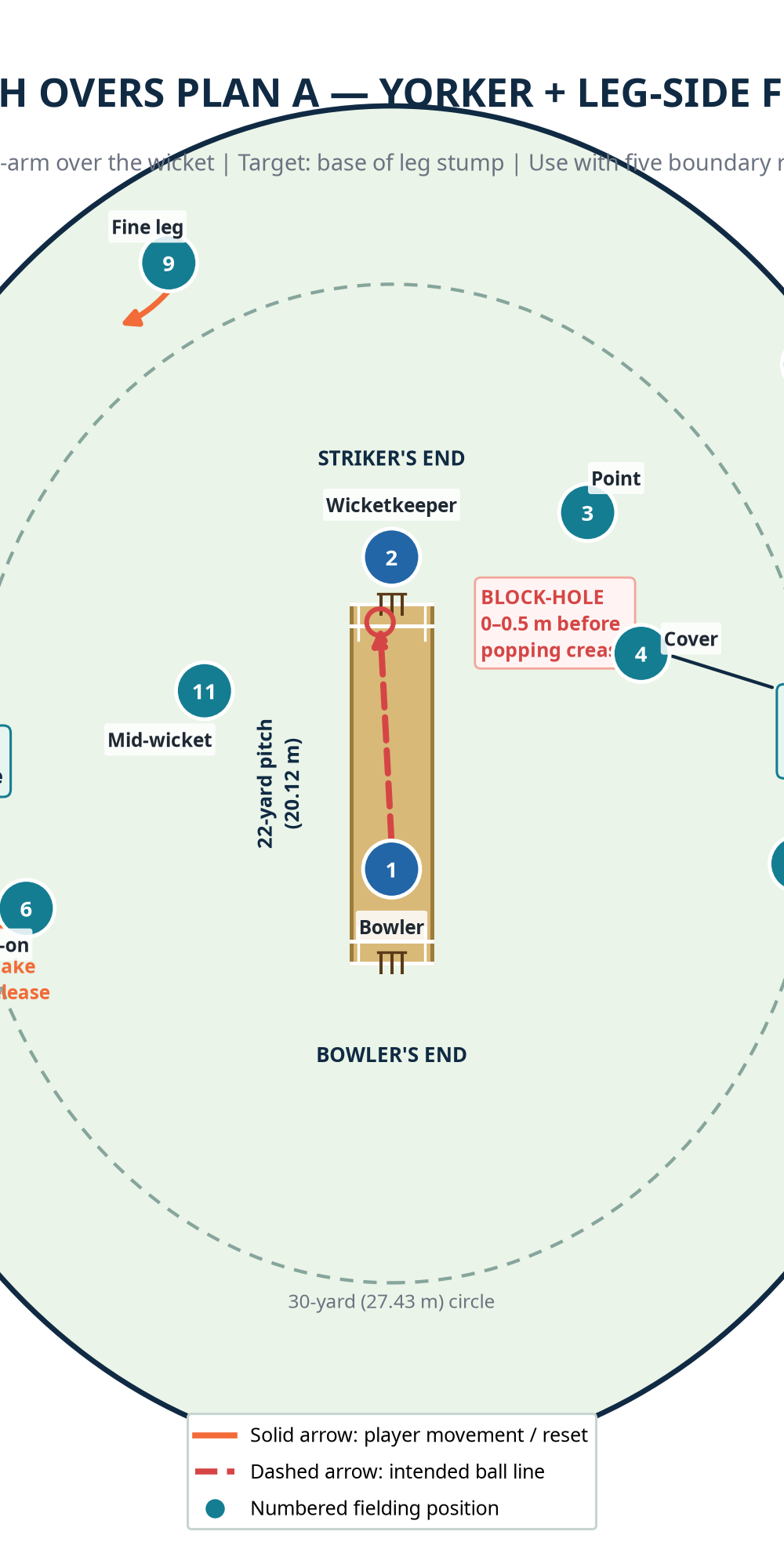
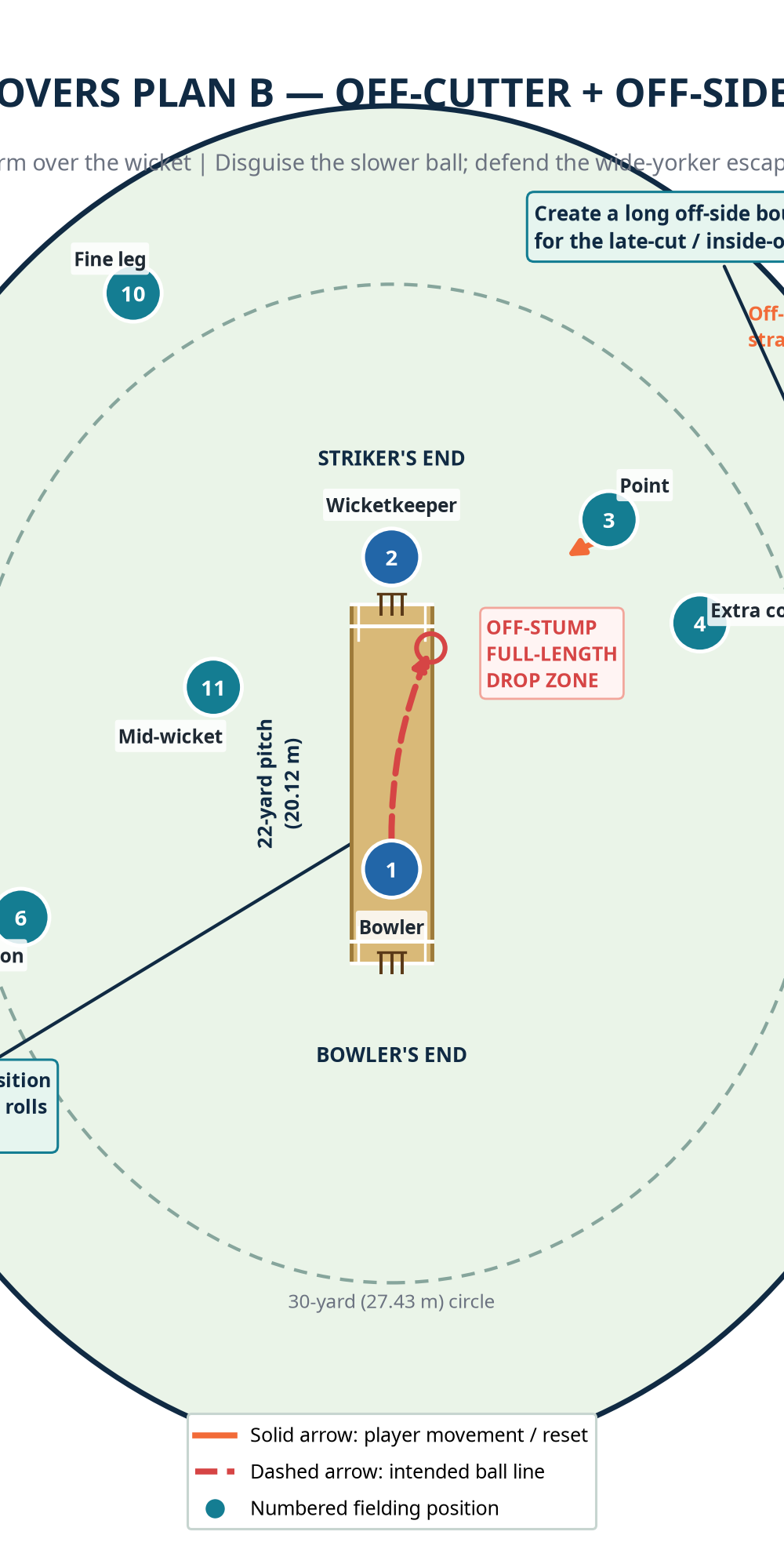
For the pace-off option, keep long-on, deep mid-wicket and fine leg on the leg side, then move the remaining protection to long-off, deep cover and deep point. Point and extra cover stay inside the circle. The bowler uses the same run-up and high-arm presentation as the yorker, but rolls the fingers over the seam late and aims full around off stump. The off-side riders start 3–5 m squarer or wider, then move a few metres straighter on release to cover the late slice and inside-out swing.
Step-by-Step Instructions
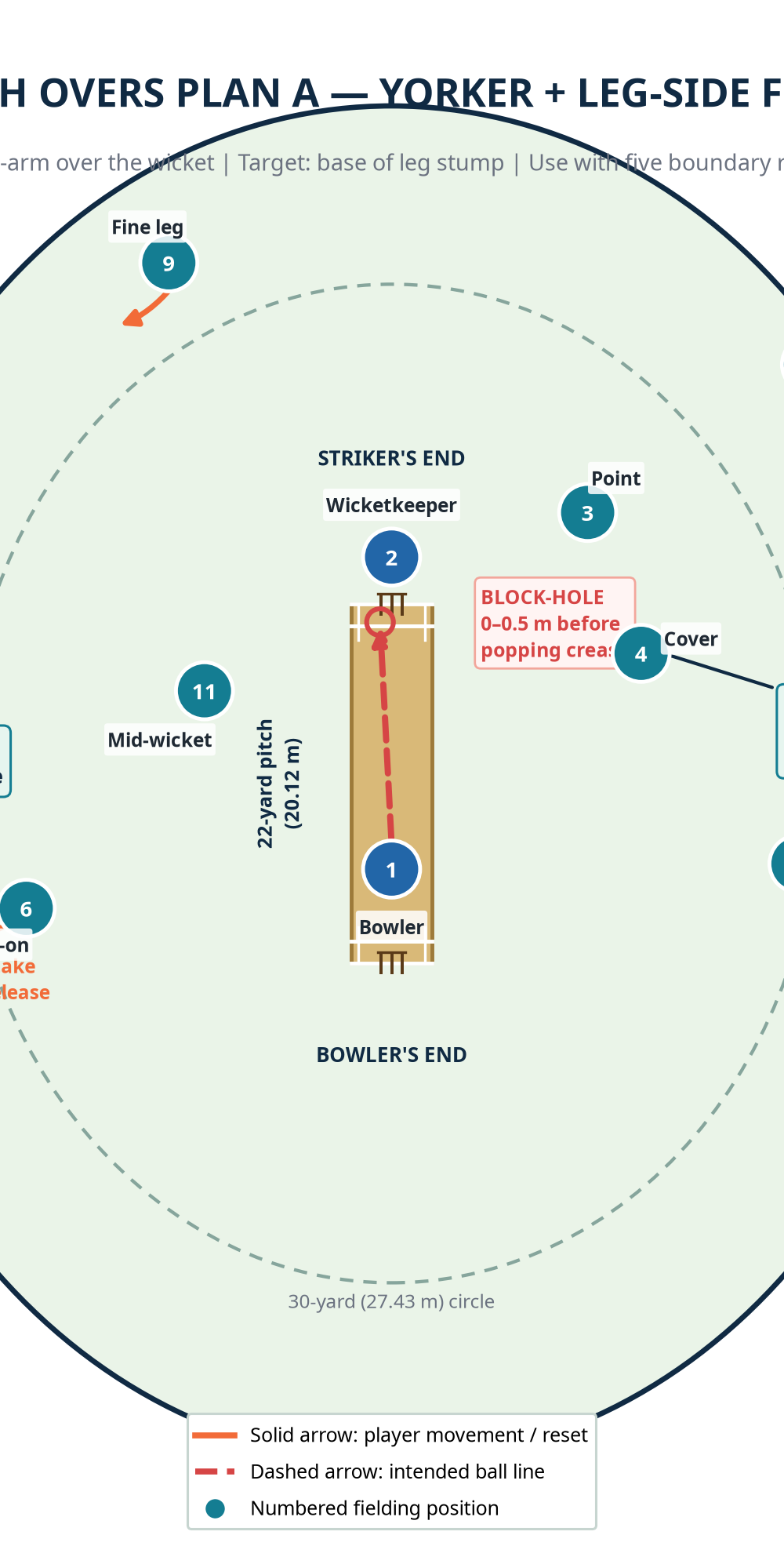
Brief the unit before the over. Name the ball, the target and the protected boundary. For example: “Ball one: leg-stump yorker; long-on and fine leg are our miss cover.” The wicketkeeper repeats the call so every player hears the same plan.
Place the field before the bowler begins the run-up. Check that five players are outside the training circle and that the two nearest boundary riders can move forward rather than being stranded on the rope. Tell point, cover and mid-wicket whether the first priority is a dot ball or a fast single.
Give the bowler one delivery cue. For Plan A, use “toe-crusher, base of stump.” The front foot lands balanced, bowling shoulder stays tall, and the release is late enough for the ball to dip into the block-hole. For Plan B, use “same arm, softer hand.” The wrist and fingers create the pace-off only after the bowling arm is high.
Run the ball live. On release, the wicketkeeper commits to the intended line, infielders take their first two steps towards the likely single, and boundary riders make their pre-agreed 2–5 m adjustment. The ball is live until it is returned to the keeper or bowler; demand a loud, accurate relay rather than a hopeful throw.
Reset in six seconds. The keeper calls “ball done,” the bowler walks back to the mark, and the captain or coach quickly checks the next option. Do not allow the field to drift between balls. A death-over plan breaks down when one rider remains too square or an infield player forgets the single-saving line.
Score the sequence. Bowl two sets of six. Award the bowling side two points for a dot, one for a single or a caught boundary save, minus two for a boundary, and minus one for a missed target. Record both execution and decision quality: a yorker that misses by two metres is not a successful yorker merely because it was not hit for four.
Key Coaching Points
| Coaching focus | Coach’s language | Observable standard |
|---|---|---|
| Target clarity | “One ball, one zone.” | The bowler names the zone before turning to run in. |
| Release disguise | “Same run-up, same arm speed.” | The slower ball is not telegraphed by a shorter stride or lower arm. |
| Boundary-rider depth | “Be deep enough to save four, close enough to attack two.” | Riders cover the likely miss and arrive balanced for the pickup. |
| Infield connection | “First two steps win the single.” | Point, cover and mid-wicket move on release, not after contact. |
| Keeper leadership | “Call it early, own the return.” | The keeper confirms line, directs the relay and triggers the reset. |
Coaches should insist on a repeatable pre-ball routine. The captain shows the field, the bowler confirms the target with a simple hand signal, and the wicketkeeper repeats the target. Under pressure, detail must be made automatic before the ball is delivered.
Common Mistakes
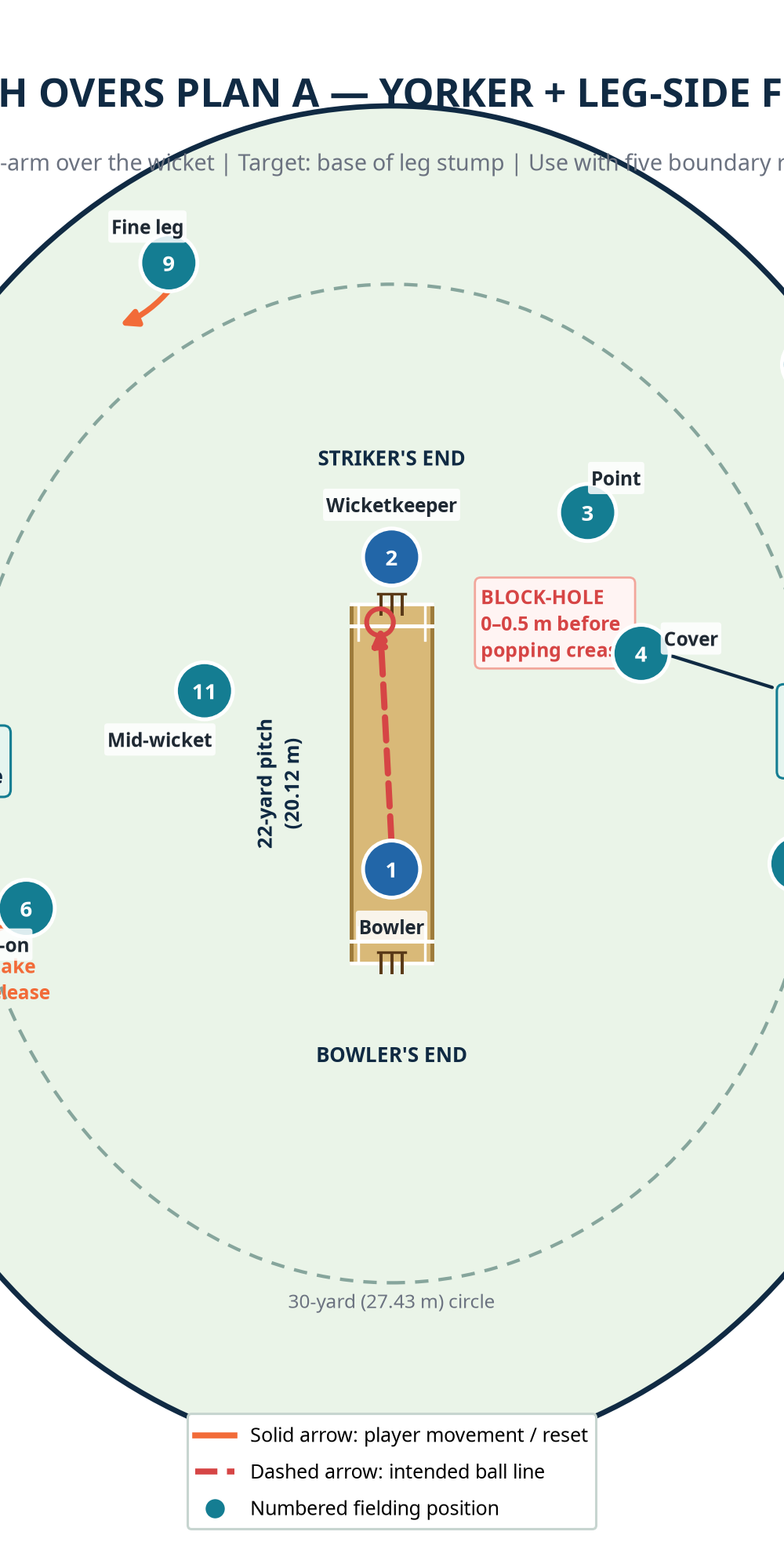
The first common error is setting a leg-side yorker field but bowling outside off stump. Correct it by stopping the rep, moving the target cone into the bowler’s eyeline and requiring three shadow releases before the next live ball. The second is placing boundary riders exactly on the rope; they cannot then move forward to intercept the mis-hit. Bring them in 3–5 m during practice and teach the first movement.
A third error is a slower ball that is visibly slower in the run-up. Film from side-on or have the non-striker watch for a shortened final stride; require the same approach rhythm for both options. Finally, coaches often accept silence after contact. Make the wicketkeeper’s call, the boundary rider’s name, and the return target non-negotiable. A correctly bowled ball still becomes two runs if the field does not communicate.
Variations & Progressions
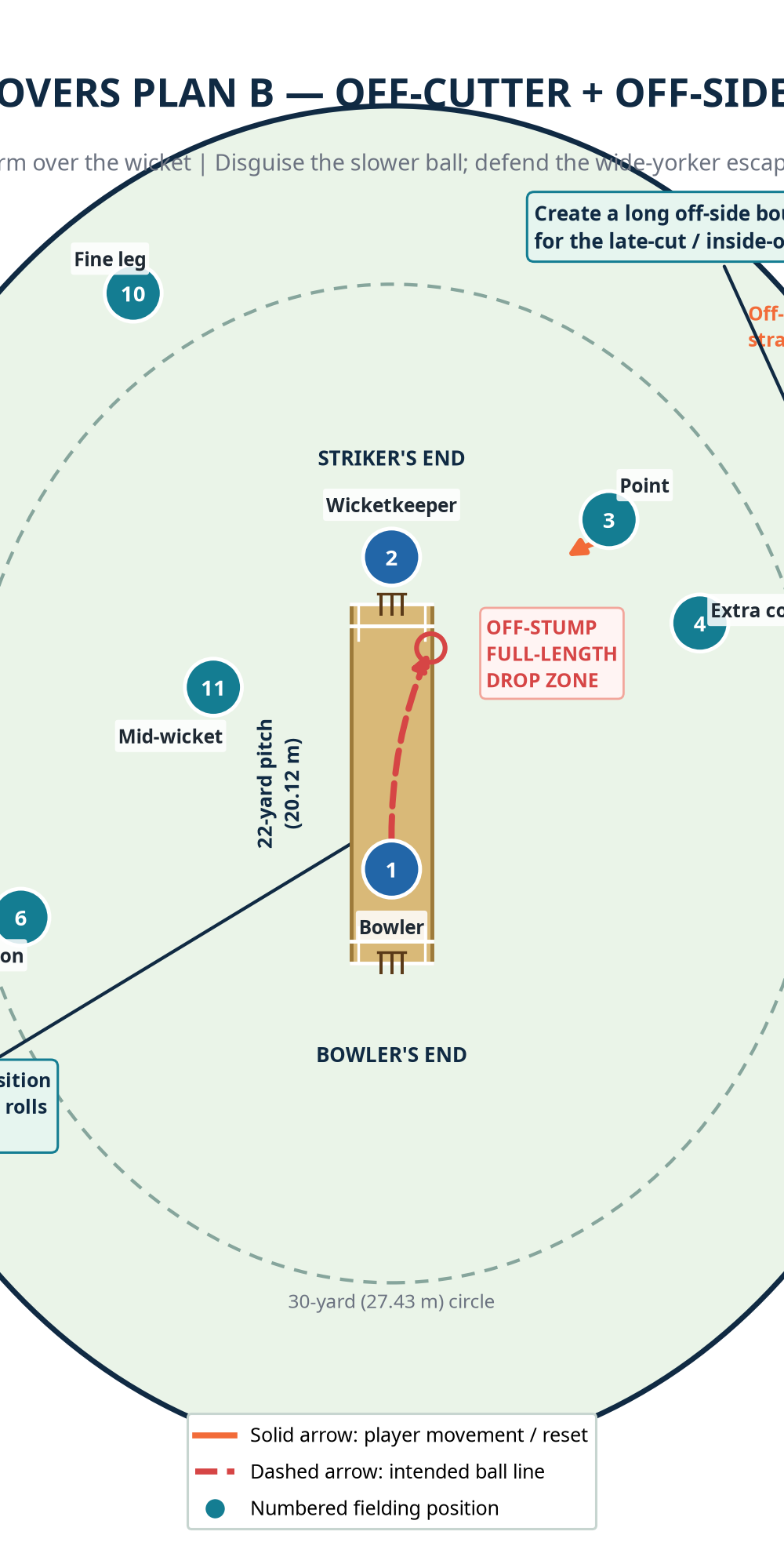
Start easier by using a half pitch, tennis balls or incrediballs, and a fixed target cone; the coach calls the delivery before each ball. Progress to a full pitch with the batter limited to leg-side shots for Plan A and off-side shots for Plan B. This lets bowlers learn the field-to-ball connection before they face a complete hitting range.
Make the session harder by giving the striker six legal balls and a live scoring target, while the batting pair may reverse sweep, ramp or move across the crease. On the coach’s late call, switch from Plan A to Plan B after the bowler reaches the top of the mark. This tests whether the bowler and field can communicate without adding panic. A final advanced progression is to require a different plan for left- and right-handed batters, with players rotating one position after each over.
Age Adaptations
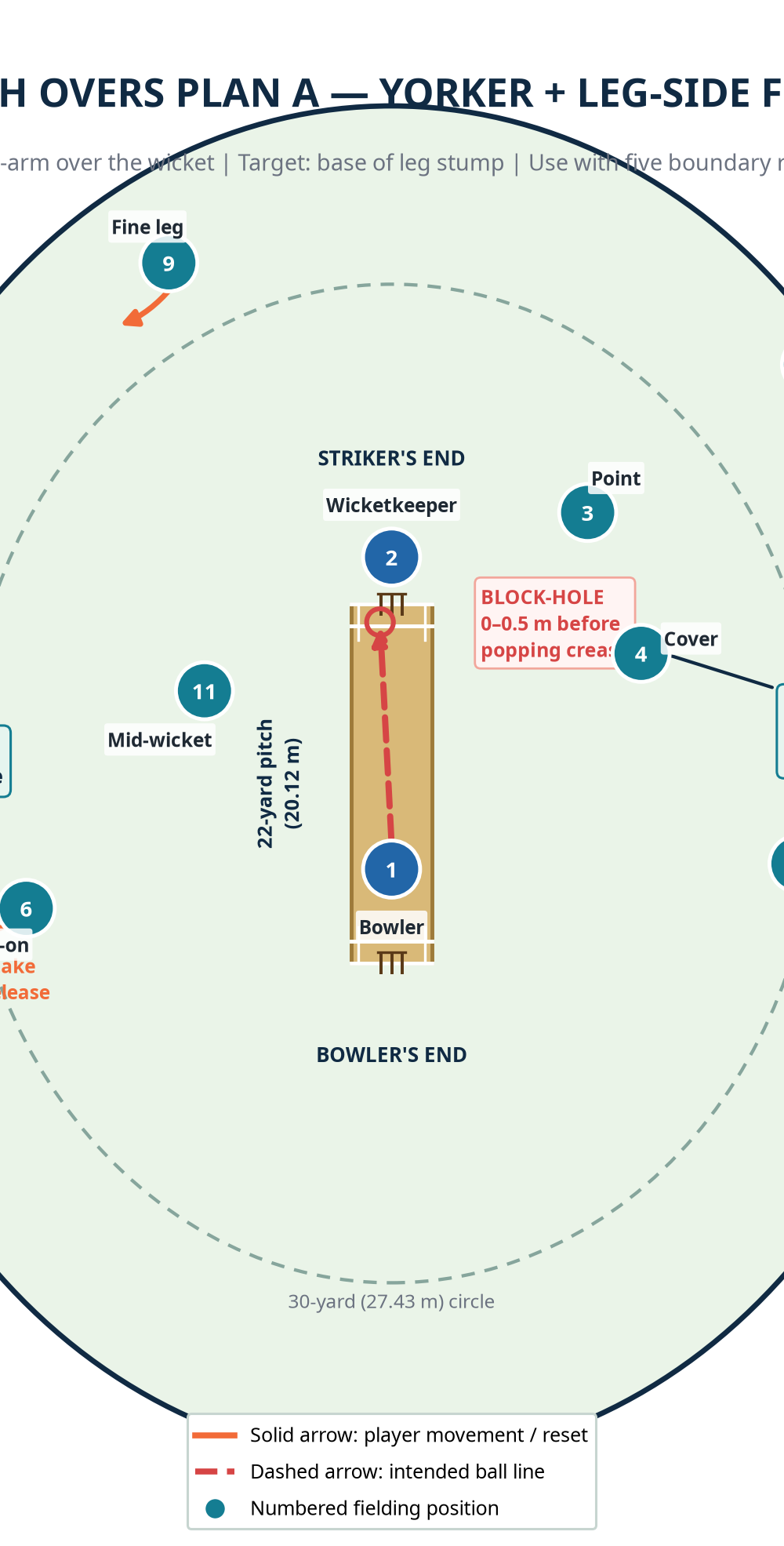
For Under-8 and Under-10, shorten the pitch as required by the local competition, use a soft ball, set three boundary zones rather than five fixed riders, and focus on accurate underarm or simple overarm full deliveries. Praise a clear target and safe stop more than pace-off skill. For Under-12 and Under-14, use a near-full pitch, name the five boundary positions, and introduce the two-ball sequence: yorker first, slower full ball second. Keep the ball count low enough that action quality remains high.
For Under-16 and open-age players, run the full 11-player version with score pressure, a batter who can change stance, and a captain responsible for calling the field. Add a constraint that the bowler must explain why each field position protects the selected delivery. That explanation is the clearest test that the group understands the set play rather than memorising a diagram.
Coach’s Close
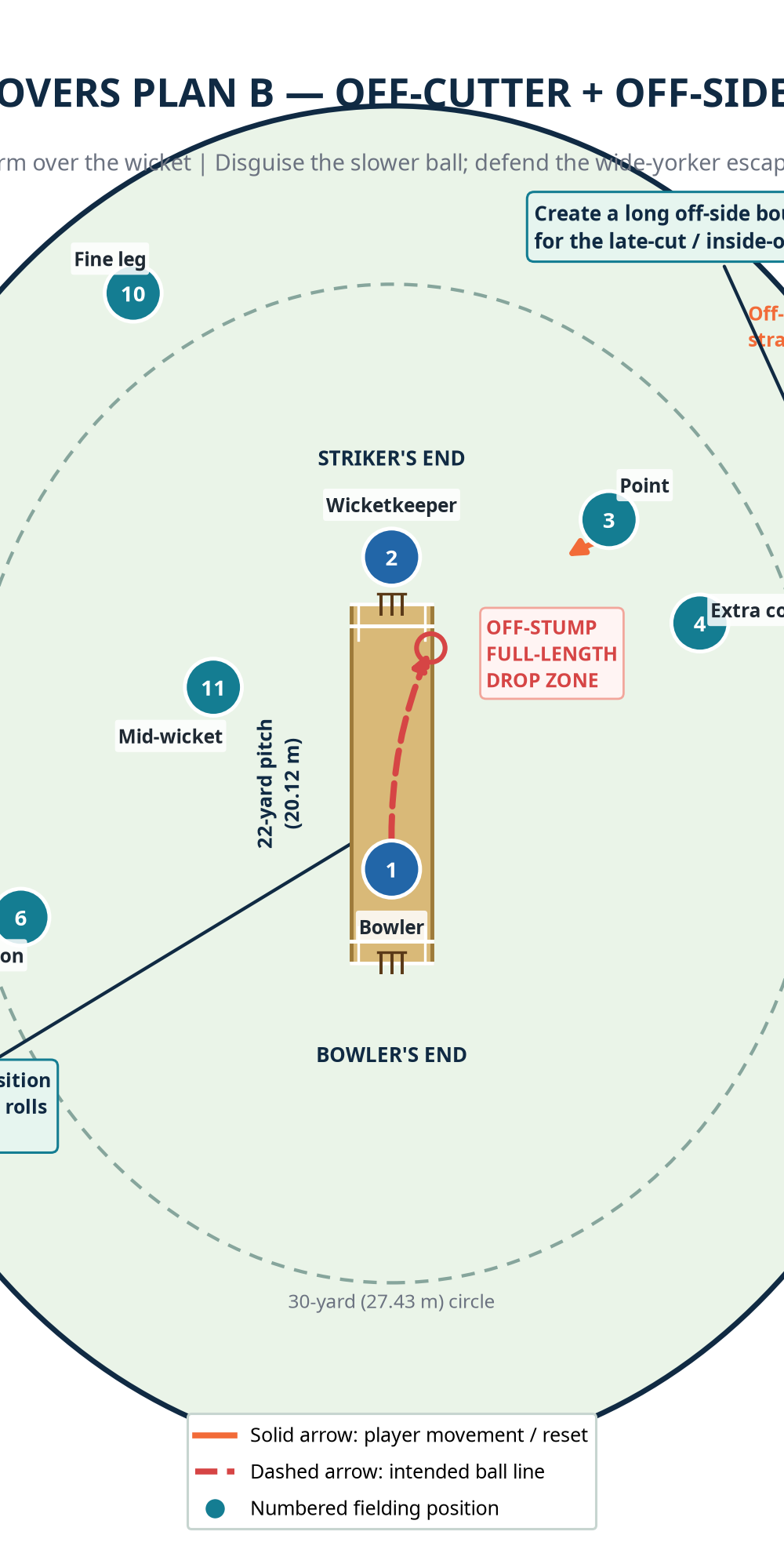
Finish with one question to each bowler: “What was your best ball, and where was your miss protected?” If they can answer both parts, the unit is developing genuine death-over control. Use the same visual language in nets, middle practice and match warm-ups so the final-over plan feels familiar when the score and noise rise.